
How to use the budget calculator
- Enter your monthly take-home pay — the total of all paychecks that land in your account in a month.
- Keep the classic 50/30/20 split or try 60/30/10, 70/20/10 or 40/30/30. You can type any percentages as long as they add up to 100%.
- Optional: open "Compare with what you actually spend" and enter your real spending for each bucket to see where you're over or under.
Save, print or share your budget
You don't have to start over next time. Under the calculator you can:
- Save the calculation in your browser with a name, then reopen it from "Saved calculations" whenever you like.
- Copy a link that reopens this exact calculation with all your numbers — on your phone, another computer or for someone you're planning with.
- Print a clean one-page report, or download it as a PDF. It shows your needs, wants and savings amounts and a budget-vs-actual table, plus a QR code at the top: scan it with your phone camera and the calculation opens again with every number filled in.
- Download a CSV to open in Excel, Google Sheets or Numbers.
Nothing is uploaded: saved calculations stay on your device, and the link and QR code carry your inputs inside the address itself.
What counts as needs, wants and savings
Needs (50%) — things you must pay to live and work: rent or mortgage, utilities, groceries, insurance, basic transport, childcare and minimum debt payments.
Wants (30%) — things that make life better but could be cut: restaurants and takeout, shopping, streaming and other subscriptions, hobbies, travel, upgrades.
Savings and debt payoff (20%) — your future: emergency fund, retirement contributions, savings goals and any payment above the minimum on your debts.
Picking a split that fits your life
The 50/30/20 rule is a starting point, not a test you pass or fail.
| Split | Who it suits |
|---|---|
| 50/30/20 | Moderate cost of living, the classic balance |
| 60/30/10 | High rent, but still saving something |
| 70/20/10 | Very high fixed costs, survival mode for now |
| 40/30/30 | Low fixed costs, saving hard for a big goal |
If your needs are well above 50%, the most powerful changes are usually the big fixed costs — rent, car payments and insurance — rather than cutting small daily treats.
Your weekly "wants" number
The calculator turns your wants bucket into a weekly amount. Thinking "I have $290 for fun this week" is much easier than tracking a monthly total, and it is the idea behind a "safe to spend" number. Our guide What Is Safe to Spend? explains how to work it out after bills and savings.
Make each bucket work harder
- Needs: if you're not sure of your real take-home, check it with the take-home pay calculator.
- Wants: subscriptions quietly eat this bucket. Add yours up with the subscription cost calculator or read how to track subscriptions.
- Savings: give the 20% a destination with the savings goal calculator, or point it at debt with the debt payoff calculator.
Keep the budget alive all month
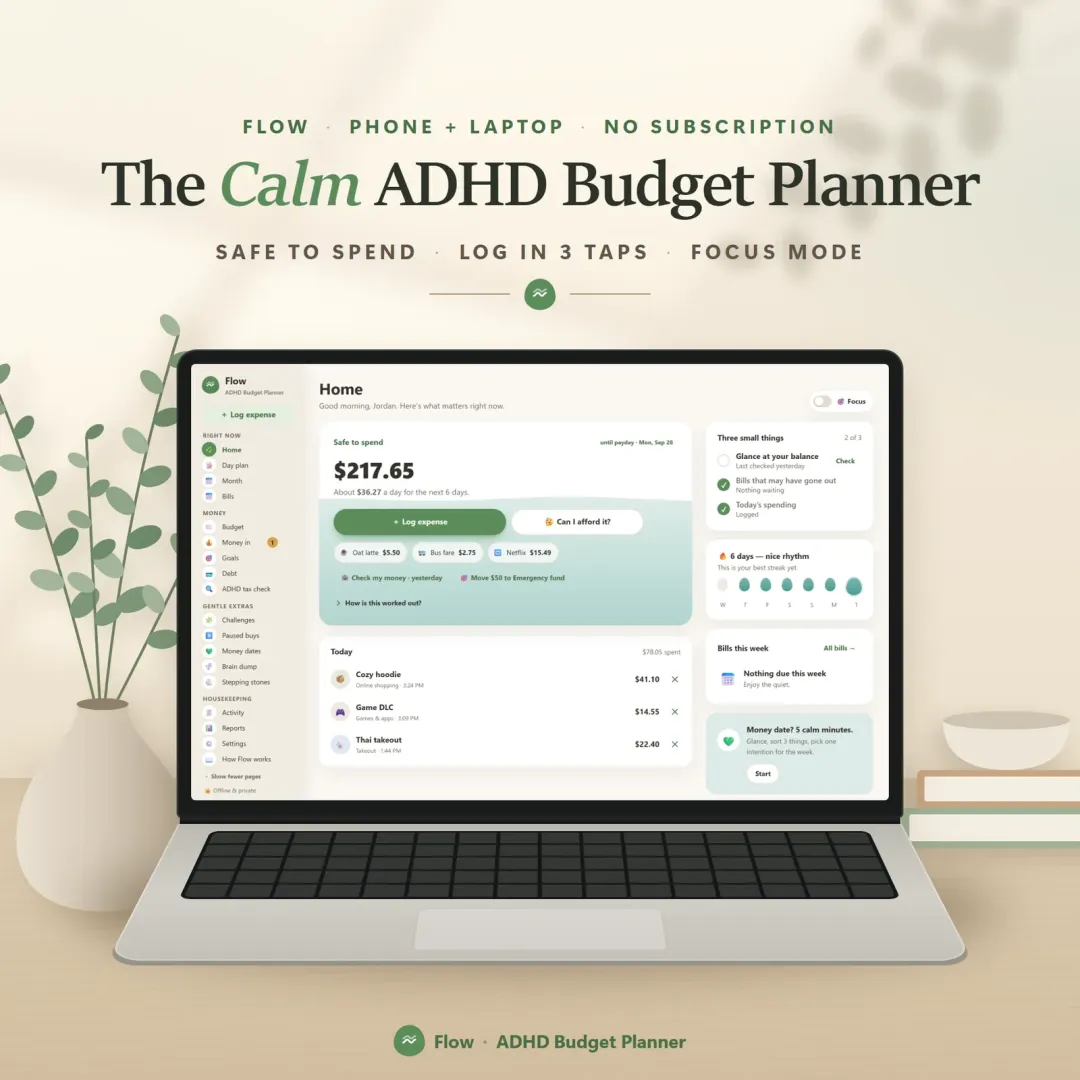
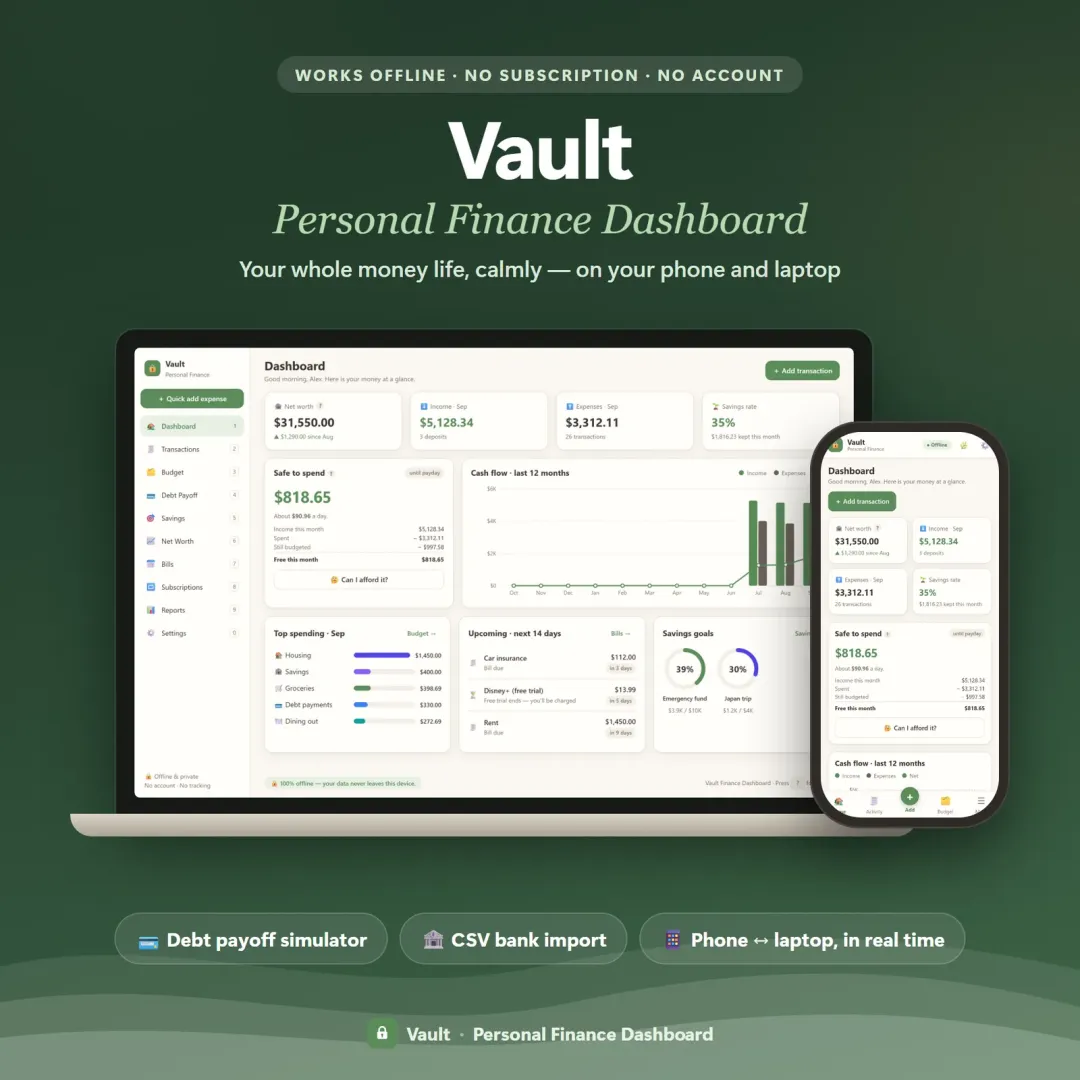
A budget is easy to set and hard to follow. Flow, the VaultlyApps budget planner built for ADHD brains, keeps one "Safe to Spend" number in view, logs spending in three taps and uses gentle streaks instead of guilt. Vault, the personal finance dashboard, puts the whole picture — budget, bills, debt and savings — on one screen. Try the free Flow demo in your browser.
Frequently asked questions
Can I save, print or download my budget?
What is the 50/30/20 budget rule?
How much should I spend on rent with the 50/30/20 rule?
What if my needs are more than 50%?
Should I use gross or net income?
Do debt payments count as needs or savings?
Is my budget saved anywhere?
Written by
Finance Specialist & Editor, VaultlyApps
Emma Whitfield writes and edits the VaultlyApps money guides and free calculators. Her focus is US household finance — budgeting on a real paycheck, paying down credit card and student debt, emergency funds and savings goals, renting — and the money side of freelancing and small-business income, from pricing and profit margins to self-employment tax. Every guide is researched against primary sources such as IRS publications and the CFPB, every number is checked in our tested calculators, and tax content is reviewed each year when new IRS figures come out. Emma is not a licensed financial adviser or tax preparer; her work is general education, not personal advice.
Researched against primary US sources, checked against independent calculators and reviewed by a finance expert on our team. Written for US readers — general education, not financial, tax or legal advice. Editorial policy · Disclaimer