How to Make a Holiday Budget You'll Actually Stick To
A complete $1,500 holiday budget, built line by line — gifts, travel, food and decor — with the Christmas savings plan that pays for it in cash and the simple tracking that keeps it on course through December.
In this article
- Meet the household
- Step 1: Where the $1,500 comes from
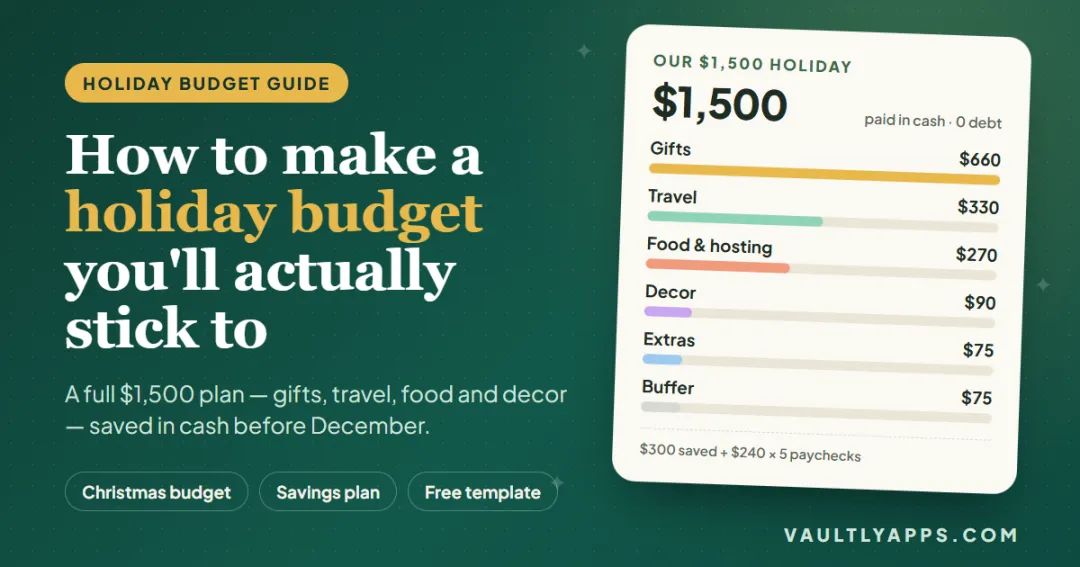
- Step 2: The full $1,500 breakdown
- Gifts: $660
- Travel: $330
- Food & hosting: $270
- Decor: $90
- Extras: $75
- Step 3: Put the spending on a calendar
- Step 4: Track it — the tools that keep the plan honest
- The mid-December check-in
- Step 5: What happens if it goes on a credit card instead
- Step 6: Close out the season and fund next year
- Build your own holiday budget
Most holiday budget advice stops at "set a limit and stick to it." This guide does the opposite: it builds one complete holiday budget from scratch — a real $1,500 plan for a family of four — so you can see exactly where every dollar goes, how it's saved before December, and how it's tracked until the last gift is wrapped. Swap in your own numbers as you go.
Meet the household
Jordan and Sam have two kids, take home $5,600 a month, and are paid every two weeks. Each December they drive 280 miles to Jordan's parents for three nights, and they host Christmas Eve dinner for eight before they leave. Last year the holidays went on a credit card and took until April to pay off. This year the rule is simple: the holiday gets paid in cash.
Step 1: Where the $1,500 comes from
The total isn't a guess — it's what they can actually fund by mid-December.
- $300 already sitting in a savings account from a summer side job.
- $240 from each of the five paychecks between October 10 and December 5. They found it by trimming takeout, pausing one streaming service and using the 30% "wants" share of their 50/30/20 budget.
| Payday | Transfer to holiday fund | Fund balance |
|---|---|---|
| Already saved | — | $300 |
| October 10 | $240 | $540 |
| October 24 | $240 | $780 |
| November 7 | $240 | $1,020 |
| November 21 | $240 | $1,260 |
| December 5 | $240 | $1,500 |
That's a sinking fund: a known cost saved for in advance. If you're starting later, the total simply comes down to what your remaining paychecks can cover — the free savings goal calculator gives you the exact amount per paycheck or week for any target and date.
Step 2: The full $1,500 breakdown
| Category | Amount | Share |
|---|---|---|
| Gifts | $660 | 44% |
| Travel | $330 | 22% |
| Food & hosting | $270 | 18% |
| Decor | $90 | 6% |
| Extras (wrap, cards, shipping, tips) | $75 | 5% |
| Buffer | $75 | 5% |
| Total | $1,500 | 100% |
The buffer matters more than it looks. Every holiday has a forgotten gift, a second grocery run or a gas price spike; a 5% buffer absorbs them without touching another category.
Gifts: $660
Every person gets a limit before anyone opens a shopping app.
| Person | Limit | Plan |
|---|---|---|
| Two kids | $220 ($110 each) | One bigger gift + books |
| Each other (Jordan ↔ Sam) | $120 | Shared: a weekend-away voucher |
| Jordan's parents | $90 | One joint gift — a framed family photo and dinner voucher |
| Sam's mom | $70 | Cozy throw and her favorite tea |
| Siblings | $60 | Family Secret Santa, $30 each |
| Teachers & soccer coach | $60 | Four $15 gift cards |
| Host gift for Jordan's parents' neighbors | $25 | Homemade cookies + a candle |
| Total | $645 | $15 left as gift wiggle room |
Two decisions made this list affordable: the siblings switched to a Secret Santa (saving about $90 compared with last year), and Jordan and Sam agreed on one shared gift for each other instead of two.
Travel: $330
The 560-mile round trip, priced before booking anything:
| Item | Cost |
|---|---|
| Gas: 560 miles ÷ 28 mpg = 20 gallons × about $3.30 | $66 |
| One motel night on the way (booked early) | $150 |
| Meals and snacks on the road, both ways | $70 |
| Pet sitter, three visits | $44 |
| Total | $330 |
Flying family members would swap gas and the motel for fares, bags and airport parking — the method is the same: list every leg before you book.
Food & hosting: $270
| Item | Cost |
|---|---|
| Christmas Eve dinner for eight | $140 |
| Extra groceries for the holiday week | $60 |
| Baking — cookies for gifts and school | $45 |
| Drinks | $25 |
| Total | $270 |
Jordan and Sam asked two guests to bring a side dish each, which kept the dinner line at $140 instead of nearly $200.
Decor: $90
| Item | Cost |
|---|---|
| Real tree | $60 |
| One replacement light strand | $18 |
| Kids' advent calendars | $12 |
| Total | $90 |
Everything else came out of the storage boxes. Decor is the easiest line to inflate a little at a time, so it gets a firm limit.
Extras: $75
The costs that never make a first draft:
| Item | Cost |
|---|---|
| Wrapping paper, tape and gift bags | $22 |
| Cards and stamps | $20 |
| Shipping a parcel to an aunt across the country | $18 |
| Thank-you tips for the mail carrier and babysitter | $15 |
| Total | $75 |
Step 3: Put the spending on a calendar
Spreading purchases out keeps any single week from getting expensive — and lines up with when the money actually arrives.
- Late October: buy the kids' gifts during early sales, using the first two transfers ($480 available).
- Mid-November: adult gifts, teacher gift cards and the Secret Santa; book the motel.
- Early December: tree, decor, cards and shipping — the parcel goes out by December 10 to avoid rush delivery fees.
- December 18–23: groceries, baking and the Christmas Eve dinner.
- December 23–26: the trip.
Step 4: Track it — the tools that keep the plan honest
A budget only works if you know what's left before you buy. Here's how Jordan and Sam track it, from simplest to most automatic — use whichever you'll actually open.
On paper. They printed the free monthly budget template for December: each holiday category gets its own line in the "wants" section with budget, actual and difference columns, and the holiday fund sits in the savings section. Every receipt gets written down the same evening.
For the numbers. The 50/30/20 budget calculator showed how much of their take-home pay could go to "wants" each month, and the savings goal calculator turned $1,200 in eight weeks into $240 per paycheck.
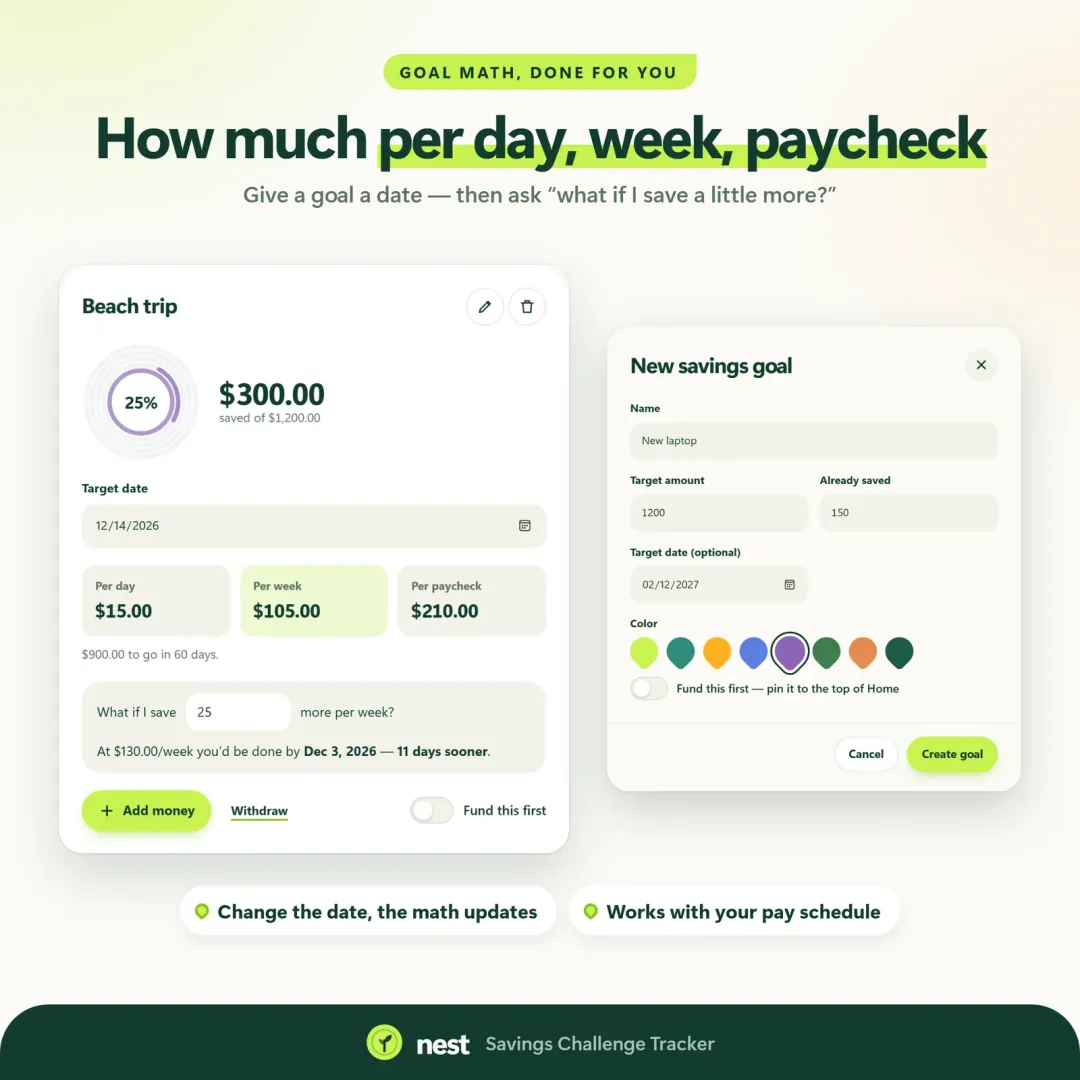
For the savings plan. Nest tracks the holiday fund as a goal with a target date, showing the amount per paycheck and whether they're on pace.
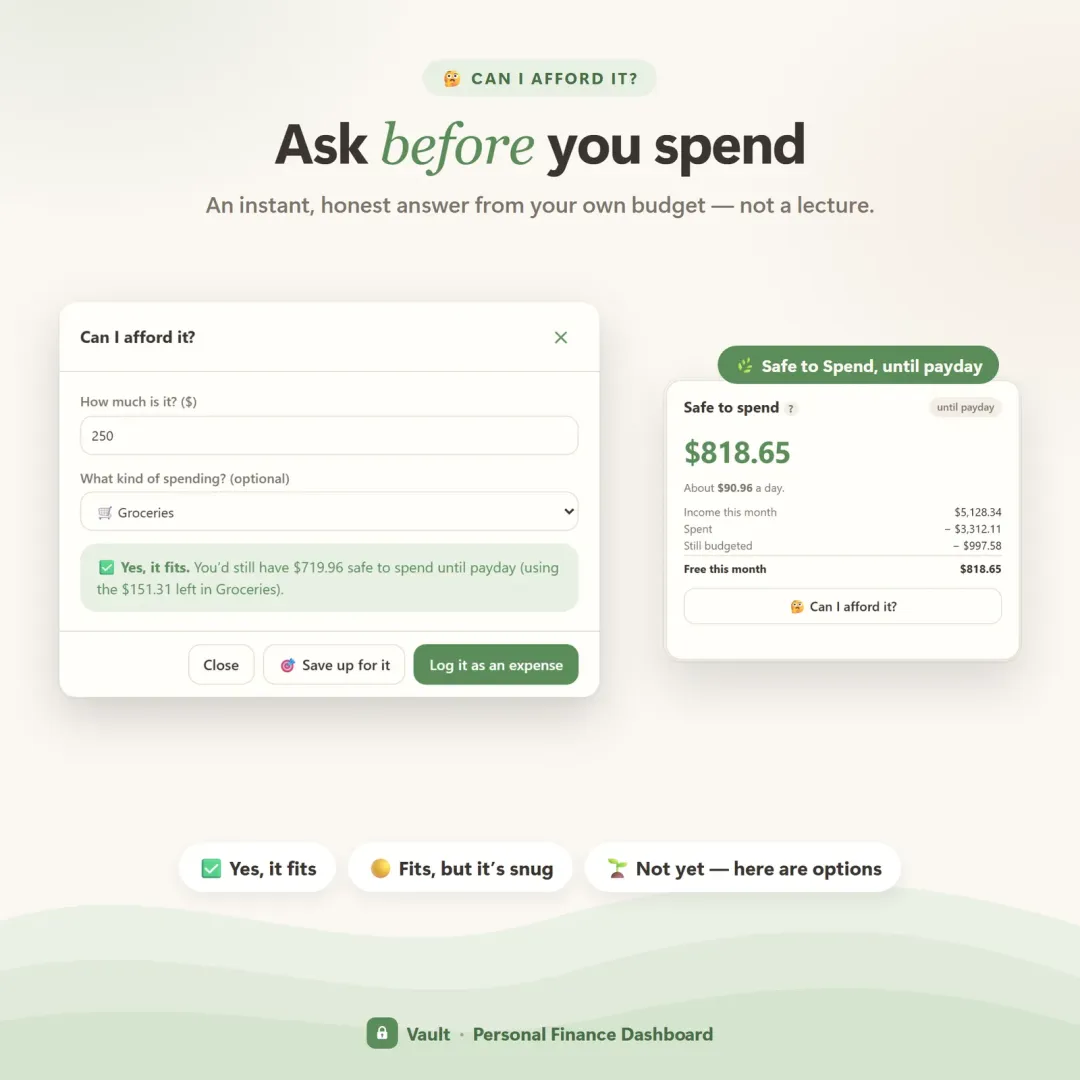
Before each purchase. In Vault, each holiday category is its own line in the budget, and the "Can I afford it?" check answers in seconds whether a gift fits what's left — or dips into next payday's money. Flow keeps a single safe-to-spend number in view, which is handy for the quick decisions in a busy store.
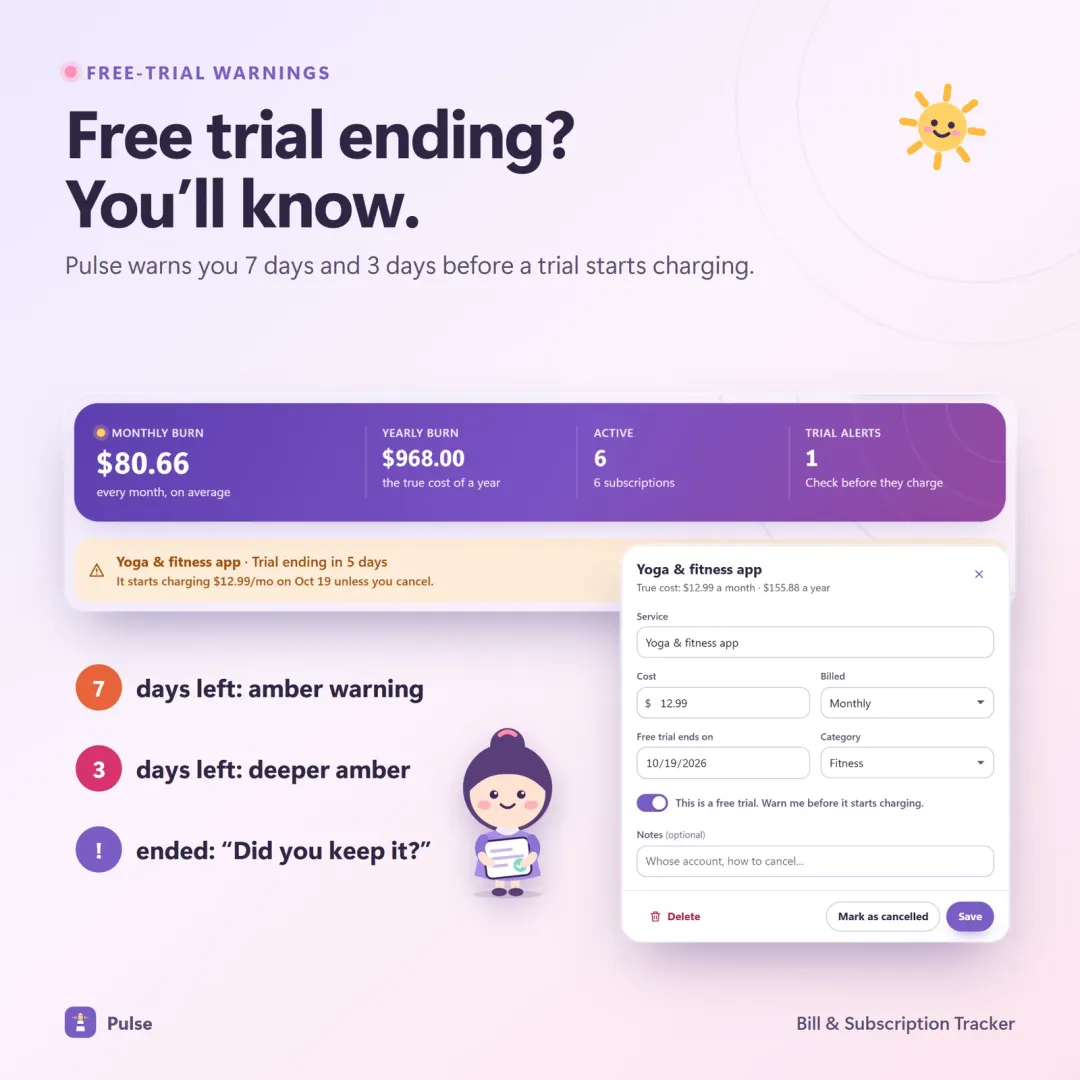
For free trials. A holiday-movie streaming trial and a faster-shipping membership both started in November. Pulse counts down to the first charge and warns 7 and 3 days before, so neither one renews in January by accident.
Every app has a free live demo you can open in your browser — try the Nest demo, Vault demo or Flow demo with sample data first.
The mid-December check-in
On December 15 they compared plan and reality:
| Category | Budget | Spent so far | Left |
|---|---|---|---|
| Gifts | $660 | $618 | $42 |
| Travel | $330 | $150 (motel prepaid) | $180 |
| Food & hosting | $270 | $45 (baking) | $225 |
| Decor | $90 | $96 | −$6 |
| Extras | $75 | $58 | $17 |
| Buffer | $75 | $0 | $75 |
| Total | $1,500 | $967 | $533 |
Decor ran $6 over (the tree cost more than expected), so $6 moved from the buffer. Gifts had $42 left — enough for a forgotten gift for the kids' bus driver without touching anything else.
Step 5: What happens if it goes on a credit card instead
Last year's version of this holiday went on a card at 24% APR. Here's what the same $1,500 costs when it's borrowed:
| How it's repaid | Time | Interest |
|---|---|---|
| Paid in full by the first due date | 1 month | $0 |
| $50 a month | 47 months | about $814 |
| Minimum payment only (1% + interest, $25 floor) | about 9½ years | about $1,887 |
That's why this plan saves first and spends second. If you already carry holiday debt from last year, the credit card payoff calculator shows the fastest way out, and our guide to APR explains why the rate matters so much.
Step 6: Close out the season and fund next year
In early January, Jordan and Sam spent ten minutes on the final numbers: $1,463 spent of $1,500, with $37 left over. Two notes went into next year's plan — budget $70 for the tree, and add a line for school holiday events.
The $37 went straight into next year's holiday fund. Starting in January, next year's $1,500 holiday needs only about $30 a week — the cheapest Christmas savings plan there is.
Build your own holiday budget
- Fund it: add what's saved to what your remaining paychecks can spare.
- Split it: gifts, travel, food, decor, extras and a 5% buffer.
- Detail it: a limit for every person and a price for every trip.
- Schedule it: spread purchases across the weeks the money arrives.
- Track it: with the free template, the budget calculator or an app — and check before you buy.
Frequently asked questions
How much should I budget for the holidays?
What should a holiday budget include?
How do I start a Christmas savings plan?
What percentage of a holiday budget should go to gifts?
What if I go over budget on one category?
Is it OK to put holiday shopping on a credit card?
Is there a free holiday budget template?
Key terms
Written by
Finance Specialist & Editor, VaultlyApps
Emma Whitfield writes and edits the VaultlyApps money guides and free calculators. Her focus is US household finance — budgeting on a real paycheck, paying down credit card and student debt, emergency funds and savings goals, renting — and the money side of freelancing and small-business income, from pricing and profit margins to self-employment tax. Every guide is researched against primary sources such as IRS publications and the CFPB, every number is checked in our tested calculators, and tax content is reviewed each year when new IRS figures come out. Emma is not a licensed financial adviser or tax preparer; her work is general education, not personal advice.
Researched against primary US sources, checked with our calculators and reviewed by a finance expert on our team. Written for US readers — general education, not financial, tax or legal advice. Editorial policy · Disclaimer