
How to Pay Yourself as a Small Business Owner (Owner's Draw vs Salary)
Owner's draw or salary, how much to take, and how to turn uneven income into a steady paycheck — a practical guide for sole proprietors, freelancers, makers and small business owners, with a worked example.
In this article
- Owner's draw vs salary: what's the difference?
- How to pay yourself, by business type
- The one rule that changes everything: tax is on profit, not on what you take
- Step 1: Separate business money from personal money
- Step 2: Find your real monthly profit
- Step 3: Decide what has to stay in the business
- Step 4: Choose a method for setting your paycheck
- The steady paycheck method
- The percentage method
- The leftover method
- A worked example: turning uneven profit into a steady paycheck
- Step 5: Make it a routine
- If you own an S corporation
- Common mistakes when paying yourself
- What about your household budget?
- Tools that make it easier
Most small business owners don't get a paycheck — they get whatever is left. Some months that's a lot; some months it's nothing. Paying yourself properly turns that guesswork into a plan: you know what you can take, when, and how much has to stay behind for taxes and the business.
Owner's draw vs salary: what's the difference?
An owner's draw is money you take out of the business for personal use. There's no payroll, no withholding and no pay slip — you simply move money from the business account to your own. A draw isn't a business expense, so it doesn't reduce the business's profit.
A salary is wages paid through payroll. Tax is withheld from each paycheck, the business pays employer payroll taxes, and the salary is a business expense.
Which one you use isn't a free choice. It depends on how the business is set up for tax purposes.
How to pay yourself, by business type
| Business type | How you pay yourself | What's taxed |
|---|---|---|
| Sole proprietor | Owner's draw | Net profit, through your personal tax return, plus self-employment tax |
| Single-member LLC (default) | Owner's draw | Same as a sole proprietor |
| Partnership / multi-member LLC | Draws, and sometimes guaranteed payments | Each partner's share of profit, plus self-employment tax |
| S corporation | Reasonable salary through payroll, plus distributions | Salary through payroll; profit passes through to owners |
| C corporation | Salary through payroll, plus dividends | Salary as wages; the corporation pays tax on its profit, dividends are taxed again |
Most freelancers, makers and Etsy sellers are sole proprietors or single-member LLCs, so the rest of this guide focuses on owner's draws — with a section on S corporations further down.
The one rule that changes everything: tax is on profit, not on what you take
This is the part that catches new business owners out. As a sole proprietor, you're taxed on your business's net profit for the year — revenue minus deductible expenses — not on how much you withdraw. Take out less than your profit and you still owe tax on all of it. Take out more and you're simply spending money that isn't there.
On top of income tax, sole proprietors and partners usually owe self-employment tax — Social Security and Medicare for the self-employed, roughly 15.3% on most of your net earnings. Nothing is withheld automatically, so the IRS expects quarterly estimated tax payments, normally due around April 15, June 15, September 15 and January 15.
That's why a good pay system sets money aside for tax before it decides what you can take home.
Step 1: Separate business money from personal money
Paying yourself only works if you can see the business's money on its own.
- A business checking account receives every sale and pays every business cost.
- A tax savings account holds the money you're setting aside for taxes. Treat it as already spent.
- Your personal account receives your paycheck — the owner's draw — and pays your household bills.
With this setup, "paying yourself" becomes a single, deliberate transfer instead of a blur of personal purchases on the business card.
Step 2: Find your real monthly profit
Look back at the last 6–12 months. For each month, take sales and subtract business expenses — materials, shipping, platform fees, software, advertising, mileage and so on. That's your net profit.
Two things make this number honest:
- Count refunds and fees. Marketplace fees and refunds come out of revenue even if the payout already deducted them.
- Spread yearly costs. A $600 annual software plan or insurance premium is $50 a month of real cost, even in the eleven months you don't pay it.
If you don't have clean records yet, start tracking now; three months of data is enough for a first paycheck.
Step 3: Decide what has to stay in the business
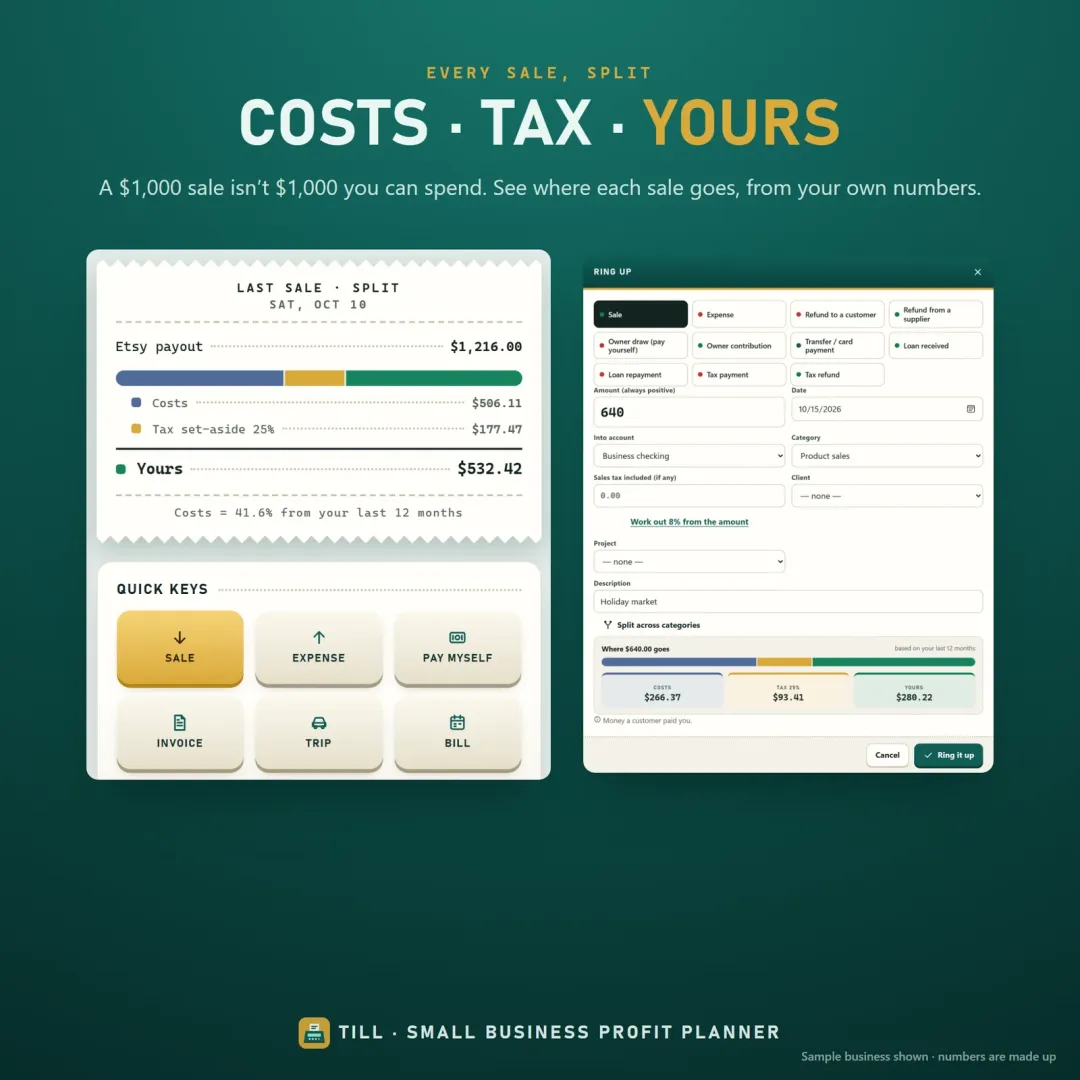
Not all profit is yours to take this month. Before setting a paycheck, decide on:
- Tax set-aside — a percentage of profit moved to the tax account. Many sole proprietors use somewhere around 25–30% as a starting point; your real rate depends on your income, deductions and location, so check it with an accountant after the first year.
- Sales tax — if you collect sales tax, VAT or GST, it was never your money. Keep it separate until you pay it.
- Upcoming bills — the next month's rent, subscriptions, supplier invoices and the business credit card balance.
- A cushion — a buffer for quiet months and surprises. One to three months of business expenses is a common goal.
- Reinvestment — money you want to spend on growth: equipment, stock, marketing.
Whatever remains after these is what's genuinely available to pay yourself. It's the business version of a safe-to-spend number.
Step 4: Choose a method for setting your paycheck
The steady paycheck method
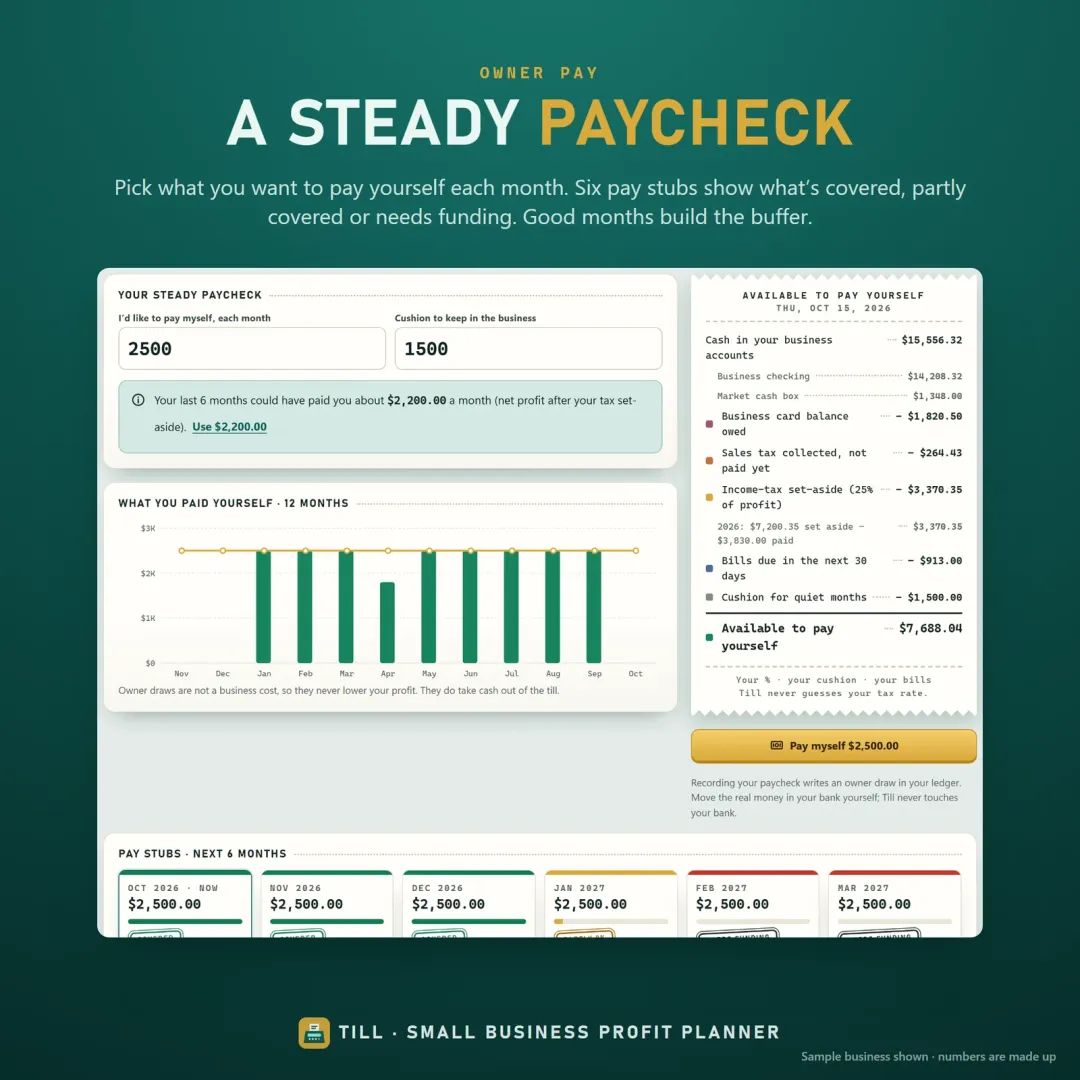
Pick a fixed monthly amount — the same every month — that's below your average after-tax profit. Good months leave extra money in the business; quiet months are covered from that buffer. Your household budget gets a predictable income, which is the whole point.
The percentage method
Every time money comes in, split it by percentages: for example, taxes, owner pay, a small profit reserve and operating costs. This is the idea behind the popular "Profit First" approach. It adapts automatically to busy and quiet months, but your personal income goes up and down with sales.
The leftover method
Pay yourself whatever is left at the end of the month. It's the most common method and the least reliable: it rewards overspending in the business and leaves your household guessing.
Most owners with uneven income do best with a steady paycheck, adjusted every three to six months.
A worked example: turning uneven profit into a steady paycheck
Here's a maker whose monthly net profit over the past year ranged from $2,600 to $6,100 — $49,000 in total, an average of about $4,083 a month. They set aside 25% of profit for taxes, which leaves an average of about $3,063 a month after tax.
Instead of taking whatever is left, they choose a steady paycheck of $2,600 a month — about 85% of the after-tax average — and start with a $4,000 cushion in the business account.
| Month | Profit | After 25% tax set-aside | Paycheck | Cushion at month-end |
|---|---|---|---|---|
| 1 | $2,800 | $2,100 | $2,600 | $3,500 |
| 2 | $3,400 | $2,550 | $2,600 | $3,450 |
| 3 | $5,200 | $3,900 | $2,600 | $4,750 |
| 5 | $2,600 | $1,950 | $2,600 | $4,575 |
| 8 | $6,100 | $4,575 | $2,600 | $7,800 |
| 12 | $5,600 | $4,200 | $2,600 | $9,550 |
(Rows for months 4, 6, 7 and 9–11 are left out to keep the table short; the cushion is carried through every month.)
The paycheck never changes, the cushion never drops below $3,450, and by the end of the year there's $9,550 in the business — enough for a raise, a bonus, new equipment or a bigger emergency fund. Taking "whatever is left" each month would have meant personal income swinging between $1,950 and $4,575.
Step 5: Make it a routine
- Pick a payday — the 1st and 15th, or the last Friday of the month — and stick to it.
- Move the money in one transfer from business to personal, and record it as an owner's draw.
- Move the tax set-aside on the same day so it never mixes with spending money.
- Pay estimated taxes quarterly from the tax account.
- Review every quarter. If the cushion keeps growing, give yourself a raise. If it keeps shrinking, lower the paycheck before it becomes a problem.
If you own an S corporation
If your business is taxed as an S corporation and you work in it, the IRS expects you to pay yourself a reasonable salary through payroll — similar to what the business would pay someone else for the same work. Payroll taxes are withheld from that salary. Profit beyond salary can then be taken as distributions.
The steady-paycheck idea still applies: set a salary the business can afford in quiet months, and treat distributions like the bonus at the end of a good quarter. Because payroll and "reasonable salary" rules have real tax consequences, this is a setup to build with an accountant.
Common mistakes when paying yourself
- Using the business account as a personal wallet. Small personal purchases make it impossible to see real profit, and messy records cost more at tax time.
- Forgetting taxes until April. Without a tax account and quarterly payments, a good year can end with a bill you can't pay.
- Paying yourself first, but too much. "Pay yourself first" works only if the amount leaves room for taxes, bills and a cushion.
- Never paying yourself at all. Leaving everything in the business can hide whether it's really profitable — and burns out the owner.
- Counting sales tax as income. Sales tax, VAT and GST belong to the tax office.
- Not adjusting. A paycheck set in a great month or a terrible month will be wrong for the next six.
What about your household budget?
Once your paycheck is steady, your personal budget can work like anyone else's. Give every dollar of the paycheck a job, keep a safe-to-spend number for day-to-day spending, and build a personal emergency fund too — the 52-week savings challenge is an easy way to start. If you're carrying personal debt, a steady paycheck makes it much easier to commit to a fixed monthly payment; see debt snowball vs debt avalanche.
Small business owners also tend to collect subscriptions — software, design tools, marketplace plans. A quick subscription audit can free up money for the cushion.
Tools that make it easier
You can run this system with a spreadsheet and three bank accounts. A dedicated tool saves time and mistakes, especially if you sell in person or on several platforms. When comparing options, our checklist for choosing business software helps you look past the feature list.
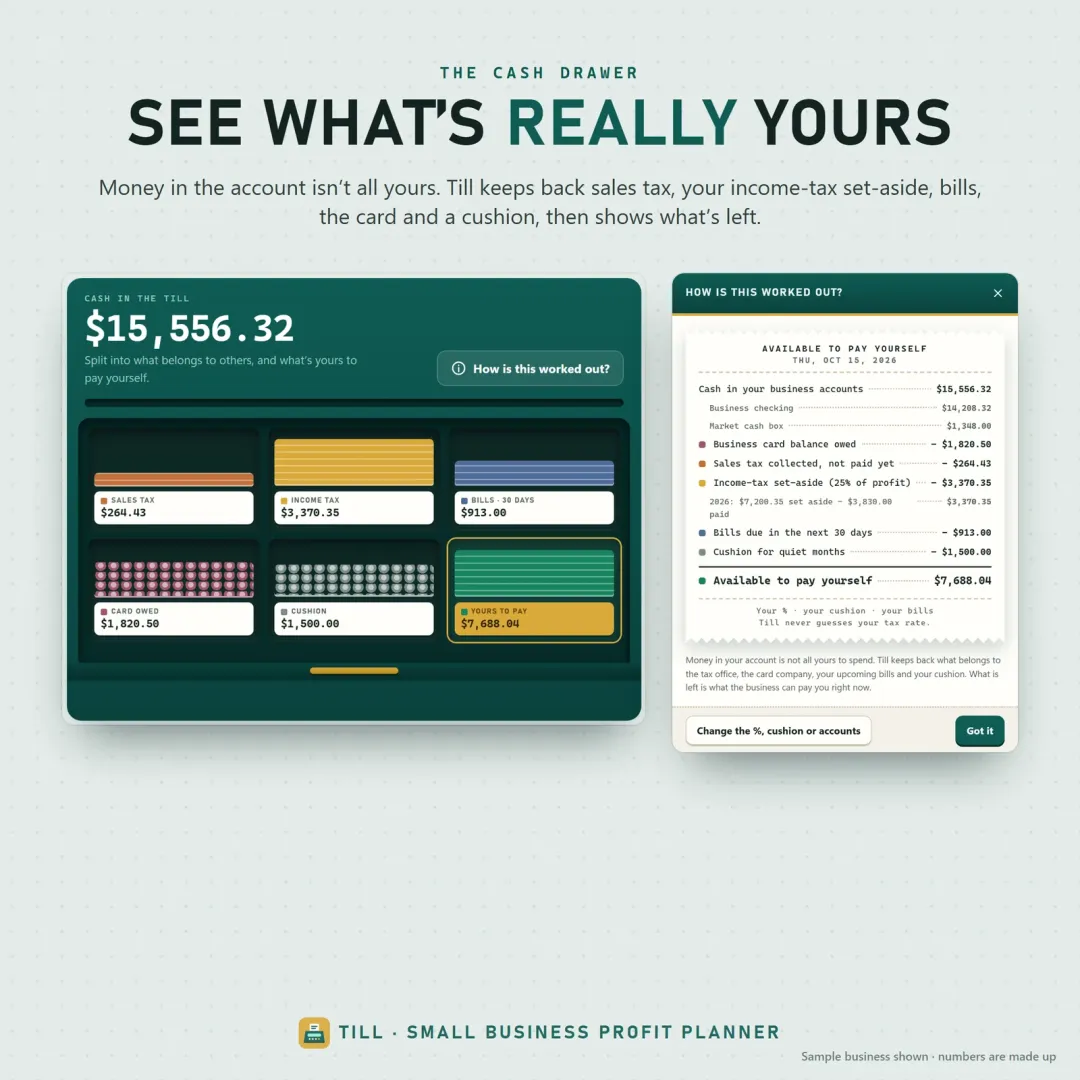
Till, our small business profit planner, was built around exactly this question. Its cash drawer splits the money in your business accounts into sales tax collected, your income-tax set-aside, bills due in the next 30 days, the card balance and your cushion — and shows what's left to pay yourself, with every line of the calculation one tap away. An owner pay planner turns that into six monthly pay stubs, and "Pay myself" records the owner's draw. It also handles invoices, mileage, reports and US quarterly tax dates. You can try it with a sample business in the free live demo.
For the personal side, Vault and Flow turn your steady paycheck into a household budget with a clear safe-to-spend number.
Frequently asked questions
Can a sole proprietor pay themselves a salary?
Is an owner's draw taxable?
How much should I pay myself from my business?
Should I pay myself every month even when sales are low?
When do S corporation owners have to take a salary?
Do I need a separate business bank account to pay myself?
Written by
Founder & developer, VaultlyApps
Mohammad Ali is the developer behind VaultlyApps. He designs, builds and tests every VaultlyApps product himself, with a focus on private, practical tools that solve one real problem well. His background also includes the construction industry, which shapes how he thinks about software for real-world work.