How the 52-Week Savings Challenge Works (and Variations That Fit Real Budgets)
Save $1 in week one, $2 in week two, up to $52 — and finish the year with $1,378. Here's how the 52-week challenge works, the math behind it, paycheck and monthly versions, and variations that are easier to keep up.

In this article
- The math behind $1,378
- The weekly schedule at a glance
- If you're paid every two weeks
- If you'd rather save monthly
- Variations that are easier to finish
- Reverse 52-week challenge
- Flat-rate challenge
- Doubled or scaled challenge
- Pick-a-week challenge
- 100-envelope challenge
- 365-day penny challenge
- Comparing the variations
- Set it up in 15 minutes
- Why people quit — and the fix for each
- Where to find the money
- Tips to actually finish
- What to do when you fall behind
- Savings challenge or debt payoff first?
- Doing the challenge as a family
- Where to keep the money
- After the challenge: what next?
- Is the 52-week challenge right for you?
- Track it without a spreadsheet
The 52-week savings challenge is one of the most popular ways to start saving because it begins tiny and grows slowly. You never have to find a big sum on day one, and by the end of the year you've built a real cushion.
The math behind $1,378
The total is the sum of the numbers from 1 to 52:
1 + 2 + 3 + … + 52 = 52 × 53 ÷ 2 = $1,378
A handy way to check your progress: after week n, you should have saved n × (n + 1) ÷ 2 dollars. After week 26 — halfway through the year — that's $351, only about a quarter of the final total. The second half of the challenge is where most of the money comes from, and also where most people quit.
Spread across the whole year, $1,378 is about $3.78 a day or $114.83 a month. That's a useful reality check: if $115 a month sounds impossible right now, start with a smaller variation rather than abandoning the idea.
The weekly schedule at a glance
| Weeks | Amount per week | Saved by end of block |
|---|---|---|
| 1–13 | $1 → $13 | $91 |
| 14–26 | $14 → $26 | $351 |
| 27–39 | $27 → $39 | $780 |
| 40–52 | $40 → $52 | $1,378 |
The final quarter alone asks for $598 — in the weeks before the holidays.
If you're paid every two weeks
Most people aren't paid weekly, so match the challenge to your paycheck. Combine two weeks into each payday: weeks 1 and 2 make $3, weeks 3 and 4 make $7, and each paycheck rises by $4 until the 26th paycheck saves $103.
| Paychecks | Amount per paycheck | Saved in the block |
|---|---|---|
| 1–7 | $3 → $27 | $105 |
| 8–13 | $31 → $51 | $246 |
| 14–20 | $55 → $79 | $469 |
| 21–26 | $83 → $103 | $558 |
The total is the same $1,378, but you make 26 transfers instead of 52 — one per payday, right after the money lands.
If you'd rather save monthly
A monthly version is the simplest to automate: $114.83 a month for 12 months reaches $1,378 (round up to $115 and you'll finish a few dollars ahead). It loses the "start tiny" feel of the classic challenge, so it suits people who already have some savings habit and just want a target.
Variations that are easier to finish
Reverse 52-week challenge
Start at $52 and count down to $1. Same $1,378, but the biggest deposits happen early in the year while motivation is high, and December only asks for a few dollars a week. The first 13 weeks ask for $598 — the same amount the classic version leaves for the end.
Flat-rate challenge
Save the average — about $26.50 a week — every week. It's less of a game, but it's predictable and easy to automate.
Doubled or scaled challenge
Multiply every week by 2 to save $2,756, or by 5 to save $6,890. Scaling works well if you're paid weekly and have a clear goal such as an emergency fund.
Pick-a-week challenge
Print the 52 amounts and tick off any one each week — a $40 week when money is good, a $3 week when it isn't. You still finish with $1,378, but you control the order.
100-envelope challenge
Number 100 envelopes from 1 to 100 and pick one at random each time you save, putting in that many dollars. Finish all 100 and you've saved $5,050. It's a bigger target, so many people spread it over more than a year or pick two envelopes a week.
365-day penny challenge
Save one cent on day 1, two cents on day 2, up to $3.65 on day 365. It totals $667.95 and turns saving into a daily habit.
Comparing the variations
| Challenge | Total saved | Biggest single deposit | Best for |
|---|---|---|---|
| Classic 52-week | $1,378 | $52 (week 52) | Starting from zero |
| Reverse 52-week | $1,378 | $52 (week 1) | Avoiding a tight December |
| Biweekly paycheck | $1,378 | $103 (paycheck 26) | People paid every two weeks |
| Monthly | $1,378 | $115 | Full automation |
| Flat-rate | $1,378 | $26.50 | Predictable budgets |
| Doubled | $2,756 | $104 | Weekly pay and a bigger goal |
| 100-envelope | $5,050 | $100 | A long-term, larger target |
| 365-day penny | $667.95 | $3.65 | Building a daily habit |
There's no "best" challenge — only the one that matches how and when you're paid.
Set it up in 15 minutes
- Choose your version from the table above, based on your pay schedule.
- Name the goal — emergency fund, holiday, car repairs, a new laptop.
- Open or pick a separate savings account for the challenge money.
- Decide the day. Payday works best: the transfer happens before the money gets spent.
- Set up the transfers. Schedule them if your bank allows changing amounts, or set a weekly reminder if not.
- Make the board. Print one, draw one, or use an app — something you'll see each week.
- Mark the hard weeks now. Circle the weeks around holidays, birthdays or annual bills, and decide in advance whether to swap or pre-pay them.
Why people quit — and the fix for each
- "The later weeks are too big." Switch to the reverse or flat-rate version mid-year. Nothing is lost; only the order changes.
- "I forgot for a few weeks." Automate, or attach the transfer to something you already do every week, like checking your bank app on payday.
- "I needed the money." That's what an emergency fund is for. Count it as a success, then restart from the week you're on.
- "It got boring." Change the format: a new board, a new goal or a family competition keeps it fresh.
Where to find the money
The early weeks are easy; the later ones need a plan. Some reliable sources:
- One cancelled subscription. A $12.99 monthly service costs $155.88 a year — enough to cover the first 17 weeks of the challenge ($153). Our subscription audit guide shows how to find the ones you've forgotten.
- Round-ups and leftovers. Move whatever is left of your weekly spending money on Sunday night.
- Your safe-to-spend number. If you know what's genuinely free each week, you know whether this week's amount fits. See what a safe-to-spend number is and how to calculate it.
- Windfalls. A refund or a small bonus can pre-pay the expensive weeks in advance.
Tips to actually finish
- Give the money a job. "Emergency fund" or "car repairs" is more motivating than "savings".
- Use a separate account. Money that sits in your main account tends to get spent.
- Automate where you can. Even with changing amounts, scheduling transfers removes the weekly decision.
- Plan for the expensive months. Look at the schedule now and decide how you'll handle weeks 40–52 — or switch to the reverse version.
- Don't quit after a missed week. Catch up gradually or stretch the timeline. A finished challenge that took 60 weeks beats an abandoned one.
- Make progress visible. A chart, a printable board or an app that shows the total growing keeps the habit alive.
What to do when you fall behind
Missing a week is normal — the later weeks are big. Choose one of these instead of restarting:
- Spread it out. Missed week 30's $30? Add $6 to each of the next five weeks.
- Swap weeks. Do a small week now and save the big one for a month with more room — the pick-a-week method in disguise.
- Extend the finish line. Add a few weeks at the end. The total is what matters, not the date.
- Shrink the challenge. Halve every remaining amount. Saving $1,000 is far better than stopping at $400.
Savings challenge or debt payoff first?
If you carry high-interest credit card debt, the interest on that debt usually costs far more than a savings account earns. Many people do both: a small challenge to build a starter emergency fund, while sending every other spare dollar to the most expensive debt. Our comparison of the debt snowball and debt avalanche explains how to order those payments.
The point of the emergency fund is to stop the next surprise from landing on a credit card. Even one finished challenge — $1,378 — covers many common emergencies, like a car repair or a medical bill.
Doing the challenge as a family
The 52-week challenge works well with children because the early amounts are small and the progress is visible. A few ideas:
- Let kids tick the board or colour in each week.
- Use a shared goal — a day trip, a pet, a family holiday — so everyone sees what the money is for.
- Run a mini version for children: 10 cents a week rising by 10 cents saves $137.80 in a year.
Where to keep the money
The challenge works best when the money is out of sight but easy to reach in a real emergency. Most people use a separate savings account that isn't linked to a debit card. In the US, many banks and credit unions offer high-yield savings accounts; check that the account is FDIC-insured (banks) or NCUA-insured (credit unions), and compare the interest rate and any monthly fees before opening one. A cash jar works for children and very small challenges, but larger amounts are safer in an insured account.
After the challenge: what next?
Finishing the year is a real achievement, and the habit is worth more than the $1,378. A few ways to keep going:
- Run it again, scaled. If the first year felt manageable, try the doubled version.
- Turn it into a goal. Pick a target amount and date, and let the weekly figure follow from it.
- Measure in months, not dollars. An emergency fund that covers one month of essential expenses, then three, is a clearer milestone than a round number.
- Automate the habit you built. Keep the same weekly transfer going, even at a flat amount.
Is the 52-week challenge right for you?
It's a good fit if you're starting from zero, like structure and want a concrete target for the year. If your income is irregular, the pick-a-week or flat-rate version will usually feel easier. If you already save consistently, a goal-based plan — a target amount and date, with the weekly amount worked out for you — may suit you better.
Track it without a spreadsheet
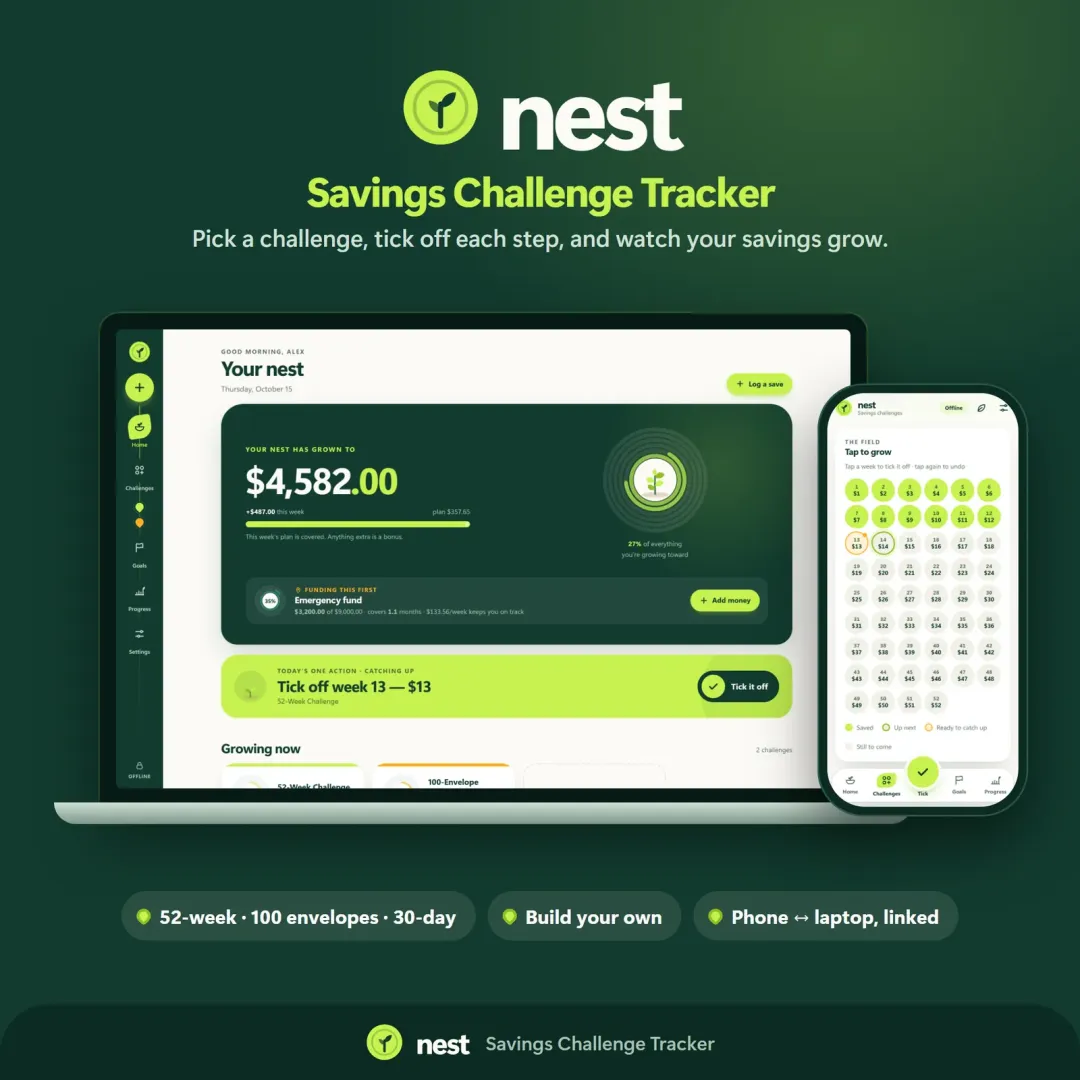
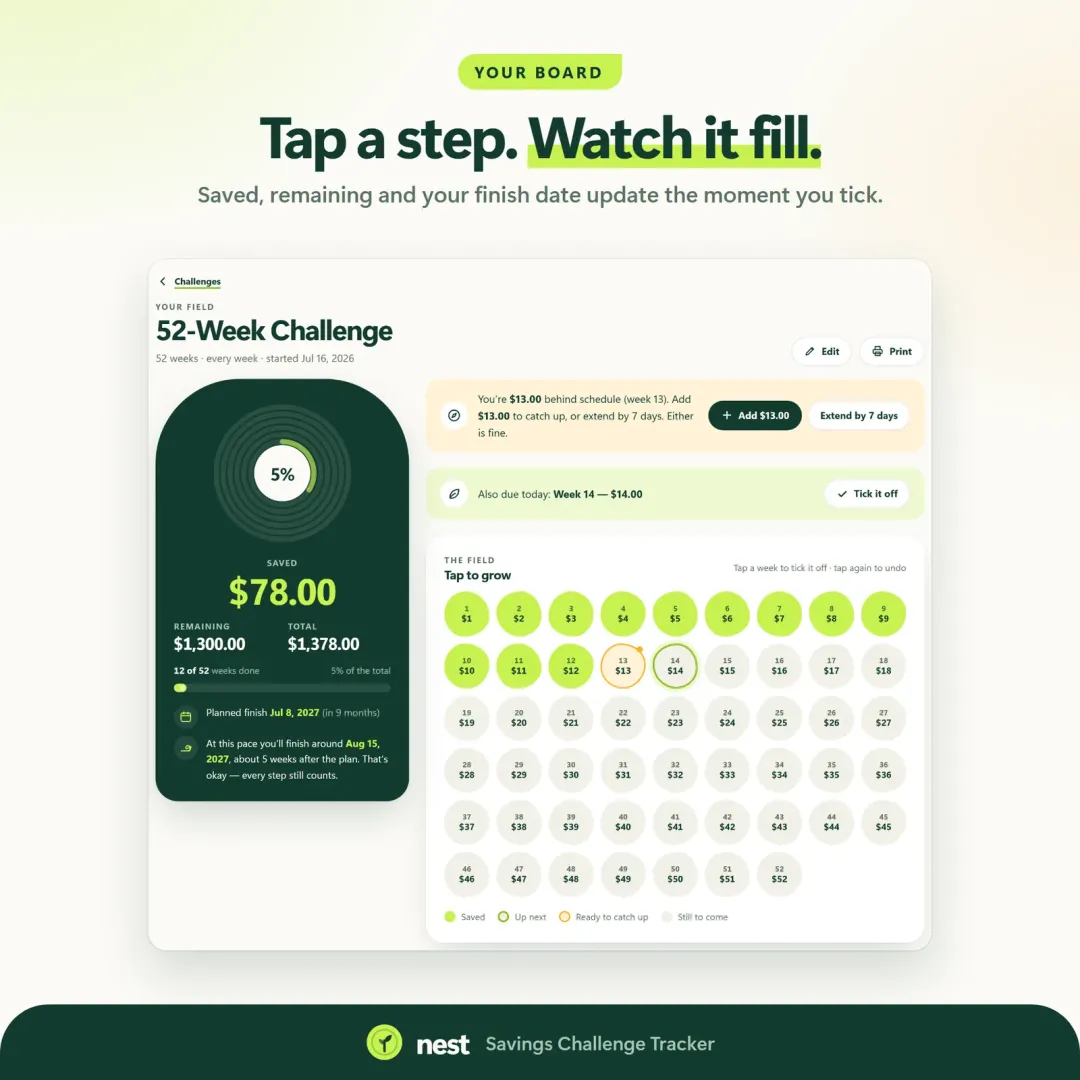
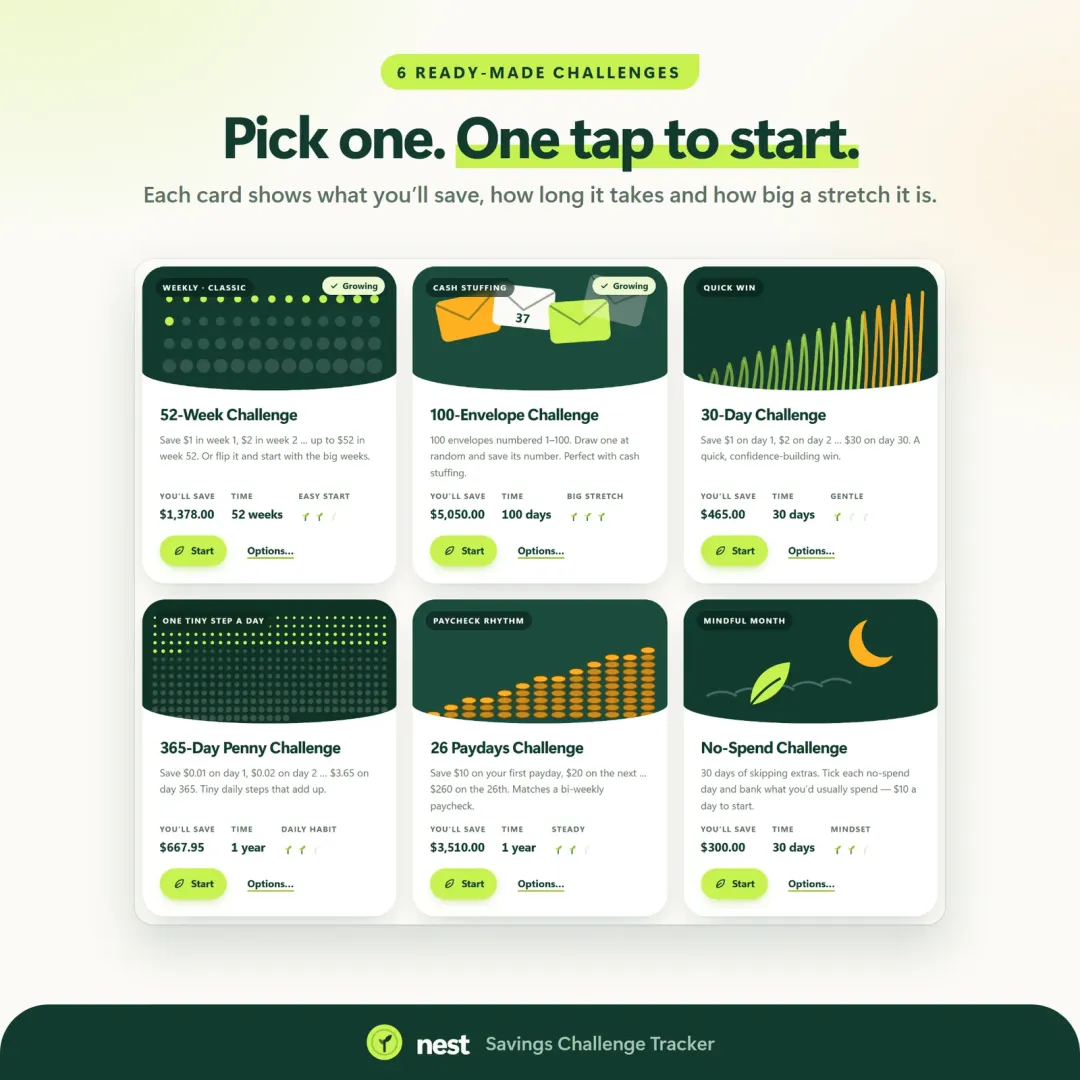
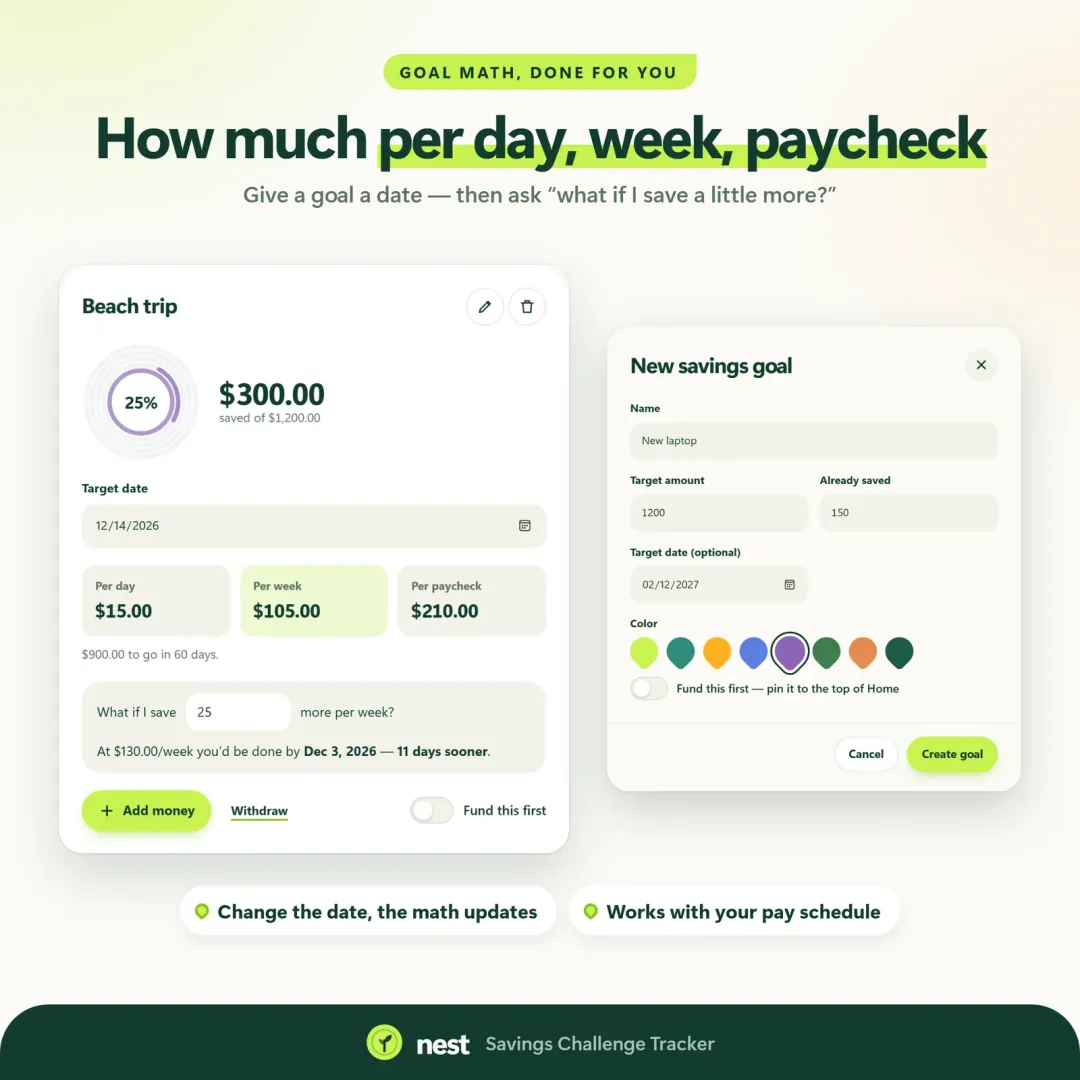
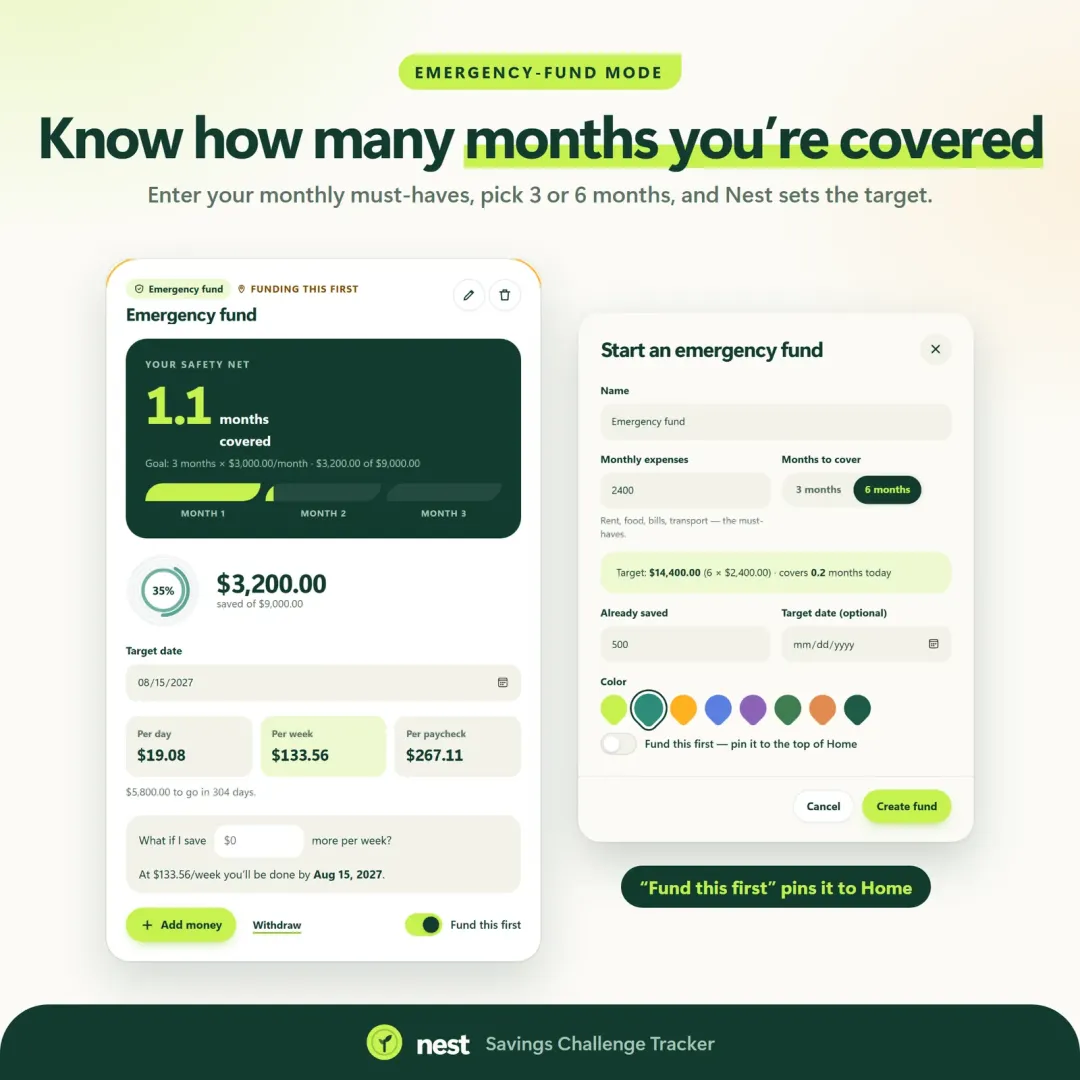
Nest is our savings challenge tracker. It includes the 52-week, 365-day penny, no-spend, 100-envelope and other challenges with one-tap tick boards, a custom challenge builder, savings goals with target dates, an emergency-fund tracker and kind catch-up options when you fall behind. If you also want a calm view of what's free to spend each week, Flow pairs well with it. Both have free live demos.
Frequently asked questions
How much do you save with the 52-week challenge?
Is it better to do the 52-week challenge in reverse?
What is the 365-day penny challenge?
Where should I keep the money from a savings challenge?
How do I do the 52-week challenge if I'm paid every two weeks?
What if I miss a week?
Written by
Founder & developer, VaultlyApps
Mohammad Ali is the developer behind VaultlyApps. He designs, builds and tests every VaultlyApps product himself, with a focus on private, practical tools that solve one real problem well. His background also includes the construction industry, which shapes how he thinks about software for real-world work.