Debt Snowball vs Debt Avalanche: Which Pays Off Debt Faster?
The snowball method pays the smallest balance first; the avalanche method pays the highest interest rate first. Here's how they compare on the same debts, with real numbers — plus the hybrid method and how to choose.
In this article
- Before you choose: list every debt
- How the debt snowball method works
- How the debt avalanche method works
- A worked example with real numbers
- The payoff order, month by month
- What extra payments do
- The hybrid method: one quick win, then the avalanche
- Snowball vs avalanche at a glance
- Which method should you choose?
- Special cases that change the order
- How to make either method work
- Mistakes that slow down any payoff plan
- Build a small buffer first
- Know what you can spend while you pay it off
- Try it with your own debts
If you have more than one debt, you have to decide which one gets your extra money first. The two best-known answers are the debt snowball and the debt avalanche. Both work. They just optimise for different things — one for motivation, one for cost — and the right choice depends far more on you than on the spreadsheet.
Before you choose: list every debt
Neither method works until you can see everything in one place. For each debt, write down:
- the current balance (from the latest statement or the lender's app, not from memory);
- the interest rate (APR) — for credit cards, the purchase APR, and note any promotional rate and the date it ends;
- the minimum payment and its due date;
- the type of debt — credit card, store card, personal loan, car loan, student loan, medical bill, buy-now-pay-later plan.
Then add up the minimums. That total is the floor you must pay every month just to stay current. Whatever you can pay above that floor is your extra payment — the fuel for either method.
How the debt snowball method works
- List your debts from smallest balance to largest, ignoring interest rates.
- Pay the minimum on every debt.
- Put every extra dollar toward the smallest balance.
- When it's paid off, add its whole payment to the next-smallest debt — the "snowball" grows.
The appeal is psychological. Small balances disappear quickly, and each paid-off account is visible proof that the plan is working. Fewer accounts also means fewer due dates, fewer statements and fewer chances to miss a payment.
How the debt avalanche method works
- List your debts from highest interest rate (APR) to lowest.
- Pay the minimum on every debt.
- Put every extra dollar toward the debt with the highest rate.
- When it's gone, roll its payment into the next-highest rate.
The appeal is mathematical. Interest is the cost of carrying debt, and the avalanche always shrinks the most expensive debt first. Every dollar sent to a 27.9% card "earns" more than a dollar sent to a 6.9% car loan.
A worked example with real numbers
Here are four debts — a total of $17,400 with $460 in minimum payments — and a budget of $700 a month for debt. Interest is calculated monthly, and minimum payments stay fixed.
| Debt | Balance | APR | Minimum |
|---|---|---|---|
| Store card | $900 | 19.9% | $30 |
| Card B | $2,500 | 22.5% | $65 |
| Card A | $6,200 | 27.9% | $155 |
| Car loan | $7,800 | 6.9% | $210 |
The snowball attacks the store card first ($900). The avalanche attacks Card A first (27.9%).
| Result | Snowball | Avalanche |
|---|---|---|
| First debt paid off | Month 4 | Month 20 |
| Debt-free in | 31 months | 31 months |
| Total interest | $4,085.80 | $3,750.60 |
With these numbers, the avalanche saves $335.20 — and both finish in the same month. But the snowball clears its first debt in month 4, while the avalanche makes you wait until month 20 for the first one.
The payoff order, month by month
The table below shows when each debt reaches zero under each method. It explains why the snowball feels faster even though it isn't.
| Debt | Snowball | Avalanche |
|---|---|---|
| Store card ($900) | Month 4 | Month 26 |
| Card B ($2,500) | Month 12 | Month 25 |
| Card A ($6,200) | Month 27 | Month 20 |
| Car loan ($7,800) | Month 31 | Month 31 |
By month 12, someone following the snowball has closed two accounts. Someone following the avalanche has closed none — but has been quietly shrinking the most expensive balance the whole time.
What extra payments do
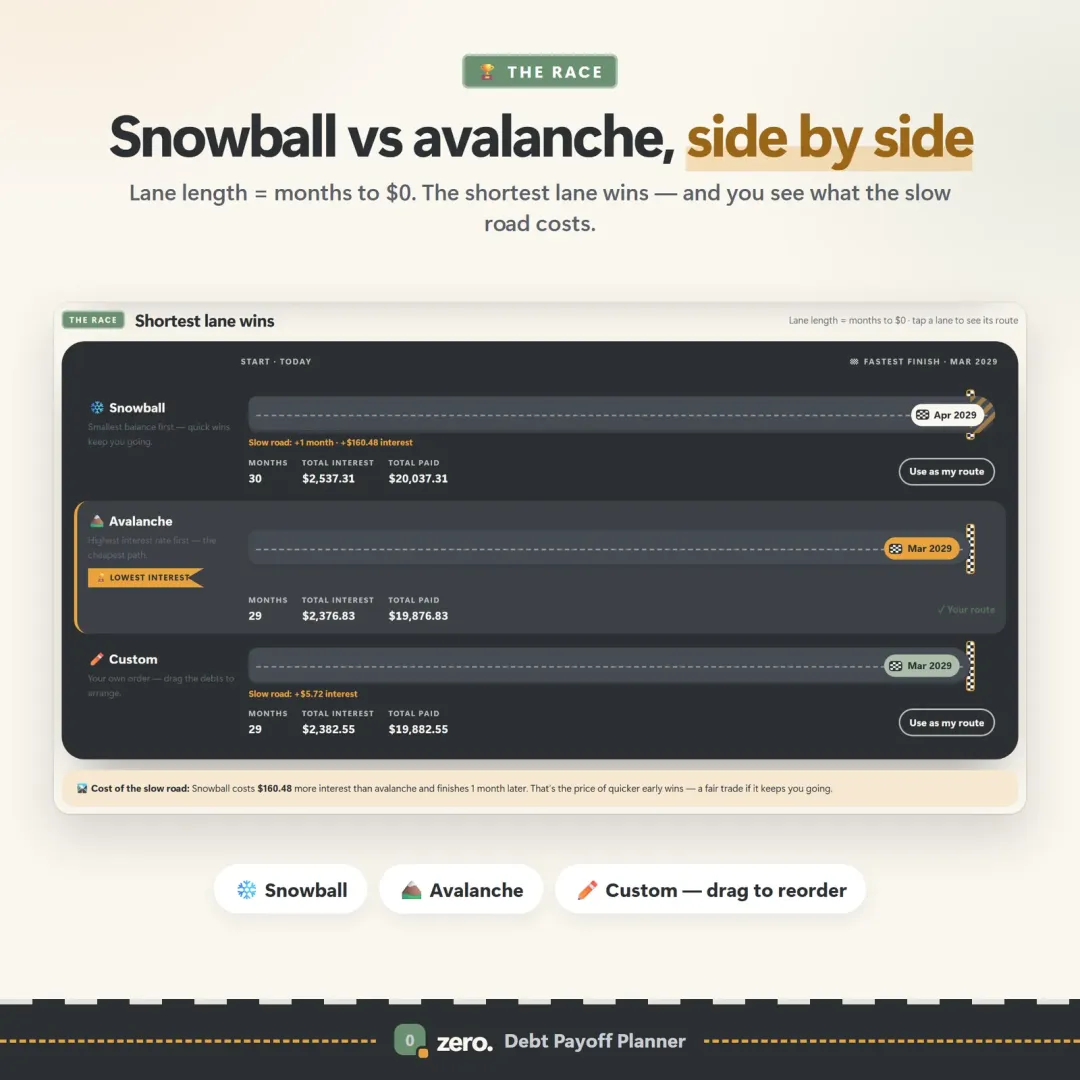
Raise the budget from $700 to $800 a month and both plans finish in 26 months. Interest falls to $3,285.29 (snowball) and $3,021.18 (avalanche). That extra $100 a month saves about $730–$800 in interest — more than the choice between methods does.
For contrast, paying only the $460 minimums would take 116 months — nearly ten years — and cost about $15,058 in interest.
The hybrid method: one quick win, then the avalanche
You don't have to choose a pure method. A popular compromise is to clear one very small balance first for momentum, then switch to highest-interest-first for everything else.
On the same four debts at $700 a month, paying the $900 store card first and then following the avalanche gives:
| Result | Snowball | Hybrid | Avalanche |
|---|---|---|---|
| First debt paid off | Month 4 | Month 4 | Month 20 |
| Debt-free in | 31 months | 31 months | 31 months |
| Total interest | $4,085.80 | $3,881.96 | $3,750.60 |
The hybrid keeps the early win of the snowball and recovers about $204 of the snowball's extra interest. It costs about $131 more than the pure avalanche — a small price if that first closed account is what keeps you going.
The hybrid works best when the "quick win" debt really is small — something you can clear in two to four months. If your smallest balance would take a year, you've lost the point of the snowball and you're paying for it.
Snowball vs avalanche at a glance
| Comparison | Debt snowball | Debt avalanche |
|---|---|---|
| Pays first | Smallest balance | Highest interest rate |
| Total interest | Same or higher | Same or lower |
| First win | Fast | Can be slow |
| Best for | Staying motivated | Minimising cost |
| Biggest risk | Paying more interest | Giving up before the first win |
Which method should you choose?
Choose the avalanche if:
- you're motivated by saving money and can wait for the first payoff;
- one debt has a much higher rate than the others (such as a 28% credit card next to a 7% car loan);
- your balances are fairly similar in size.
Choose the snowball if:
- you've started payoff plans before and stopped;
- you have several small balances you could clear within a few months;
- fewer bills to track would make life simpler.
Choose the hybrid if you want both: one or two quick wins, then the cheapest order.
The gap between the methods is often a few hundred dollars over years. The gap between finishing a plan and abandoning it is thousands. Pick the one you'll keep.
Special cases that change the order
The examples above assume normal credit cards and loans. A few situations deserve a second look:
- 0% promotional balances. A balance on a 0% intro rate costs nothing until the promotion ends. Note the end date. If the remaining balance will switch to a high rate before you could clear it, it may need priority before that date.
- Deferred-interest store financing. Some "no interest if paid in full" plans charge all the interest back to the purchase date if a balance remains at the deadline. Treat the deadline as a hard target.
- Debts in collections or close to it. Missed payments can bring fees and other consequences that a simple interest comparison doesn't capture. Getting every account current comes before optimising the order.
- Variable rates. If a rate is likely to rise, the avalanche order may change during the plan. Re-check your list whenever a statement shows a new APR.
- Student loans and medical bills can have repayment programs, hardship options or fixed terms that are worth understanding before you make extra payments.
How to make either method work
- Fix one monthly total and never drop it. Both methods depend on paying the same amount every month, even as debts disappear. When a debt is paid off, its payment moves — it doesn't come back to your spending money.
- Automate the minimums so nothing is late while you focus on the target debt.
- Stop adding new debt. A payoff plan can't outrun new balances. Keeping a small buffer helps here.
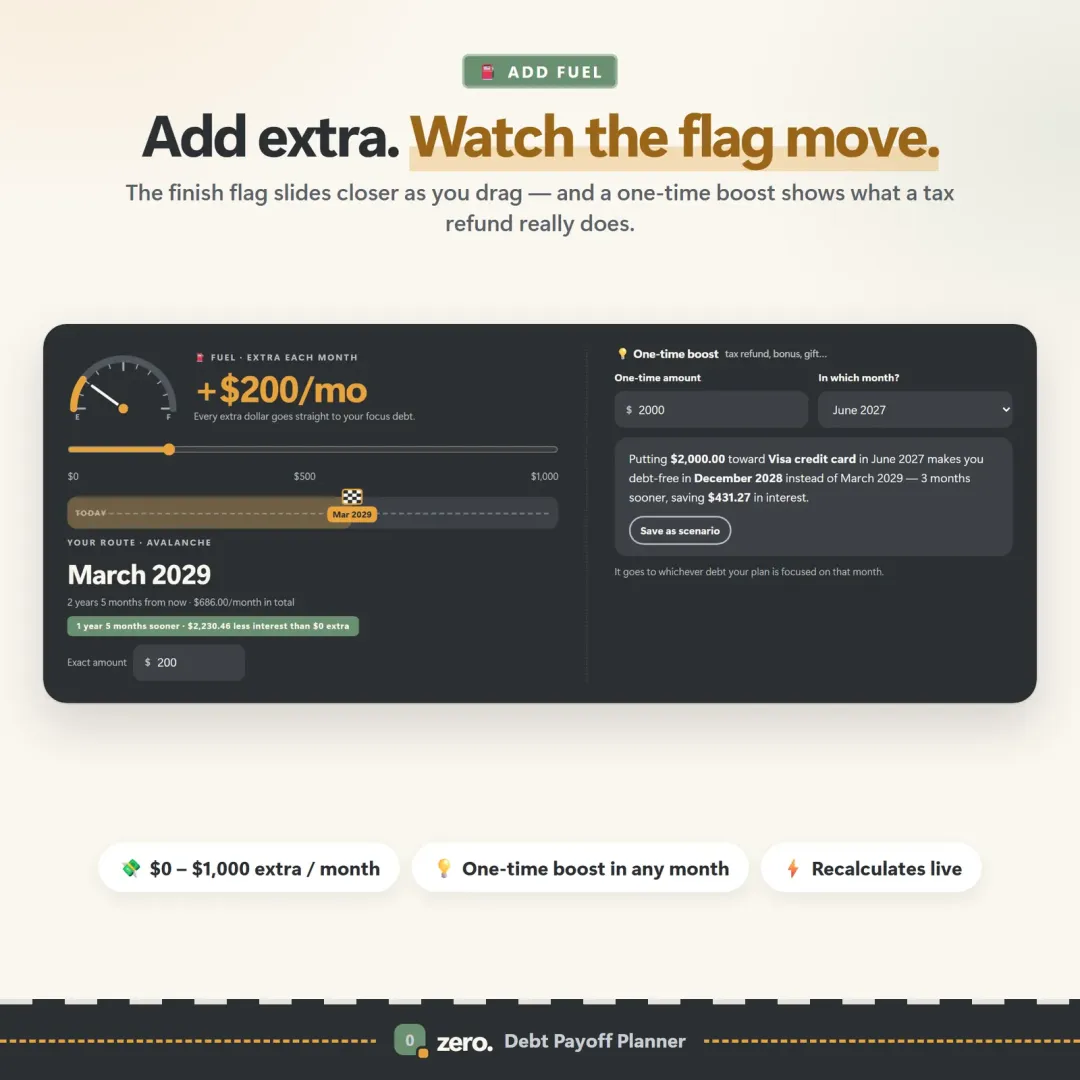
- Throw windfalls at the target. Tax refunds and bonuses shorten the timeline noticeably.
- Track your debt-free date, not just balances. A date is easier to stay motivated by than a falling number.
- Review once a month. Update balances from your statements, check that the target debt is still the right one, and note your progress.
Mistakes that slow down any payoff plan
- Spreading extra money across every debt. Paying a little extra on all four debts feels fair, but it delays every payoff. Both methods work because the extra money is concentrated on one target at a time.
- Letting the payment shrink when a debt disappears. When the store card is gone, its $30 minimum and the extra money you were sending it must move to the next target. If it drifts back into everyday spending, the "snowball" never grows.
- Ignoring due dates. A late fee or penalty rate on one account can wipe out months of careful ordering. Automate every minimum before you think about the order.
- Paying down a card while still using it. If the card keeps collecting new purchases, the balance moves sideways. Use a debit card or cash for day-to-day spending during the plan.
- Never updating the list. Balances, rates and minimums change. A quick monthly review keeps the target correct and shows the progress you've made — which is what keeps people going in month 14.
Build a small buffer first
A payoff plan is fragile if one car repair sends you straight back to a credit card. Many people keep a starter emergency fund — often a few hundred to a thousand dollars — before paying aggressively, then build it further once the expensive debts are gone.
If you like structure, a savings challenge can build that buffer alongside your minimums. Our guide to the 52-week savings challenge shows several versions, including a flat weekly amount that's easy to automate.
Know what you can spend while you pay it off
The hardest part of a payoff plan isn't the maths — it's the month-to-month spending. If you overspend in week three, the extra payment shrinks. A safe-to-spend number helps: it subtracts bills, savings and the debt payment first, so the money left over is genuinely free to spend without derailing the plan.
Try it with your own debts
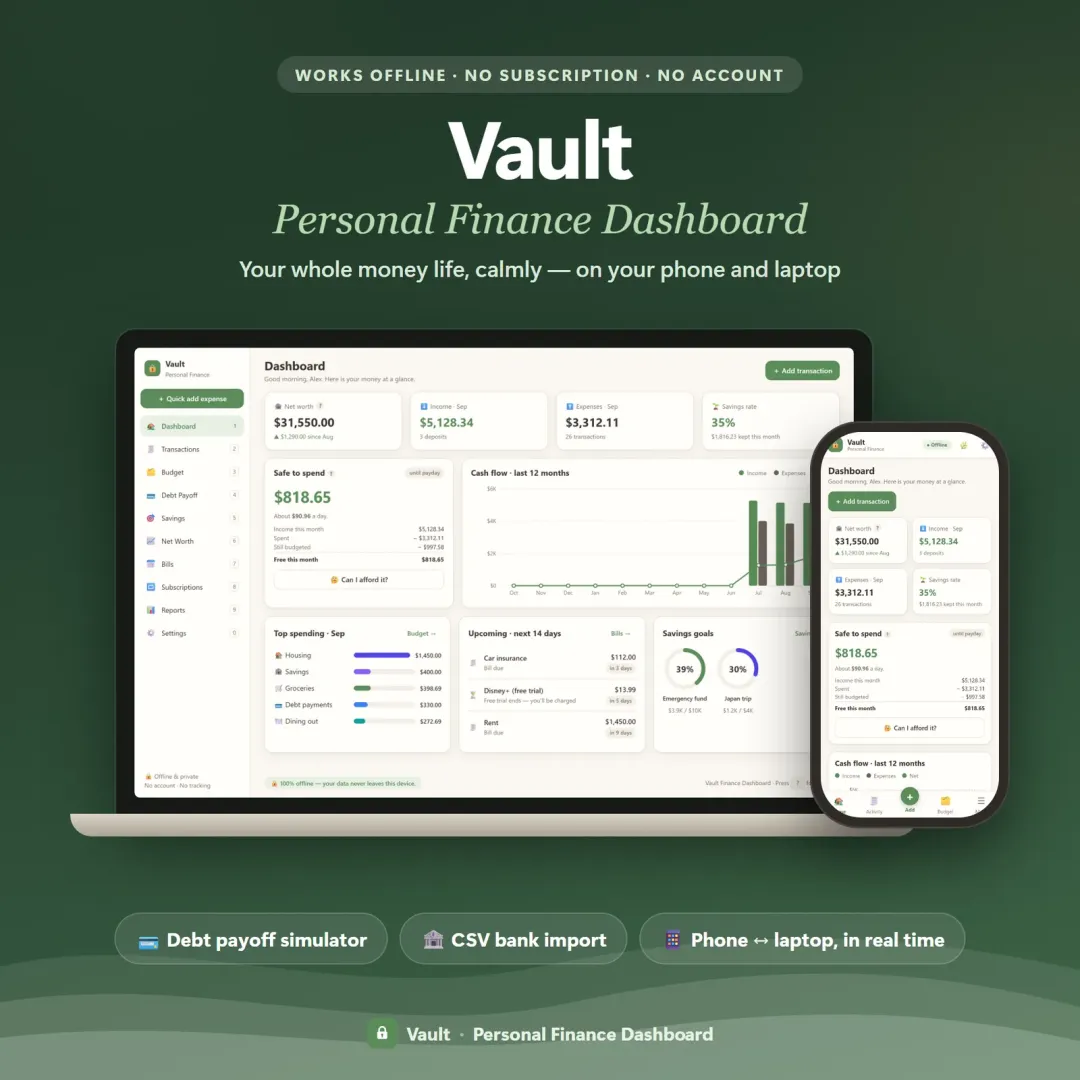
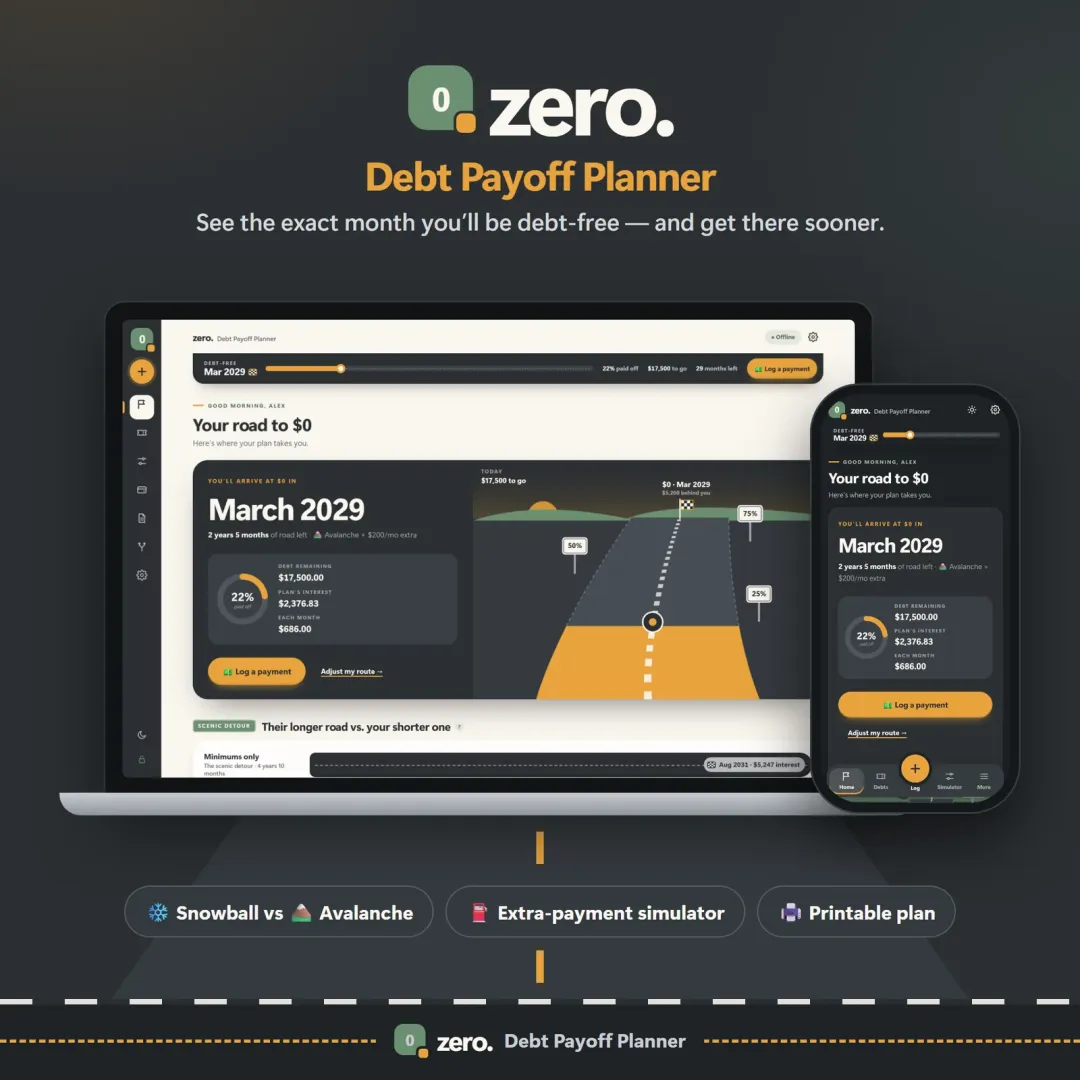
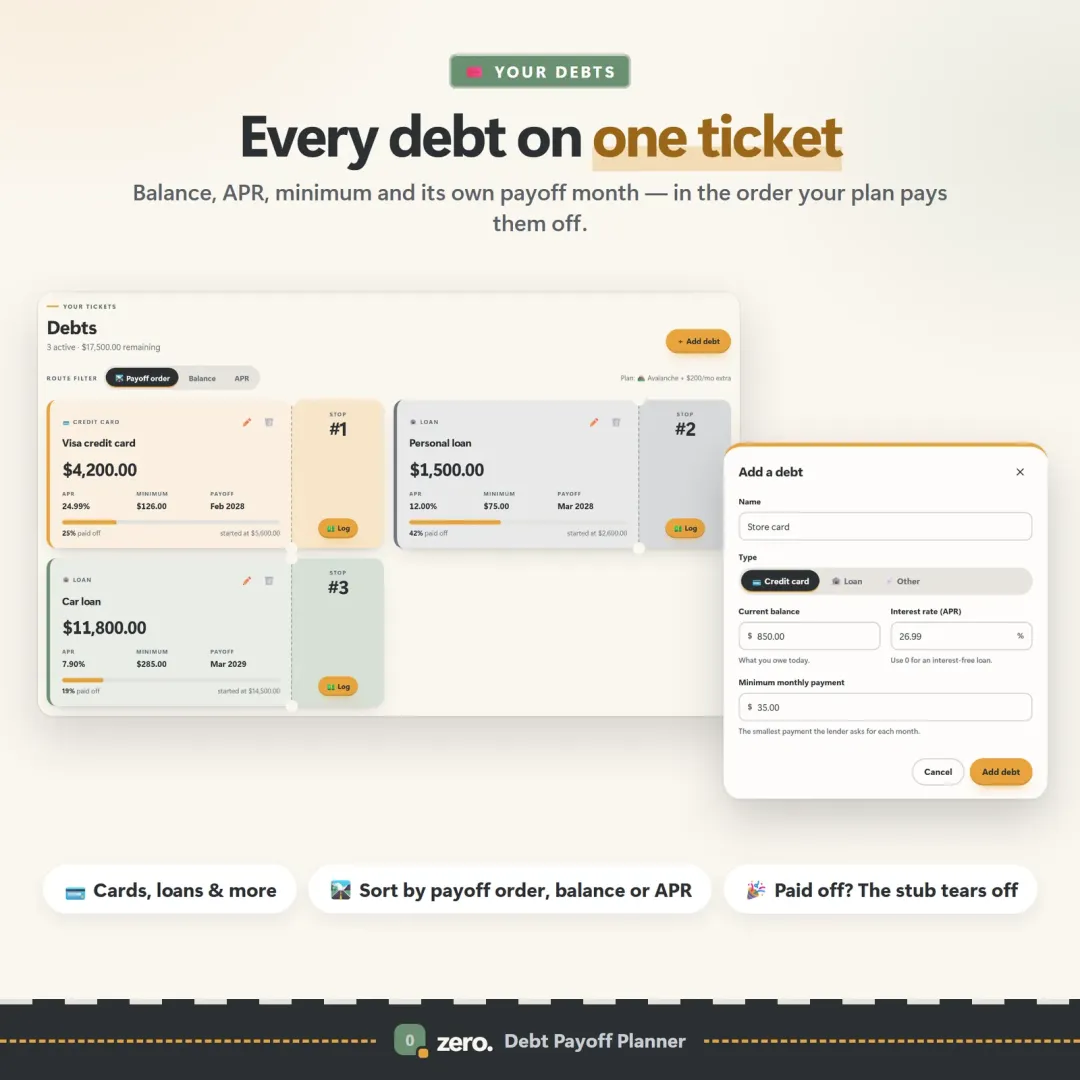
The fastest way to decide is to run both methods on your real balances. Our debt payoff planner, Zero, compares snowball, avalanche and a custom order side by side, shows your debt-free date and total interest, lets you drag an extra-payment slider to see how much sooner you could finish, and saves what-if scenarios to compare. Vault includes the same comparison inside a full budget dashboard, and Flow keeps a calm Safe to Spend number in view while you pay debts down. All three have free live demos.
Frequently asked questions
Is the debt avalanche always cheaper than the debt snowball?
Which is faster, snowball or avalanche?
Can I combine the snowball and avalanche methods?
Should I pay off debt or save first?
Does closing a credit card after paying it off help?
What counts as an extra payment?
Written by
Founder & developer, VaultlyApps
Mohammad Ali is the developer behind VaultlyApps. He designs, builds and tests every VaultlyApps product himself, with a focus on private, practical tools that solve one real problem well. His background also includes the construction industry, which shapes how he thinks about software for real-world work.