Roth IRA vs 401(k): Which Should You Fund First in 2026?
A 401(k) has higher limits and often a free employer match; a Roth IRA gives tax-free growth and more control. Here's how they compare in 2026 — limits, taxes, access and fees — with the math on Roth vs traditional, and a simple order for where each retirement dollar should go.
In this article
- Roth IRA vs 401(k) at a glance
- Why the 401(k) match comes first
- Why a Roth IRA is often next
- The real question: Roth or traditional?
- Roth 401(k): the best of both?
- A simple funding order
- How much should you save in total?
- Common mistakes
- Where to keep short-term money
- Watch it all grow
- The short version
Two accounts do most of the heavy lifting for American retirement savers: the 401(k) through your job and the Roth IRA you open yourself. Both grow without yearly taxes, both are worth using, and the question most people actually face is simpler than "which one?": which one first, and how much in each?
This guide compares them side by side for 2026, shows the math behind the Roth-vs-traditional decision, and ends with a simple order for where each retirement dollar should go. To try your own numbers, use the free 401(k) calculator and Roth IRA calculator.
Roth IRA vs 401(k) at a glance
| 401(k) | Roth IRA | |
|---|---|---|
| Who opens it | Your employer | You, at any brokerage |
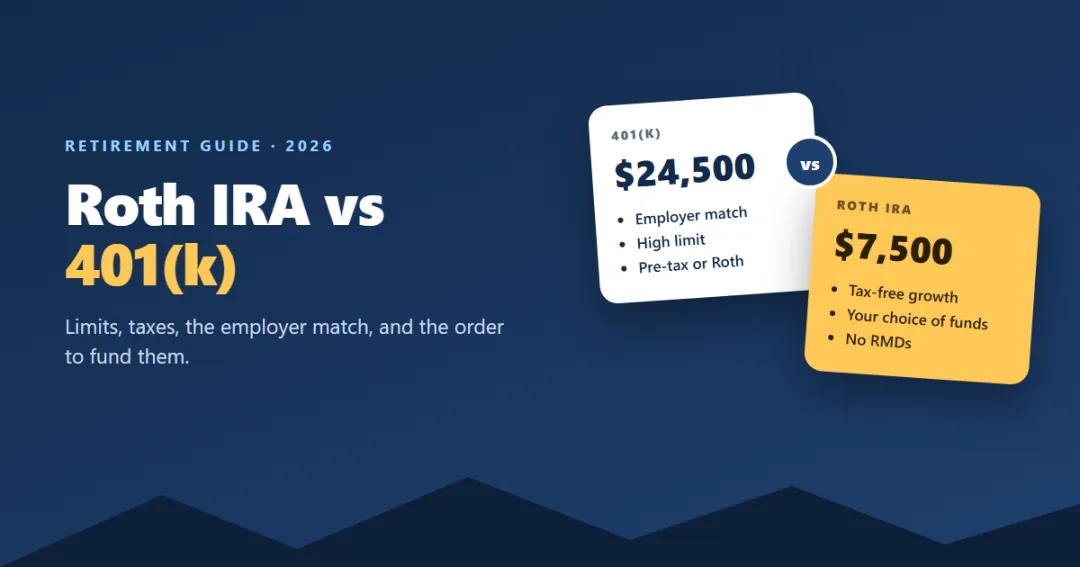
| 2026 limit (under 50) | $24,500 | $7,500 |
| Catch-up | +$8,000 at 50+ ($11,250 at 60–63) | +$1,100 at 50+ |
| Employer match | Often | Never |
| Income limit | None | Phases out from $153,000 single / $242,000 joint |
| Tax treatment | Traditional (pre-tax) and often Roth option | After-tax, tax-free growth and withdrawals |
| Investments | The plan's menu | Almost anything |
| Early access | Limited; loans in some plans | Contributions any time |
| Required withdrawals | Yes for traditional money (from 73) | None during your lifetime |
Why the 401(k) match comes first
If your employer matches contributions, that match is the best return you'll ever get. A typical match is 50% of what you put in, up to 6% of pay. On a $70,000 salary:
- you contribute 6% = $4,200 a year,
- your employer adds $2,100, an instant 50% return.
Over 30 years at 7%, those combined contributions grow to about $616,000. Contributing only 3% would cut the match in half and leave a large share of that on the table. So step one is almost always: contribute enough to get the full match. The 401(k) calculator shows exactly how much match you'd miss at a lower rate.
Why a Roth IRA is often next
After the match, many people get more value from a Roth IRA than from extra 401(k) contributions:
- Tax-free growth and withdrawals. Every dollar of growth comes out tax-free after 59½.
- More investment choice and often lower fees. You pick the brokerage and the funds. Some 401(k) menus have high-fee funds.
- Flexibility. You can take your contributions back out at any time without tax or penalty. It isn't a savings account, but it's a useful backstop.
- No required minimum distributions during your lifetime.
$7,500 a year from 30 to 65 at 7% grows to about $1.11 million with nothing more ever paid in tax. Starting at 25 gives about $1.6 million; at 35, about $758,000. Run your own numbers in the Roth IRA calculator, which also checks the 2026 income limit for you.
The real question: Roth or traditional?
The 401(k) vs IRA question is partly about accounts; the bigger choice is Roth vs traditional tax treatment, because most 401(k) plans now offer both.
- Traditional: you skip tax on the contribution now, and pay tax on everything you withdraw later.
- Roth: you pay tax now, and everything comes out tax-free later.
If your tax rate is the same now and in retirement, they come out exactly equal. Here's why, at a 22% tax rate, over 30 years at 7%:
| Contribution | Balance after 30 years | After tax in retirement | |
|---|---|---|---|
| Roth | $7,500 (after tax) | about $758,000 | about $758,000 |
| Traditional, 12% rate later | $9,615 (pre-tax, same take-home cost) | about $972,000 | about $855,000 |
| Traditional, 22% rate later | $9,615 | about $972,000 | about $758,000 |
| Traditional, 24% rate later | $9,615 | about $972,000 | about $739,000 |
So the decision comes down to one question: will your tax rate be higher or lower in retirement than it is now?
- Early career, lower income now? Roth usually wins: your rate is likely to rise.
- Peak earning years, high bracket now? Traditional often wins: you save tax at a high rate and may withdraw at a lower one.
- Not sure? Split your contributions. Tax diversification gives you flexibility to choose which account to draw from in retirement.
Roth 401(k): the best of both?
Many plans now offer a Roth 401(k). It combines the 401(k)'s high limit and employer match with Roth tax treatment, and it has no income limit. For high earners who can't contribute to a Roth IRA directly, it's often the simplest way to get tax-free growth. Employer match money has traditionally gone into the pre-tax side, though newer rules let plans offer Roth matching.
A simple funding order
For most people, this order gets the most out of every dollar:
- Starter emergency fund and no high-interest debt. Retirement money shouldn't be your emergency plan. The emergency fund calculator helps.
- 401(k) up to the full employer match.
- Roth IRA up to the limit ($7,500 in 2026, $8,600 at 50+), if your income allows.
- Back to the 401(k), Roth or traditional, up to $24,500.
- Taxable brokerage account for anything beyond that.
If your 401(k) has very low-cost index funds, some people skip the IRA step and simply max the 401(k). If you're self-employed, a solo 401(k) or SEP-IRA can replace the employer plan.
How much should you save in total?
A common target is 15% of gross income for retirement, including any employer match. If that's not possible today, start with the match, then raise your contribution by 1% every year or with every raise until you get there. Small increases add up dramatically over decades; see the effect in the compound interest calculator.
To check whether your savings will last once you retire, try the how long will my money last calculator.
Common mistakes
- Missing the match to fund a Roth IRA first.
- Leaving 401(k) money in cash or the default money-market fund for years. Check your investment choices.
- Cashing out a 401(k) when you change jobs. You'll pay tax and usually a 10% penalty. Roll it into your new plan or an IRA instead.
- Contributing to a Roth IRA above the income limit, which leads to a 6% excess-contribution tax each year until fixed.
- Ignoring fees. A 1% annual fee can take a quarter or more of your balance over a career.
Where to keep short-term money
Retirement accounts are for retirement. Money for a house in two years, a car or your emergency fund belongs somewhere safe and reachable. Our guide to CD vs high-yield savings explains which money goes where.
Watch it all grow
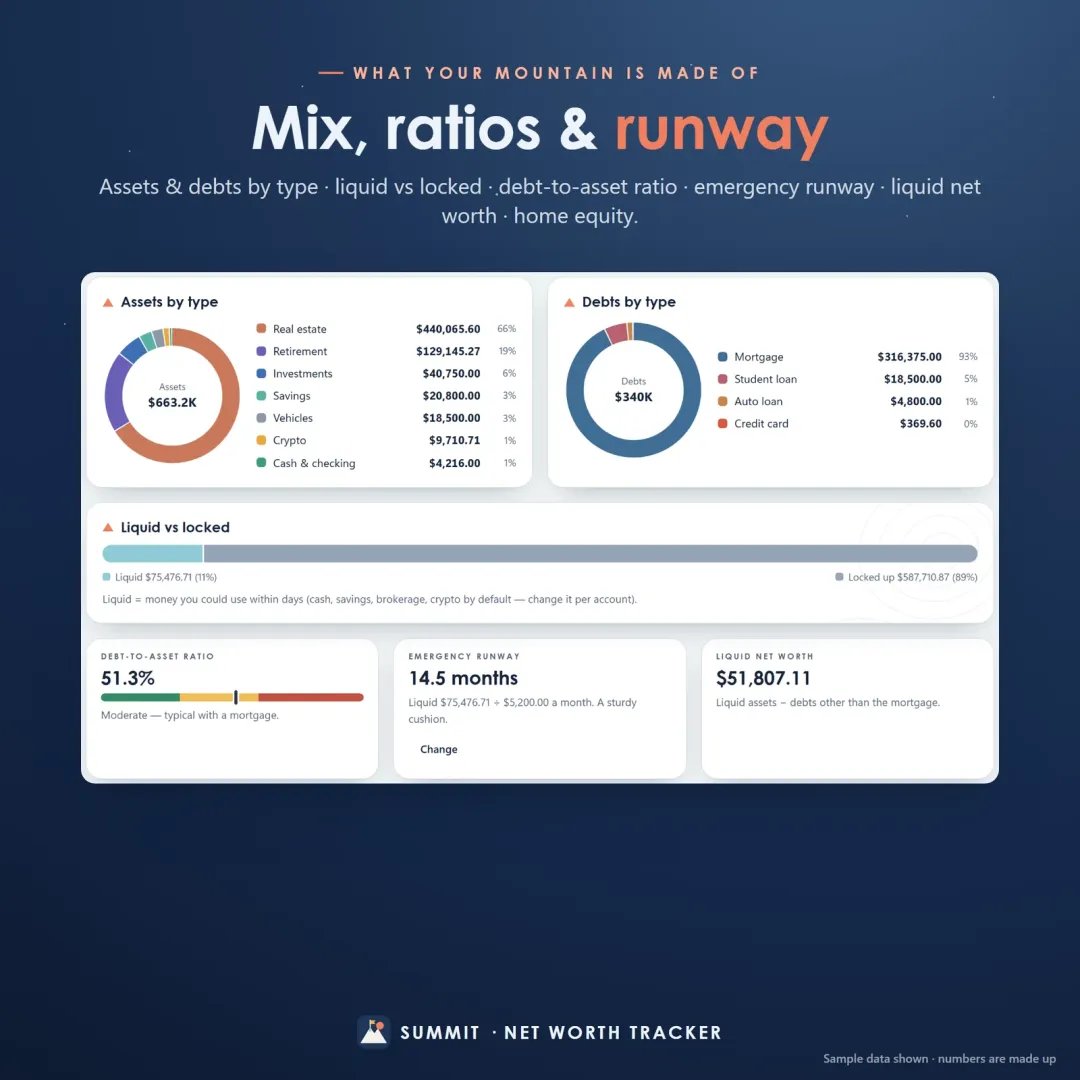
The 401(k), Roth IRA, savings and debts each live in a different place, which makes it hard to see progress. Summit is a net worth tracker that pulls every balance onto one screen with a monthly check-in, a history chart and a forecast. Nest helps you build the savings goals alongside, and Vault keeps your budget and bills in view. Each has a free demo with sample data you can open in your browser.
The short version
- 401(k) first, up to the full employer match. It's free money.
- Then a Roth IRA, for tax-free growth, low fees and flexibility, if your income allows.
- Then back to the 401(k) up to the limit.
- Roth vs traditional depends on whether your tax rate will be higher or lower in retirement; when unsure, split.
- Check your numbers in the 401(k) calculator and Roth IRA calculator.
This article is general education, not tax or investment advice. Limits are for 2026; returns aren't guaranteed.
Frequently asked questions
Is a Roth IRA better than a 401(k)?
Can I have both a Roth IRA and a 401(k)?
What are the 2026 limits?
Is a Roth 401(k) the same as a Roth IRA?
Should I choose Roth or traditional contributions?
Can I take money out of a Roth IRA before retirement?
What if my income is too high for a Roth IRA?
Written by
Finance Specialist & Editor, VaultlyApps
Emma Whitfield writes and edits the VaultlyApps money guides and free calculators. Her focus is US household finance — budgeting on a real paycheck, paying down credit card and student debt, emergency funds and savings goals, renting — and the money side of freelancing and small-business income, from pricing and profit margins to self-employment tax. Every guide is researched against primary sources such as IRS publications and the CFPB, every number is checked in our tested calculators, and tax content is reviewed each year when new IRS figures come out. Emma is not a licensed financial adviser or tax preparer; her work is general education, not personal advice.
Researched against primary US sources, checked with our calculators and reviewed by a finance expert on our team. Written for US readers — general education, not financial, tax or legal advice. Editorial policy · Disclaimer