How Property Taxes Work: Assessments, Mill Rates, Exemptions and How to Lower Your Bill
Your property tax bill comes from three numbers: your home's assessed value, any exemptions and your local tax rate. Here's how each one works, why the same house can cost $1,000 or $7,800 a year depending on the state, how escrow and reassessment change your payment, and five legal ways to pay less.

In this article
Property tax is one of the biggest costs of owning a home, and one of the least understood. Two identical houses can have bills thousands of dollars apart, the bill can jump the year after you buy, and most people never check whether their assessment is even right.
This guide explains how property taxes work in plain English: where the bill comes from, what assessments, mill rates and exemptions mean, how escrow fits in, and five legal ways to lower what you pay. To estimate your own bill, use the free property tax calculator.
The formula
Every property tax bill comes down to three numbers:
Property tax = (assessed value − exemptions) × tax rate
- Assessed value: what the local assessor says your property is worth for tax purposes.
- Exemptions: amounts taken off the assessed value, such as a homestead exemption.
- Tax rate: the combined rate of every local government that taxes your property.
1. Assessed value
Your county (or city) assessor values every property, usually based on recent sales of similar homes, size, age, condition and features. How that value is used varies by state:
- Full market value. Some states tax 100% of the assessed market value.
- Assessment ratio. Others tax a fixed percentage, for example 70% of market value.
- Caps. Some states limit how much the assessed value of an owner-occupied home can rise each year, so long-time owners pay on a value well below market. Those caps often reset when the home is sold.
Reassessments may happen every year or every few years. Your assessment notice shows the value and how to appeal.
2. Exemptions
Exemptions lower the taxable value. Common ones include:
- Homestead: for your primary residence.
- Senior: for owners above a certain age, sometimes with income limits.
- Veteran and disability exemptions.
- Agricultural use for qualifying land.
Most require you to apply; they aren't automatic. If you just bought a home, check your county's deadline.
3. Tax rate (and mills)
Your bill combines rates from several bodies: the county, the city or township, the school district (often the biggest share) and special districts for things like libraries, fire, water or parks. Rates are often written in mills: one mill is $1 of tax per $1,000 of assessed value, so 25 mills = 2.5%.
A worked example
- Market value: $350,000
- Assessment ratio: 70% → assessed value $245,000
- Homestead exemption: $25,000 → taxable value $220,000
- Total rate: 25 mills
Tax = $220,000 × 25 ÷ 1,000 = $5,500 a year, about $458 a month. That's an effective rate of about 1.57% of the home's market value.
Why location matters so much
Because rates are set locally, the same home is taxed very differently across the country. A $350,000 home at each state's approximate average effective rate:
| State | Average effective rate | Tax per year |
|---|---|---|
| New Jersey | 2.23% | $7,805 |
| Illinois | 2.08% | $7,280 |
| Texas | 1.74% | $6,090 |
| New York | 1.72% | $6,020 |
| Florida | 0.89% | $3,115 |
| California | 0.75% | $2,625 |
| Colorado | 0.51% | $1,785 |
| Hawaii | 0.28% | $980 |
State averages from Tax Foundation data published in 2025. States with no income tax often lean more on property tax, and rates inside a state can vary a lot from county to county. Compare all 50 states in the property tax calculator.
How you actually pay: escrow
Most homeowners with a mortgage don't pay the tax bill directly. The lender adds about one-twelfth of the yearly tax to each monthly payment, holds it in an escrow account and pays the bill when it's due. That's why:
- a property tax increase raises your mortgage payment, often after the lender's yearly escrow review;
- you prepay a few months of tax into escrow at closing (included in the closing costs calculator);
- your lender may send a refund or ask for more if the escrow balance is off.
When shopping for a home, include property tax in the monthly budget; how much house can I afford does this automatically.
The tax often rises after you buy
A common surprise: the seller's tax bill isn't your tax bill. In many places the home is reassessed at the sale price, and caps or exemptions the seller had don't transfer. If the seller owned the home for 15 years under a cap, your bill could be much higher. Ask your county how purchases are assessed, and estimate using the price you'll pay.
Five ways to lower your property tax
- Claim every exemption you qualify for: homestead first, then senior, veteran or disability.
- Check your assessment for errors: wrong square footage, an extra bathroom that doesn't exist, a finished basement that isn't. Errors are common and easy to fix.
- Appeal an assessment that's too high. Gather recent sales of comparable homes, file within the deadline (often 30–90 days after the notice) and present your evidence. Many appeals are settled informally with the assessor's office.
- Know your state's caps and freezes, including programs that freeze taxes for seniors.
- Time improvements wisely. Major additions raise the assessed value; routine maintenance usually doesn't.
Property tax for landlords
For rentals, property tax is a deductible business expense, but it's also one of the biggest costs, and reassessment after purchase can change a deal from profitable to not. Use the real post-purchase tax in the rental property calculator before you make an offer. New to renting out property? Start with how to become a landlord.
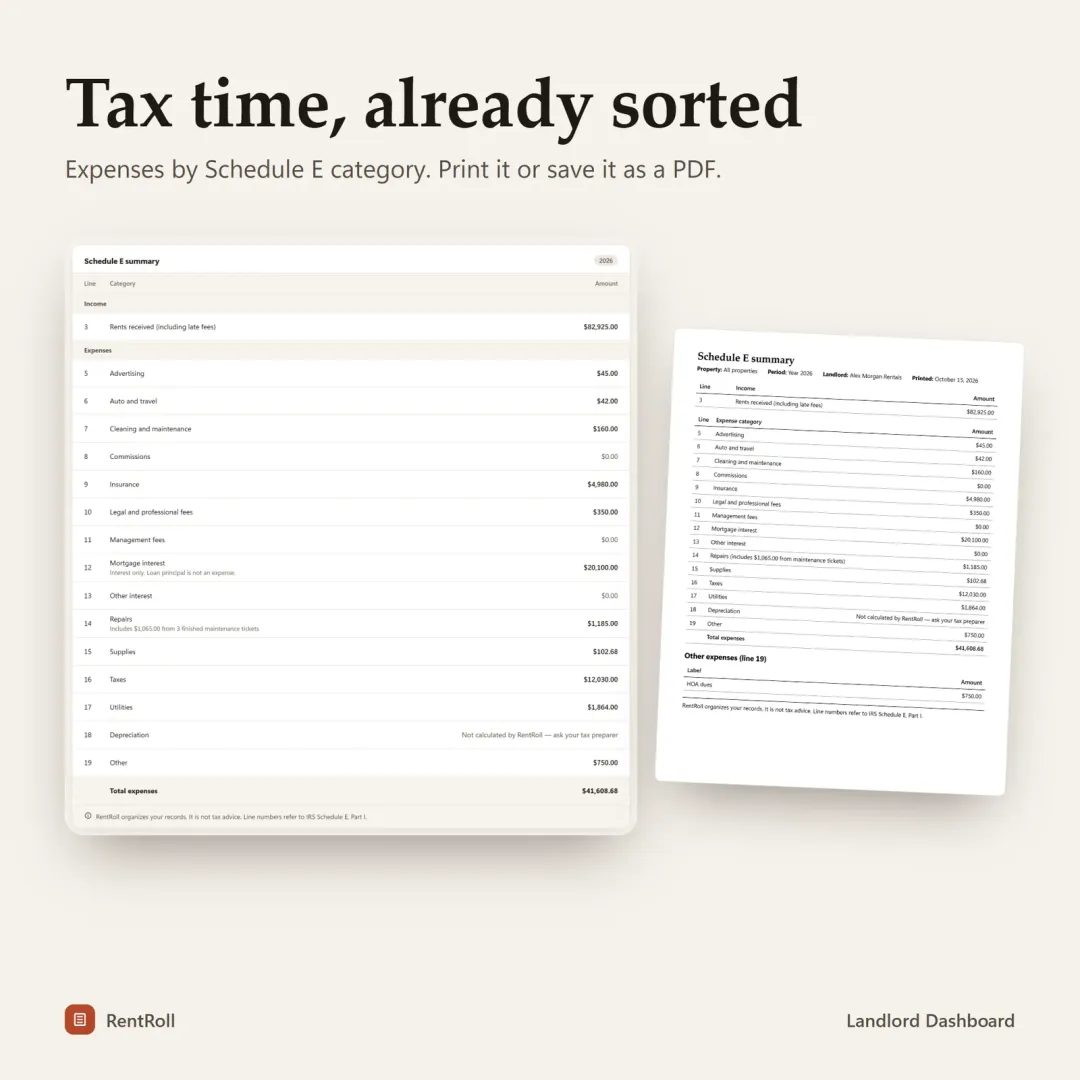
RentRoll is a landlord dashboard that tracks property tax, insurance and repairs against rent for each property and produces a Schedule E-style summary. Vault keeps a homeowner's escrow, bills and budget in one place, and Summit shows your home's value and equity in your net worth. Each has a free demo with sample data.
Renting? Property tax still matters
Renters don't get a tax bill, but landlords build property tax into rent, so high-tax areas usually have higher rents. If you're deciding whether to buy, the rent vs buy calculator includes property tax in the cost of owning, and our guide on whether to rent or buy a house walks through the decision.
The short version
- Property tax = (assessed value − exemptions) × rate.
- Rates are set locally, so the same home can pay $1,000 or $7,800 a year.
- 1 mill = $1 per $1,000 of assessed value.
- Taxes are usually paid through escrow in your mortgage payment, and often rise after you buy.
- Claim exemptions, check your assessment and appeal if it's too high.
- Estimate your bill in the property tax calculator.
General information; your county assessor and tax collector set the actual values, rates and deadlines.
Frequently asked questions
How is property tax calculated?
What is a mill rate?
Why did my property tax go up when I didn't change anything?
Do property taxes go up when you buy a house?
What is a homestead exemption?
Are property taxes deductible?
How do I appeal my property tax assessment?
Written by
Finance Specialist & Editor, VaultlyApps
Emma Whitfield writes and edits the VaultlyApps money guides and free calculators. Her focus is US household finance — budgeting on a real paycheck, paying down credit card and student debt, emergency funds and savings goals, renting — and the money side of freelancing and small-business income, from pricing and profit margins to self-employment tax. Every guide is researched against primary sources such as IRS publications and the CFPB, every number is checked in our tested calculators, and tax content is reviewed each year when new IRS figures come out. Emma is not a licensed financial adviser or tax preparer; her work is general education, not personal advice.
Researched against primary US sources, checked with our calculators and reviewed by a finance expert on our team. Written for US readers — general education, not financial, tax or legal advice. Editorial policy · Disclaimer