Every unit at a glance
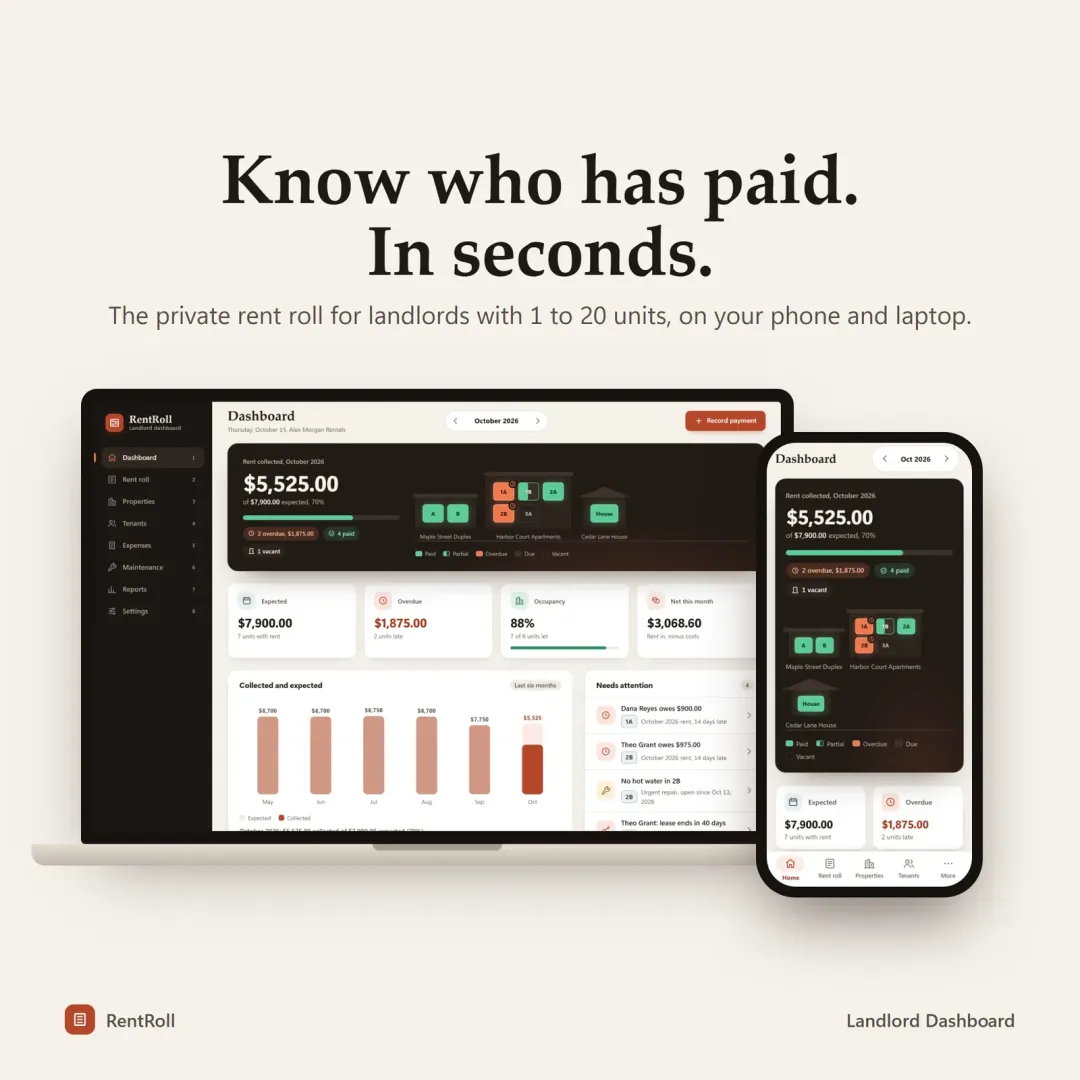
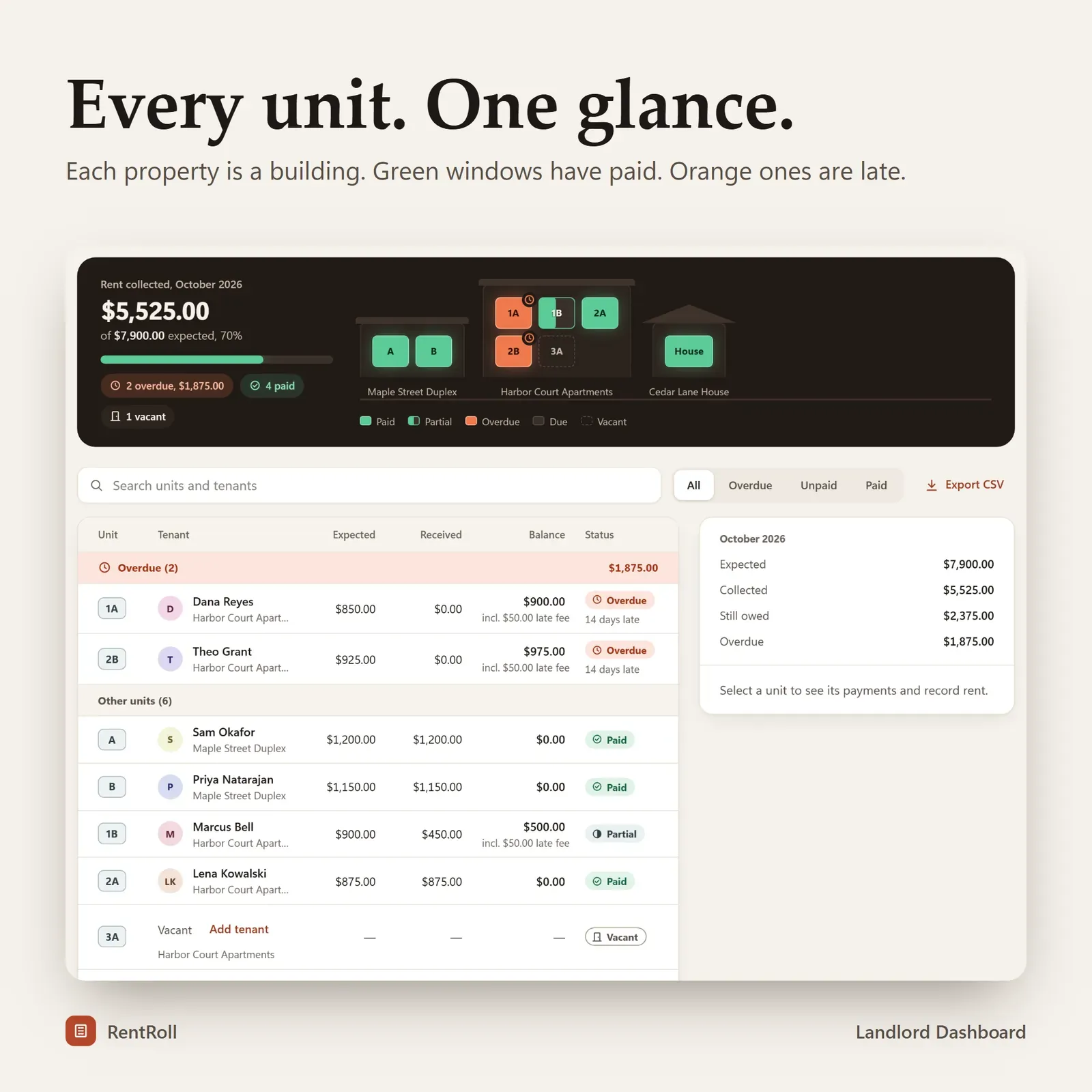
RentRoll draws each property as a building and each unit as a window. When rent is paid, the window lights up; overdue units stand out in orange. Underneath, the collection dashboard shows rent expected, collected and overdue, occupancy and net income for the month, plus a collected-vs-expected chart and your collection rate.
A "Needs attention" list brings together late rent, leases ending soon and urgent repairs, so the first screen tells you what to do today.
The rent roll
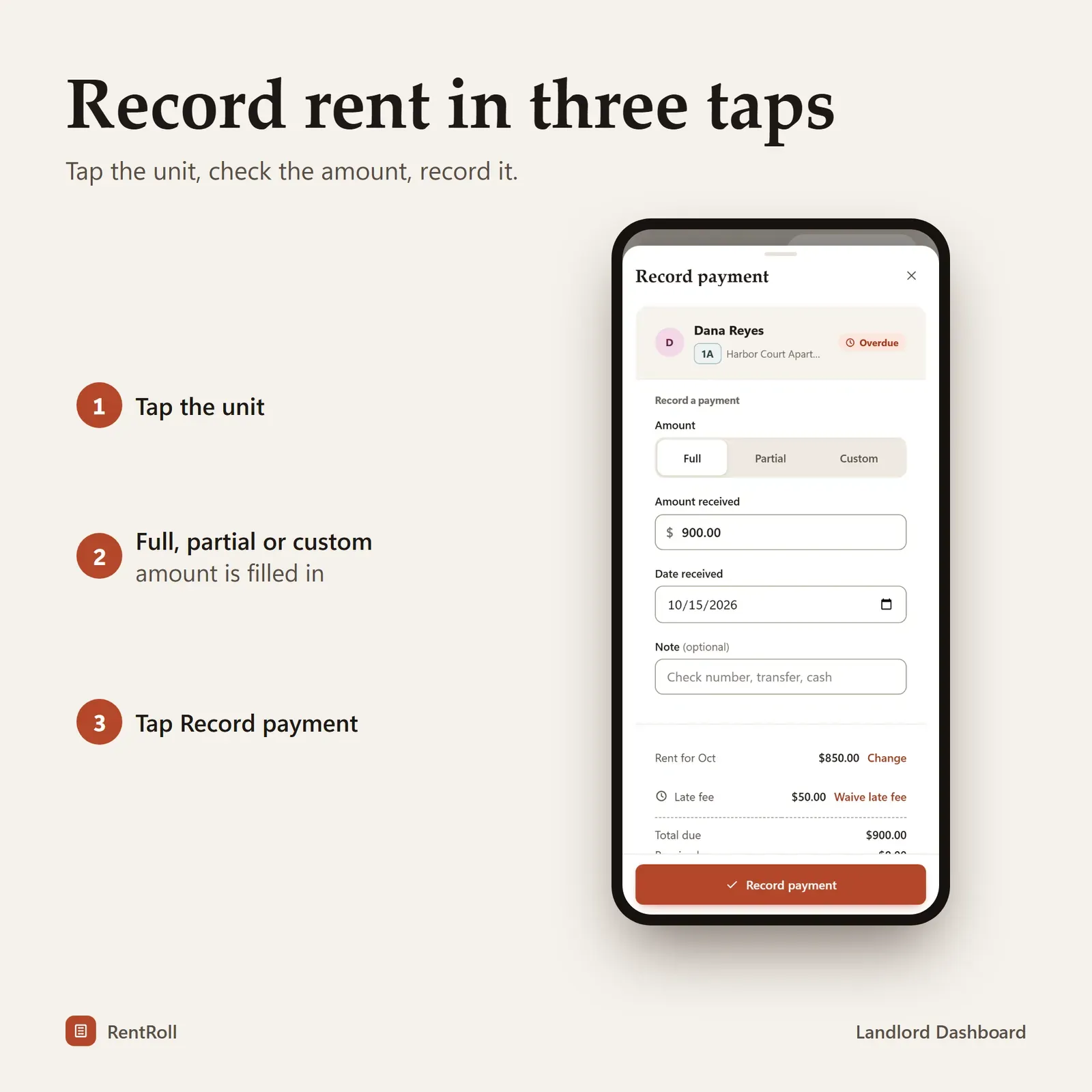
The rent roll is one row per unit: tenant, expected rent, received, balance and status — paid, partial, late or vacant. Recording a payment takes three taps: full, partial or a custom amount, with several payments per month if a tenant pays in instalments.
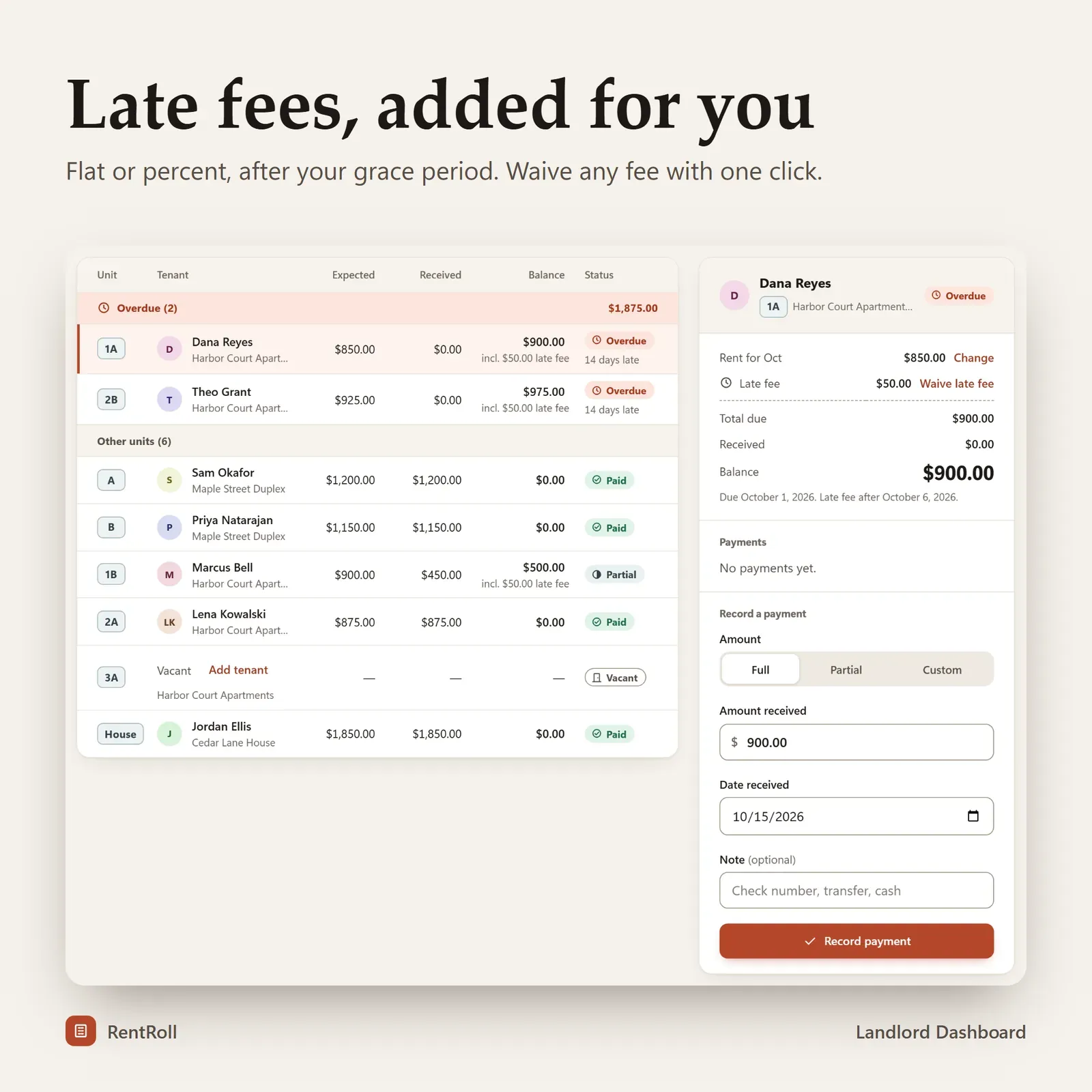
Late fees can be a flat amount or a percentage of rent, applied automatically after the grace period you set. Each fee is assessed once and never rewritten behind your back, and you can waive any fee with one click.
Tenants and leases
Tenants, contact details, deposits and lease dates live in one directory. Lease countdowns turn amber at 60 days, giving you time to renew, re-let or raise the rent. A move-out flow handles deposit returns and deductions so the record is complete when a tenant leaves.
Expenses and maintenance
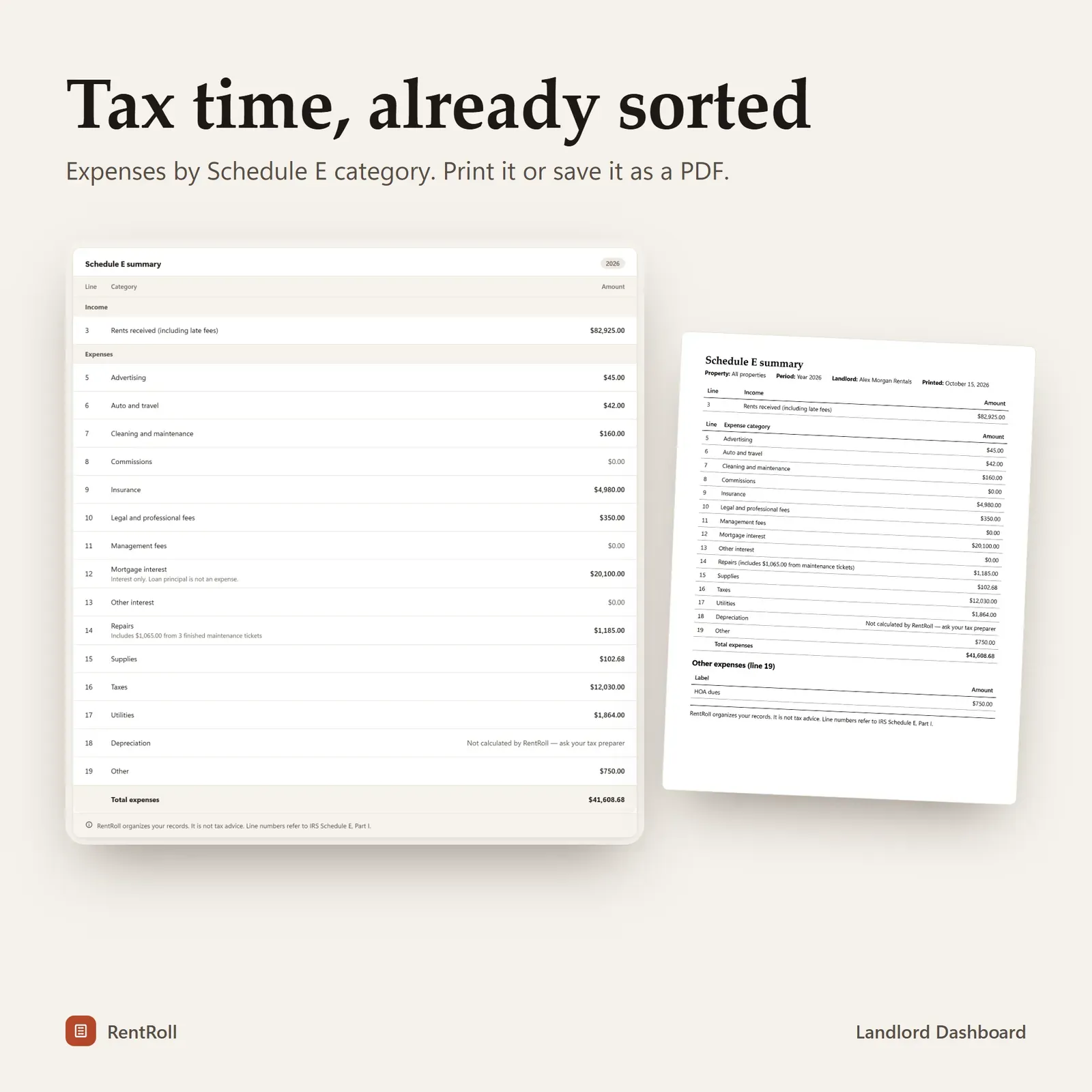
Rental expenses are categorized using real Schedule E categories from the start, with per-property totals. Monthly repeating bills are added automatically, and you can import expenses from a CSV file.
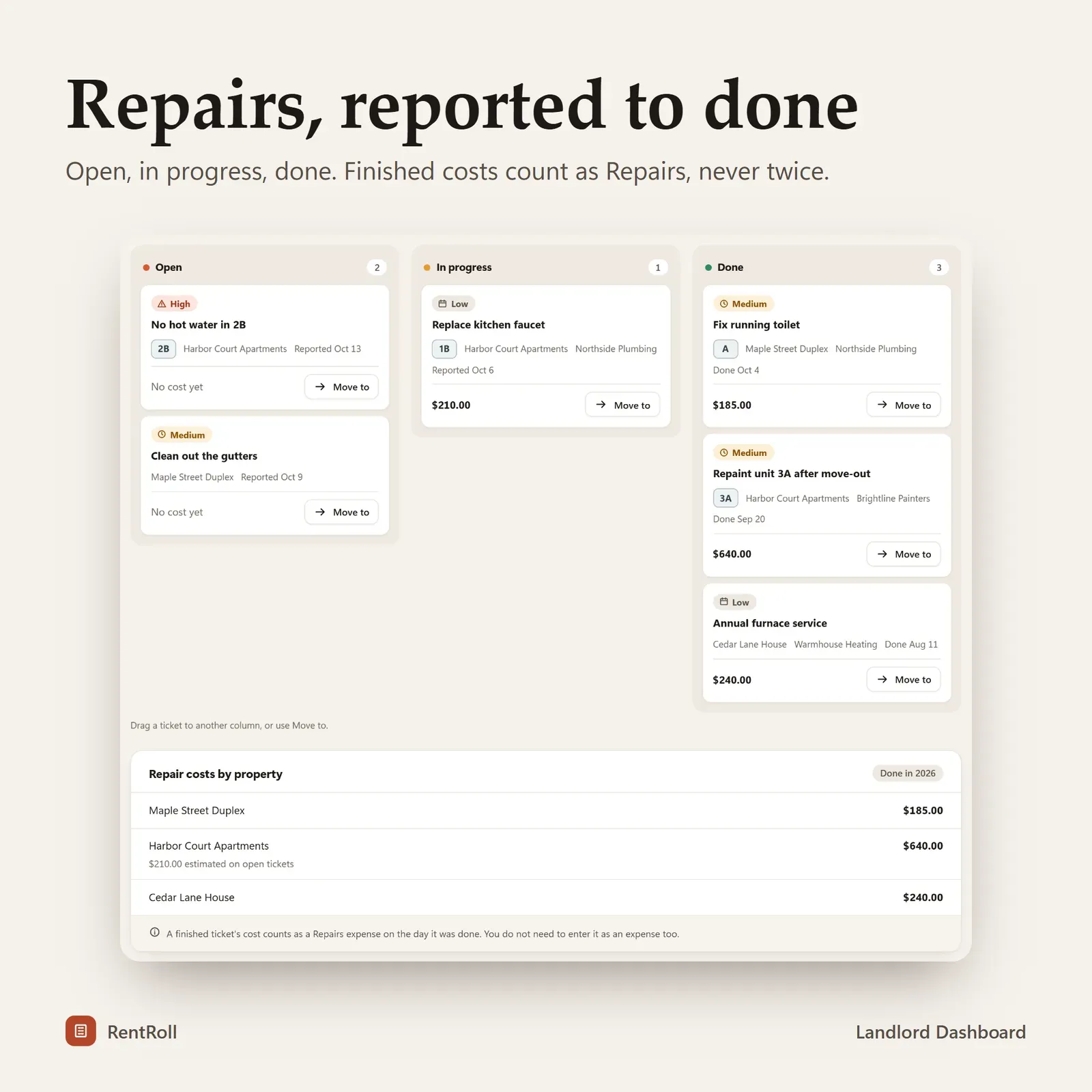
The maintenance log is a board — Open, In progress, Done — with priority, cost and vendor for each job. When a repair is finished, its cost counts toward your expenses automatically, so nothing is entered twice.
Records that are ready for tax time
At the end of the year you can print a profit-and-loss report per property (by month or year to date), a rent roll and a Schedule E summary with the IRS line numbers — or export the rent ledger, expenses and tenants as CSV for your preparer. For landlords outside the US there's an annual expense summary by category.
RentRoll organizes your records; it isn't tax or legal advice. Your preparer still makes the final decisions.
Who RentRoll is for
RentRoll is designed for small landlords with roughly 1 to 20 units — a duplex, a few single-family rentals, a small building — who have outgrown a spreadsheet but don't need an enterprise property-management platform with tenant portals and online payments. It's also useful for accidental landlords renting out one former home, and for anyone who manages a few units for family.
Choosing software for a small rental business? Our checklist for choosing business software uses RentRoll as a worked example of fit over features.
A typical month with RentRoll
- The 1st: the rent roll shows every unit as due. As payments arrive, record them — full or partial — and the windows light up.
- After the grace period: late fees are applied automatically to unpaid units; waive any that don't make sense.
- During the month: add repairs to the maintenance board and move them to Done when finished.
- Month-end: check net income per property and the collection rate.
- Year-end: print the Schedule E summary and P&L, or export CSVs for your preparer.
Spreadsheet or RentRoll?
Many small landlords start with a spreadsheet, and it works — until it doesn't. The usual breaking points are partial payments, late fees, a second property and tax time. RentRoll is built for exactly those moments:
| Task |
Typical spreadsheet |
RentRoll |
| Partial and multiple payments |
Extra columns and notes |
Built in, with the balance owed |
| Late fees |
Calculated by hand |
Automatic after your grace period |
| Lease end dates |
Easy to miss |
Countdowns that turn amber at 60 days |
| Repairs |
A separate list |
Maintenance board feeding expenses |
| Year-end |
Re-sorting expenses |
Schedule E summary with line numbers |
| Phone at the door |
Awkward |
Record rent in three taps |
If your spreadsheet already does all of this comfortably, keep it. If it's starting to fight you, the free demo shows the difference in a few minutes.
Privacy and devices
RentRoll has no account and no bank connection. It records rent you receive; it doesn't collect rent online. Tenant details and finances stay on your own devices. Link your phone and laptop once with a 6-digit code or QR, and rent recorded on your phone at the door appears on your laptop a moment later — encrypted on the device before it travels.
RentRoll installs from your private link on iPhone, iPad, Android, Mac, Windows and Chromebook and works offline once installed. It has Brick, Light and Dark themes, supports USD, CAD, GBP, EUR and AUD, and includes keyboard shortcuts and backup and restore.
What you get
- Your private RentRoll link and QR code.
- A 21-page PDF guide: Start Here, How to Open & Install, How RentRoll Works and the license.
- Bonus printables: rent receipts, a move-in / move-out checklist, tenant and property info sheets, a mileage log, 7 landlord worksheets and 5 wallpapers.
- Free updates for the app itself.
Getting started
- Open your private link from the Start Here page and install RentRoll.
- Explore the sample portfolio — 3 properties and 8 units — with the guided tour.
- Clear the samples and add your first property, its units and tenants.
- Record this month's rent; the dashboard does the rest.
Running a small business alongside your rentals? Till tracks income, invoices, tax set-asides and mileage. For household bills and subscriptions, see Pulse.
Good to know
RentRoll is for organizing records. It is not tax or legal advice — always check with your tax preparer. It is licensed for your own rental business.