
How to Become a Landlord: A Step-by-Step Guide for Your First Rental (2026)
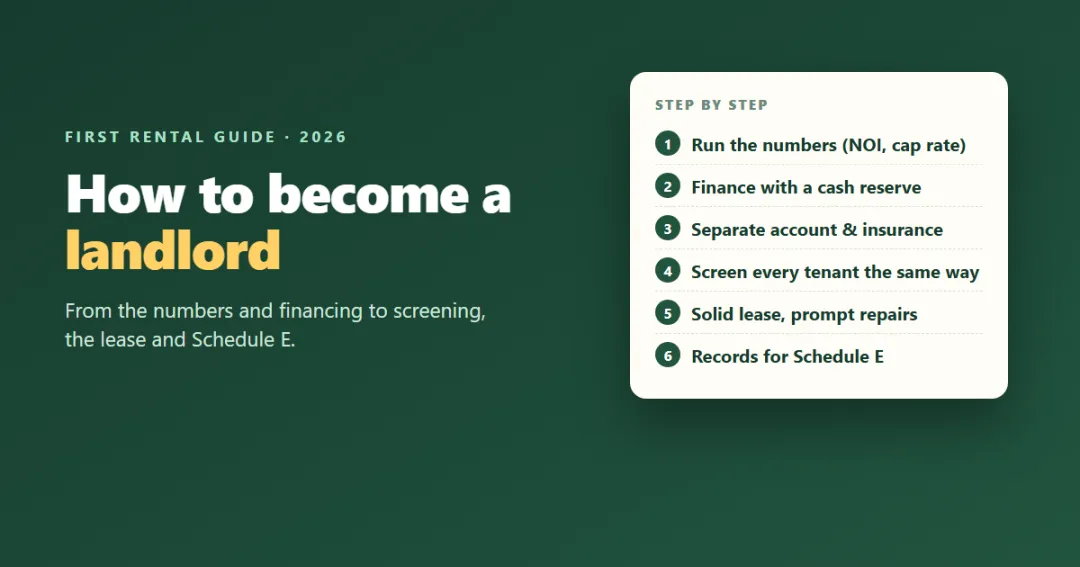
Becoming a landlord starts long before the first tenant: running the numbers, financing, setting up the business side, screening, leases and keeping records for taxes. Here's a step-by-step guide for your first rental property, with the key formulas, a worked example and the mistakes new landlords make most.
In this article
- Step 1: Decide if being a landlord fits you
- Step 2: Learn the key numbers
- A worked example
- Step 3: Pick the right property
- Step 4: Finance it
- Step 5: Set up the business side
- Step 6: Prepare and price the unit
- Step 7: Find and screen tenants
- Step 8: Sign a solid lease
- Step 9: Manage it well
- Step 10: Keep records for taxes
- Mistakes new landlords make
- Run it like a business
- The short version
Owning a rental property is one of the oldest ways to build wealth: tenants help pay down your loan, rent can rise over time, and the property may appreciate. It's also a real business with real responsibilities. The landlords who do well treat it that way from day one.
This guide walks through becoming a landlord step by step: deciding if it's right for you, running the numbers, financing, setting up the business, finding and screening tenants, leases, and keeping records for taxes. Along the way you'll find the free calculators that do the math.
Step 1: Decide if being a landlord fits you
Before looking at listings, be honest about:
- Time: repairs, showings, tenant questions, paperwork. Self-managing a single-family rental can take a few hours a month, more during turnovers.
- Money: you need a down payment, closing costs and a reserve for repairs and vacancies.
- Temperament: late payments, 10 pm plumbing calls and difficult conversations come with the job.
- Alternatives: a property manager (often 8–10% of rent) saves time but cuts cash flow.
Step 2: Learn the key numbers
Three formulas tell you whether a rental is a good deal.
Net operating income (NOI) = rent − vacancy − operating expenses (property tax, insurance, maintenance, management, HOA, utilities you pay). It excludes the mortgage.
Cap rate = NOI ÷ price. It compares properties as if bought for cash. Use the cap rate calculator.
Cash flow = rent − all expenses − mortgage payment. This is what actually lands in your account each month. The rental property calculator shows cash flow and cash-on-cash return with your loan.
A worked example
A $300,000 single-family home rents for $2,200 a month.
- Gross rent: $26,400 a year
- Vacancy (5%): − $1,320
- Property tax $3,600, insurance $1,500, maintenance $2,400, management 8%: about − $9,500
- NOI ≈ $15,600, a cap rate of about 5.2%
With a mortgage, your cash flow depends on the rate and down payment. At today's rates many properties barely break even with 20–25% down, so be realistic: a deal that only works with perfect tenants and no repairs isn't a deal.
Step 3: Pick the right property
- Location: jobs, schools, transit and low vacancy matter more than granite countertops.
- Condition: older homes can mean big repair bills; get an inspection.
- Property tax: it often rises after a sale because of reassessment. Estimate it with the property tax calculator and read our guide to how property taxes work.
- Rents: check comparable rentals nearby, not the seller's optimistic figure.
- Rules: HOA rental restrictions, local rental licensing, rent control and short-term rental bans.
A common screening rule is the 1% rule: monthly rent around 1% of the price. It's hard to find in many markets today, but it's a quick sanity check.
Step 4: Finance it
- Investment property loans typically need 15–25% down and have slightly higher rates than a home you live in.
- House hacking: buying a duplex, triplex or fourplex and living in one unit can let you use owner-occupied financing with a smaller down payment.
- Cash reserves: lenders often require months of payments in reserve, and you should want them anyway.
- Closing costs: budget 2–5%; see the closing costs calculator.
Not sure buying makes sense at all? The rent vs buy calculator and our guide on whether to rent or buy a house cover the decision for your own home.
Step 5: Set up the business side
- Separate bank account for rent and expenses: it makes taxes and bookkeeping far easier.
- Landlord insurance (not a homeowners policy) and consider an umbrella policy.
- Entity: many small landlords start in their own name; an LLC may add liability separation. Ask a local attorney.
- Rental license or registration if your city requires one.
- A record system for rent, expenses, repairs and leases from day one.
Step 6: Prepare and price the unit
Make it safe, clean and working: smoke and CO detectors, locks, appliances, no hazards. Price it by comparing similar rentals nearby; pricing slightly under market often fills a unit faster, and every vacant month costs about 8% of a year's rent.
Step 7: Find and screen tenants
- Advertise with good photos and the key facts: rent, deposit, pets, utilities, move-in date.
- Use a written application and the same criteria for everyone: income (often about 3× rent), credit, rental history, references and, where legal, background checks.
- Follow fair housing laws: you can't refuse or treat tenants differently based on race, color, religion, national origin, sex, familial status, disability or other protected classes under state and local law.
Step 8: Sign a solid lease
Use a lease that complies with your state's landlord-tenant law. It should cover rent and due date, late fees and grace period, security deposit, who pays which utilities, maintenance responsibilities, pets, entry notice and how partial months are handled. For move-in in the middle of a month, the prorated rent calculator works out the first payment.
Step 9: Manage it well
- Collect rent on time, every time, with clear late-fee rules.
- Fix things fast: good tenants stay when problems are handled quickly.
- Inspect at move-in and move-out with photos.
- Raise rent sensibly at renewal, within local rules.
- Keep a reserve for big repairs: roofs, HVAC, water heaters.
Step 10: Keep records for taxes
Rental income and expenses go on Schedule E. Deductible expenses include mortgage interest, property tax, insurance, repairs, management, travel to the property and depreciation: residential buildings (not land) are depreciated over 27.5 years. Keep every receipt and a running ledger; a tax professional who knows real estate is worth the fee in the first year.
Mistakes new landlords make
- Underestimating expenses: forgetting vacancy, capital repairs and management.
- Skipping screening because a tenant seems nice.
- Mixing personal and rental money.
- No written lease or a lease that doesn't follow state law.
- Buying with no reserve, so one repair becomes a crisis.
- Ignoring local rules on licensing, deposits, notices and evictions.
Run it like a business
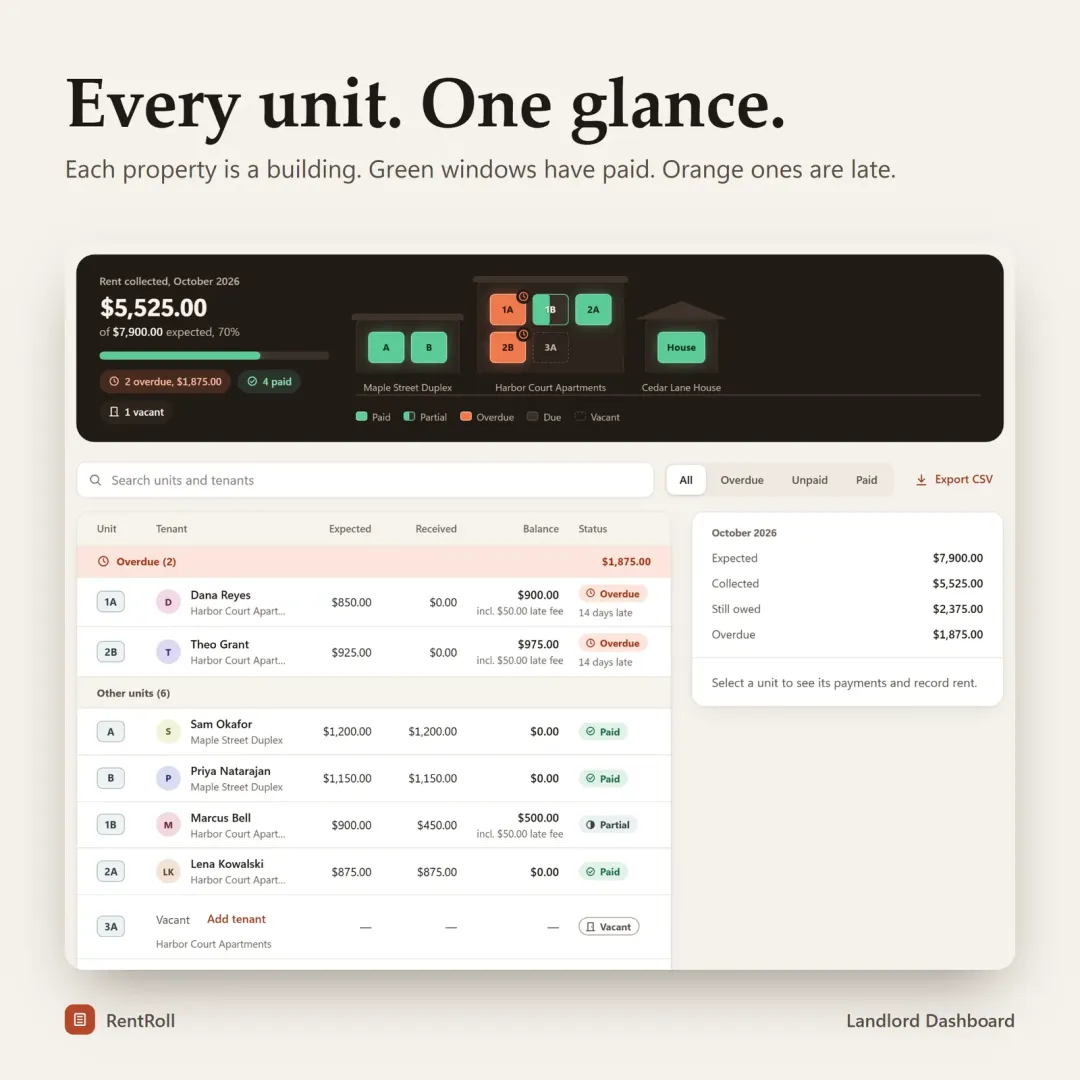
RentRoll is a landlord dashboard built for small landlords: a rent roll with one row per unit, full and partial rent payments, automatic late fees after a grace period, a maintenance board and a Schedule E-style tax summary. Summit shows your rental's equity in your overall net worth. Both have a free demo with sample data you can open in your browser.
The short version
- Decide whether you have the time, money and temperament.
- Learn NOI, cap rate and cash flow and run conservative numbers.
- Pick the location and property, and check taxes and local rules.
- Finance with a realistic down payment and a cash reserve.
- Set up a separate account, insurance and records.
- Screen consistently, sign a compliant lease and manage promptly.
- Track everything for Schedule E.
Start with the numbers in the cap rate calculator.
General information, not legal or tax advice. Landlord-tenant law varies by state and city.
Frequently asked questions
How much money do I need to become a landlord?
Is being a landlord worth it?
What is a good cap rate for a rental property?
Do I need an LLC to be a landlord?
How do I screen tenants?
How are rental properties taxed?
Written by
Finance Specialist & Editor, VaultlyApps
Emma Whitfield writes and edits the VaultlyApps money guides and free calculators. Her focus is US household finance — budgeting on a real paycheck, paying down credit card and student debt, emergency funds and savings goals, renting — and the money side of freelancing and small-business income, from pricing and profit margins to self-employment tax. Every guide is researched against primary sources such as IRS publications and the CFPB, every number is checked in our tested calculators, and tax content is reviewed each year when new IRS figures come out. Emma is not a licensed financial adviser or tax preparer; her work is general education, not personal advice.
Researched against primary US sources, checked with our calculators and reviewed by a finance expert on our team. Written for US readers — general education, not financial, tax or legal advice. Editorial policy · Disclaimer