Quarterly Estimated Taxes 2026: How Much to Pay, When, and How to Avoid Penalties
Freelancers, sellers and side hustlers have to pay tax during the year, not just in April. Here's how quarterly estimated taxes work in 2026 — who must pay, how to work out the amount, the four due dates, the safe-harbor rules that prevent penalties, and a simple system so the money is always ready.
In this article
- Who has to pay estimated taxes?
- The 2026 due dates
- What you're paying: two federal taxes
- How much to pay: worked examples (2026, single)
- Have a W-2 job as well?
- The safe-harbor rules: how to avoid penalties
- What if your income is uneven?
- How to pay
- Reduce what you owe, legally
- A system so the money is always ready
- The short version
When you work for an employer, tax comes out of every paycheck and you barely think about it. The moment you earn money on your own, as a freelancer, an Etsy or eBay seller, a contractor or a side hustler, nobody withholds anything. The IRS still expects to be paid as you go, which is where quarterly estimated taxes come in.
This guide explains how estimated taxes work in 2026: who has to pay, how to work out the amount, the four due dates, the safe-harbor rules that keep you clear of penalties, and a simple system so the money is always there when it's due. For your own numbers, use the free 1099 tax calculator.
Who has to pay estimated taxes?
You generally need to make estimated payments if you expect to owe $1,000 or more in federal tax for 2026 after withholding and refundable credits. That usually includes:
- freelancers and independent contractors paid on a 1099,
- online sellers on Etsy, eBay, Poshmark and similar platforms,
- small business owners who are sole proprietors, single-member LLCs or partners,
- landlords and people with large investment income,
- anyone with a side business on top of a W-2 job, unless extra withholding covers it.
The 2026 due dates
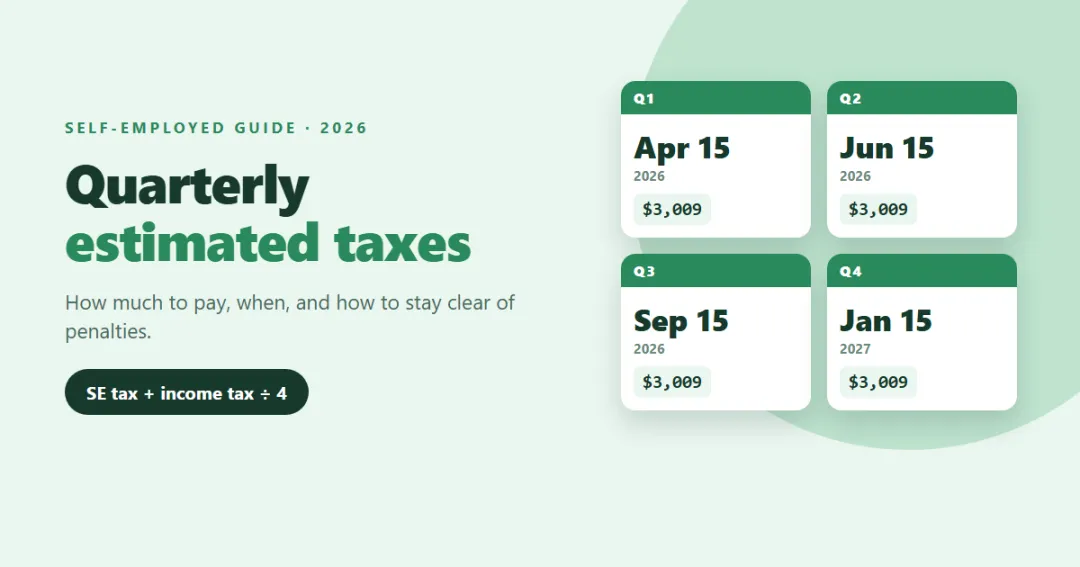
| Payment | Income earned | Due date |
|---|---|---|
| Q1 | January 1 – March 31 | April 15, 2026 |
| Q2 | April 1 – May 31 | June 15, 2026 |
| Q3 | June 1 – August 31 | September 15, 2026 |
| Q4 | September 1 – December 31 | January 15, 2027 |
The "quarters" aren't equal: the second covers only two months and the fourth covers four. Put the dates in your calendar now, with a reminder a week before each one. Most states with an income tax have their own estimated payments on similar dates.
What you're paying: two federal taxes
Self-employment tax. As an employee, your employer pays half of Social Security and Medicare. As a self-employed person, you pay both halves: 15.3% (12.4% Social Security up to the 2026 wage base of $184,500, plus 2.9% Medicare) on 92.35% of your net profit. Half of it is deductible.
Income tax. Your profit (plus any wages) minus half of SE tax, the standard deduction and, for many sole proprietors, the 20% qualified business income (QBI) deduction, taxed at the normal brackets.
Then add state income tax if your state has one.
How much to pay: worked examples (2026, single)
| Profit | SE tax | Income tax | Federal total | Each quarter |
|---|---|---|---|---|
| $30,000 | $4,239 | $942 | $5,181 | $1,295 |
| $40,000 | $5,652 | $1,775 | $7,427 | $1,857 |
| $60,000 | $8,478 | $3,559 | $12,037 | $3,009 |
| $80,000 | $11,304 | $5,344 | $16,647 | $4,162 |
| $100,000 | $14,130 | $8,235 | $22,365 | $5,591 |
These assume no other income, the standard deduction and the QBI deduction. Notice that self-employment tax is the bigger part for most people at these incomes; it's the tax new freelancers forget.
With a 5% state tax, add roughly another $1,860 at $40,000 of profit or $3,720 at $80,000.
Have a W-2 job as well?
If you have a paycheck and 1099 income, your W-2 wages fill the lower brackets first, so your side income is taxed at a higher rate. Example: $60,000 of wages with $6,000 withheld, plus $30,000 of side profit. Total federal tax is about $13,500, leaving about $7,500 to cover: roughly $1,880 a quarter.
You have two choices:
- make quarterly estimated payments, or
- raise your W-4 withholding at your job to cover it. Withholding counts as if it were paid evenly through the year, so it can even fix a shortfall late in the year.
The safe-harbor rules: how to avoid penalties
You won't owe an underpayment penalty if your withholding plus estimated payments, paid on time, cover at least the smaller of:
- 90% of this year's tax, or
- 100% of last year's total tax, or 110% if last year's adjusted gross income was over $150,000 ($75,000 if married filing separately).
The "last year" rule is the easiest to use when your income is growing. Say you owed $9,000 in total federal tax last year and expect to owe $16,600 this year. Paying $2,250 a quarter (100% of last year) keeps you penalty-free, even though you'll owe the rest in April. Just make sure you've set that difference aside.
Enter last year's tax in the 1099 tax calculator to see your safe-harbor minimum next to the full estimate.
What if your income is uneven?
Sellers and freelancers rarely earn the same every month. A holiday-heavy Etsy shop might make 40% of its year in Q4. You have two options:
- Pay equal amounts based on your yearly estimate, the simplest route.
- Annualize using Form 2210's annualized income method, paying less in slow quarters and more after busy ones. It takes more work but avoids paying tax on income you haven't earned yet.
Either way, revisit your estimate each quarter and adjust if the year is going much better or worse than planned.
How to pay
- IRS Direct Pay: free, from your bank account, no sign-up.
- Your IRS online account: see past payments and schedule new ones.
- EFTPS: free; good for scheduling a whole year ahead.
- Card: through IRS-approved processors, for a fee.
- Check: with a Form 1040-ES payment voucher.
Choose "estimated tax" and the right tax year (2026) when you pay. Keep the confirmations; you'll need the total when you file.
Reduce what you owe, legally
The less profit you report, the less you pay, so track every business expense:
- marketplace and payment fees (see our guides to eBay fees and Etsy fees),
- supplies, packaging, shipping labels and cost of goods,
- software, a share of your phone and internet,
- business mileage,
- a home office used only for work.
Bigger levers: a SEP-IRA or solo 401(k) can shelter a large slice of profit, and self-employed health insurance premiums are deductible. Our guide on how to calculate reseller profit shows how sellers should track costs.
A system so the money is always ready
The real problem with estimated taxes isn't the math; it's having spent the money by the time the due date arrives. A simple fix:
- Open a separate savings account just for tax.
- Move a fixed percentage of every payment into it the day it arrives. Your 1099 tax calculator "set aside monthly" figure, divided by income, gives your percentage; 25–30% is common.
- Pay each quarter from that account, and leave anything left over for April.
- Review the percentage each quarter as your income changes.
Our guide on how to pay yourself as a small business owner builds the same idea into a full pay plan.
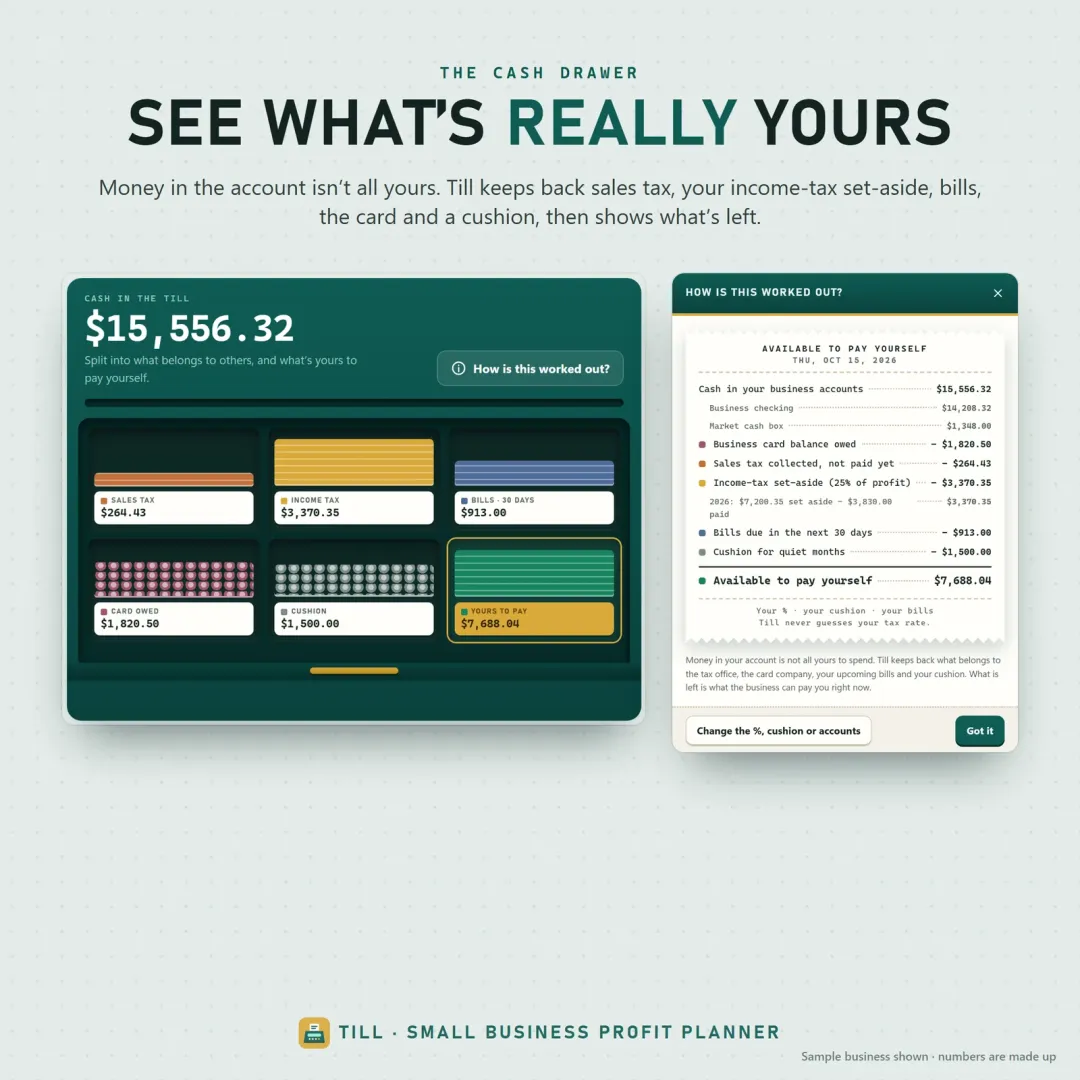
Till is a small business profit planner that splits every sale into costs, a tax set-aside and your share, so the quarterly payment is already waiting when it's due. Flip tracks resellers' profit item by item across platforms. Both have a free demo with sample data you can open in your browser.
The short version
- If you'll owe $1,000+, pay estimated tax four times a year.
- 2026 due dates: April 15, June 15, September 15, 2026 and January 15, 2027.
- You pay self-employment tax (about 15.3%) plus income tax, plus state tax.
- Stay penalty-free with 90% of this year or 100% (110%) of last year's tax.
- Set aside a percentage of every payment in a separate account.
- Work out your numbers in the 1099 tax calculator.
General information using 2026 federal figures, not tax advice. A tax professional can help with your specific situation.
Frequently asked questions
Who has to pay quarterly estimated taxes?
When are estimated taxes due in 2026?
How do I calculate my quarterly estimated tax?
What happens if I don't pay estimated taxes?
What is the safe harbor rule?
Can I pay all my estimated tax at once?
How do I pay estimated taxes to the IRS?
Written by
Finance Specialist & Editor, VaultlyApps
Emma Whitfield writes and edits the VaultlyApps money guides and free calculators. Her focus is US household finance — budgeting on a real paycheck, paying down credit card and student debt, emergency funds and savings goals, renting — and the money side of freelancing and small-business income, from pricing and profit margins to self-employment tax. Every guide is researched against primary sources such as IRS publications and the CFPB, every number is checked in our tested calculators, and tax content is reviewed each year when new IRS figures come out. Emma is not a licensed financial adviser or tax preparer; her work is general education, not personal advice.
Researched against primary US sources, checked with our calculators and reviewed by a finance expert on our team. Written for US readers — general education, not financial, tax or legal advice. Editorial policy · Disclaimer