How to use the self-employment tax calculator
- Enter your net self-employment profit for the year — business income minus business expenses (Schedule C line 31 for sole proprietors).
- If you also have a job, enter your W-2 wages. They count toward the Social Security cap.
- Choose your filing status, your estimated federal income tax bracket and your state tax rate.
- Read your self-employment tax, total to set aside, quarterly estimate and monthly set-aside.
Save, print or share your tax set-aside plan
You don't have to start over next time. Under the calculator you can:
- Save the calculation in your browser with a name, then reopen it from "Saved calculations" whenever you like.
- Copy a link that reopens this exact calculation with all your numbers — on your phone, another computer or for someone you're planning with.
- Print a clean one-page report, or download it as a PDF. It shows your self-employment tax, total to set aside, quarterly estimate and a full tax breakdown, plus a QR code at the top: scan it with your phone camera and the calculation opens again with every number filled in.
- Download a CSV to open in Excel, Google Sheets or Numbers.
Nothing is uploaded: saved calculations stay on your device, and the link and QR code carry your inputs inside the address itself.
How self-employment tax works
Employees split Social Security and Medicare with their employer — each pays 7.65%. When you work for yourself, you are both, so you pay the full 15.3%.
- Start with 92.35% of profit. This adjustment mirrors the employer half that employees never see.
- Social Security: 12.4% of that amount, up to the 2026 wage base of $184,500 (minus any W-2 wages).
- Medicare: 2.9% of the full amount, with no cap.
- Additional Medicare: 0.9% above $200,000 (single) or $250,000 (married filing jointly).
Half of the Social Security and Medicare part is deductible when you calculate income tax.
Income tax on top
Self-employment tax is only part of the bill. Your profit is also subject to federal and state income tax. This calculator applies your bracket to profit minus the deductible half of SE tax — a simple, slightly cautious estimate. Real-life deductions like the 20% qualified business income (QBI) deduction, retirement contributions and the standard deduction can lower it.
Quarterly estimated taxes
Because nobody withholds tax from your income, the IRS expects you to pay during the year. The usual due dates are April 15, June 15, September 15 and January 15. Paying too little can lead to an underpayment penalty. The calculator divides your total into four equal payments and also shows a monthly amount to move into a separate tax savings account.
Building tax into your pricing
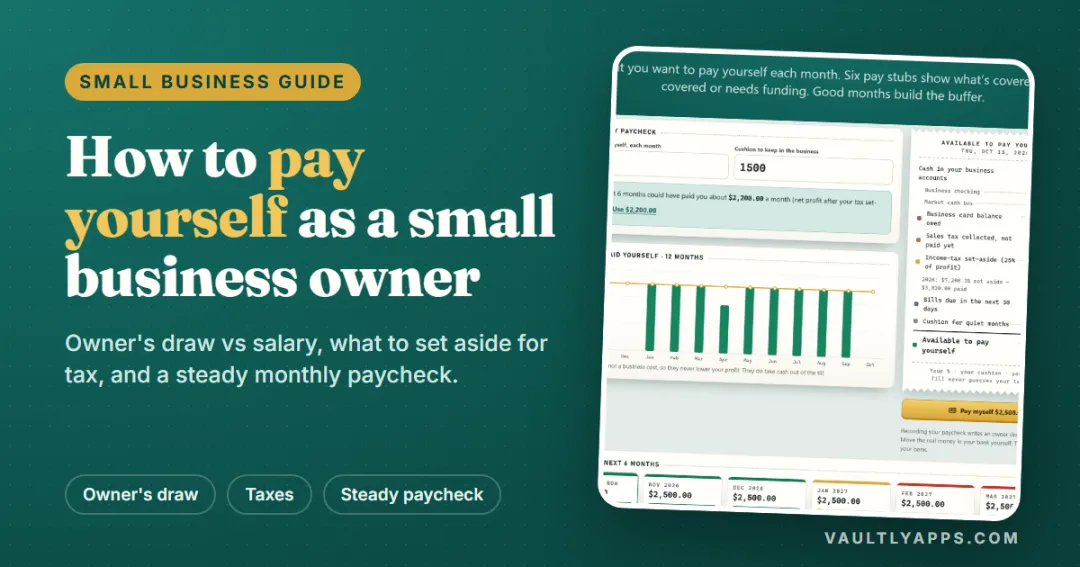
Every sale should cover your costs, your fees, your taxes and your own pay. If the margin is thin, tax time hurts. Check your prices with the profit margin calculator, and read How to Pay Yourself as a Small Business Owner for a simple owner's pay system that puts tax money aside first.
If you're comparing self-employment with a job, the take-home pay calculator shows what the same income looks like as a salary, and the budget calculator helps plan an irregular income.
Set tax aside on every sale
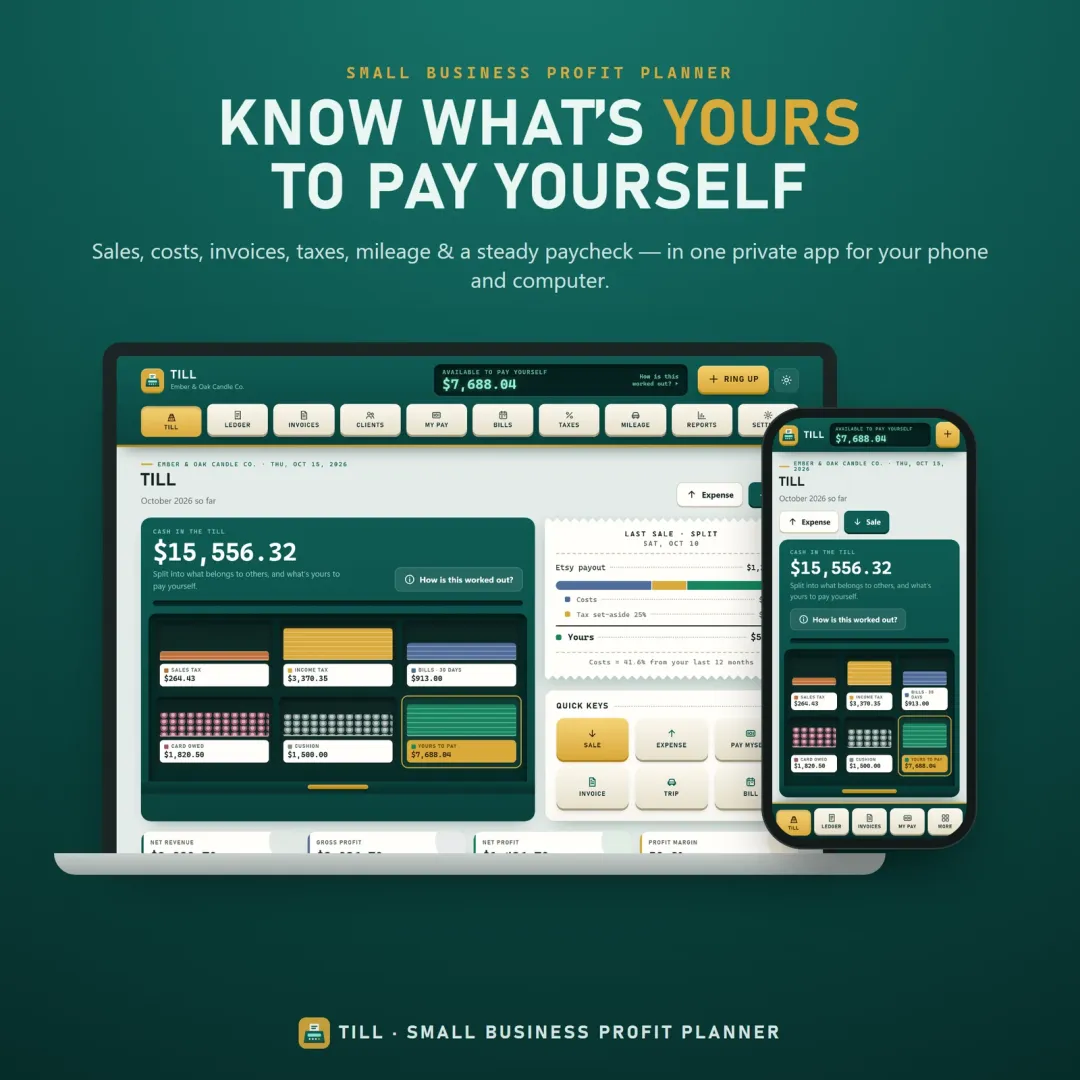
Till, the VaultlyApps small business profit planner, splits each sale into costs, sales tax, an income-tax set-aside and what's yours to pay yourself — so the quarterly bill is already waiting when it's due. Try the free Till demo in your browser.
Frequently asked questions
Can I save, print or download my tax set-aside plan?
How much is self-employment tax in 2026?
How much should I set aside for taxes if I'm self-employed?
Do I have to pay self-employment tax on a small side business?
When are quarterly estimated taxes due?
What is the deductible half of self-employment tax?
Is this a substitute for a tax professional?
Written by
Finance Specialist & Editor, VaultlyApps
Emma Whitfield writes and edits the VaultlyApps money guides and free calculators. Her focus is US household finance — budgeting on a real paycheck, paying down credit card and student debt, emergency funds and savings goals, renting — and the money side of freelancing and small-business income, from pricing and profit margins to self-employment tax. Every guide is researched against primary sources such as IRS publications and the CFPB, every number is checked in our tested calculators, and tax content is reviewed each year when new IRS figures come out. Emma is not a licensed financial adviser or tax preparer; her work is general education, not personal advice.
Researched against primary US sources, checked against independent calculators and reviewed by a finance expert on our team. Written for US readers — general education, not financial, tax or legal advice. Editorial policy · Disclaimer