
How to use the Roth IRA calculator
- Enter your age, the age you plan to retire and your current Roth IRA balance.
- Enter how much you'd like to contribute each year. The calculator caps it at your limit.
- Enter your modified AGI and filing status so it can apply the 2026 income phase-out.
- Choose an annual return and the tax rate you expect in retirement to see the tax a Roth saves.
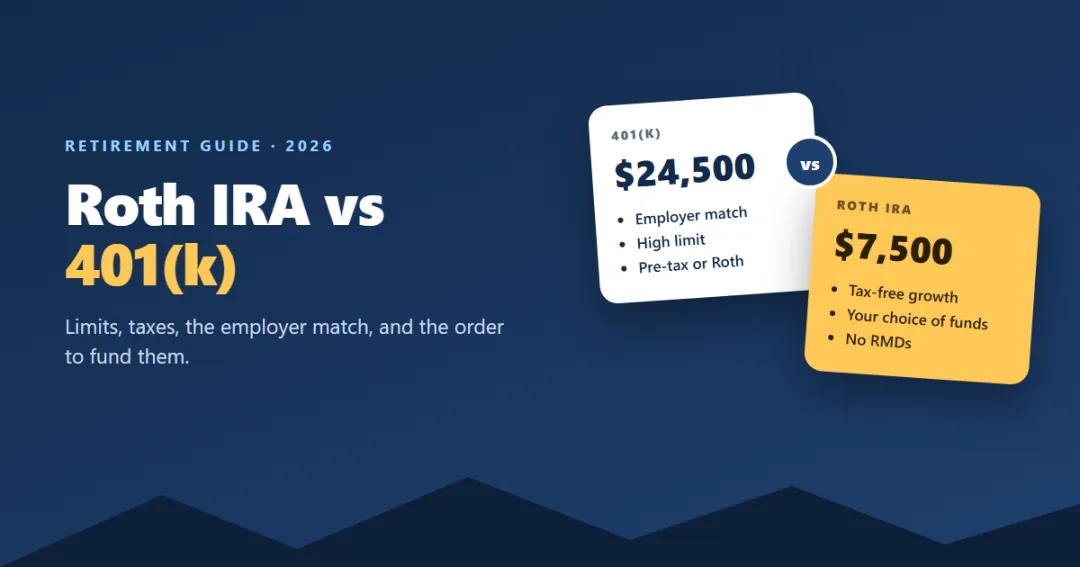
2026 Roth IRA limits
| 2026 | |
|---|---|
| Contribution limit | $7,500 |
| Catch-up, age 50+ | + $1,100 (total $8,600) |
| Full contribution, single / head of household | MAGI under $153,000 |
| Phase-out, single / head of household | $153,000 – $168,000 |
| Full contribution, married filing jointly | MAGI under $242,000 |
| Phase-out, married filing jointly | $242,000 – $252,000 |
Inside the phase-out range, your limit shrinks in proportion to how far into the range your income is, rounded up to the next $10 (and never below $200 until it reaches zero). A single filer with $155,000 of MAGI can still put in $6,500; at $160,000, $4,000. You also need at least as much earned income as you contribute.
Why starting early matters so much
$7,500 a year at 7%, until age 65:
| Start at | You put in | Balance at 65 |
|---|---|---|
| 25 | $300,000 | about $1.60 million |
| 35 | $225,000 | about $758,000 |
| 45 | $150,000 | about $329,000 |
Starting at 25 instead of 35 adds only $75,000 of contributions but more than doubles the result. In a Roth, all of that growth comes out tax-free in retirement.
Roth vs traditional
- Roth IRA: contribute after-tax money, grow tax-free, withdraw tax-free after 59½ (with the five-year rule). No required minimum distributions during your lifetime.
- Traditional IRA: contributions may be deductible now, but every dollar you withdraw is taxed as income later.
If you're early in your career or expect your tax rate to be the same or higher in retirement, the Roth usually wins. The "tax you avoid" figure in the calculator shows the value of tax-free growth at the retirement tax rate you enter.
Roth IRA and your 401(k)
They work well together. A common order:
- Contribute to your 401(k) up to the full employer match: see the 401(k) calculator.
- Max out a Roth IRA for tax-free growth and more investment choices.
- Go back to the 401(k) with any extra.
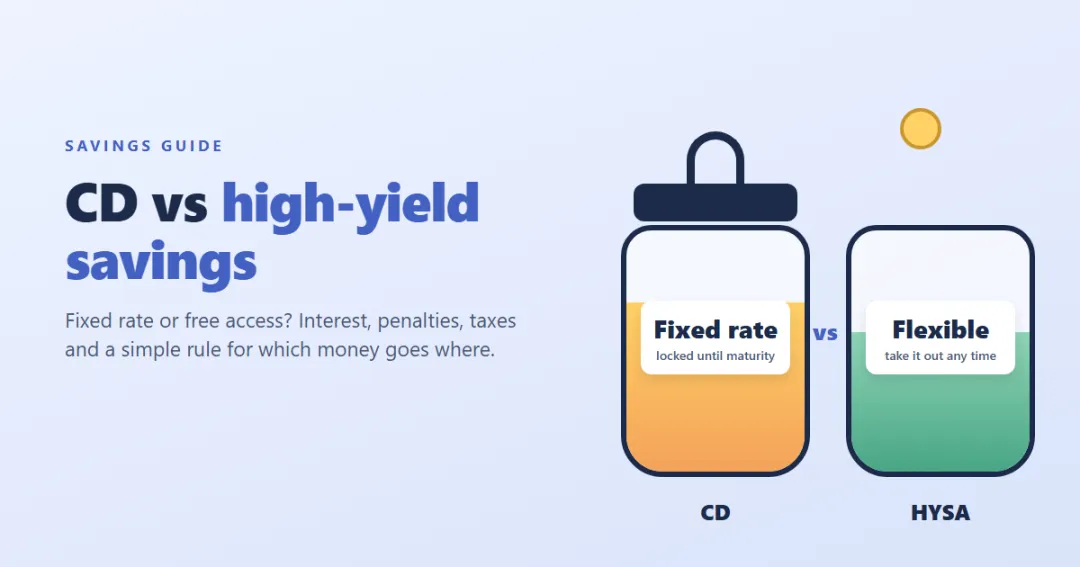
For money you'll need in the next few years, a Roth IRA isn't the right place; a high-yield savings account or CD is. The guide to CD vs high-yield savings explains which money goes where.
Turning the balance into income
To see how long a tax-free balance would last in retirement at different withdrawal rates, use the how long will my money last calculator. For growth with monthly instead of yearly deposits, try the compound interest calculator.
Track it with everything else
Your Roth IRA is one piece of your net worth. Summit is a net worth tracker that keeps your retirement accounts, savings and debts on one screen, with a monthly check-in and a forecast of where you're heading. Nest helps you build the savings goals around it. Both have a free demo with sample data you can open in your browser.
Estimates using 2026 IRS limits, kept at 2026 levels for future years. Returns aren't guaranteed; this isn't tax or investment advice.
Frequently asked questions
How much can I put in a Roth IRA in 2026?
What are the 2026 Roth IRA income limits?
How much will a Roth IRA grow?
Roth IRA or traditional IRA?
Can I take money out of a Roth IRA early?
What if my income is too high for a Roth IRA?
When is the deadline for 2026 contributions?
Written by
Finance Specialist & Editor, VaultlyApps
Emma Whitfield writes and edits the VaultlyApps money guides and free calculators. Her focus is US household finance — budgeting on a real paycheck, paying down credit card and student debt, emergency funds and savings goals, renting — and the money side of freelancing and small-business income, from pricing and profit margins to self-employment tax. Every guide is researched against primary sources such as IRS publications and the CFPB, every number is checked in our tested calculators, and tax content is reviewed each year when new IRS figures come out. Emma is not a licensed financial adviser or tax preparer; her work is general education, not personal advice.
Researched against primary US sources, checked against independent calculators and reviewed by a finance expert on our team. Written for US readers — general education, not financial, tax or legal advice. Editorial policy · Disclaimer