How to Build a Self-Care Routine You'll Actually Keep (60 Ideas + Daily, Weekly and Monthly Checklists)
A self-care routine isn't bubble baths and face masks — it's the small, boring things that keep you well. 60 self-care ideas across six areas, sample daily, weekly and monthly routines, a self-care routine for busy days, and how to make it stick.
In this article
- What a self-care routine really is
- The six types of self-care
- 60 self-care ideas
- Physical self-care
- Emotional self-care
- Mental self-care
- Social self-care
- Practical self-care (life admin and money)
- Environmental self-care
- Sample self-care routines
- A daily self-care routine (about 15 minutes total)
- A weekly self-care routine (self-care Sunday)
- A monthly self-care checklist
- A self-care routine for busy (or hard) days
- How to make a self-care routine stick
- Self-care that doesn't cost money
- Track your self-care with Hoop
- The bottom line
Search "self-care" and you'll see bath bombs, face masks and scented candles. Those are lovely, but they're treats. A real self-care routine is mostly made of small, unglamorous habits: going to bed on time, drinking water, eating a proper lunch, answering the email you've been dreading, paying the bill before it's late. Done regularly, those are what keep you well.
This guide gives you 60 self-care ideas across six areas, sample daily, weekly and monthly self-care routines, a 10-minute version for busy days, and a simple way to make it stick.
What a self-care routine really is
A self-care routine is a short list of habits you do on a schedule to look after yourself. Three things make it work:
- It's regular. Daily and weekly habits do more than an occasional spa day.
- It's small. Five to fifteen minutes at a time, so you can keep it on bad days too.
- It covers more than your body. Your mind, relationships, home and money all affect how you feel.
The six types of self-care
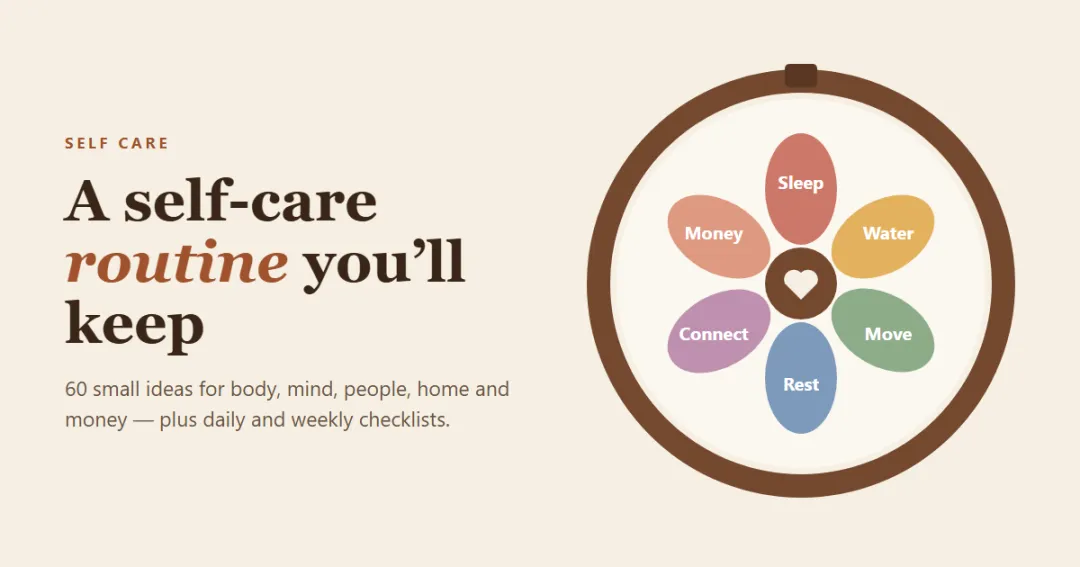
- Physical — sleep, food, water, movement, health appointments.
- Emotional — noticing and naming how you feel, rest, saying no.
- Mental — learning, reading, quiet time, less screen noise.
- Social — time with people who are good for you.
- Practical — bills, budget, meal plans, paperwork — the life admin that causes stress when it piles up.
- Environmental — a tidy space, fresh air, light, a bedroom that helps you sleep.
Most people's routines are heavy on the first and skip the fifth. Yet an unpaid bill or a messy kitchen can weigh on you more than a missed face mask.
60 self-care ideas
Physical self-care
- Drink a glass of water when you wake up
- Go to bed at the same time most nights
- Eat a breakfast with protein
- Take a proper lunch break away from your desk
- Walk for 10 minutes outside
- Stretch for five minutes after work
- Take your vitamins or medication with a meal
- Book the dentist, eye or doctor's appointment you've been putting off
- Cook one simple meal from scratch
- Take a warm shower or bath before bed
Emotional self-care
- Write one line about how you feel today
- Name one thing that went well
- Say no to one thing you don't have room for
- Cry, laugh or move — let a feeling out instead of holding it
- Take five slow breaths before a hard conversation
- Spend 15 minutes on something just for fun
- Unfollow accounts that make you feel worse
- Write a kind note to yourself on a hard day
- Rest without guilt — schedule it
- Talk to a professional if things feel heavy for a long time
Mental self-care
- Read 10 pages of a book
- Learn something small — a word, a recipe, a song
- Five minutes of quiet with no phone
- Do one puzzle or crossword
- Write tomorrow's top three tasks before bed
- Listen to music instead of the news
- Brain-dump everything on your mind onto paper
- Spend 20 minutes on a hobby
- Turn off non-essential notifications
- Take a digital detox evening once a week
Social self-care
- Text a friend just to say hi
- Call a parent or grandparent
- Eat one meal a week with someone you love
- Plan a walk with a friend instead of a coffee
- Join a class, club or group
- Ask for help with one thing
- Spend phone-free time with your partner or kids
- Write a thank-you message
- Spend less time with people who drain you
- Plan something to look forward to
Practical self-care (life admin and money)
- Check your spending for two minutes each morning
- Pay bills on the day they arrive — or set up autopay
- Do a weekly budget check
- Cancel one subscription you don't use (here's how)
- Move a small amount to savings on payday
- Plan meals for the week and write a grocery list
- Keep a small emergency fund so surprises don't become crises
- Put important dates in one calendar
- Clear your inbox once a week
- Sort the paper pile on the kitchen counter
Environmental self-care
- Make your bed
- Do a five-minute tidy each evening
- Open a window for fresh air
- Change your sheets every week
- Add a plant to your desk
- Keep your phone charger outside the bedroom
- Clear one drawer or shelf
- Get daylight in the morning
- Keep a water bottle where you'll see it
- Make one corner of your home a calm spot to rest
Sample self-care routines
A daily self-care routine (about 15 minutes total)
Morning: a glass of water, open the curtains, two minutes of stretching, top three tasks. Midday: a proper lunch away from the screen and a short walk. Evening: five-minute tidy, phone on the charger outside the bedroom, one line about your day, lights out on time.
A weekly self-care routine (self-care Sunday)
- Sleep in or have a slow morning.
- A long walk or a class you enjoy.
- Laundry and fresh sheets.
- Meal plan and grocery list.
- A 10-minute money check: spending, upcoming bills, savings.
- A short weekly review: what went well, what was hard, one small change.
- An early, screen-free evening.
A monthly self-care checklist
- Book any health appointments that are due.
- Review subscriptions and bills.
- Look at your savings and net worth trend.
- Declutter one area of your home.
- Plan one thing to look forward to.
- Check in honestly: how have you felt this month?
A self-care routine for busy (or hard) days
When you're exhausted, overwhelmed or unwell, shrink it to a bare minimum:
- Water
- Something to eat
- Medication if you take it
- Teeth
- Bed on time
That's it. On those days, those five things are your self-care routine — and doing them keeps the habit alive for better days.
How to make a self-care routine stick
- Start with three habits. Add more only when these feel automatic — that takes around two months on average.
- Attach each one to a cue. After coffee, after work, after brushing your teeth.
- Group by time of day. Morning, evening and weekly habits each get their own moment. Our morning routine ideas include an evening wind-down too.
- Track it gently. Ticking off small habits is a reward in itself. Allow rest days — a self-care routine that punishes you for missing a day isn't self-care.
- Review weekly. Five minutes on Sunday: what helped, what didn't, one small change.
Self-care that doesn't cost money
Self-care can turn into shopping. Most of the habits above are free: sleep, water, walks, calling a friend, a library book, a tidy room. If spending is part of how you unwind, give it a monthly "fun money" amount in your budget so it feels good instead of guilty. Flow, our gentle budget planner, and Pulse, our bill and subscription tracker, make the practical side easier.
Track your self-care with Hoop
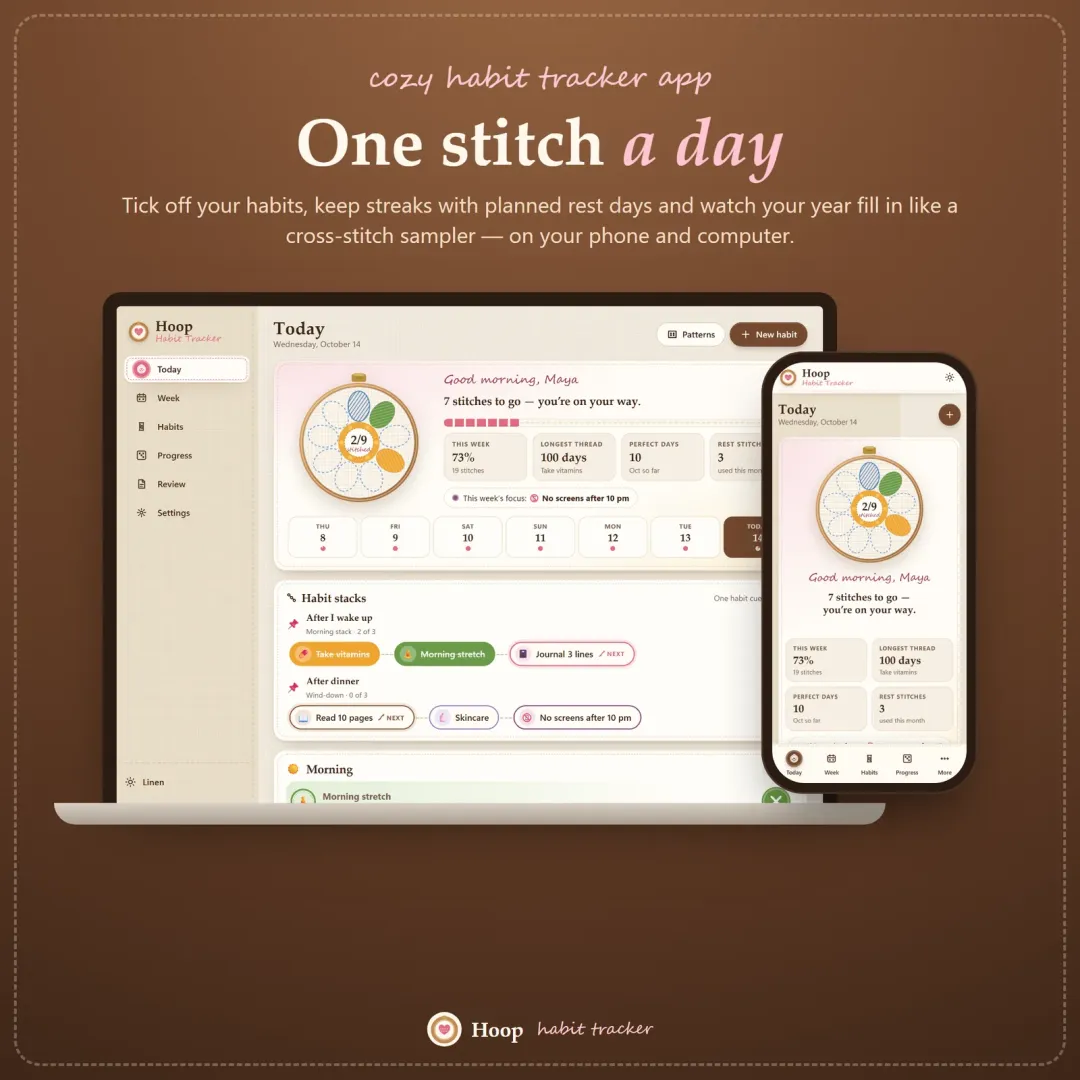
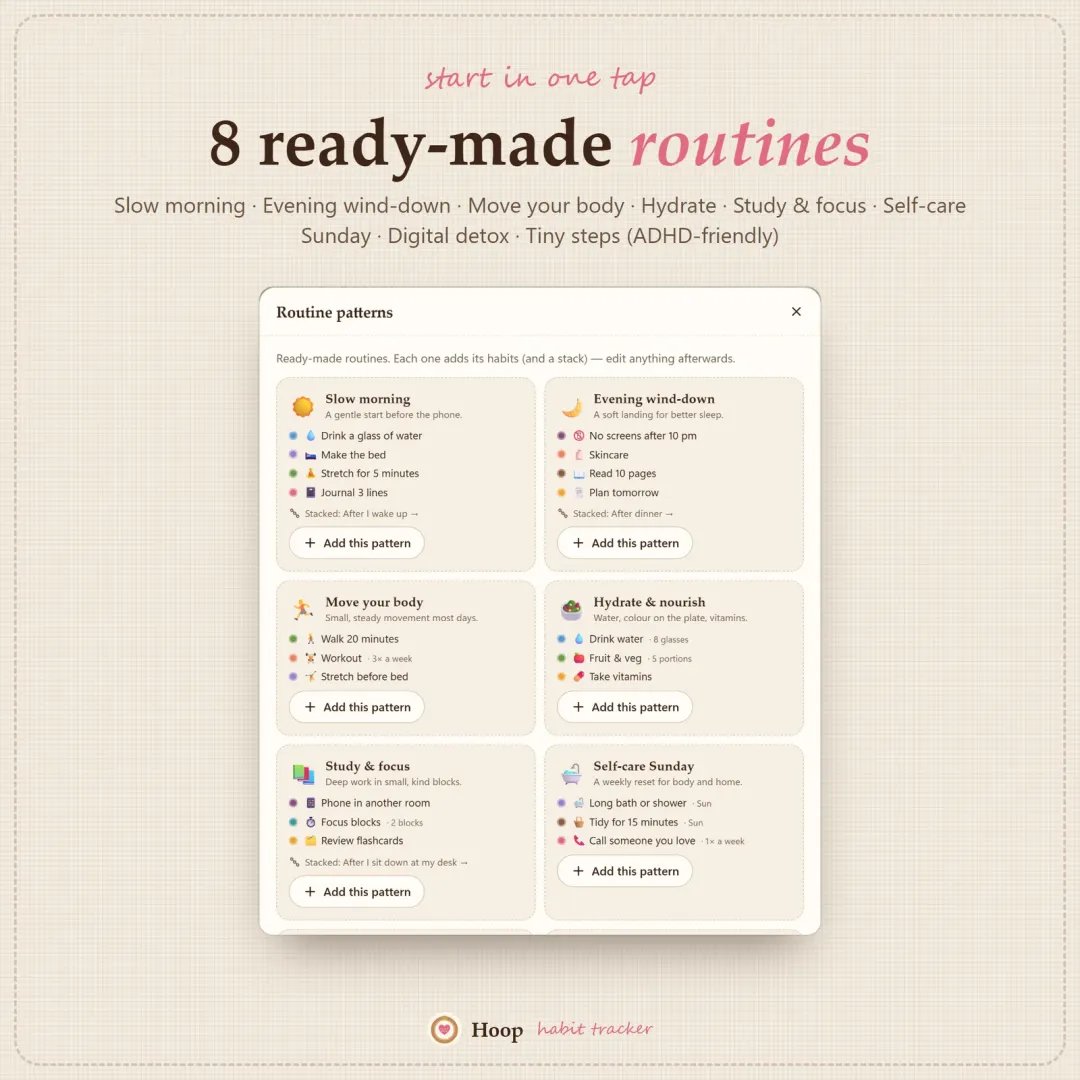
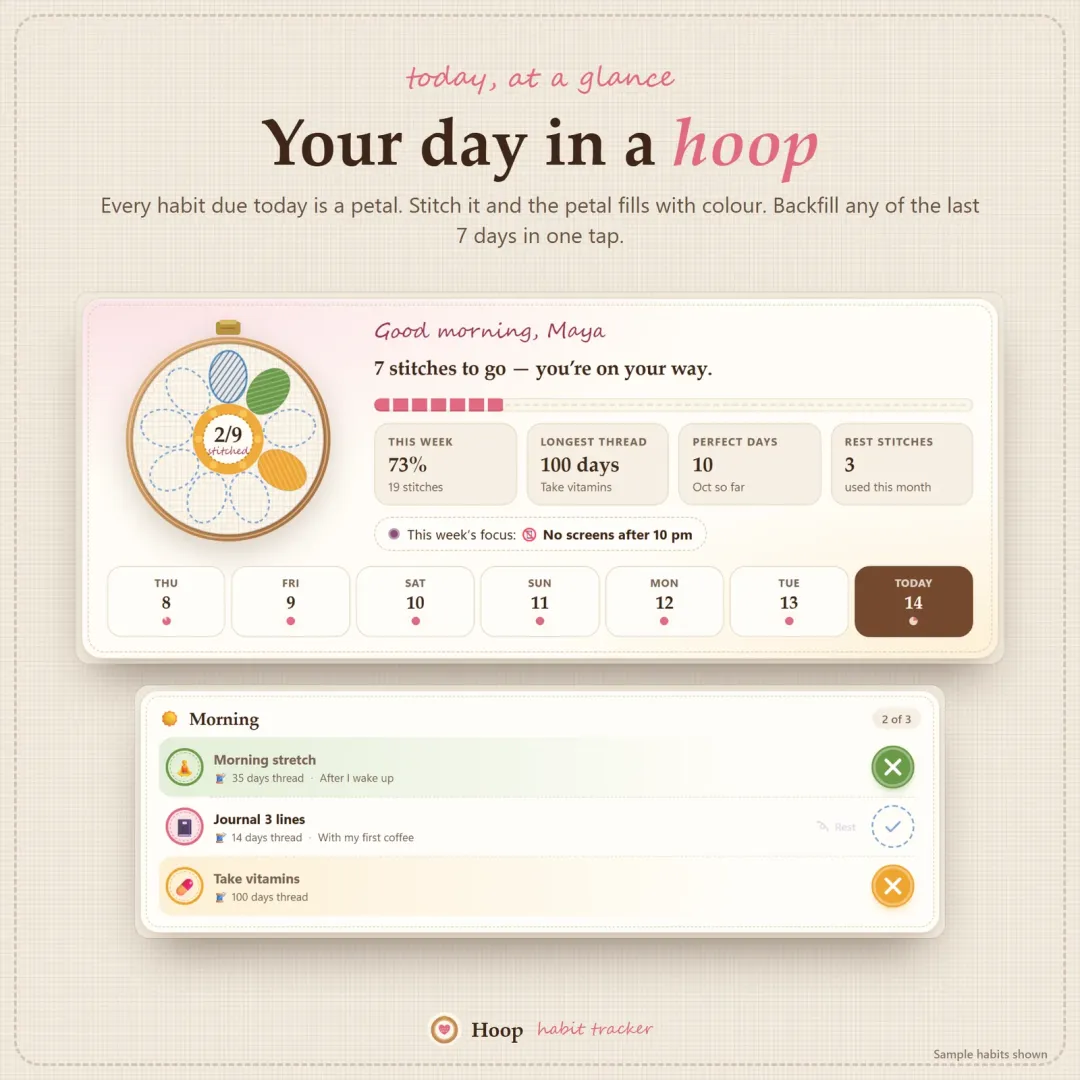
Hoop is a gentle habit tracker that works well for a self-care routine. Habits are grouped by morning, afternoon and evening; count habits like water use − and +; and a one-tap Self-care Sunday routine is built in. Streaks forgive, with rest days and vacation pauses, so a bad week never wipes out your progress. A daily mood and one-line note turn it into a tiny self-care journal.
Try the free Hoop demo — no sign-up needed.
The bottom line
A self-care routine is a few small habits done regularly: sleep, water, movement, rest, people, a tidy space and a little life admin. Start with three, attach them to cues, keep a bare-minimum version for hard days, and track it without guilt. And if you're struggling for weeks at a time, reach out to a professional — that's self-care too.
This article is general information, not medical or mental health advice.
Frequently asked questions
What is a self-care routine?
What should a daily self-care routine include?
What are the types of self-care?
How do I start self-care when I'm busy?
What is a self-care Sunday?
Is self-care selfish?
When is self-care not enough?
Written by
Finance Specialist & Editor, VaultlyApps
Emma Whitfield writes and edits the VaultlyApps money guides and free calculators. Her focus is US household finance — budgeting on a real paycheck, paying down credit card and student debt, emergency funds and savings goals, renting — and the money side of freelancing and small-business income, from pricing and profit margins to self-employment tax. Every guide is researched against primary sources such as IRS publications and the CFPB, every number is checked in our tested calculators, and tax content is reviewed each year when new IRS figures come out. Emma is not a licensed financial adviser or tax preparer; her work is general education, not personal advice.
Researched against primary US sources, checked with our calculators and reviewed by a finance expert on our team. Written for US readers — general education, not financial, tax or legal advice. Editorial policy · Disclaimer