How Long Does It Take to Form a Habit? What the Research Really Says (and a 66-Day Plan)
It isn't 21 days. The best-known study found 66 days on average, with a range of 18 to 254. Here's what the research says, why missing a day doesn't matter, and a simple 66-day plan to build a habit that sticks — with habit stacking, tiny habits and a tracker.
In this article
- The short answer
- Where the 21-day myth comes from
- The study behind 66 days
- What makes a habit form faster
- How to build a habit, step by step
- 1. Pick one habit and make it specific
- 2. Shrink it until it's easy
- 3. Attach it to a cue with habit stacking
- 4. Make it obvious and easy
- 5. Celebrate it right away
- 6. Track it — but forgive yourself
- A 66-day habit plan
- How to keep a streak without burning out
- How long does it take to break a bad habit?
- Which habits are worth building?
- Track it with Hoop
- The bottom line
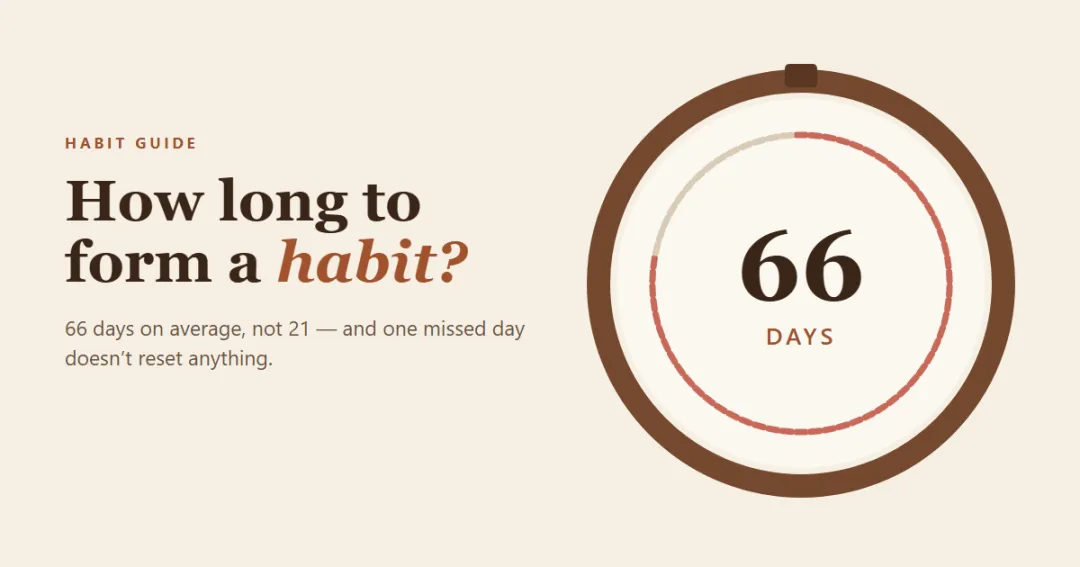
"It takes 21 days to form a habit" is one of the most repeated lines in self-help — and it's wrong. The best research we have says it takes about 66 days on average for a new behaviour to become automatic, and anywhere from 18 to 254 days depending on the person and the habit.
That's not bad news. It means that if you're three weeks into a new habit and it still takes effort, nothing is wrong with you. You're right on schedule. This guide covers what the research actually found, what makes a habit form faster, how to build a habit step by step, and a simple 66-day plan you can start today.
The short answer
- Average: 66 days for a daily habit to feel automatic (Lally and colleagues, University College London).
- Range: 18 to 254 days in the same study.
- Across many studies: a 2024 systematic review of 20 studies on health habits found median times of roughly two months, with averages of around three to five months.
- Missing a day: doesn't meaningfully set you back. Missing many days in a row does.
So the honest answer to "how long does it take to form a habit?" is: plan for about two months, expect it to feel easier long before it feels automatic, and don't panic if it takes longer.
Where the 21-day myth comes from
In 1960, plastic surgeon Maxwell Maltz published Psycho-Cybernetics. He noticed that his patients seemed to need "a minimum of about 21 days" to get used to a new face after surgery, or to stop feeling a missing limb, and he suggested the same might apply to other changes.
Notice the words minimum and about. Over the following decades, retellings dropped both, and "it takes at least 21 days" became "it takes 21 days". It's a tidy number that fits on a poster, but it was never a measured result.
The study behind 66 days
In 2009, health psychologist Phillippa Lally and her colleagues at University College London ran the study most people now quote. Ninety-six volunteers each picked one new eating, drinking or activity habit to do once a day in the same situation — things like "eat a piece of fruit with lunch", "drink a bottle of water after breakfast" or "run for 15 minutes before dinner". Every day for 12 weeks, they logged whether they'd done it and rated how automatic it felt ("I do it without having to remember", "I'd find it hard not to do it" and so on).
The researchers then fitted a curve to each person's scores and looked at how long it took to reach the plateau — the point where the habit stopped getting more automatic.
The findings:
- The average was 66 days, but individual times ranged from 18 to 254 days. Several people hadn't reached their plateau when the study ended.
- Automaticity grows fast at first, then slows. The biggest gains came in the early weeks; after that each extra day added less. That's why a habit can feel "almost there" for a long time.
- Harder behaviours took longer. Drinking water was quicker to become automatic than doing exercise.
- Missing one day didn't matter. A single missed opportunity had no meaningful effect on the overall curve.
That last finding is the one most habit trackers ignore — and it's the one that matters most for keeping going.
What makes a habit form faster
The research points to a few things that speed habit formation up:
- A clear, stable cue. "After breakfast" or "when I sit down at my desk" works better than "sometime today". The same time and place each day is best.
- A small, simple behaviour. One glass of water beats a whole new diet; two minutes of stretching beats an hour at the gym.
- Frequency. Daily habits form faster than weekly ones, simply because you get more repetitions.
- Enjoyment. Habits that feel good right away — or that you reward right away — stick faster than ones whose only payoff is months later.
- Your own sense of choice. People who chose their habit themselves, for their own reasons, tended to do better than those following someone else's plan.
And a few things slow it down: vague goals ("get healthier"), changing the time every day, starting too big, and trying to change many habits at once.
How to build a habit, step by step
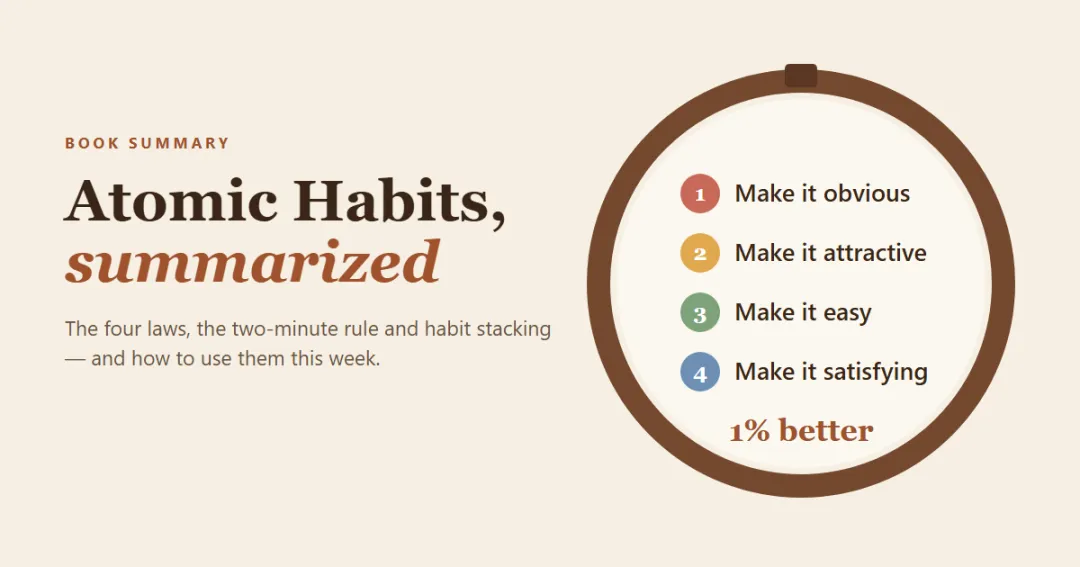
Here's a practical method that pulls together the research and the best-known habit books — James Clear's Atomic Habits (our summary) and BJ Fogg's Tiny Habits.
1. Pick one habit and make it specific
"Exercise more" isn't a habit. "Walk for 10 minutes after lunch" is. Name the behaviour, the amount and the moment. If you have a bigger goal — run a 5K, read 20 books, save $1,000 — pick the one small daily action that moves it forward.
2. Shrink it until it's easy
BJ Fogg's Tiny Habits method starts with a version so small it's almost silly: floss one tooth, do two push-ups, read one page. The point isn't the amount — it's building the automatic link between the cue and the action. Once the habit runs on autopilot, it naturally grows. On a bad day, the tiny version is what keeps the chain alive.
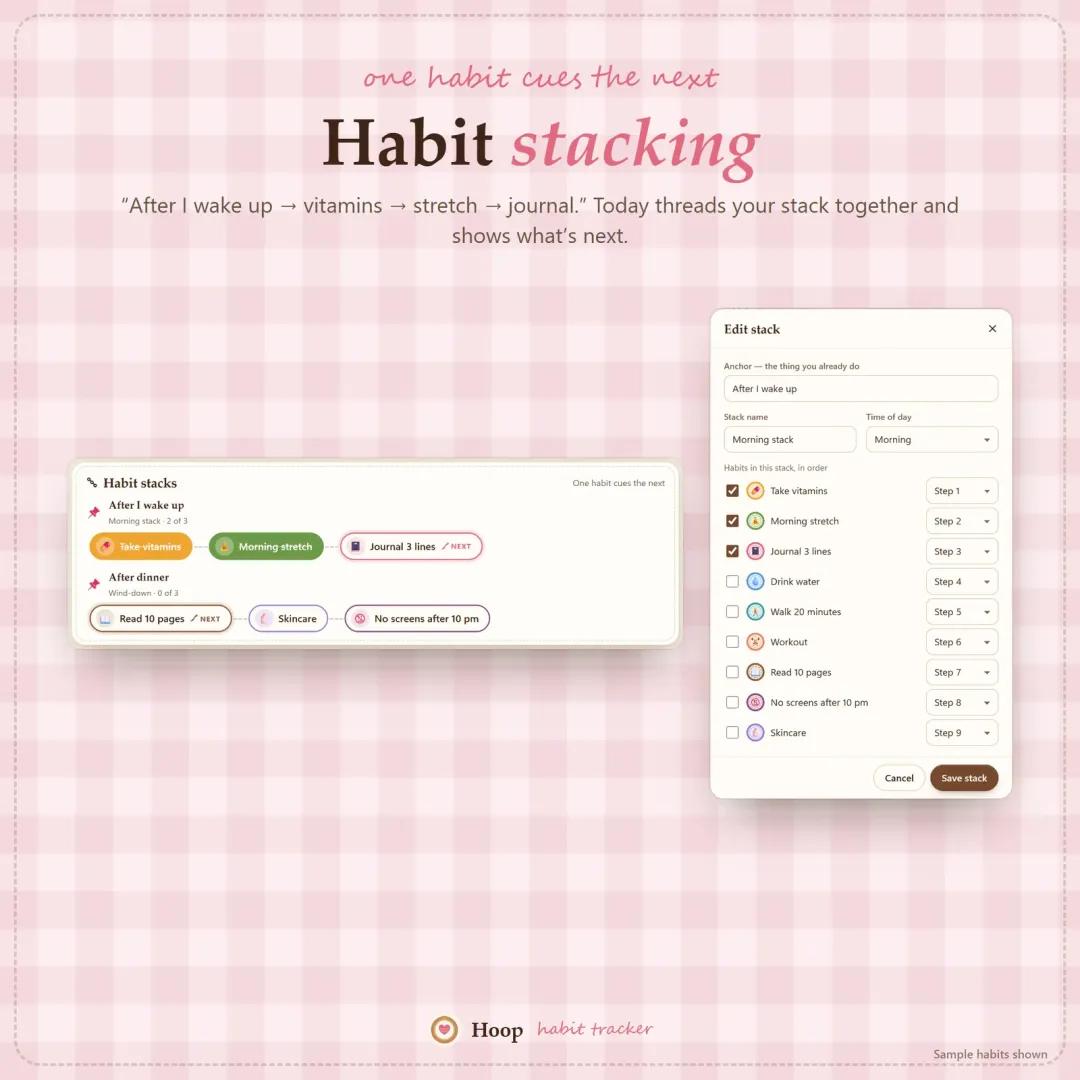
3. Attach it to a cue with habit stacking
Habit stacking means linking the new habit to something you already do every day, using a simple formula:
After I [current habit], I will [new habit].
Some habit stacking examples:
- After I pour my morning coffee, I'll take my vitamins.
- After I sit down at my desk, I'll write my top three tasks for the day.
- After I brush my teeth at night, I'll put my phone on the charger in the kitchen.
- After I get paid, I'll move $25 into savings.
- After I finish dinner, I'll go for a 10-minute walk.
- After I get into bed, I'll read one page.
Psychologists call this an implementation intention — deciding in advance exactly when and where you'll act. It works because the old habit becomes the reminder. You don't need willpower or a notification; the coffee cup is the trigger.
4. Make it obvious and easy
Put the vitamins next to the coffee machine. Leave your running shoes by the door. Keep a water bottle on your desk. Every bit of friction you remove — and every bit you add to the habit you're trying to drop — makes a real difference over two months.
5. Celebrate it right away
Fogg recommends a tiny celebration right after the habit — a "yes!", a fist pump, ticking a box. It sounds silly, but a quick good feeling right after the action helps the brain tag it as worth repeating. Ticking a habit off in a tracker is a simple, built-in version of this.
6. Track it — but forgive yourself
Tracking does two jobs: it reminds you, and it shows progress that's otherwise invisible. Two weeks in, nothing feels different; a two-week streak on a tracker proves something is changing.
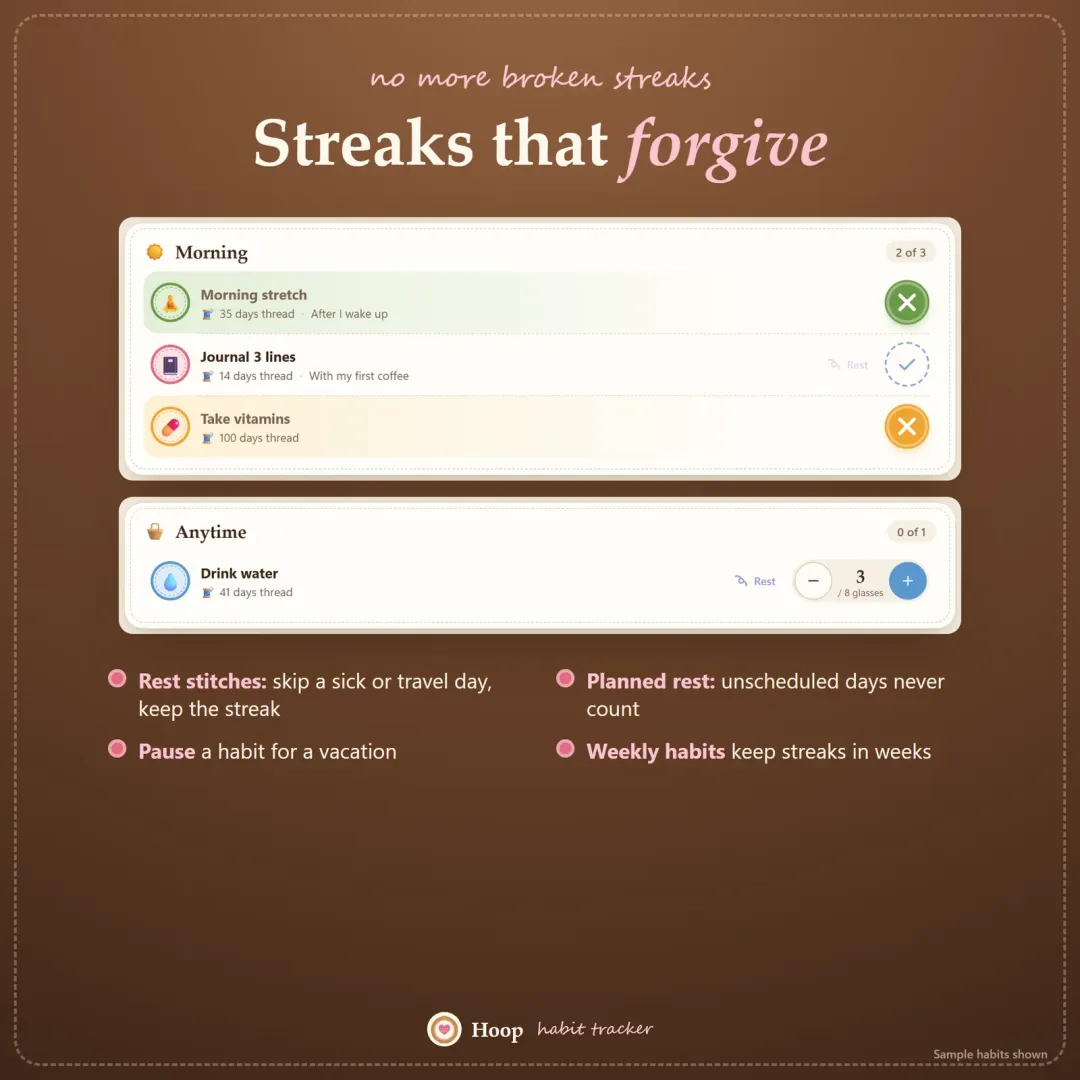
But remember what the research found: one missed day doesn't matter. A tracker that resets your streak to zero over one bad day turns a harmless slip into a reason to quit. Use one that allows planned rest days — or simply follow the rule never miss twice.
A 66-day habit plan
Here's a simple plan built around the average from the UCL study. Use it for one habit at a time.
| Days | Focus | What to do |
|---|---|---|
| 1–7 | Start tiny | Do the two-minute version every day at the same cue. Tick it off. Don't increase anything yet. |
| 8–21 | Protect the cue | Keep the same time and place. If you miss a day, do it the next day without fail. |
| 22–35 | Grow a little | If it feels easy, increase slightly — 2 minutes to 5, one page to three. Keep the tiny version for bad days. |
| 36–50 | Expect the dip | Motivation often drops here. Look back at your streak and your "why". Plan rest days for travel. |
| 51–66 | Notice autopilot | Do you do it without thinking? Would skipping feel odd? If yes, it's becoming a habit. |
| 67+ | Add the next habit | Stack a new habit onto this one, and start the plan again. |
If day 66 arrives and the habit still takes effort, that's normal — remember the range ran to 254 days. Keep going; the curve is still rising.
How to keep a streak without burning out
Streaks are motivating, but they can backfire. A few rules that keep them helpful:
- Plan rest days. If your habit is "gym three times a week", the other four days aren't misses — they're rest.
- Allow a few free misses a month. Sick days happen. A tracker that gives you two or three "rest stitches" a month removes the all-or-nothing pressure.
- Pause for holidays. A two-week trip shouldn't erase a 90-day streak.
- Never miss twice. One miss is an accident; two in a row is the start of a new habit — of not doing it.
- Keep a "bad day" version. One push-up still counts.
How long does it take to break a bad habit?
Our full guide covers how to break a bad habit step by step; here is the short version. There's less research on breaking habits than on forming them, but most experts agree it takes at least as long, because the old cue keeps firing. The most reliable approach isn't willpower — it's changing the setup:
- Spot the cue. When and where does the habit happen? Bored on the couch at 9 pm? Stressed after a meeting?
- Change the environment. Move the phone charger out of the bedroom. Don't keep soda in the house. Log out of shopping apps.
- Replace, don't just remove. Swap the behaviour for one that meets the same need: tea instead of soda, a walk instead of scrolling.
- Track the "avoid" days. A count of no-soda days is just as motivating as a streak of good habits.
- Expect slips. Treat a slip as information about the cue, not proof that you've failed.
Which habits are worth building?
Start with habits that make other habits easier — sleep, movement, water and a short daily plan — or with a habit tied to a goal you care about right now. Money habits are some of the most rewarding, because the results compound: a weekly budget check, a no-spend day, or moving money to savings every payday. A savings challenge like the 52-week savings challenge is really a habit-building plan with a dollar figure attached.
Need inspiration? See our lists of habit tracker ideas and morning routine ideas.
Track it with Hoop
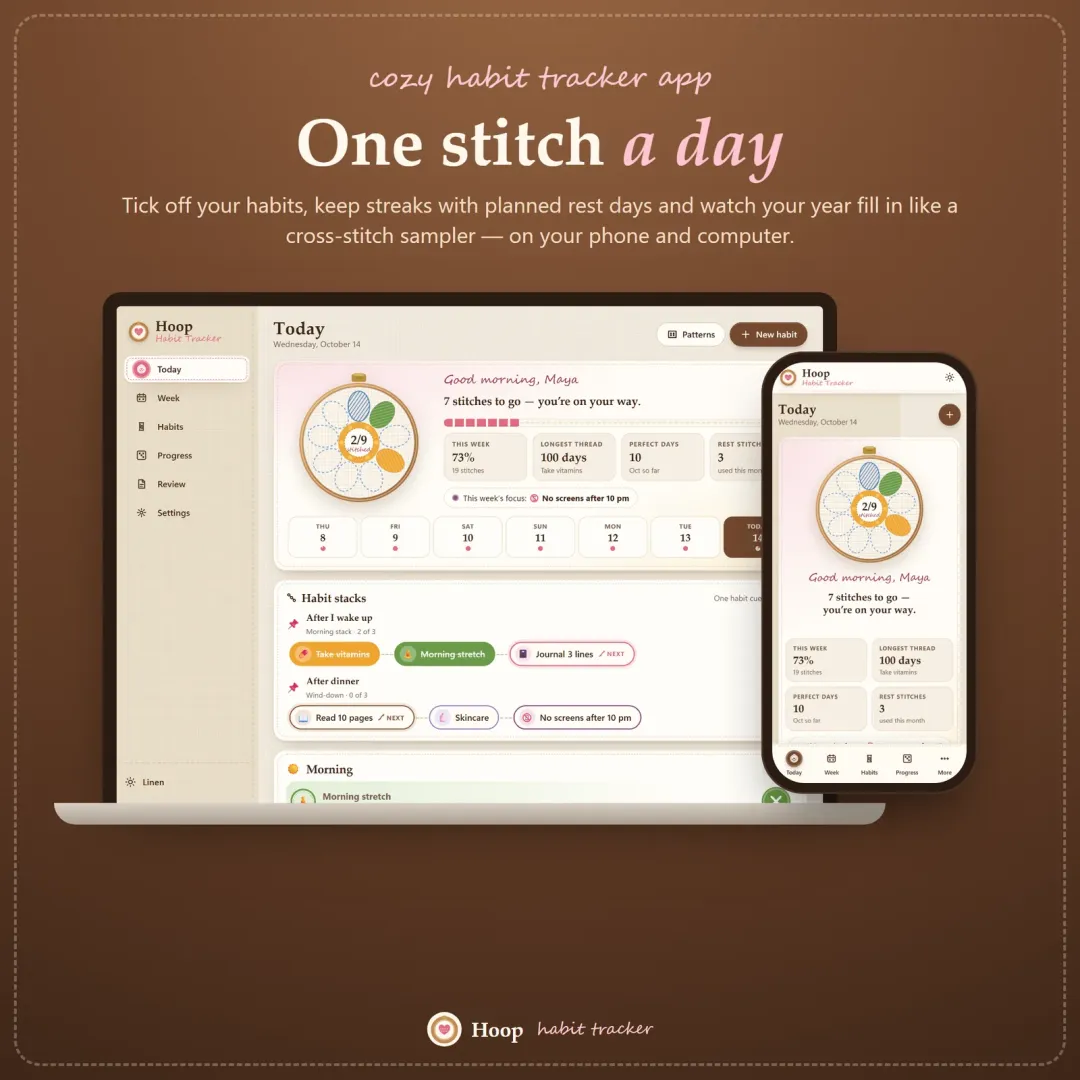
We built Hoop around exactly these findings. Each habit gets a cue and a time of day, habits can be chained into stacks, and every habit can be yes/no, a count (8 glasses of water) or something to avoid. Streaks forgive: days a habit isn't scheduled are rest, every habit gets a few rest stitches a month, and a vacation pause keeps the streak safe. Milestone patches mark 7, 21, 66 and 365 days, and a year view shows your progress as a cross-stitch sampler — so the slow climb the research describes becomes something you can actually see.
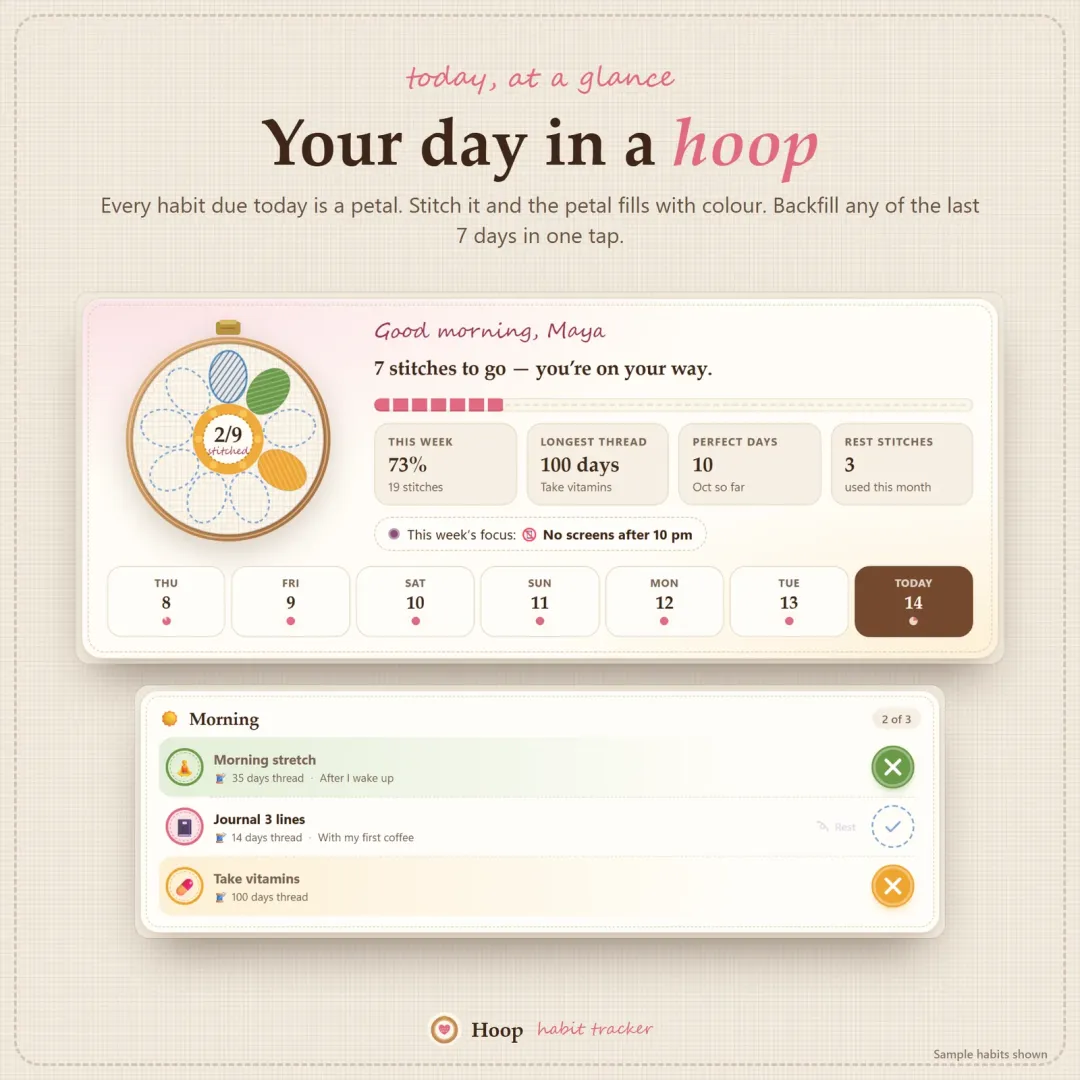
You can try the free Hoop demo in your browser with sample habits — no sign-up.
The bottom line
It takes about 66 days on average to form a habit, not 21 — and it can take much longer. Start tiny, tie the habit to a cue you already have, make it easy, celebrate it, and track it with room for rest days. Miss a day? Do it tomorrow. Two months from now, it'll be something you just do.
Sources: Lally, P., van Jaarsveld, C. H. M., Potts, H. W. W. & Wardle, J. (2010), "How are habits formed: Modelling habit formation in the real world", European Journal of Social Psychology; Singh, B. et al. (2024), "Time to form a habit: a systematic review and meta-analysis of health behaviour habit formation and its determinants", Healthcare; Maltz, M. (1960), Psycho-Cybernetics.
Frequently asked questions
How long does it take to form a habit?
Is it true that it takes 21 days to form a habit?
Does missing one day ruin a habit?
Why do some habits form faster than others?
How long does it take to break a bad habit?
What is habit stacking?
How many habits should I build at once?
Written by
Finance Specialist & Editor, VaultlyApps
Emma Whitfield writes and edits the VaultlyApps money guides and free calculators. Her focus is US household finance — budgeting on a real paycheck, paying down credit card and student debt, emergency funds and savings goals, renting — and the money side of freelancing and small-business income, from pricing and profit margins to self-employment tax. Every guide is researched against primary sources such as IRS publications and the CFPB, every number is checked in our tested calculators, and tax content is reviewed each year when new IRS figures come out. Emma is not a licensed financial adviser or tax preparer; her work is general education, not personal advice.
Researched against primary US sources, checked with our calculators and reviewed by a finance expert on our team. Written for US readers — general education, not financial, tax or legal advice. Editorial policy · Disclaimer