40 Morning Routine Ideas (Plus an ADHD Morning Routine and an Evening Routine That Makes Mornings Easy)
40 simple morning routine ideas for body, mind, home, work and money — plus sample 10-, 30- and 60-minute routines, an ADHD-friendly morning routine, evening routine ideas that make mornings easier, and how to make a routine stick.
In this article
- How to choose your morning routine ideas
- 40 morning routine ideas
- For your body
- For your mind
- For your home
- For your day
- For your money
- Sample morning routines
- The 10-minute morning routine
- The 30-minute morning routine
- The 60-minute slow morning routine
- An ADHD morning routine that actually works
- Evening routine ideas that make mornings easier
- A self-care routine for the weekend
- How to make your morning routine stick
- Track your routine with Hoop
- The bottom line
The best morning routine isn't the one with 14 steps and a 5 a.m. alarm. It's the one you'll actually do on a Tuesday when you slept badly and the kids can't find their shoes. That usually means a handful of small, repeatable habits in the same order every day.
Below are 40 morning routine ideas to pick from, sample routines for 10, 30 and 60 minutes, an ADHD morning routine that's built for real brains, evening routine ideas that make mornings easier, and a simple way to make it all stick.
How to choose your morning routine ideas
Before the list, three rules that make the difference between a routine and a wish list:
- Pick three to five ideas, not twenty. You can always add more later.
- Cover what you need most. Usually that's one thing for your body, one for your mind, and one for your day.
- Put them in a fixed order. Each step becomes the cue for the next — "after I drink water, I stretch". That's habit stacking, and it's why routines run on autopilot once they're settled.
40 morning routine ideas
For your body
- Drink a glass of water before coffee — keep it on your nightstand.
- Open the curtains or step outside for a few minutes of daylight.
- Stretch for two minutes — neck, shoulders, hamstrings.
- Make your bed. A one-minute win that makes the room feel calmer.
- Take vitamins or medication right next to breakfast.
- Go for a 10-minute walk around the block.
- Do a short workout — 10 squats, 10 push-ups, a 1-minute plank.
- Eat a breakfast with protein — eggs, yogurt, oats with nuts.
- Take a cool shower or finish your shower with 30 seconds of cold.
- Do a skincare routine — cleanser, moisturizer, sunscreen.
For your mind
- No phone for the first 30 minutes — leave it charging in another room.
- Write three lines in a journal — how you feel, one thing you're grateful for, one intention.
- Breathe for one minute — four seconds in, six seconds out.
- Meditate for five minutes with an app or a simple timer.
- Read five pages of a book with your coffee.
- Listen to a podcast or music while you get ready instead of scrolling.
- Say one kind thing to yourself in the mirror (it feels silly; it works).
- Pray or reflect if that's part of your life.
- Learn one thing — a word in a new language, one flashcard deck.
- Check your mood and write it down in one word.
For your home
- Unload the dishwasher while the kettle boils.
- Do a five-minute tidy of one surface.
- Start a load of laundry.
- Water the plants.
- Take out the trash or recycling on collection day.
- Prep lunch or take out what you prepped last night.
- Wipe the bathroom sink after you use it.
- Open a window for fresh air.
For your day
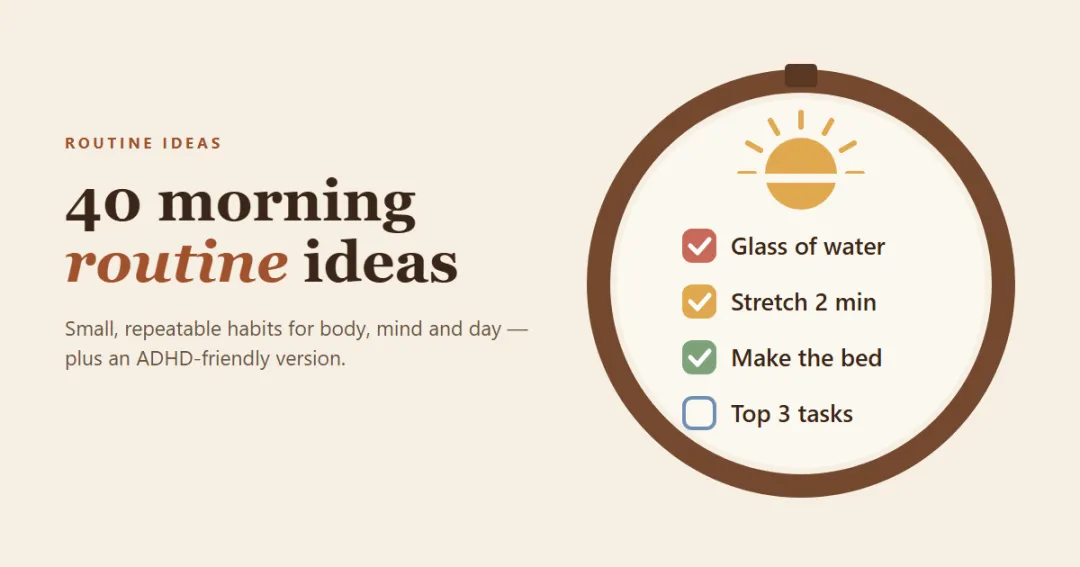
- Write your top three tasks — just three.
- Look at your calendar for today and tomorrow.
- Do the hardest task first for 25 minutes before email.
- Check the weather and plan clothes accordingly.
- Review your goals for the week in one minute.
- Clear your inbox to under 10 — or don't open it until your first task is done.
- Send one message you've been putting off.
For your money
- Check yesterday's spending — two minutes in your banking app or budget.
- Log any receipts from yesterday.
- Look at your "safe to spend" number for the day (what that means).
- Mark a no-spend day and pack lunch and coffee.
- Move a small amount to savings on payday mornings — even $10 builds the habit (try the 52-week savings challenge).
Sample morning routines
The 10-minute morning routine
For busy weekdays:
- Glass of water (1 min)
- Open the curtains and stretch (3 min)
- Make the bed (1 min)
- Write your top three tasks (3 min)
- Vitamins with breakfast (2 min)
The 30-minute morning routine
- Water and daylight (3 min)
- 10-minute walk or short workout (10 min)
- Shower and skincare (8 min)
- Breakfast with protein, no phone (5 min)
- Top three tasks and calendar check (4 min)
The 60-minute slow morning routine
For weekends or work-from-home days:
- Water, curtains open, make the bed (5 min)
- Stretch or yoga (15 min)
- Coffee and 15 pages of a book (15 min)
- Journal: three lines plus gratitude (5 min)
- Proper breakfast (15 min)
- Look at the week ahead and money check-in (5 min)
An ADHD morning routine that actually works
Standard routine advice often fails ADHD brains: too many steps, too much remembering, and a perfect-or-nothing feel that collapses on the first chaotic morning. An ADHD morning routine works better when it's short, visible, prepared in advance and forgiving.
The night before (5 minutes):
- Clothes out, bag packed, keys and wallet in one "launch pad" spot by the door.
- Breakfast decided — or set out.
- Medication next to the coffee machine or your toothbrush, so you see it.
The morning (15–20 minutes):
- Water + medication with breakfast — one cue, two habits.
- Get dressed in the clothes that are already out.
- Brush teeth and wash your face.
- Eat something — even a small, easy breakfast.
- Check the launch pad — keys, wallet, phone, bag.
- Look at your one most important task for the day, written on a sticky note.
Tricks that help:
- Make it visual. A checklist on the bathroom mirror or a tracker with big tick boxes beats a list in your head.
- Use time cues. A playlist where each song is one step, or a timer, keeps "five more minutes" from becoming forty.
- Keep a bare-minimum version. On hard days: water, meds, teeth, out the door. That still counts.
- Remove decisions. Same breakfast on weekdays, a capsule wardrobe, a fixed order.
- Skip the guilt. If you miss a day, start again the next morning. One missed day doesn't undo anything.
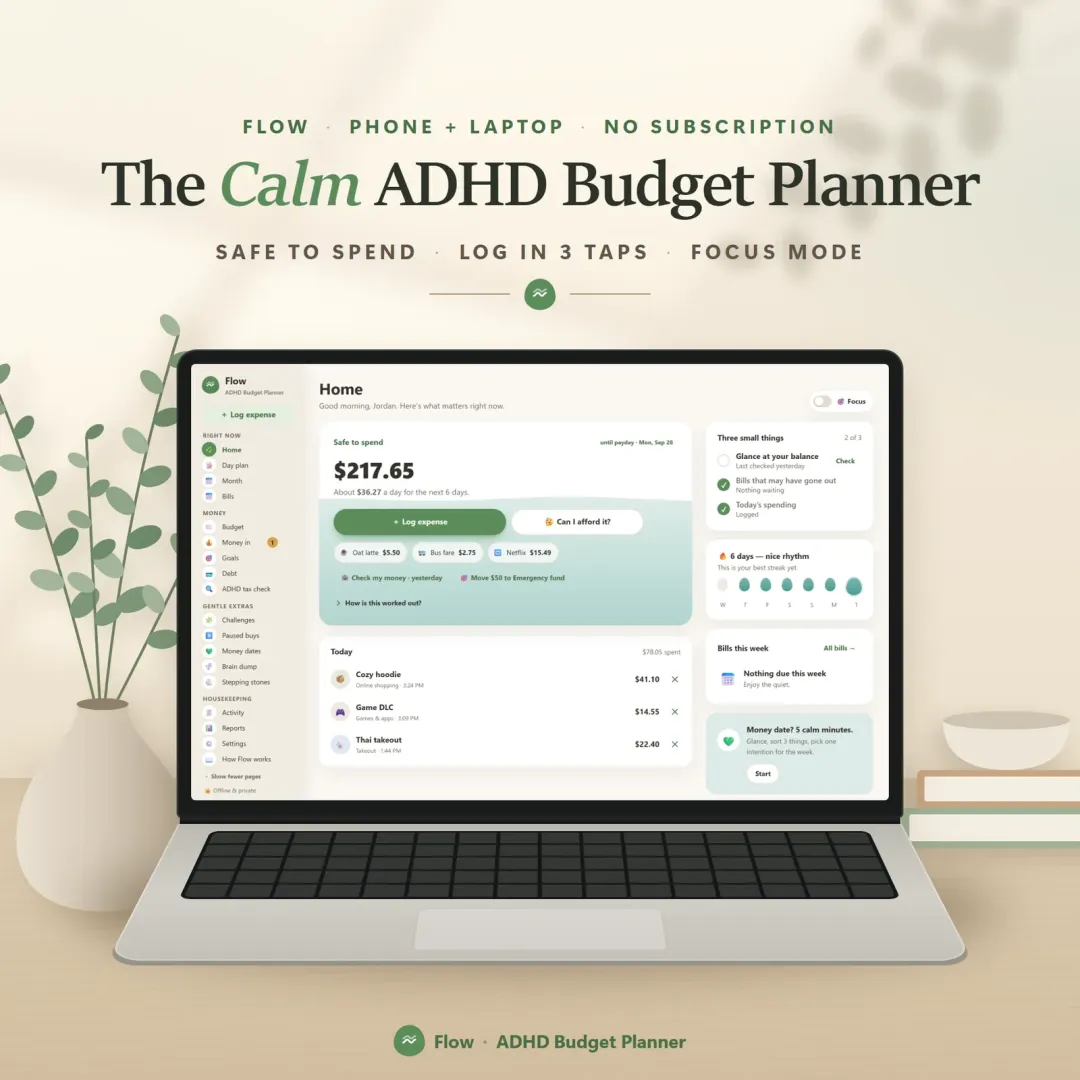
If money tasks tend to slip too, Flow is our ADHD-friendly budget planner, built on the same small-steps idea.
Evening routine ideas that make mornings easier
A great morning routine usually starts the night before. Here are evening routine ideas to pick from:
- Tidy for five minutes — dishes in, counters clear.
- Set out tomorrow's clothes and pack your bag.
- Write tomorrow's top three tasks so your morning brain doesn't have to.
- Prep breakfast or lunch.
- Check tomorrow's calendar.
- Screens off 30–60 minutes before bed — a simple digital detox habit.
- Charge your phone outside the bedroom.
- Take a warm shower or bath.
- Read a few pages of a paper book.
- Write one line about your day — what went well.
- Stretch or breathe for three minutes.
- Go to bed at the same time most nights.
A simple evening wind-down: tidy (5 min) → bag and clothes ready (3 min) → tomorrow's top three (2 min) → screens off, shower, read.
A self-care routine for the weekend
Weekends are a good time for a longer self-care routine that resets the week: a slow breakfast, a walk outside, a longer shower or bath, laundry and fresh sheets, a meal plan and grocery list, ten minutes on your budget, and a short weekly review — what went well, what got in the way, one small change for next week. More ideas: our guide to building a self-care routine has 60 of them, with daily, weekly and monthly checklists.
How to make your morning routine stick
- Start smaller than you think. Three habits for two weeks, then add one.
- Keep the same order. The order is what makes it automatic.
- Prepare the night before. Most failed mornings are really unprepared evenings.
- Track it. Ticking each step off is a small reward, and a week of ticks is proof it's working.
- Allow rest days. Weekends can have a different routine; sick days can have none.
- Give it time. Research suggests a daily habit takes about 66 days on average to feel automatic.
Track your routine with Hoop
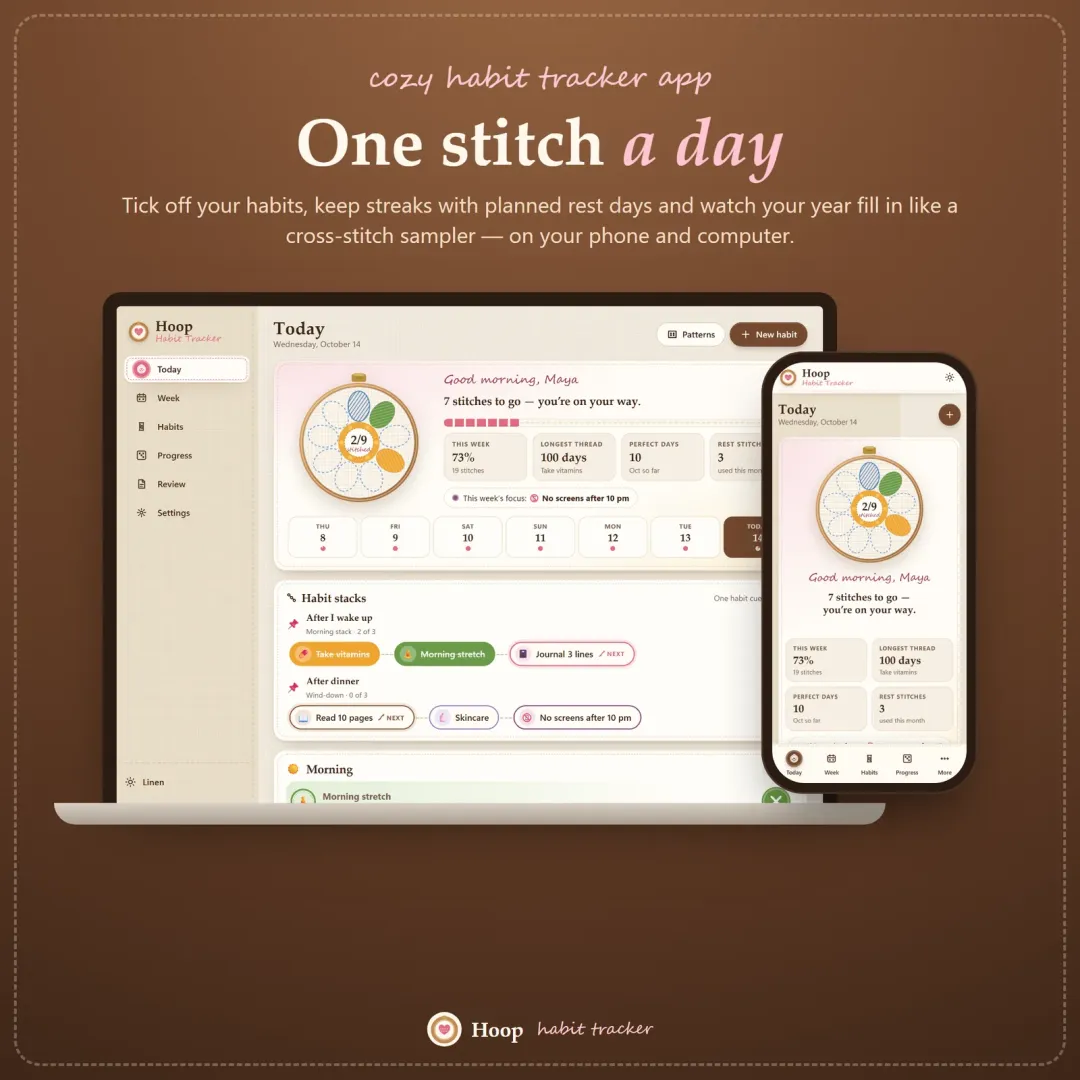
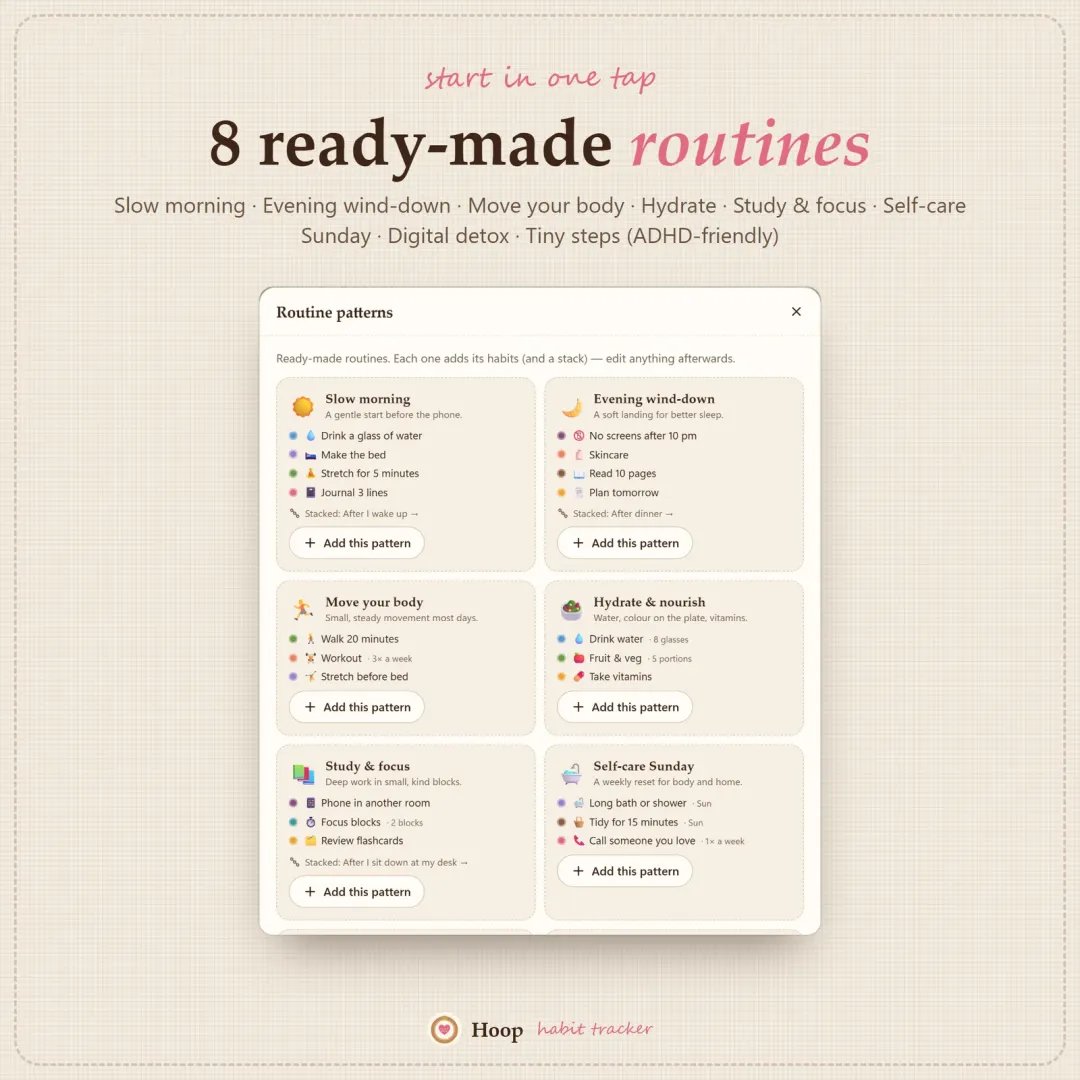
Hoop is a gentle habit tracker that groups your habits by morning, afternoon, evening and anytime, so your morning routine is the first thing you see when you wake up. Build it as a habit stack — "after I wake up → water → stretch → journal" — and Hoop shows the next step. Add a ready-made routine in one tap (slow morning, evening wind-down, digital detox, self-care Sunday or ADHD-friendly tiny steps), count habits like glasses of water with − and +, and keep your streak with planned rest days. A weekly review and a year view show how far you've come.
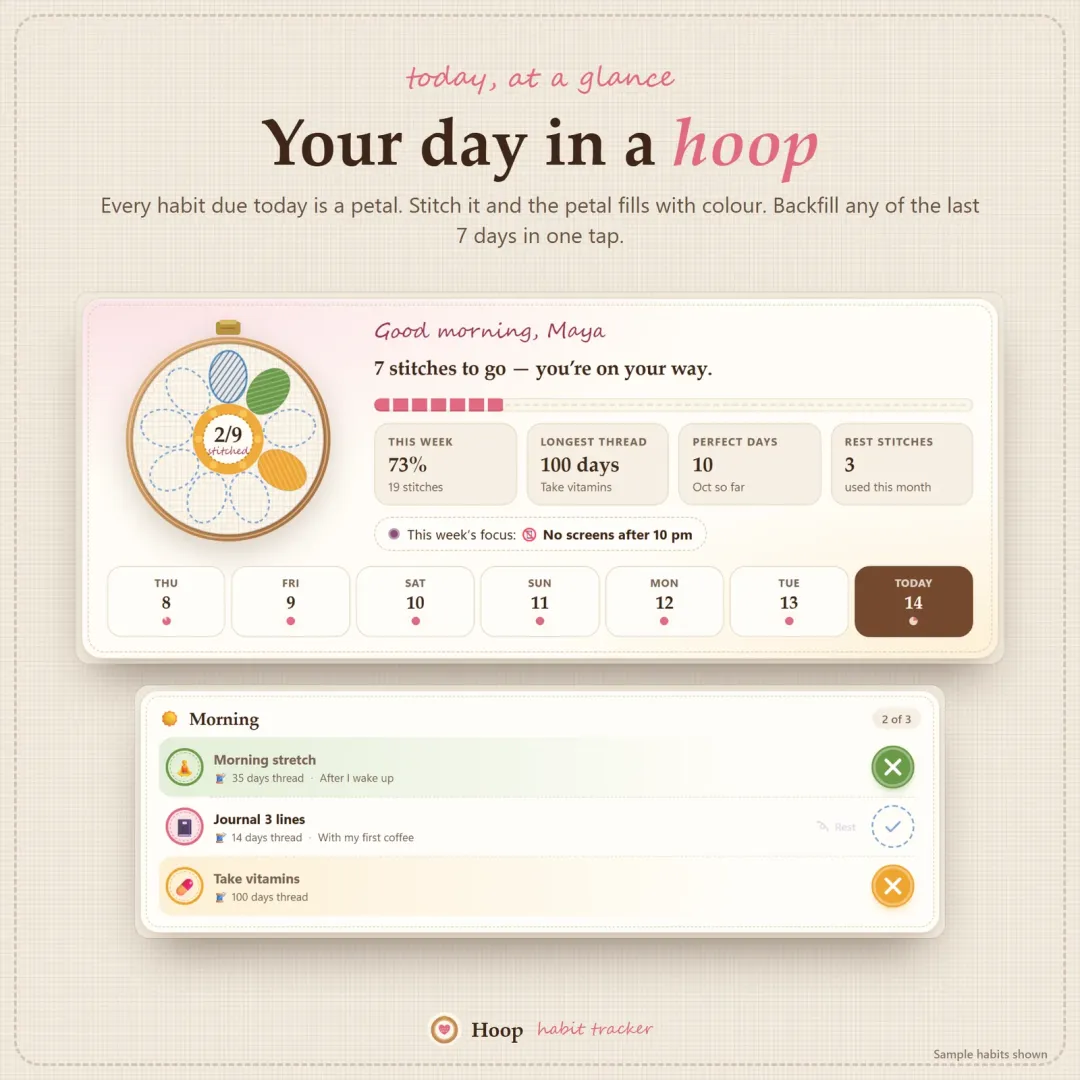
Try the free Hoop demo in your browser — no sign-up, sample habits included. For more inspiration, see our habit tracker ideas.
The bottom line
Pick three to five morning routine ideas that cover your body, your mind and your day. Put them in a fixed order, prepare the night before, keep a bare-minimum version for hard days, and track it for a couple of months. A short routine you do every day will change more than a perfect one you do twice.
Frequently asked questions
What is a good morning routine?
How long should a morning routine be?
What should I do first thing in the morning?
What is a good morning routine for ADHD?
How do I stick to a morning routine?
What should an evening routine include?
Should I wake up at 5 a.m.?
Written by
Finance Specialist & Editor, VaultlyApps
Emma Whitfield writes and edits the VaultlyApps money guides and free calculators. Her focus is US household finance — budgeting on a real paycheck, paying down credit card and student debt, emergency funds and savings goals, renting — and the money side of freelancing and small-business income, from pricing and profit margins to self-employment tax. Every guide is researched against primary sources such as IRS publications and the CFPB, every number is checked in our tested calculators, and tax content is reviewed each year when new IRS figures come out. Emma is not a licensed financial adviser or tax preparer; her work is general education, not personal advice.
Researched against primary US sources, checked with our calculators and reviewed by a finance expert on our team. Written for US readers — general education, not financial, tax or legal advice. Editorial policy · Disclaimer