VaultlyApps logo VaultlyApps
Hoop app icon Live Web app (installable PWA)

Hoop

Habit Tracker

A cozy habit tracker for your phone and computer — stitch your habits each day, keep streaks with planned rest days, stack habits into a morning routine and watch your year fill in like a cross-stitch sampler.

Try the live demo to explore the application — it runs right here on VaultlyApps with sample data, no sign-up needed.

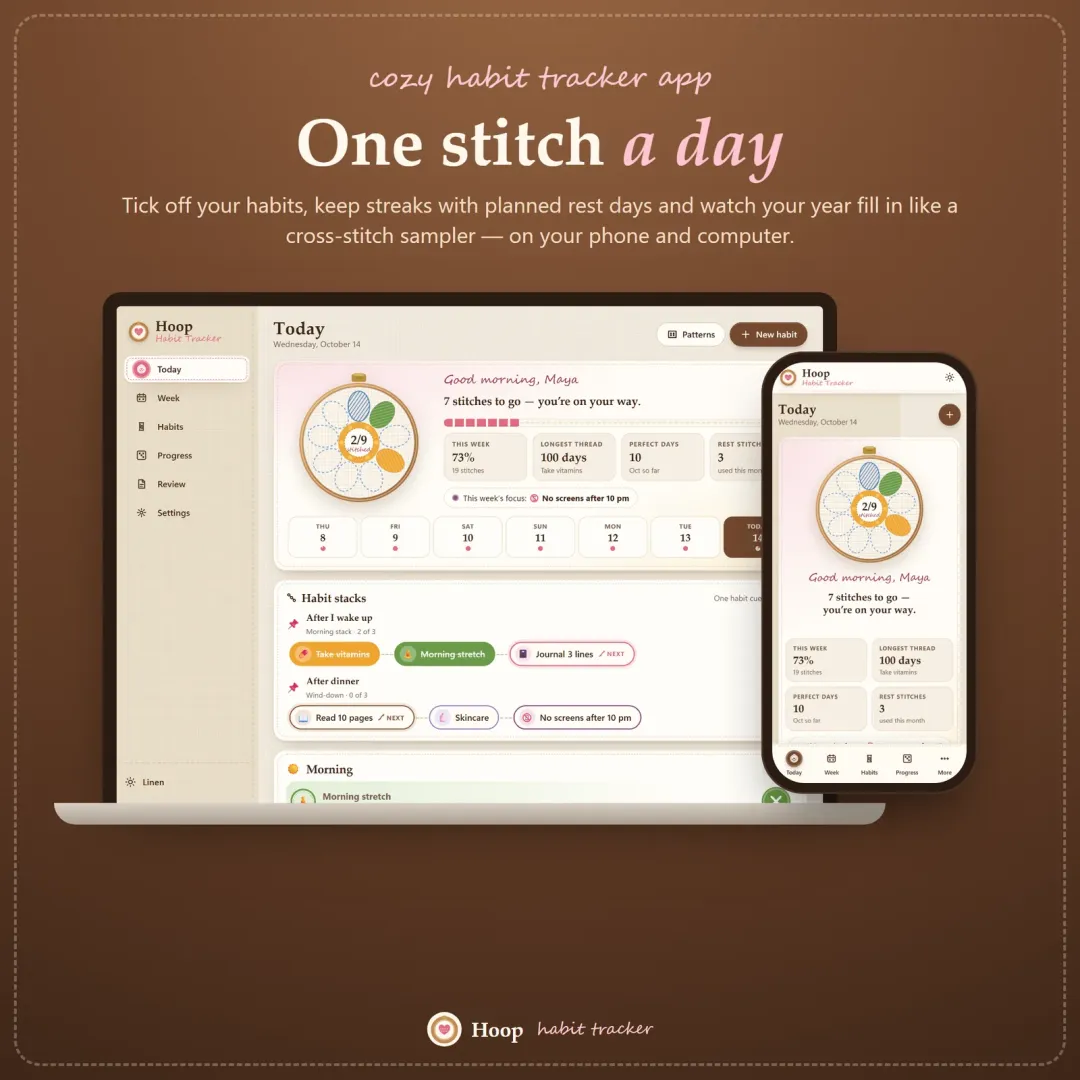
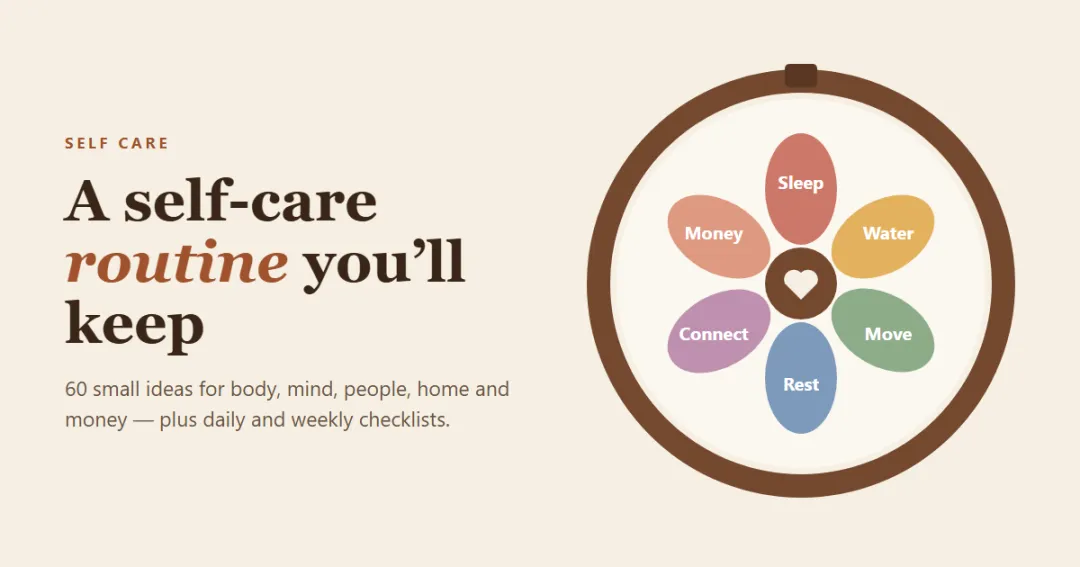
Hoop habit tracker app with today's habits shown as petals of an embroidery hoop flower

What is Hoop?

Hoop is a habit tracker app. You add your habits — yes/no habits, count habits such as 8 glasses of water, or habits to avoid — choose when each one is due, and tick them off each day. Hoop keeps your current and best streak, gives every habit a few rest days a month so one bad day never breaks a streak, chains habits into routines with habit stacking, and shows your week, month and whole year as an embroidery-style sampler. A weekly review, goals and challenges, a daily mood log, print and CSV export are built in. It works on phone and computer without an account.

What problem does Hoop solve?

Most habit trackers are a grid of checkboxes that punish you for one missed day. Miss once and the streak resets to zero, the red mark stares back, and many people quit the whole system within a few weeks. Real habit building needs room for sick days, travel and off weeks, a clear cue for each habit, and a way to see slow progress over months — not just today's checklist. Hoop is built around that: forgiving streaks, habit stacks and a year view that shows how far you've come.

Key features

  • Today, in a hoop

    One petal per habit that fills with colour when you stitch it, habits grouped by morning, afternoon, evening and anytime, and the last 7 days easy to fill in if you forgot.

  • Three kinds of habits

    Yes/no habits, count habits with a target and unit (8 glasses, 10 pages, 2 focus blocks) and avoid habits (no soda, no screens after 10 pm).

  • Streaks that forgive

    Days a habit isn't scheduled are planned rest, each habit gets a few rest stitches a month, and a vacation pause keeps your streak safe. No red failure marks.

  • Habit stacking

    Chain habits after a cue — "After I make coffee → vitamins → stretch → journal" — and Today shows the chain and what comes next.

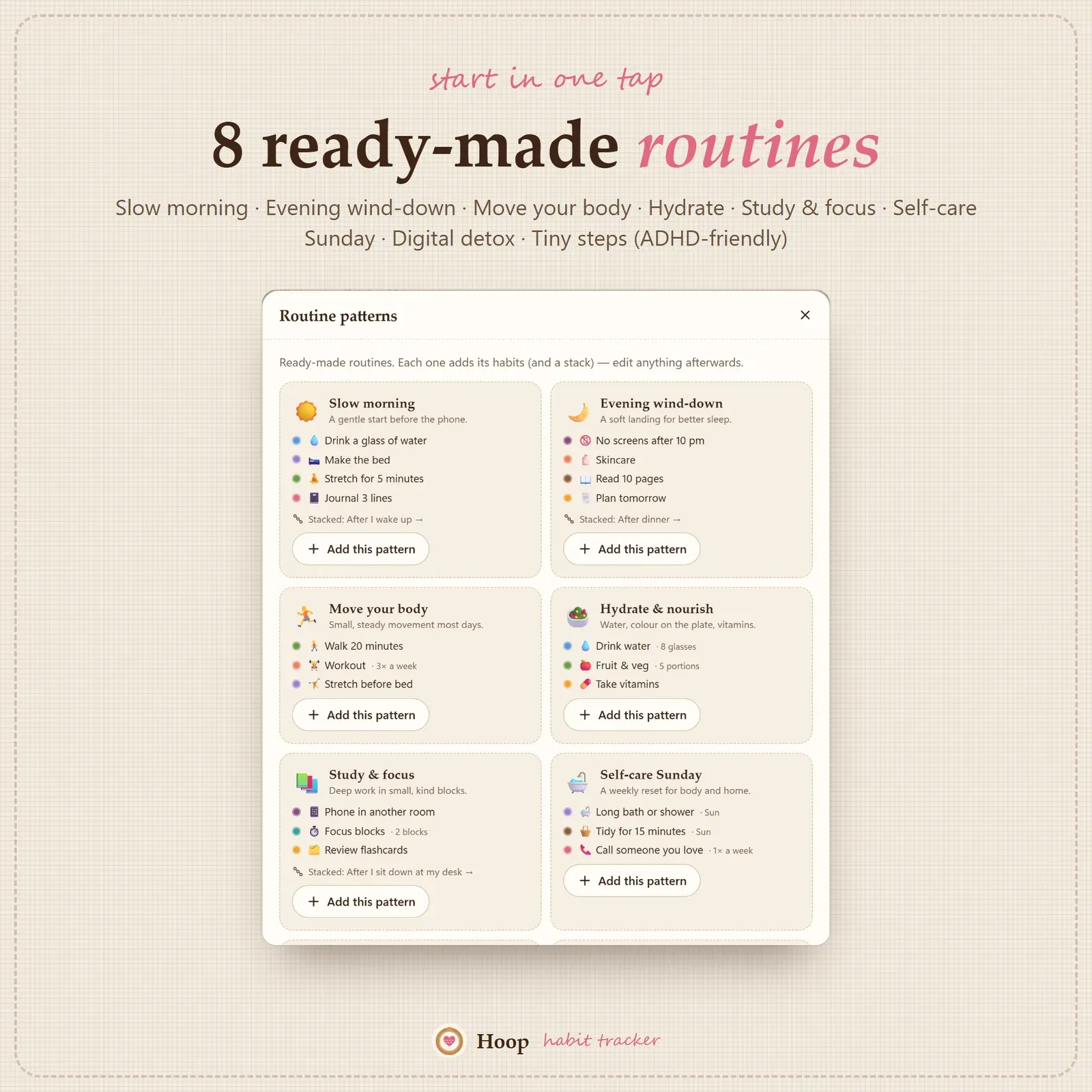
  • Eight ready-made routines

    Slow morning routine, evening wind-down, move your body, hydrate and nourish, study and focus, self-care Sunday, digital detox and tiny steps (two-minute, ADHD-friendly habits) — added in one tap.

  • Week, month and year views

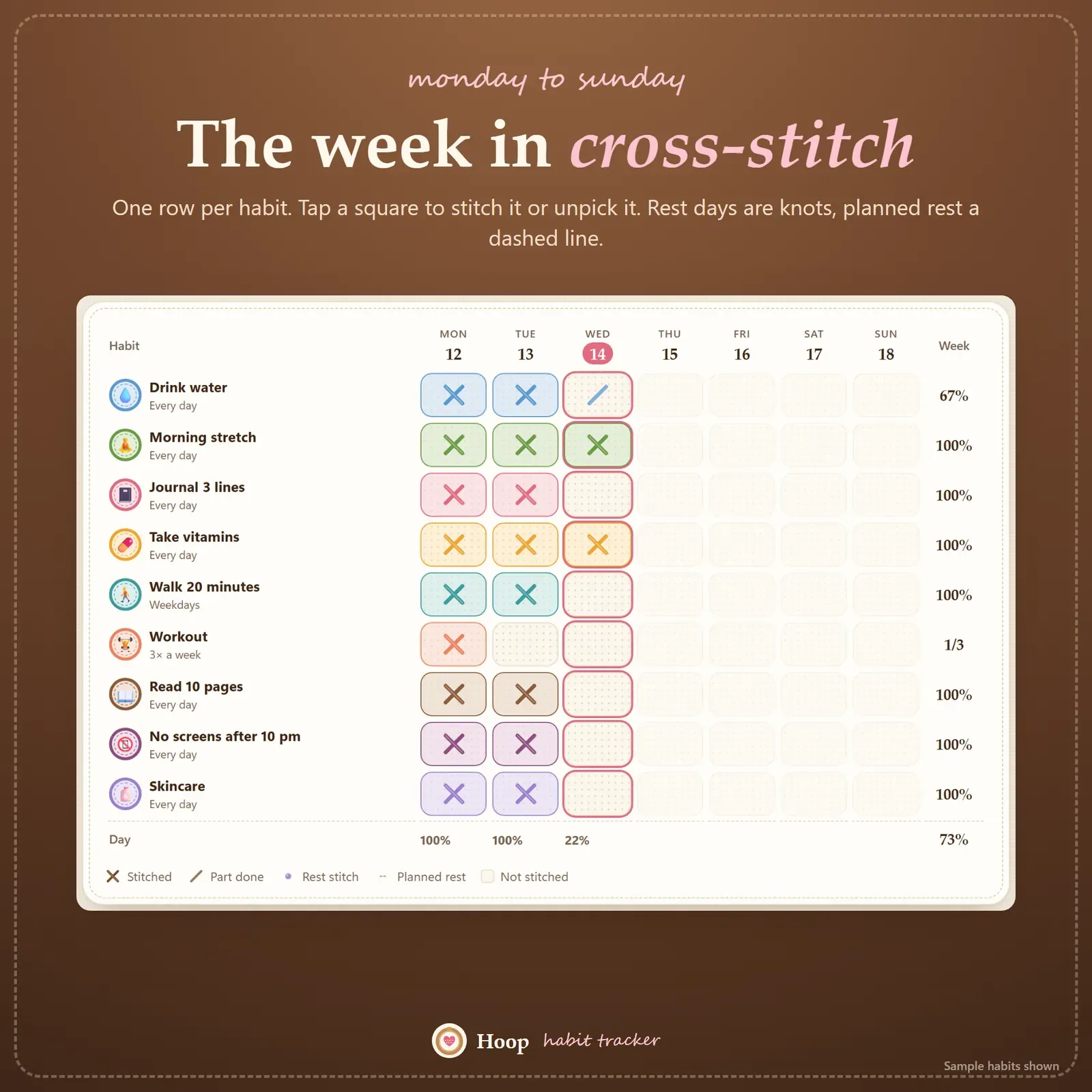
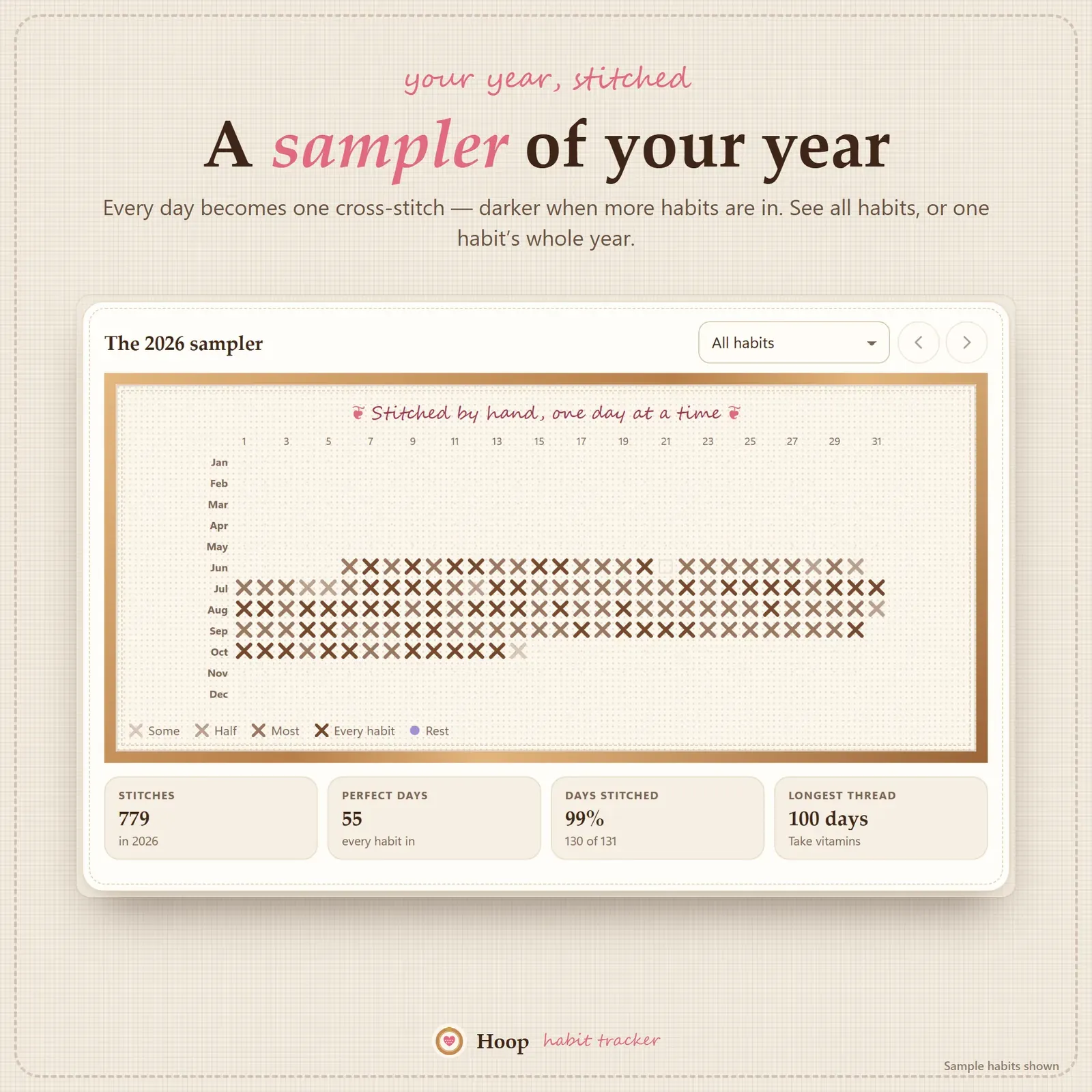
    A Monday-to-Sunday cross-stitch grid, a month calendar for every habit and a year heatmap you can view for all habits or just one.

  • Milestone patches and progress

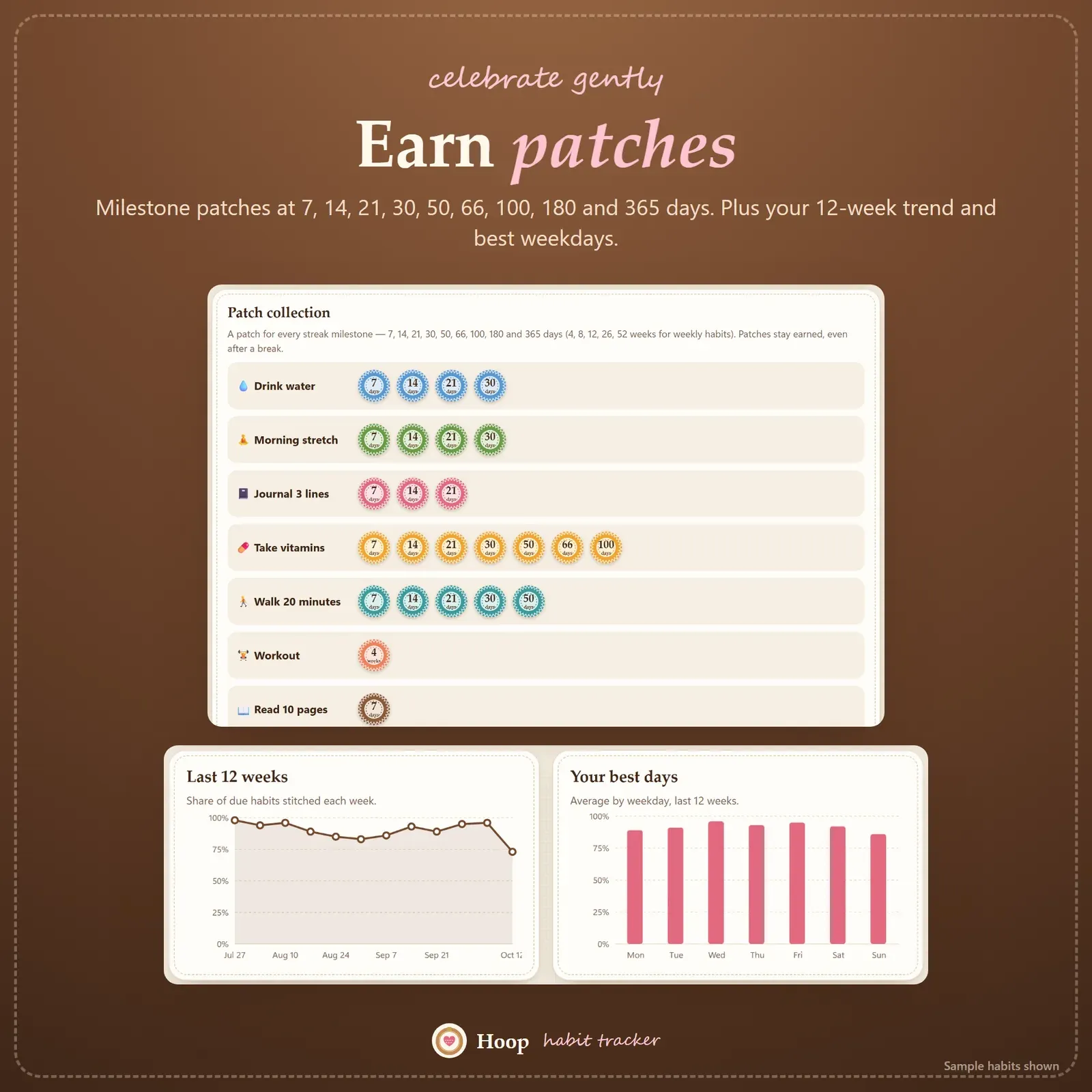
    Patches at 7, 14, 21, 30, 50, 66, 100, 180 and 365 days, a 12-week trend, your best weekdays and habits ranked by the last 30 days.

  • Weekly review, goals and mood

    A short weekly review with a focus habit for next week, goals and 30-day challenges, and a mood plus one-line note each day.

Screenshots

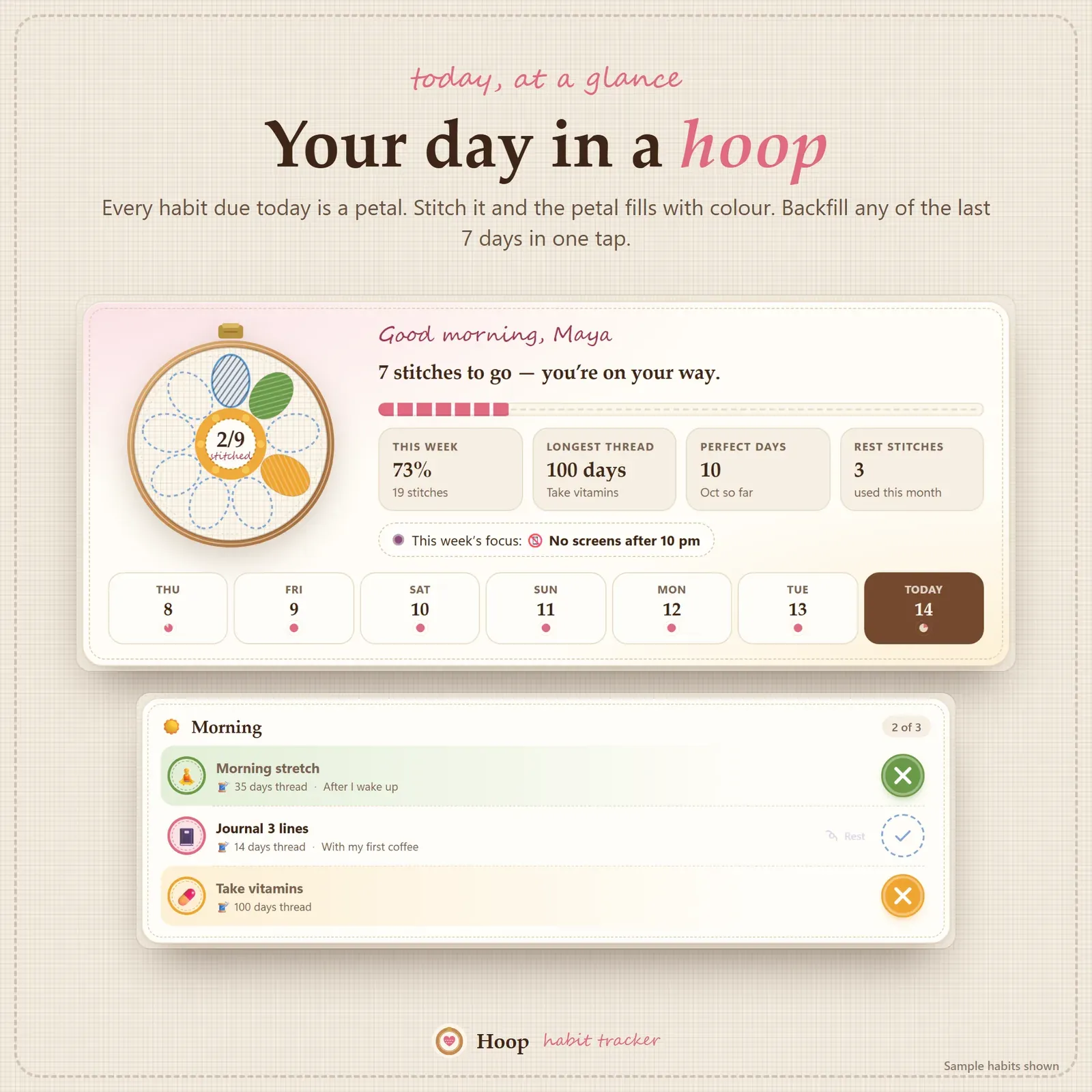
  • Today's habits in a hoop — one petal per habit fills with colour when you tick it off

    Today's habits in a hoop — one petal per habit fills with colour when you tick it off

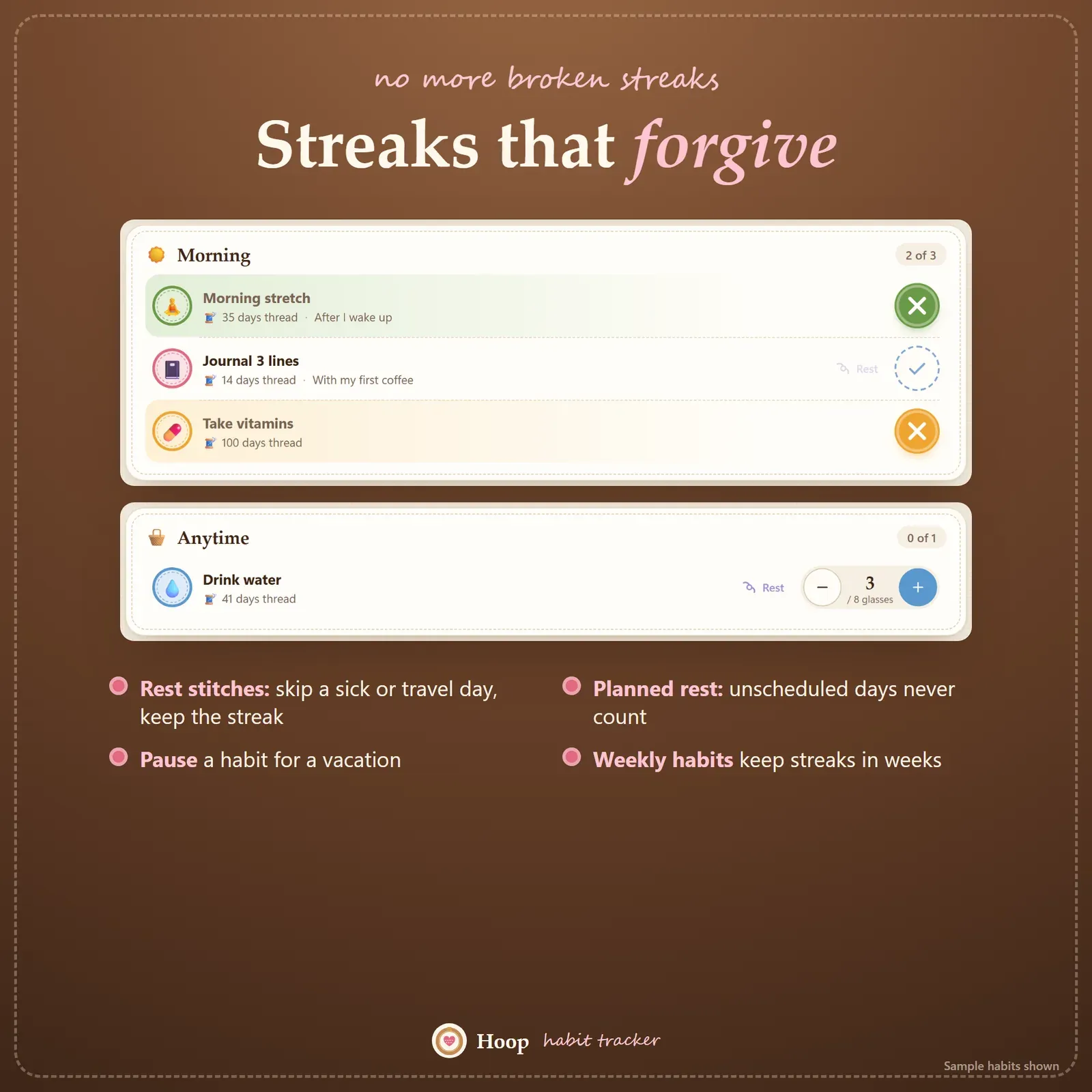
  • Habit streaks with rest days and vacation pauses that never break the streak

    Habit streaks with rest days and vacation pauses that never break the streak

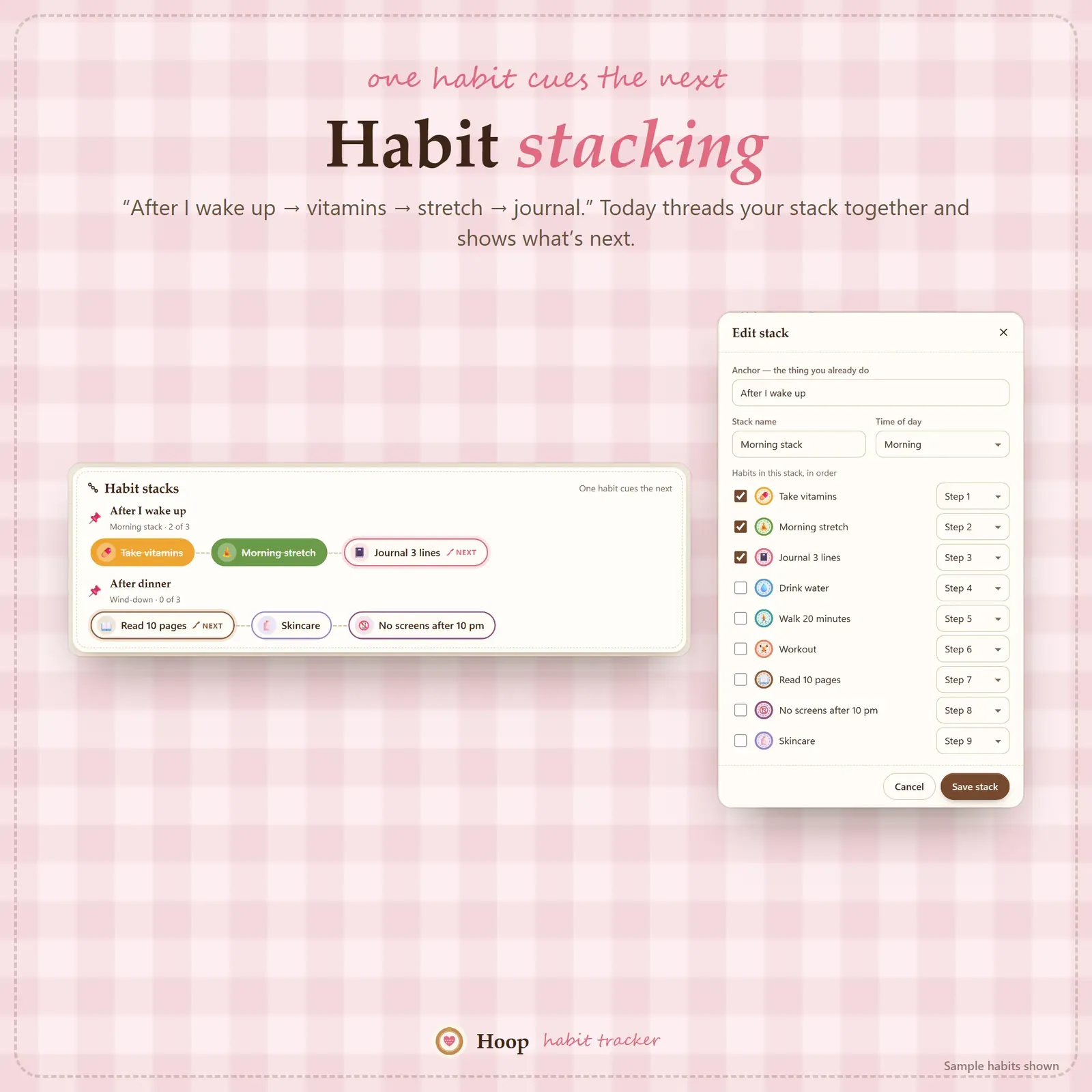
  • Habit stacking — a morning routine chain of habits with the next step shown

    Habit stacking — a morning routine chain of habits with the next step shown

  • Eight ready-made routines including a slow morning routine, evening wind-down and ADHD-friendly tiny steps

    Eight ready-made routines including a slow morning routine, evening wind-down and ADHD-friendly tiny steps

  • Weekly habit tracker grid from Monday to Sunday in a cross-stitch style

    Weekly habit tracker grid from Monday to Sunday in a cross-stitch style

  • Year in habits shown as a cross-stitch sampler heatmap

    Year in habits shown as a cross-stitch sampler heatmap

  • Milestone patches at 7 to 365 days and progress charts for every habit

    Milestone patches at 7 to 365 days and progress charts for every habit

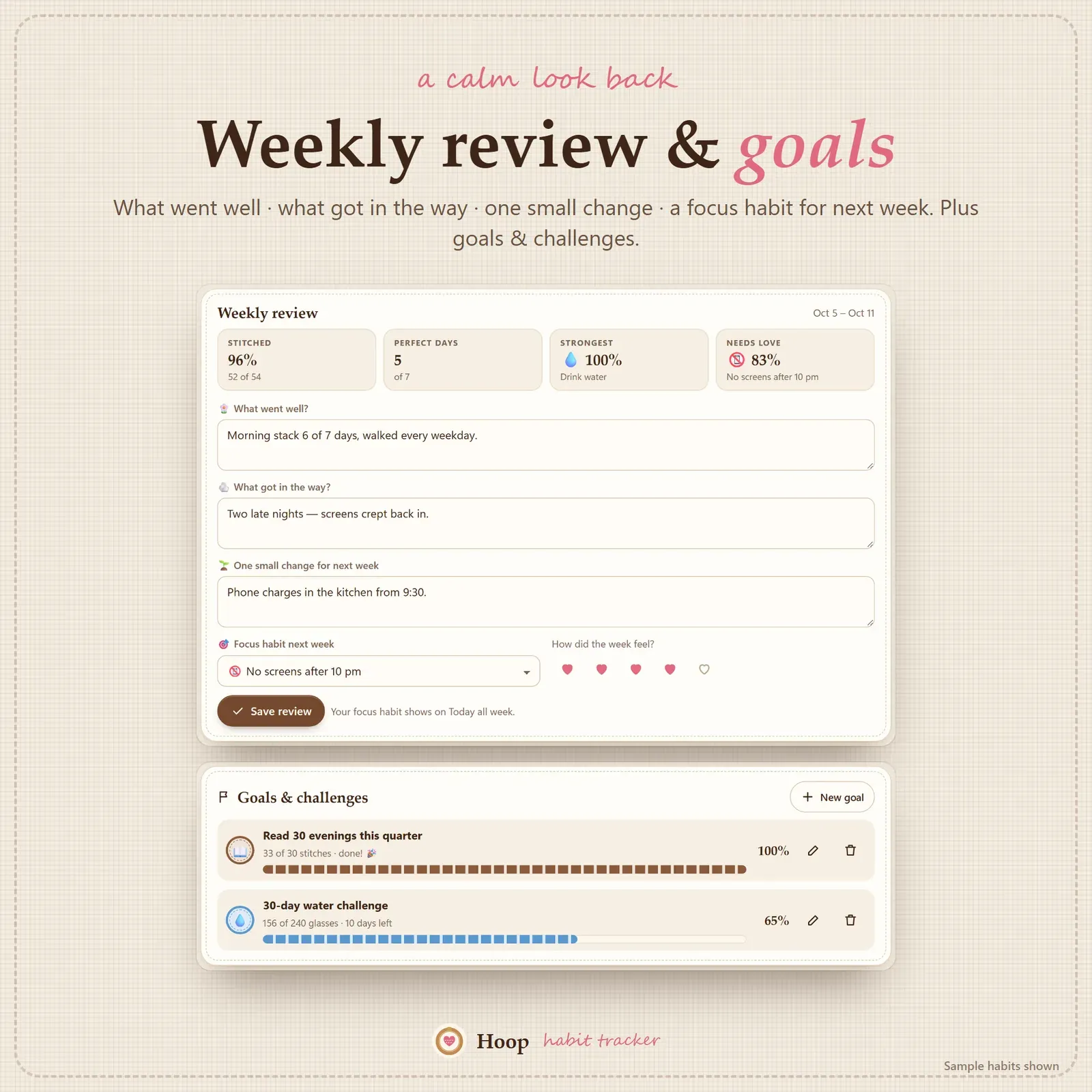
  • Weekly review — what went well, what got in the way and one small change for next week

    Weekly review — what went well, what got in the way and one small change for next week

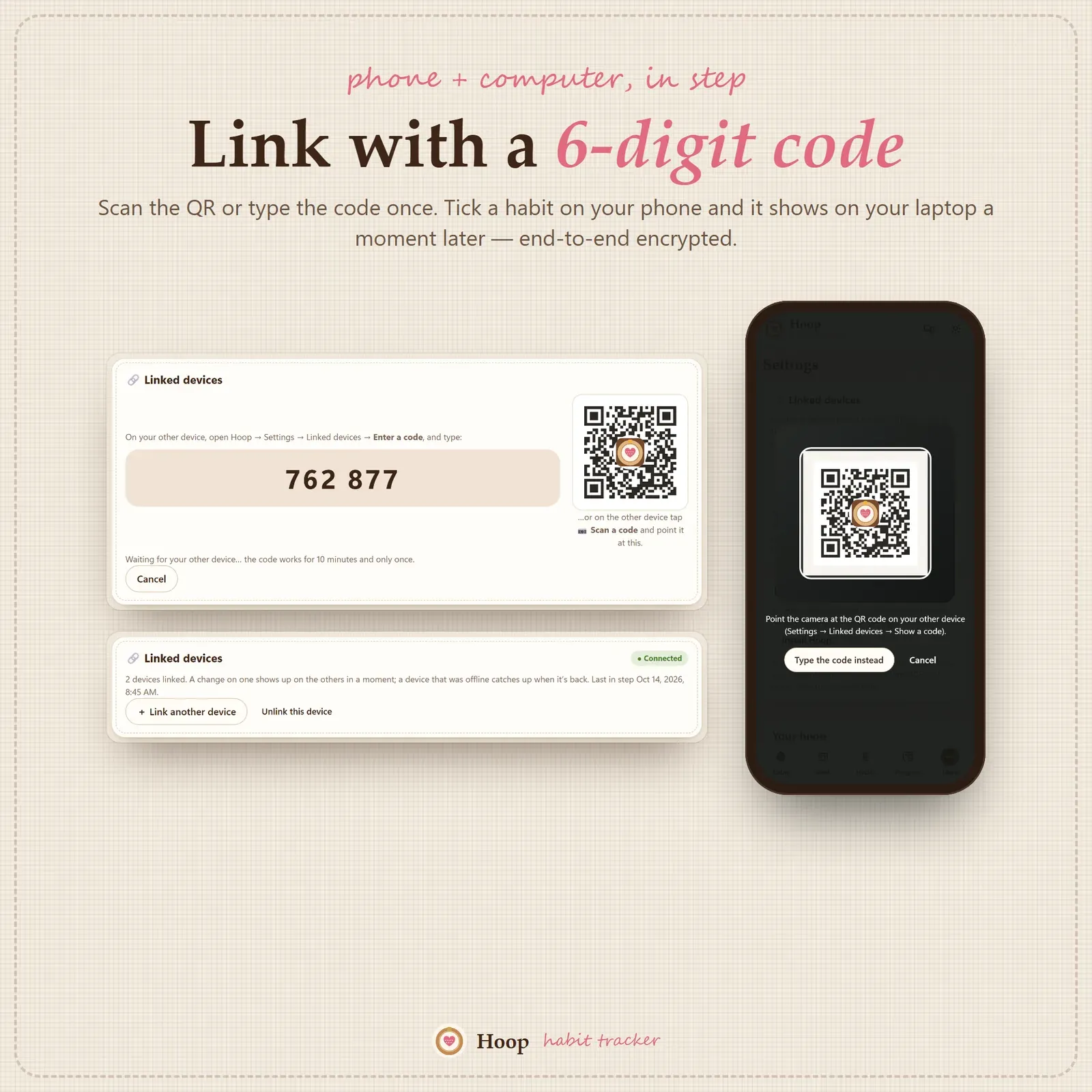
  • Phone and laptop linked with a 6-digit code or QR

    Phone and laptop linked with a 6-digit code or QR

How does Hoop work?

  1. 1

    Try the live demo with sample habits — no sign-up.

  2. 2

    After buying, open Hoop from your private link and install it on your phone or computer.

  3. 3

    Add your own habits, or add a ready-made routine in one tap.

  4. 4

    Stitch your day — Hoop keeps your streaks, patches and year sampler for you.

Who is Hoop for?

  • Anyone building a morning or evening routine
  • People with ADHD who want a gentle tracker
  • Students and busy parents
  • Self-care and wellness planners

Your day, in a hoop

Hoop's home screen is a small embroidery hoop. Every habit you have today is a petal, and when you tick a habit off — Hoop calls it a stitch — that petal fills with its thread colour. By the evening the flower is complete, and you can see at a glance what's done and what's left without reading a list.

Below the hoop your habits are grouped by morning, afternoon, evening and anytime, so the morning routine sits at the top when you wake up and the wind-down habits wait until later. Forgot to tick something yesterday? The last seven days are one tap away. A short greeting with your name, today's mood and a one-line note finish the page — a tiny habit journal without a blank page to fill.

Three kinds of habits, not just checkboxes

Real habits aren't all yes-or-no, so Hoop has three kinds:

  • Yes / no — took vitamins, made the bed, journaled.
  • Count — a target and a unit, with − and + buttons: 8 glasses of water, 10 pages, 2 focus blocks, 7,000 steps.
  • Avoid — something you're cutting back: no soda, no screens after 10 pm, no impulse buys.

Each habit can be due every day, on chosen weekdays (gym on Monday, Wednesday and Friday) or X times a week (yoga 3× a week, any days). Weekly habits keep their streak in weeks, so a Tuesday-and-Saturday week counts just as much as Monday-and-Wednesday. You can add a cue ("after I pour my coffee"), a "why", a time of day, an emoji and one of nine thread colours.

Streaks that forgive

The fastest way to lose a habit is to lose a long streak over one bad day. Hoop is built so that doesn't happen:

  • Days a habit isn't scheduled are planned rest, not misses.
  • Every habit gets a few rest stitches each month — use one for a sick day, a travel day or a day that simply went wrong, and the streak carries on. In the app a rest day shows as a French knot.
  • A vacation pause freezes a habit for as long as you're away.

Hoop shows your current streak, best streak and completion rate, and the completion rate only counts days that were really due. There are no red "failed" marks anywhere — just a fresh thread when you need one.

This matches what habit research says. In the best-known study on how long it takes to form a habit, missing a single day had no real effect on whether the habit stuck. Consistency over weeks matters; perfection doesn't.

Habit stacking and ready-made routines

Habit stacking means linking a new habit to something you already do: "After I wake up, I drink a glass of water. After I drink the water, I stretch for two minutes." In Hoop you build a stack by choosing a cue and putting habits in order. Today then shows the chain as one routine, with the next step highlighted, so you don't have to remember the order.

If you'd rather not start from scratch, add one of eight ready-made routines in one tap and edit it afterwards:

  1. Slow morning routine — water, stretch, make the bed, three lines in a journal.
  2. Evening wind-down — tidy for five minutes, screens off, tomorrow's top three, read.
  3. Move your body — a walk, steps, stretching.
  4. Hydrate & nourish — water, fruit and vegetables, a proper lunch.
  5. Study & focus — focus blocks, a review, phone in another room.
  6. Self-care Sunday — rest, a long shower, plan the week.
  7. Digital detox — no phone in the first hour, screen-time limit, no scrolling in bed.
  8. Tiny steps — two-minute versions of common habits, made for ADHD brains and low-energy days.

Looking for more ideas? Our list of morning routine ideas has 40 of them, including an ADHD-friendly morning routine.

Week, month and year in stitches

The Week page is a cross-stitch grid: habits down the side, Monday to Sunday across the top. Tap any square to stitch it. It's the same layout as a paper weekly habit tracker, without the eraser marks.

Every habit has its own month calendar, and the year sampler shows your whole year as a heatmap of stitches — for all habits together or for one habit at a time. It's the view that shows real progress: a habit you struggled with in March looks very different by September.

Patches, progress and a weekly review

Hoop marks milestones with patches at 7, 14, 21, 30, 50, 66, 100, 180 and 365 days. The Progress page adds a 12-week trend, your best and hardest weekdays, and every habit ranked by the last 30 days, so you can see which habits are settling in and which need a smaller step.

Once a week, the weekly review asks four short questions: what went well, what got in the way, one small change for next week, and which habit to focus on. Your answers are saved, so you can read back over a month or a year of reviews. Goals and challenges sit next to it — "read 30 evenings this quarter", a 30-day water challenge — with progress filled in from your check-ins.

Who Hoop is for

Anyone building better habits: people starting a morning or evening routine, students who want a study habit, busy parents who need small wins, wellness and self-care planners, and people with ADHD who've given up on trackers that punish every missed day. It's also a good home for money habits — a no-spend day, checking your budget once a week, or a 52-week savings challenge.

A typical week with Hoop

  1. Each morning: open Today, follow your morning stack and stitch each habit.
  2. During the day: use − / + for count habits like water.
  3. Each evening: finish the hoop, pick a mood and write one line.
  4. On a bad day: do the two-minute version, or use a rest stitch — the streak is safe.
  5. On Sunday: do the weekly review and choose next week's focus habit.

Print the week sheet, the year sampler or a weekly review on clean white pages. Export your check-ins and habits as CSV for Excel, Numbers or Google Sheets, or import past check-ins from another habit app. Backup and restore take one file.

Privacy and devices

Hoop has no account, no ads and no tracking. Your habits stay on your own devices. Link your phone and computer once with a 6-digit code or QR, and a habit stitched on one shows on the other a moment later — encrypted on the device before it travels.

Hoop installs from your private link on iPhone, iPad, Android, Mac, Windows and Chromebook and works offline once installed. On a computer everything sits in a linen sidebar; on a phone, in a simple bottom bar. Three themes — Linen, Night stitch and Gingham — keep the embroidery look.

What you get

  • Your private Hoop link and QR code.
  • A 12-page PDF guide: Start Here, How to Open & Install, How Hoop Works and the license.
  • Bonus printables: 7 worksheets (monthly habit tracker, weekly habit tracker, habit planner, habit stack builder, weekly review, mood and energy log, morning and evening routines), 6 stitch boards to color in and 5 wallpapers.
  • Free updates for the app itself.

Good to know

Hoop is a self-tracking tool, not medical or professional advice. It needs internet the first time you open it on each device and works offline after that.


Hoop FAQ

How long does it take to form a habit?

The well-known study by Phillippa Lally and colleagues (2009) found it took 66 days on average for a daily habit to feel automatic, with a range of 18 to 254 days depending on the person and the habit. That's why Hoop has a 66-day patch and keeps going to 365 — and why one missed day doesn't reset anything.

What should I track in a habit tracker?

Start with three to five habits that matter to you now — for example water, movement, reading, sleep time and a no-spend day. Make each one small and specific, give it a cue, and add more only once these feel easy. Hoop's ready-made routines are a good starting point.

How do I keep a streak going?

Make the habit small enough to do on a bad day, attach it to something you already do (habit stacking), and plan rest days in advance. In Hoop, unscheduled days, rest stitches and vacation pauses all keep the streak unbroken.

Is Hoop good for ADHD?

Many people with ADHD like it because it's gentle — no guilt, no red marks, tiny two-minute habits, clear cues and a visual hoop that fills in. It isn't a medical tool, but it's designed to be easy to come back to after an off day.

Does Hoop send reminders?

No push notifications. Hoop uses cues and habit stacks instead — each habit is tied to a time of day or to the habit before it, which research suggests is a stronger trigger than a phone alert.

Can I use it on my phone and my computer?

Yes. Link them once with a 6-digit code or QR, and a habit you tick on your phone appears on your laptop a moment later, end-to-end encrypted. It also works offline once installed.

Can I print my habit tracker?

Yes. Print the week sheet, the year sampler or your weekly review, and the bonus pack includes printable monthly and weekly habit trackers, a habit stack builder and coloring boards.

Is there a subscription?

No. Hoop is a one-time purchase with free updates, no account and no ads.

Who it's for

Further reading

Related articles

All articles
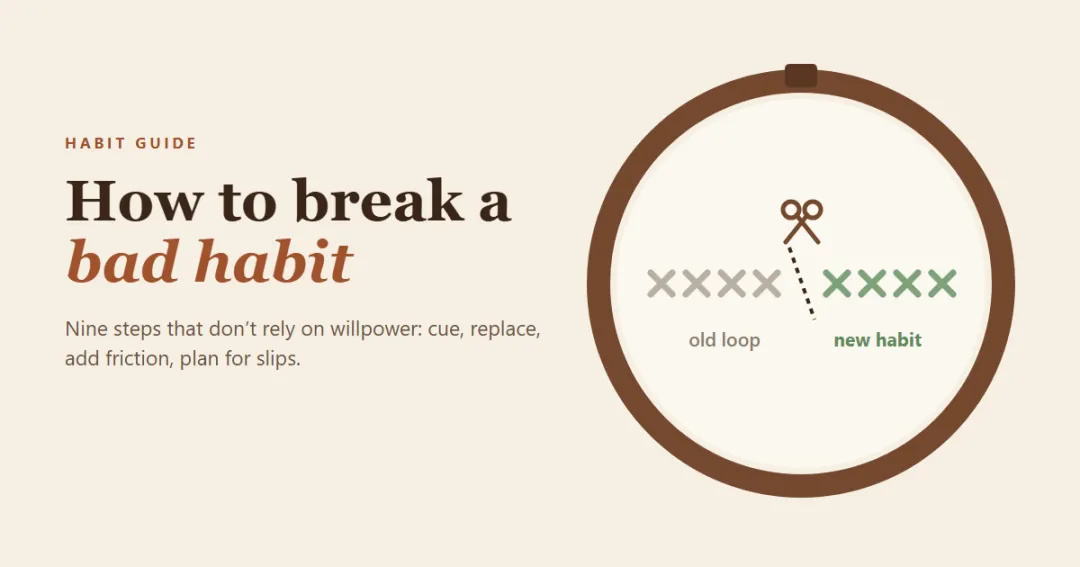
How to break a bad habit — a thread being cut and re-stitched into a new pattern

Productivity

How to Break a Bad Habit: 9 Steps That Work (Without Relying on Willpower)

Willpower alone rarely breaks a habit. Here's a 9-step method that does — find the cue, change your environment, replace the habit, add friction, plan for slips — with examples for phone scrolling, snacking, impulse spending, procrastination and more.

9 min read
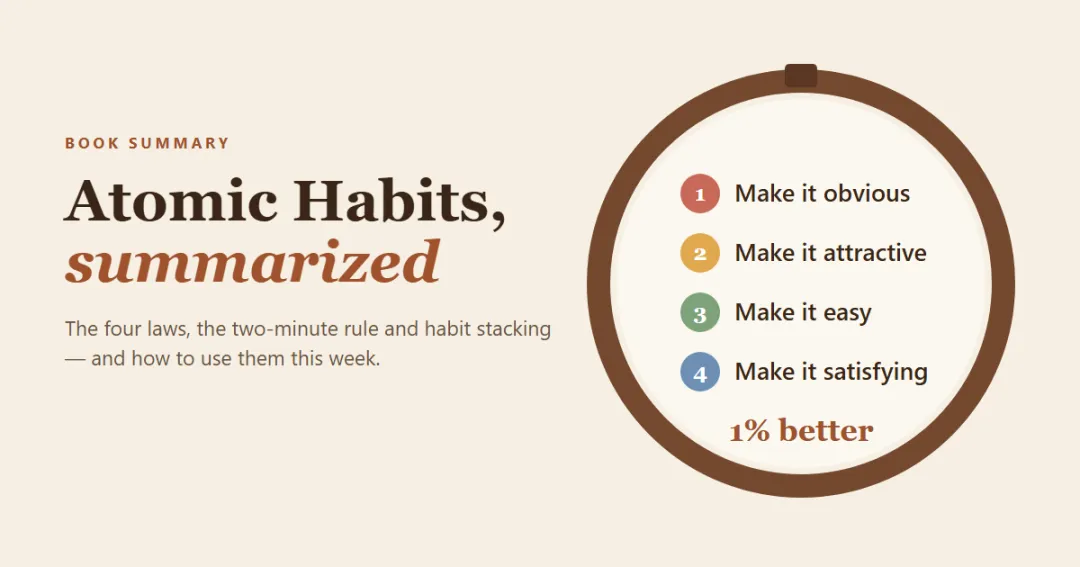
Atomic Habits summary — four laws: make it obvious, attractive, easy and satisfying

Productivity

Atomic Habits Summary: The 4 Laws, Key Ideas and How to Use Them

A plain-English summary of James Clear's Atomic Habits: the 1% idea, identity-based habits, the habit loop, the Four Laws of Behavior Change (and how to invert them to break bad habits), the two-minute rule, habit stacking and habit tracking — with examples you can use this week.

9 min read

More from VaultlyApps

Related projects

All projects
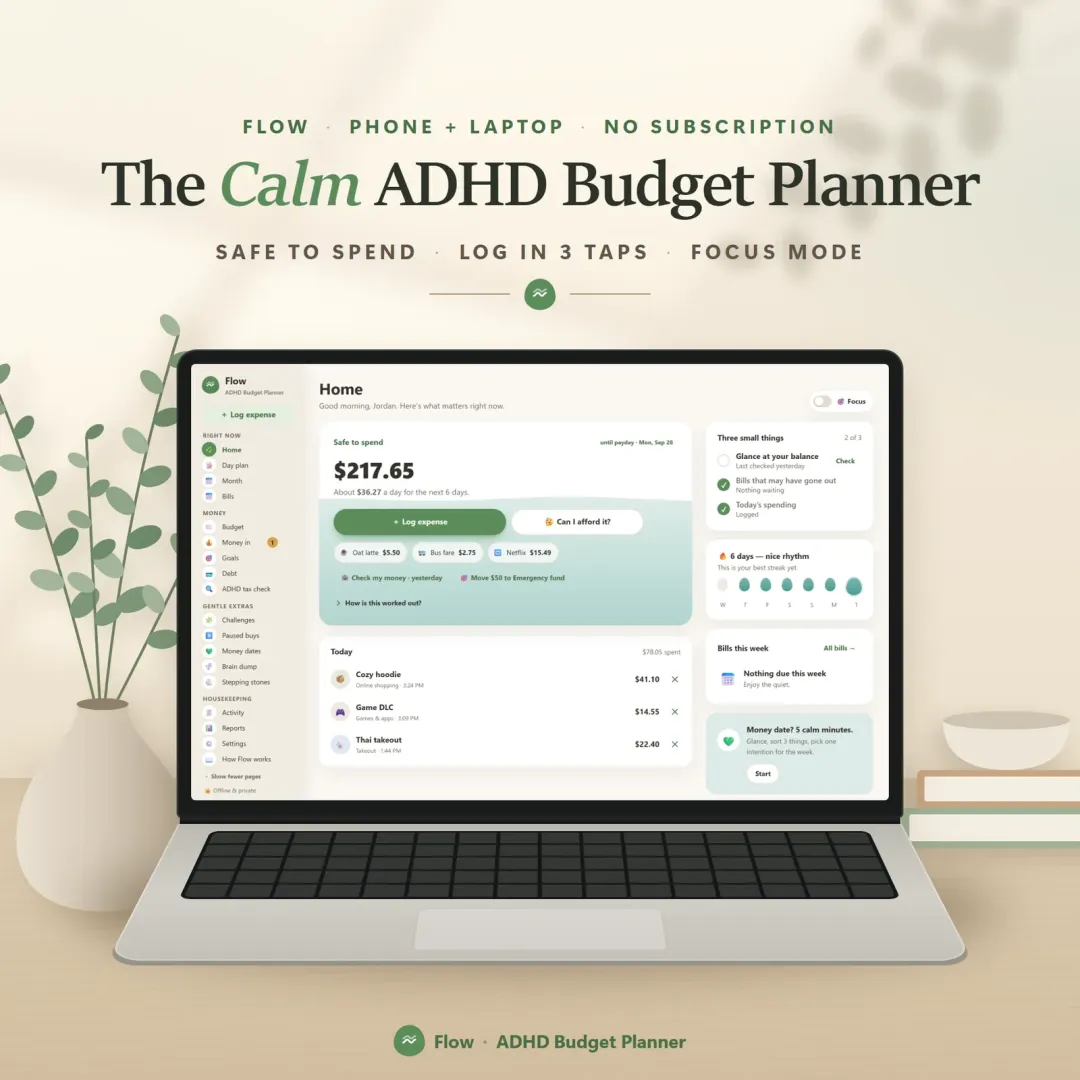
Flow ADHD budget planner showing a calm Safe to Spend screen Live
Flow app icon

Flow

ADHD Budget Planner

A calm budget planner designed for ADHD brains — one Safe to Spend number, 3-tap logging, focus mode and kind overspend fixes instead of red warnings.

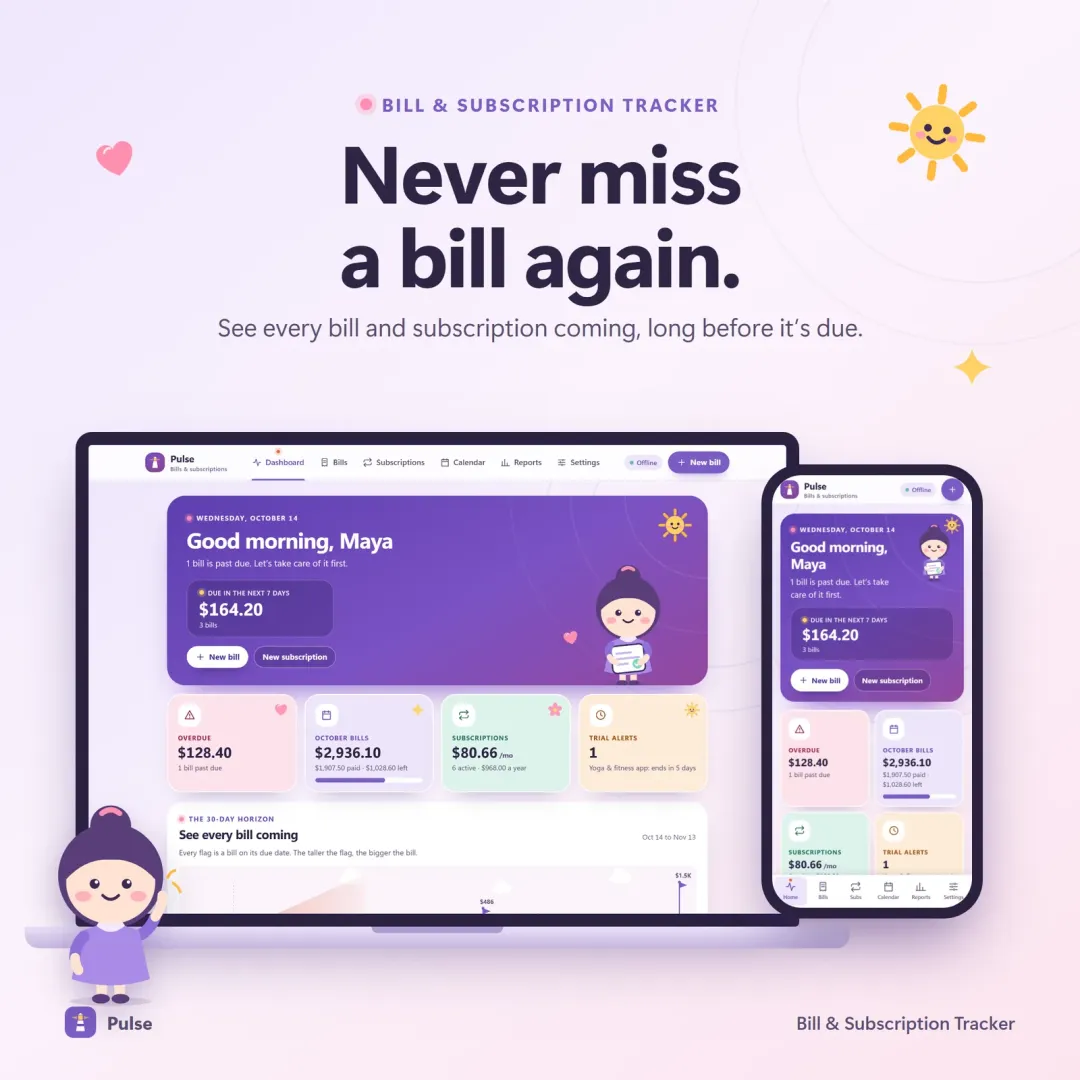
Pulse bill tracker with the 30-day horizon of bill flags and the Penny mascot Live
Pulse app icon

Pulse

Bill & Subscription Tracker

Every bill and subscription in one calm place — a 30-day horizon of due dates, free-trial countdowns and a simulator that shows what cancelling would save.

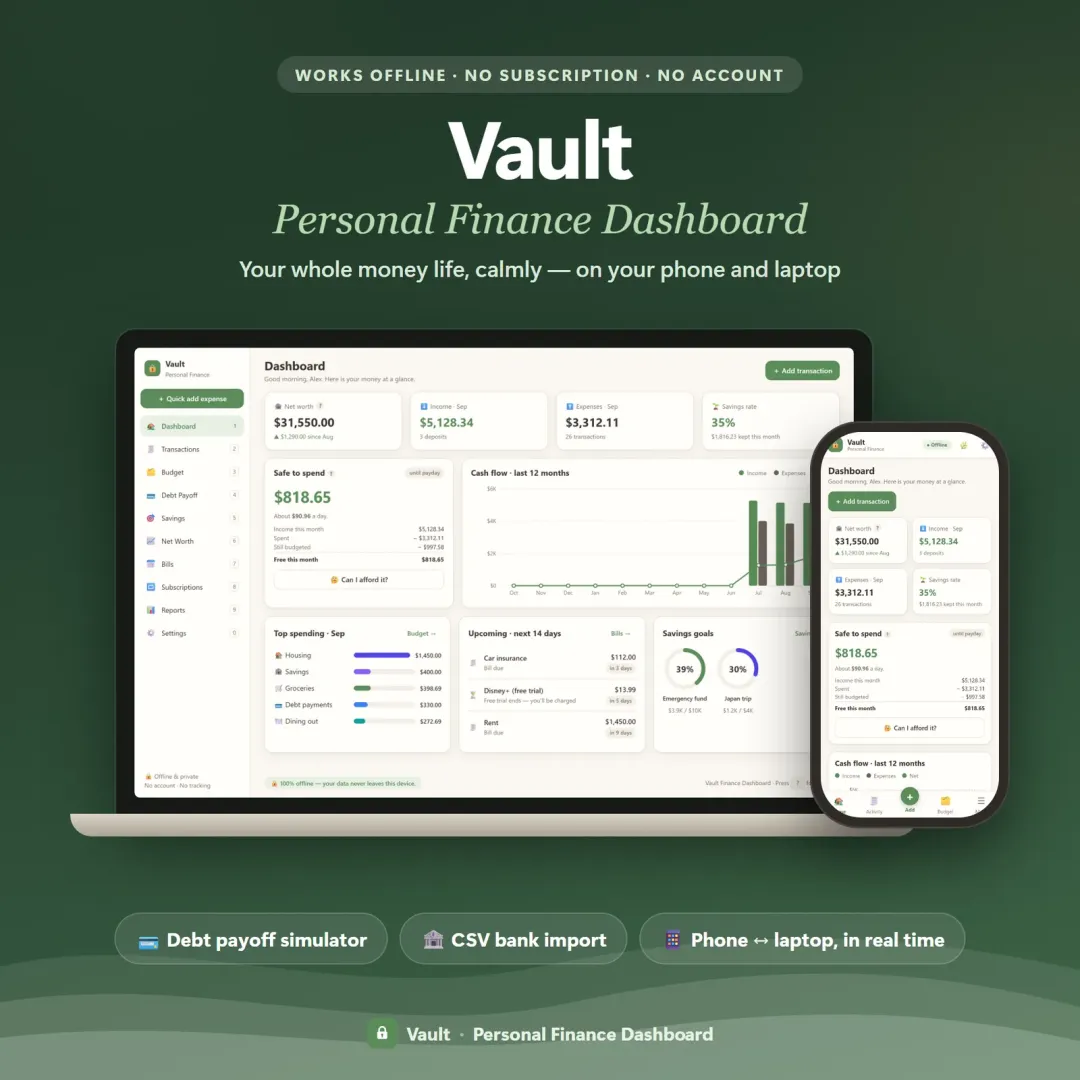
Vault personal finance dashboard shown on a laptop and a phone, with the safe-to-spend number and cash-flow charts Live
Vault app icon

Vault

Personal Finance Dashboard

Your whole money picture on one private dashboard — safe-to-spend, budgets, bills, goals, debt payoff and net worth, on your phone and laptop.

See Hoop in action

The live demo runs in your browser with realistic sample data. Nothing to install, nothing to sign up for.

We use optional cookies for anonymous analytics. Nothing optional is set until you choose. Cookie policy