Atomic Habits Summary: The 4 Laws, Key Ideas and How to Use Them
A plain-English summary of James Clear's Atomic Habits: the 1% idea, identity-based habits, the habit loop, the Four Laws of Behavior Change (and how to invert them to break bad habits), the two-minute rule, habit stacking and habit tracking — with examples you can use this week.
In this article
- The big idea: small habits compound
- The plateau of latent potential
- Systems, not goals
- Identity-based habits
- The habit loop
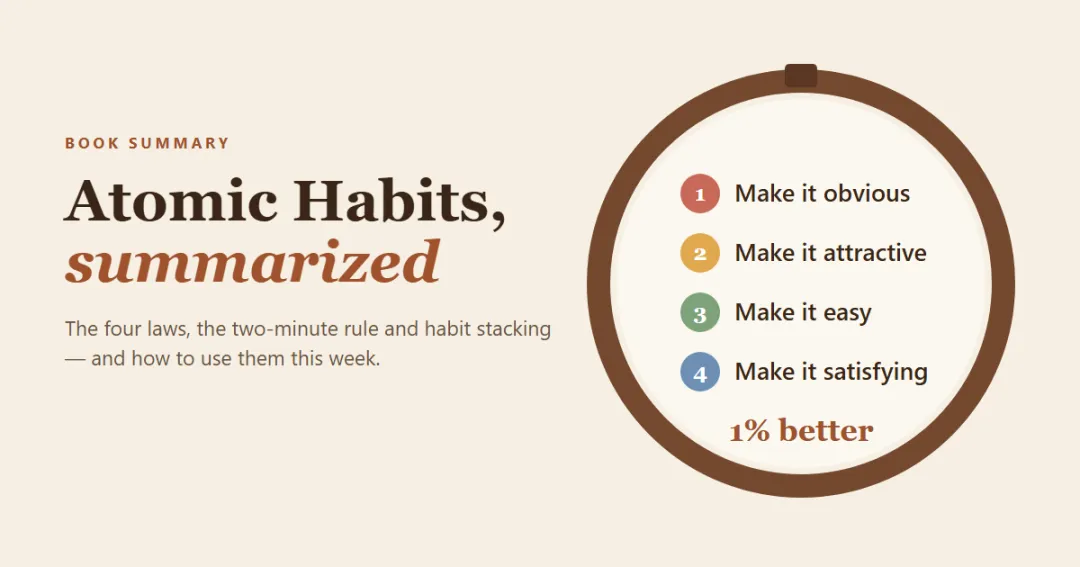
- The Four Laws of Behavior Change
- Law 1: Make it obvious
- Law 2: Make it attractive
- Law 3: Make it easy
- Law 4: Make it satisfying
- Breaking bad habits: invert the laws
- Advanced ideas
- How to use Atomic Habits this week
- Key takeaways
- Put it into practice with Hoop
Atomic Habits by James Clear (2018) is one of the best-selling self-improvement books of the last decade, and for good reason: it turns habit research into a simple, practical system. This Atomic Habits summary covers the book's key ideas in plain English — the 1% rule, identity-based habits, the habit loop, the Four Laws of Behavior Change, the two-minute rule, habit stacking and habit tracking — plus examples of how to use each one this week.
This is an independent summary written in our own words. For the full stories, research and detail, read the book.
The big idea: small habits compound
The title says it: an "atomic" habit is tiny, but it's also a source of great energy — like an atom. Clear's core argument is that small changes, repeated consistently, compound the way money does with interest.
The famous example: if you get 1% better every day for a year, you end up about 37 times better (1.01³⁶⁵ ≈ 37.8). If you get 1% worse every day, you end up near zero (0.99³⁶⁵ ≈ 0.03). Of course real life isn't that precise — the point is that habits that look insignificant on any single day add up to big differences over years. That's the same reason compound interest makes small savings matter.
The plateau of latent potential
Clear explains why people quit: results lag behind effort. You work out for weeks and look the same; you save for months and the balance still feels small. Progress builds out of sight — like an ice cube that doesn't melt from 25°F to 31°F, then melts at 32°F. He calls this the Plateau of Latent Potential. The work isn't wasted; it's stored.
Systems, not goals
A central idea: goals are about the results you want; systems are about the processes that get you there. Winners and losers often have the same goals, so goals alone can't explain success. Goals can also make you unhappy ("I'll be happy once I hit my target") and stop progress once reached.
Instead, focus on the system — the daily habits. If you want to pay off debt, the goal is "be debt-free"; the system is "every payday, an extra $50 goes to the smallest card" (our debt snowball guide shows why that works).
Identity-based habits
Clear describes three layers of change:
- Outcomes — what you get (lose 10 pounds).
- Processes — what you do (go to the gym).
- Identity — what you believe about yourself (I'm someone who moves every day).
Most people start with outcomes. Clear suggests starting with identity: decide the type of person you want to be, then prove it to yourself with small wins. Every action is a vote for the type of person you want to become. You don't need a unanimous vote — just a majority. One missed workout doesn't erase twenty that you did.
Try it: "I'm a reader" (one page a night), "I'm a saver" (move $5 every day), "I'm someone who doesn't miss workouts" (even five minutes counts).
The habit loop
Every habit runs through four steps:
- Cue — something triggers the habit (your phone buzzes).
- Craving — you want the change the habit brings (to know what the message says).
- Response — you do the habit (pick up the phone).
- Reward — you get the payoff (you read it), and your brain learns to repeat the loop.
Each of the four laws targets one step of the loop.
The Four Laws of Behavior Change
| Step | Build a good habit | Break a bad habit |
|---|---|---|
| Cue | 1. Make it obvious | Make it invisible |
| Craving | 2. Make it attractive | Make it unattractive |
| Response | 3. Make it easy | Make it difficult |
| Reward | 4. Make it satisfying | Make it unsatisfying |
Law 1: Make it obvious
- Implementation intentions. Decide exactly when and where: "I will [behavior] at [time] in [location]." Vague plans ("I'll read more") fail; specific ones ("I'll read at 9 pm in bed") don't.
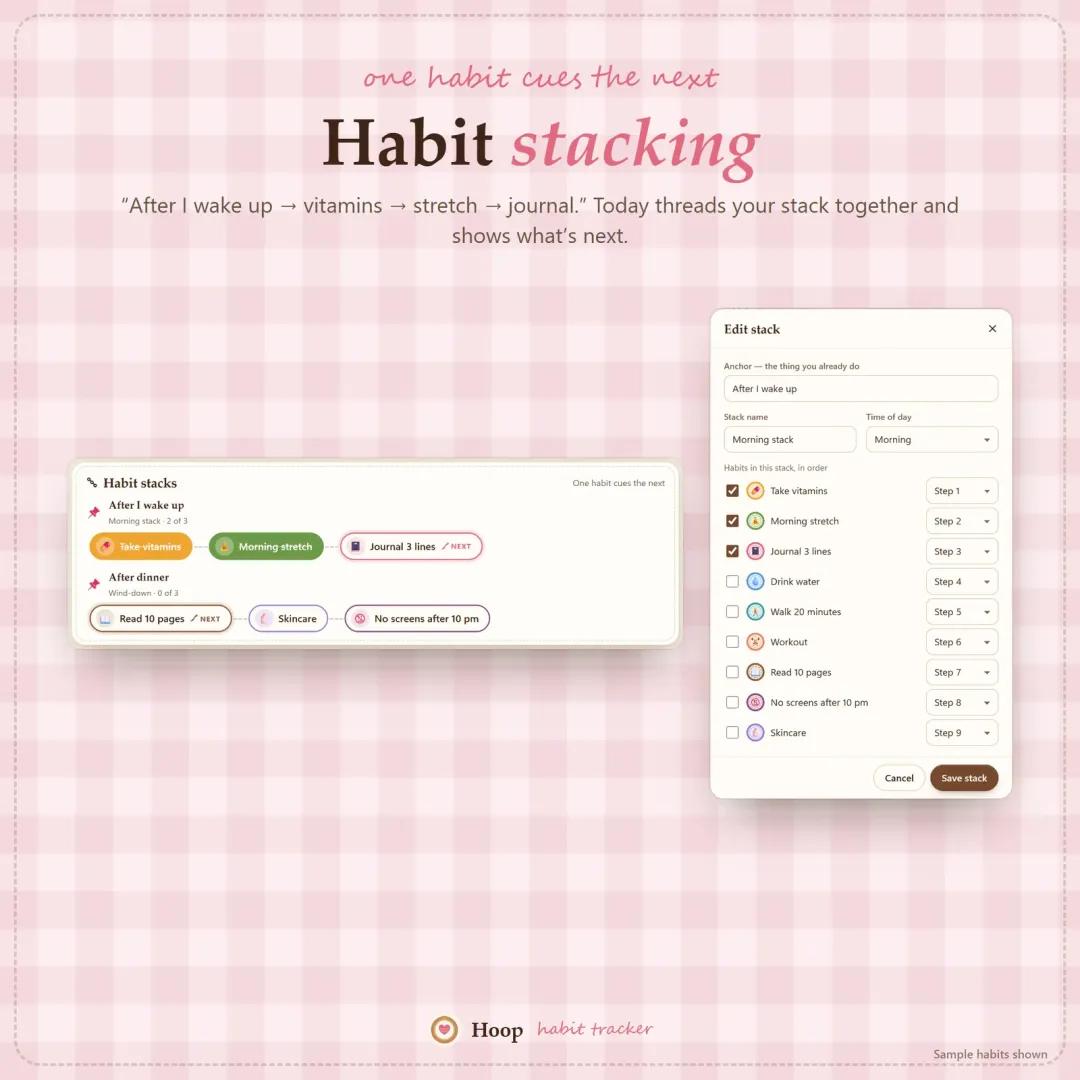
- Habit stacking. Link a new habit to an existing one: "After I [current habit], I will [new habit]." After I pour my coffee, I'll write my top three tasks. More habit stacking examples are in our guide to how long it takes to form a habit.
- Design your environment. Make cues for good habits visible — the guitar in the middle of the room, fruit on the counter, a water bottle on the desk.
Law 2: Make it attractive
- Temptation bundling. Pair something you need to do with something you want to do: only listen to your favorite podcast while walking, only watch your show on the exercise bike.
- Join a culture where your desired behavior is normal. We copy the people close to us, the many and the powerful. Spend time with people who already have the habits you want.
- Reframe it. "I get to go for a run" instead of "I have to".
Law 3: Make it easy
- Reduce friction. Lay out your gym clothes the night before; prep vegetables on Sunday; set up automatic savings transfers.
- The two-minute rule. Scale a new habit down to two minutes: "read before bed" becomes "read one page"; "do yoga" becomes "take out my yoga mat". The aim is to master the art of showing up — a habit must be established before it can be improved.
- Repetitions over time. Clear stresses that habits form through the number of times you do them, not the number of days that pass. Practice beats planning.
Law 4: Make it satisfying
- Immediate rewards. We repeat what feels good now. Give a delayed-reward habit an instant payoff: when you skip a purchase, move that amount into a savings account labelled for something fun.
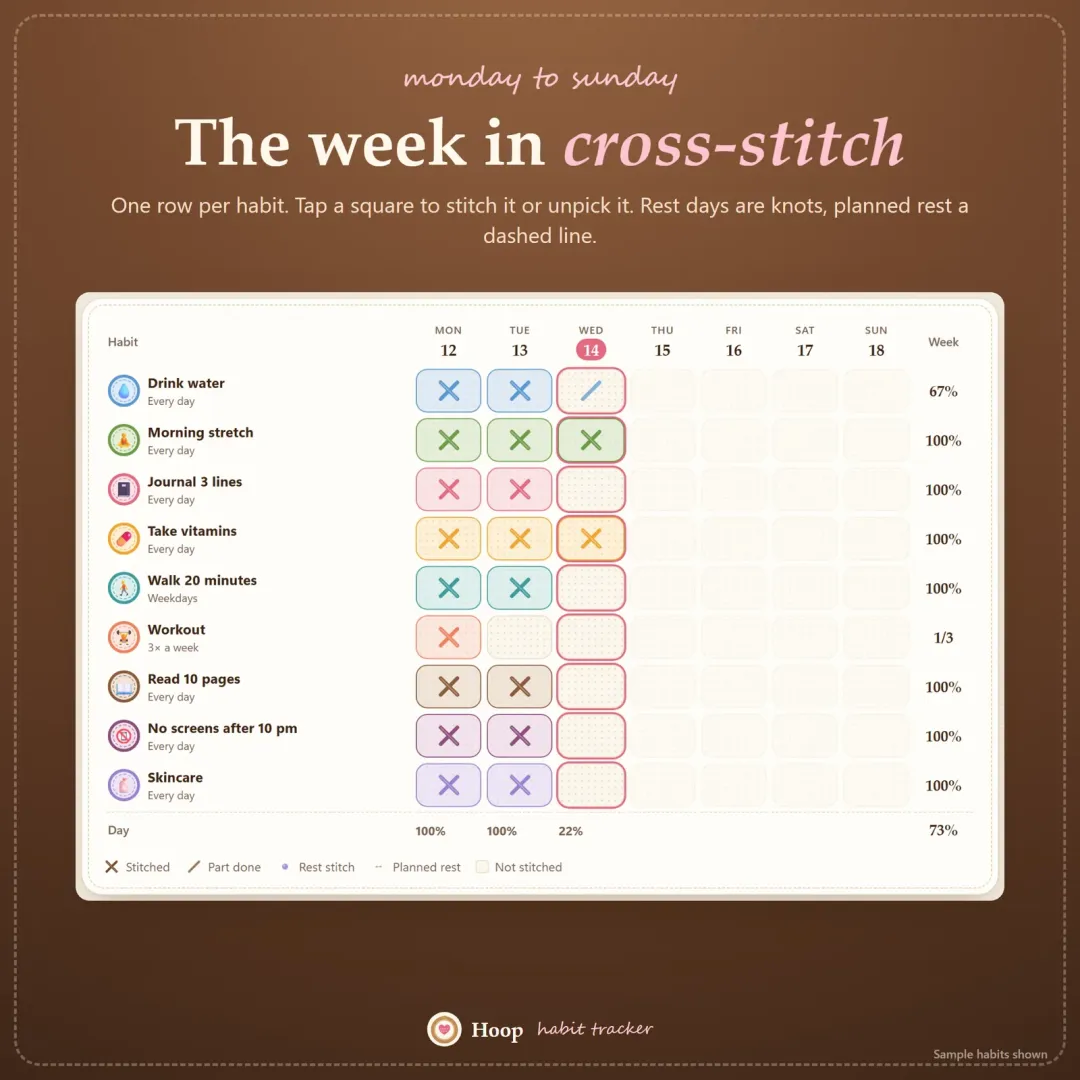
- Habit tracking. Marking an X on a calendar is a small reward in itself, and a visible streak makes you want to keep it going. Don't break the chain.
- Never miss twice. Missing once is an accident; missing twice is the start of a new habit. When you slip, get back on track the next day.
Breaking bad habits: invert the laws
To break a bad habit, flip each law:
- Make it invisible — remove cues: phone in another room, no snacks on the counter, unsubscribe from shopping emails.
- Make it unattractive — list the real costs; reframe ("scrolling makes me feel worse, not better").
- Make it difficult — add friction: log out of apps, delete saved cards, put the TV remote in a drawer.
- Make it unsatisfying — an accountability partner or a habit contract that makes the cost of the bad habit immediate.
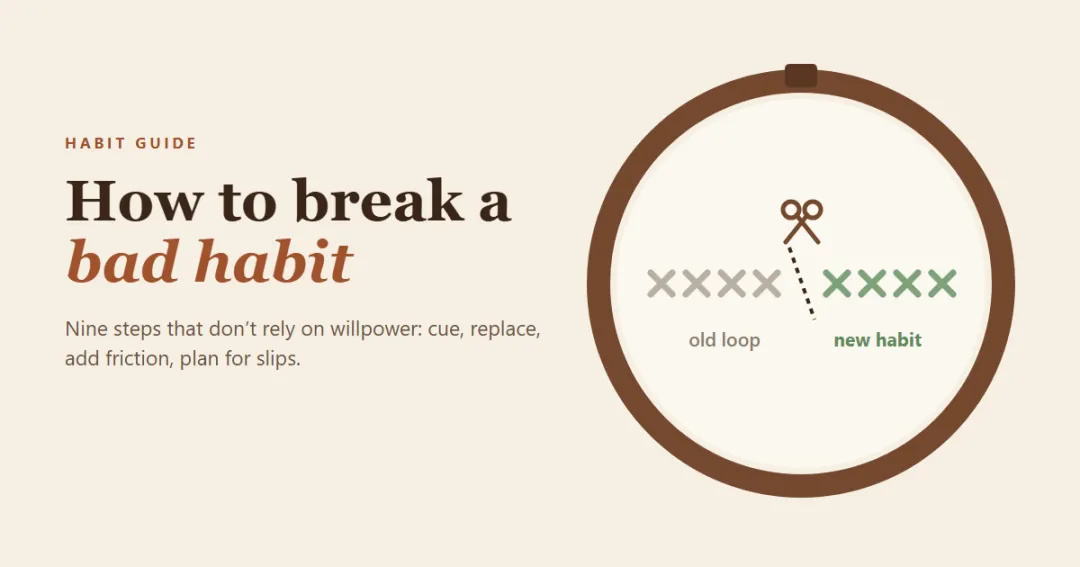
We go deeper on this in how to break a bad habit.
Advanced ideas
- The Goldilocks Rule. We stay motivated when tasks are just at the edge of our ability — not too easy, not too hard.
- Boredom is the real enemy. Professionals stick to the schedule when it's dull; amateurs wait for motivation.
- Habits plus deliberate practice. Once a habit is automatic, review and refine it, or you'll plateau.
- Reflection and review. Clear does an annual review and an integrity report. A short weekly review is an easy way to start.
How to use Atomic Habits this week
- Pick one identity you want to vote for ("I'm someone who saves", "I'm a reader").
- Choose one two-minute habit that proves it.
- Write an implementation intention or habit stack: "After I [X], I will [Y]."
- Make it easy: prepare everything the night before.
- Track it and never miss twice.
- Review on Sunday: what helped, what got in the way, one small change.
Key takeaways
- Small habits compound — focus on getting 1% better.
- Fall in love with systems, not goals.
- Build habits around identity: every action is a vote.
- Use the habit loop: cue, craving, response, reward.
- Four laws: obvious, attractive, easy, satisfying — inverted to break bad habits.
- Start with two minutes; show up first, improve later.
- Track your habits and never miss twice.
Put it into practice with Hoop
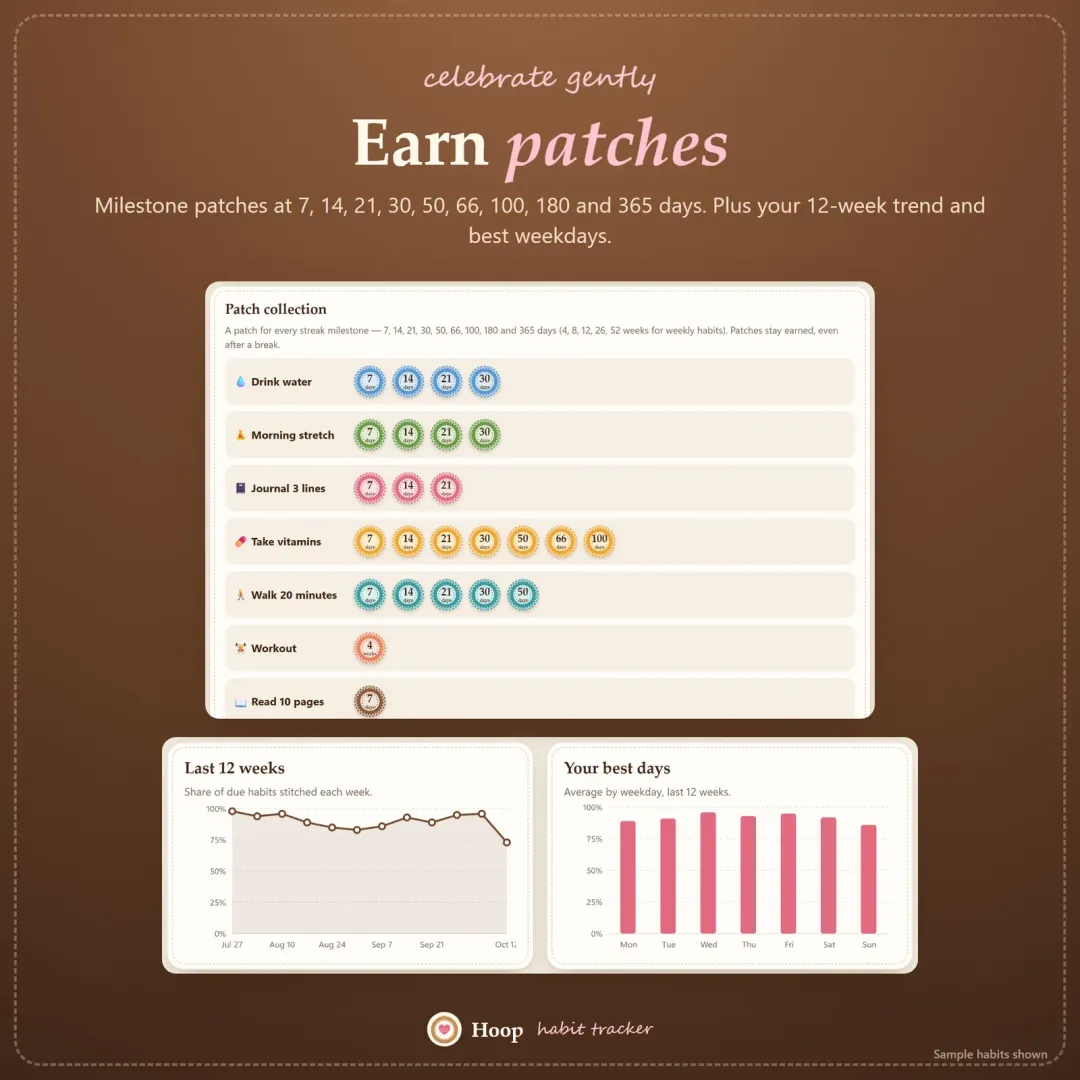
Hoop is a habit tracker built on these same ideas. Every habit gets a cue and a time of day (Law 1), habits chain into stacks, an ADHD-friendly "tiny steps" routine turns the two-minute rule into one tap (Law 3), and each habit you stitch fills a petal in your daily hoop (Law 4). Streaks allow rest days, which fits "never miss twice" better than a tracker that resets on one slip, and patches mark your milestones along the way.
Try the free Hoop demo — no sign-up.
Atomic Habits is written by James Clear and published by Avery (Penguin Random House). VaultlyApps is not affiliated with the author or publisher.
Frequently asked questions
What is the main idea of Atomic Habits?
What are the 4 laws of Atomic Habits?
What is the two-minute rule?
What does '1% better every day' mean?
What are identity-based habits?
Is Atomic Habits worth reading?
How long does it take to form a habit according to Atomic Habits?
Written by
Finance Specialist & Editor, VaultlyApps
Emma Whitfield writes and edits the VaultlyApps money guides and free calculators. Her focus is US household finance — budgeting on a real paycheck, paying down credit card and student debt, emergency funds and savings goals, renting — and the money side of freelancing and small-business income, from pricing and profit margins to self-employment tax. Every guide is researched against primary sources such as IRS publications and the CFPB, every number is checked in our tested calculators, and tax content is reviewed each year when new IRS figures come out. Emma is not a licensed financial adviser or tax preparer; her work is general education, not personal advice.
Researched against primary US sources, checked with our calculators and reviewed by a finance expert on our team. Written for US readers — general education, not financial, tax or legal advice. Editorial policy · Disclaimer