LLC vs Sole Proprietorship in 2026: Taxes, Costs, Protection and Which to Choose
Should you form an LLC or stay a sole proprietor? For most small businesses the taxes are exactly the same; the real differences are liability protection, state fees and paperwork. Here's a clear 2026 comparison with real tax numbers, what an LLC costs in each state, when an S corp election starts to pay, and a simple way to decide.
In this article
- The quick comparison
- Taxes: why they're usually the same
- Where an LLC changes your taxes: the S corp election
- What an LLC costs by state
- Liability: what an LLC does and doesn't protect
- When a sole proprietorship is enough
- When to form an LLC
- Taxes and paperwork that apply either way
- How to decide in five minutes
- Know your profit before you choose
When you start earning money on your own, from an Etsy shop, freelance clients or a side hustle, you're automatically a sole proprietor. Sooner or later someone tells you to "get an LLC". Is it worth it?
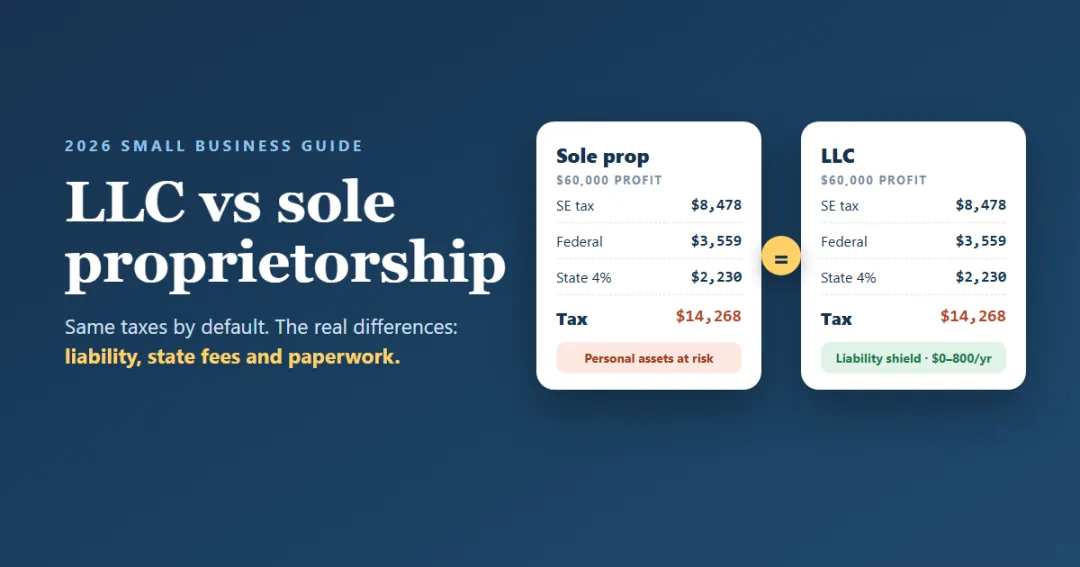
The short answer surprises most people: for taxes, usually nothing changes. A single-member LLC pays exactly the same tax as a sole proprietorship unless it elects otherwise. The real differences are liability protection, state fees and paperwork. This guide compares them with real 2026 numbers so you can decide.
The quick comparison
| Sole proprietorship | Single-member LLC | |
|---|---|---|
| How to start | Automatic when you start selling | File articles of organization with your state |
| Startup cost | $0 (a DBA name is often $10–100) | $35–500 filing fee |
| Yearly cost | $0 | $0–800+ depending on the state |
| Federal income tax | Schedule C on your Form 1040 | The same, by default |
| Self-employment tax | 15.3% on profit | The same, by default |
| QBI deduction (up to 20%) | Yes | Yes |
| Personal liability | You're personally liable for business debts and lawsuits | Generally limited to what the LLC owns |
| Can elect S corp tax | No | Yes |
| Paperwork | Minimal | Annual report in most states, operating agreement |
| Credibility | Fine for most buyers | Looks more established to some clients |
Taxes: why they're usually the same
The IRS treats a single-member LLC as a disregarded entity: it ignores the LLC and taxes you as the owner. You file the same Schedule C, pay the same income tax, and pay the same self-employment tax: 15.3% on 92.35% of your profit (12.4% Social Security up to the $184,500 wage base in 2026, plus 2.9% Medicare).
Here's a single filer with a 4% state tax, sole proprietor or single-member LLC:
| Business profit | Self-employment tax | Federal income tax | State tax | Total |
|---|---|---|---|---|
| $40,000 | $5,652 | $1,775 | $1,487 | $8,914 |
| $60,000 | $8,478 | $3,559 | $2,230 | $14,268 |
| $100,000 | $14,130 | $8,235 | $3,717 | $26,082 |
These include the standard deduction, the deduction for half of SE tax and the qualified business income (QBI) deduction, which the 2025 tax law made permanent at 20%. See your own numbers with the 1099 tax calculator or the LLC tax calculator, which also adds your state's LLC fee.
A multi-member LLC is different: by default it's taxed as a partnership, files Form 1065 and gives each owner a Schedule K-1. The total tax is similar, but the paperwork and tax-prep cost are higher.
Where an LLC changes your taxes: the S corp election
An LLC can choose to be taxed as an S corporation. You then pay yourself a reasonable salary through payroll, and the rest of the profit comes out as distributions that don't pay the 15.3% self-employment tax. A sole proprietor can't do this without first forming an entity.
Single filer, 4% state tax, with about $2,500 a year of extra costs for payroll and the extra tax return:
| Profit | Salary | Sole prop / LLC tax | S corp total | You save |
|---|---|---|---|---|
| $60,000 | $35,000 | $14,268 | $13,971 | $297 |
| $80,000 | $45,000 | $19,621 | $18,531 | $1,090 |
| $120,000 | $60,000 | $32,923 | $29,879 | $3,044 |
| $200,000 | $90,000 | $60,866 | $53,547 | $7,319 |
The election rarely pays below about $50,000–60,000 of profit, and the IRS expects a salary close to what you'd pay someone else for the work. Try different salaries in the S corp tax calculator.
What an LLC costs by state
The LLC itself is cheap in most states, but a few are expensive:
| State | Filing fee | Yearly cost |
|---|---|---|
| Montana | $35 | About $20 annual report |
| Kentucky | $40 | $15 annual report |
| Arizona | $50 | No annual report |
| Texas | $300 | No annual report fee (franchise tax only above a high revenue threshold) |
| Nevada | $425 total to start | About $350 a year |
| Massachusetts | $500 | About $500 a year |
| California | $70 | At least $800 franchise tax a year, from the first year |
| New York | $200 | $9 every two years, plus a one-time publication requirement that can cost $1,000 or more |
Fees change, so confirm with your Secretary of State. Form the LLC in the state where you live and work: a "cheap" state like Wyoming or Delaware usually means registering in your home state too, and paying both.
Good news on paperwork: US LLCs no longer have to file a beneficial ownership (BOI) report. FinCEN's final rule took effect on August 14, 2026, and permanently exempts domestic companies.
Liability: what an LLC does and doesn't protect
This is the real reason to form an LLC. As a sole proprietor, there's no line between you and the business: if a customer sues or the business can't pay a debt, your savings, car and home can be at risk.
An LLC puts a wall between business debts and your personal assets. But it's not a force field:
- You're still liable for your own mistakes. If you personally injure someone or give negligent professional advice, the LLC doesn't shield you.
- Personal guarantees on loans, leases and credit cards make you personally liable anyway.
- Mixing money breaks the wall. Courts can "pierce the veil" if you pay personal bills from the business account or don't keep the LLC separate.
Keep a separate business bank account, sign contracts in the LLC's name, and consider business liability insurance, which protects a sole proprietor and an LLC alike, often for a few hundred dollars a year.
When a sole proprietorship is enough
- You're testing an idea or earning a few thousand dollars a year.
- The work is low risk: digital downloads, writing, design, tutoring.
- You have no employees, leases or business loans.
- You live in a state with high LLC fees and your profit is small.
Many Etsy sellers and freelancers start this way. Our Etsy shop ideas and guide to whether selling on Etsy is worth it help you test an idea before spending on formation.
When to form an LLC
- You sell physical products that could injure someone: candles, cosmetics, food, children's items.
- You sign leases or contracts, rent a workspace or take on business debt.
- You hire employees or contractors.
- Your profit is steady and growing, and you want to elect S corp status later.
- Clients or platforms ask for a business entity.
Taxes and paperwork that apply either way
- Quarterly estimated taxes if you'll owe $1,000 or more; see quarterly estimated taxes.
- Form 1099-NEC from clients who pay you $2,000 or more from 2026 (it was $600), and Form 1099-K from payment apps and marketplaces above $20,000 and 200 transactions. You owe tax on all profit, even without a form.
- A free EIN from the IRS keeps your Social Security number off client forms.
- Separate bank account and records, so taxes and any LLC protection hold up.
- Paying yourself: as a sole proprietor or single-member LLC you take owner's draws, not a salary; see how to pay yourself as a small business owner.
How to decide in five minutes
- Could a customer, client or landlord claim more than you could pay? → LLC (plus insurance).
- Is your profit above about $60,000 and steady? → LLC, then compare an S corp election.
- Low risk, small or uncertain income, high state fees? → Stay a sole proprietor for now, with insurance and a separate account.
Whichever you choose, set aside money for tax from every payment; the self-employment tax calculator shows how much.
Know your profit before you choose
Till is a small business profit planner that splits every payment into costs, a tax set-aside and your own pay, so you can see your real profit and when an LLC or S corp starts to make sense. Try the free demo with a sample business.
General information as of October 2026, not legal or tax advice. Talk to a CPA or attorney about your situation.
Frequently asked questions
Do LLCs pay less tax than sole proprietors?
Is an LLC better than a sole proprietorship?
How much does it cost to form an LLC?
Do I need to file a BOI report for my LLC?
Can a sole proprietor have an EIN?
When should I switch from a sole proprietorship to an LLC?
Written by
Finance Specialist & Editor, VaultlyApps
Emma Whitfield writes and edits the VaultlyApps money guides and free calculators. Her focus is US household finance — budgeting on a real paycheck, paying down credit card and student debt, emergency funds and savings goals, renting — and the money side of freelancing and small-business income, from pricing and profit margins to self-employment tax. Every guide is researched against primary sources such as IRS publications and the CFPB, every number is checked in our tested calculators, and tax content is reviewed each year when new IRS figures come out. Emma is not a licensed financial adviser or tax preparer; her work is general education, not personal advice.
Researched against primary US sources, checked with our calculators and reviewed by a finance expert on our team. Written for US readers — general education, not financial, tax or legal advice. Editorial policy · Disclaimer