What Is the ADHD Tax? The Real Costs and How to Stop Paying Them
The ADHD tax is the extra money people with ADHD lose to late fees, forgotten subscriptions and missed returns. Here's where it comes from, how to add up yours and the systems that bring it down.

In this article
- What counts as the ADHD tax?
- Why does ADHD make money so expensive?
- Add up your own ADHD tax
- How to stop paying the ADHD tax
- Bills: remove memory from the job
- How to organize bills
- Subscriptions and trials: catch them on the way in
- Returns: make them a same-day job
- Impulse buys: build in a pause
- Food: plan for the tired version of you
- Lost things: give them a home and a spare
- ADHD money management that actually fits
- Forgive the backlog
- An app built around the ADHD tax
- When to get more help
You forgot to return the $60 shoes until the window closed. The free trial turned into a yearly charge. The electric bill was paid on time in every way except actually being paid. None of these feels like much on its own, but together they have a name: the ADHD tax.
What counts as the ADHD tax?
It's usually a lot of small costs rather than one big one. Here are the most common:
- Late fees and overdrafts: the money was there, but the bill wasn't paid in time.
- Forgotten subscriptions and free trials: services you stopped using, and trials you meant to cancel.
- Missed returns and refunds: the item is in the bag, the bag is by the door, and the window closed last week.
- Buying things twice: you've lost it, or you can't find it, or you forgot you already had it.
- Lost and replaced items: keys, chargers, glasses, cards and bottles, and the fees that come with replacing them.
- Food that goes to waste: you bought ingredients with a plan, then ordered delivery because cooking felt impossible.
- Rush fees: express shipping, last-minute tickets and the taxi you took because you lost track of time.
- Tickets and penalties: parking tickets, library fines, expired registrations and tax penalties for filing late.
- Impulse buys: especially the ones that were really about a dopamine hit on a hard day.
It can have a time and energy cost too: the hours spent looking for things, redoing paperwork or recovering from a missed deadline. And many people mention a kind of shame tax, where avoiding the money app for weeks makes each problem bigger.
Why does ADHD make money so expensive?
ADHD doesn't make anybody bad with money. It affects the exact skills that everyday money admin depends on:
- Time blindness. "Due in three weeks" doesn't feel real until it's overdue. Our guide to time blindness goes further into this.
- Working memory. "I'll cancel that later" has nowhere to live, so it disappears.
- Task initiation. Paying a bill is simple, but that doesn't make it easy to start. A boring task with no deadline pressure can be very hard to begin.
- Impulsivity. Shopping apps are built to remove the pause that an ADHD brain already finds hard to make.
- Dopamine seeking. A new purchase gives a real lift, and that's hard to compete with on a low day. A dopamine menu gives you cheaper options.
- Avoidance. After a few money mistakes, opening the banking app starts to feel threatening, so it stops happening, and the costs grow. This is sometimes called money avoidance, and it's covered in our guide to financial anxiety.
The research takes this seriously. A 2020 study in Science Advances (opens in a new tab) linked Swedish population records with credit data and found that people with ADHD started adulthood with similar default rates after accounting for factors like income and education, but their risk of defaulting on debt rose with age, peaking at more than six times the general population's by around age 40. It's one country and it shows a link rather than a cause, but it matches what people describe: the costs tend to build up over time, and they're worth taking seriously early.
Add up your own ADHD tax
The number is more useful than the idea, so take 20 minutes (set a timer, and try body doubling if it helps) and go through your last three months of bank and card statements. Then multiply by four. Here's a made-up example of what a year might look like:
| Cost | How it happened | Per year |
|---|---|---|
| Takeout when dinner plans fell through | $20, every other week | $520 |
| Two forgotten subscriptions | $15 a month each | $360 |
| Missed returns | 4 items at about $40 | $160 |
| Bought twice or replaced | 6 items at about $20 | $120 |
| Late fees | 3 at $35 | $105 |
| Parking ticket and a replacement ID | 2 at about $45 | $90 |
| Overdraft fees | 2 at about $27 | $54 |
| Total | $1,409 |
That's about $117 a month, or a noticeable amount of a tight budget. Please don't treat your total as a score. It's a list of the fixes likely to pay off most, so start with the biggest line.
How to stop paying the ADHD tax
Trying harder is the plan that's already failed. A good system needs to work on your worst day, so aim for fewer decisions and fewer things to remember.
Bills: remove memory from the job
- Put fixed bills on autopay, at least for the minimum payment on cards.
- Line up due dates. Ask each company to move your bill to just after payday. A few dates are far easier to manage than many. This also helps you avoid overdraft fees.
- Add calendar alerts the evening before each bill and payday. An alert you can see beats a good intention.
How to organize bills
Keep one list that everything goes on: the bill, the amount, the due date, how it's paid and where to log in. Keep it in one app, or as one sheet of paper on the fridge. Then move paperwork to paperless where you can, so nothing gets lost in a pile. For the paper that remains, use a single open tray rather than folders. If you can't see it, it may as well not exist.
Subscriptions and trials: catch them on the way in
When you start a free trial, immediately set a reminder for two days before it ends, or cancel right away if the service lets you keep the trial. Use a virtual card or a low-limit card for trials if you have one. Every few months, track down all your subscriptions and see what they add up to with the subscription cost calculator.
Returns: make them a same-day job
Keep a return bag in the car or by the door, with the receipt inside. Write the last return date on the bag in thick marker and add it to your phone's calendar. If you won't get to it within a week, consider whether it's worth buying from places with long return windows or free pickup.
Impulse buys: build in a pause
Use a 48-hour rule: non-essentials go on a list, and you come back two days later. Remove saved cards from shopping sites and delete the shopping apps from your phone, so buying takes a few more steps. Our guide on how to stop impulse buying has 15 more ideas.
Food: plan for the tired version of you
Keep a few no-effort meals at home, so "too tired to cook" doesn't automatically mean a $25 delivery. Then budget for some takeout on purpose. Planned takeout is a choice, while unplanned takeout is a fee.
Lost things: give them a home and a spare
Keep a tracker tag on your keys and wallet, and buy spares of the things you keep replacing, such as chargers. A spare costs less than repeatedly paying rush prices.

ADHD money management that actually fits
Most budgets assume you'll log every purchase in the right category every day, forever. That's the opposite of how ADHD works. A system for budgeting with ADHD works better when it has these features:
- One number instead of 20 categories. "You can spend $40 today" is an answer you can use. A safe-to-spend number does this.
- Logging that takes seconds, or no logging at all. Checking your real balance now and then can replace most of it.
- No punishment for gaps. Streaks and red warnings can make you quit after a missed week. A system should be easy to come back to.
- A short, regular check-in. Think of it as a money date: 10 minutes once a week with a drink you like. Check your balance, look at the bills ahead and do one small job. Then you're done.
- Budget for the ADHD tax itself. Add a line for it. If you set aside $30 a month for mistakes, then a late fee is an expense you've planned for and not a disaster.
- Help from someone else. A partner, a friend or a coach can sit with you while you do it. Being in the same room often makes starting easier.
If your income is the larger problem, how to stop living paycheck to paycheck covers the plan for that, and the paycheck budget calculator shows what's left per day. To help with time as well as money, time blocking for ADHD is a good next read.
Forgive the backlog
If you're avoiding a pile of unopened mail, you don't have to fix all of it today. Pick one envelope. Many companies waive a first late fee if you call and ask, and a short, honest call can settle something you've been dreading for months. When something goes wrong, it helps to ask "what would have prevented this?" rather than "what's wrong with me?" The first question leads to a better system. The second one just leads back to avoidance.
An app built around the ADHD tax
Harbor is our daily spending tracker and paycheck budget planner, and it's made for ADHD brains. You get one number, what's safe to spend today, with bills before payday already kept back. You can type a spend like a text, or skip logging and do a balance check instead. Can it fit? shows a price in days of money and hours of work, with a 48-hour wait list. Money back countdowns track returns, refunds and free trials, and copy-ready scripts help you ask for a fee back or cancel a subscription. There's no red, no streaks, and a Rough day mode that shows just the number. You can try the free demo with sample numbers.
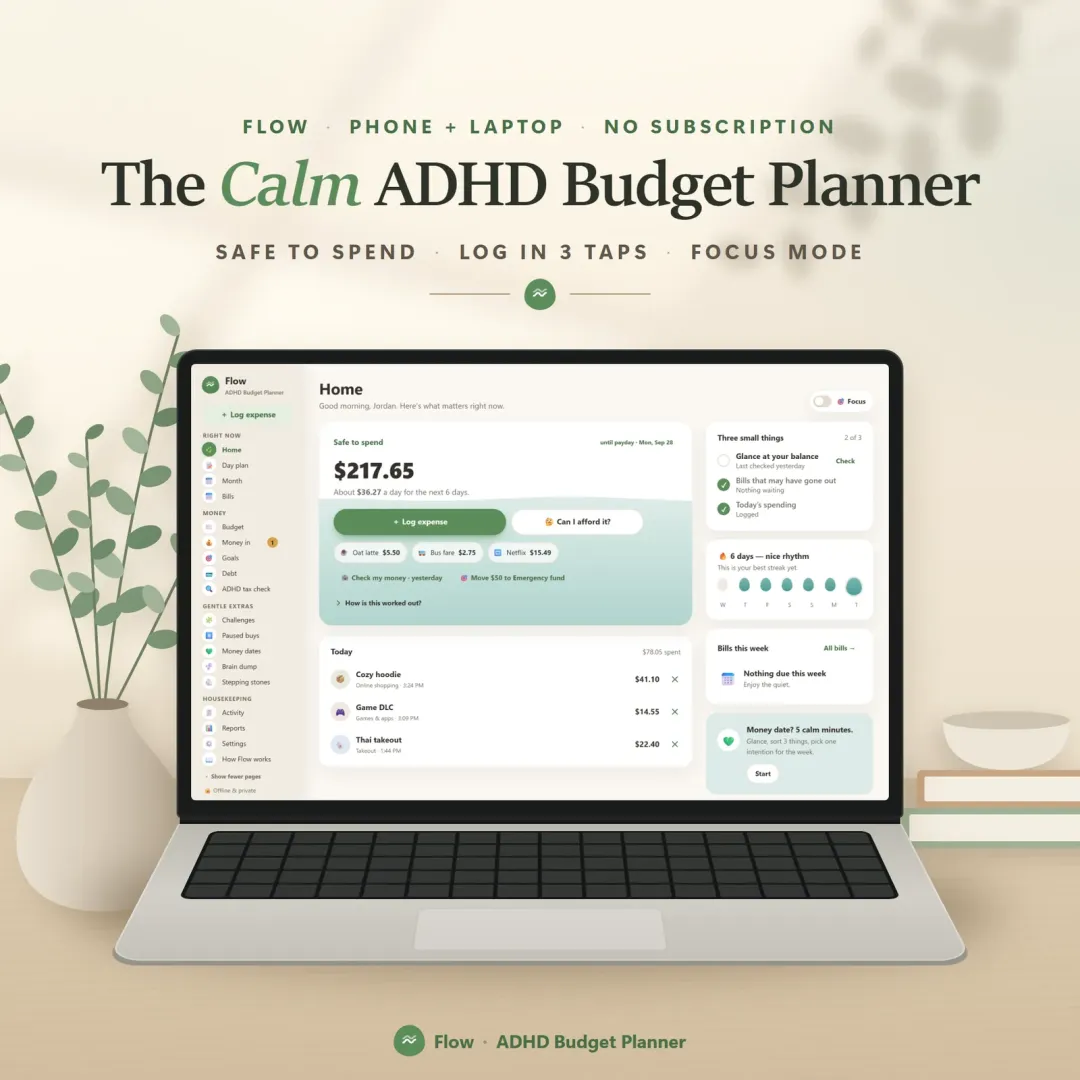
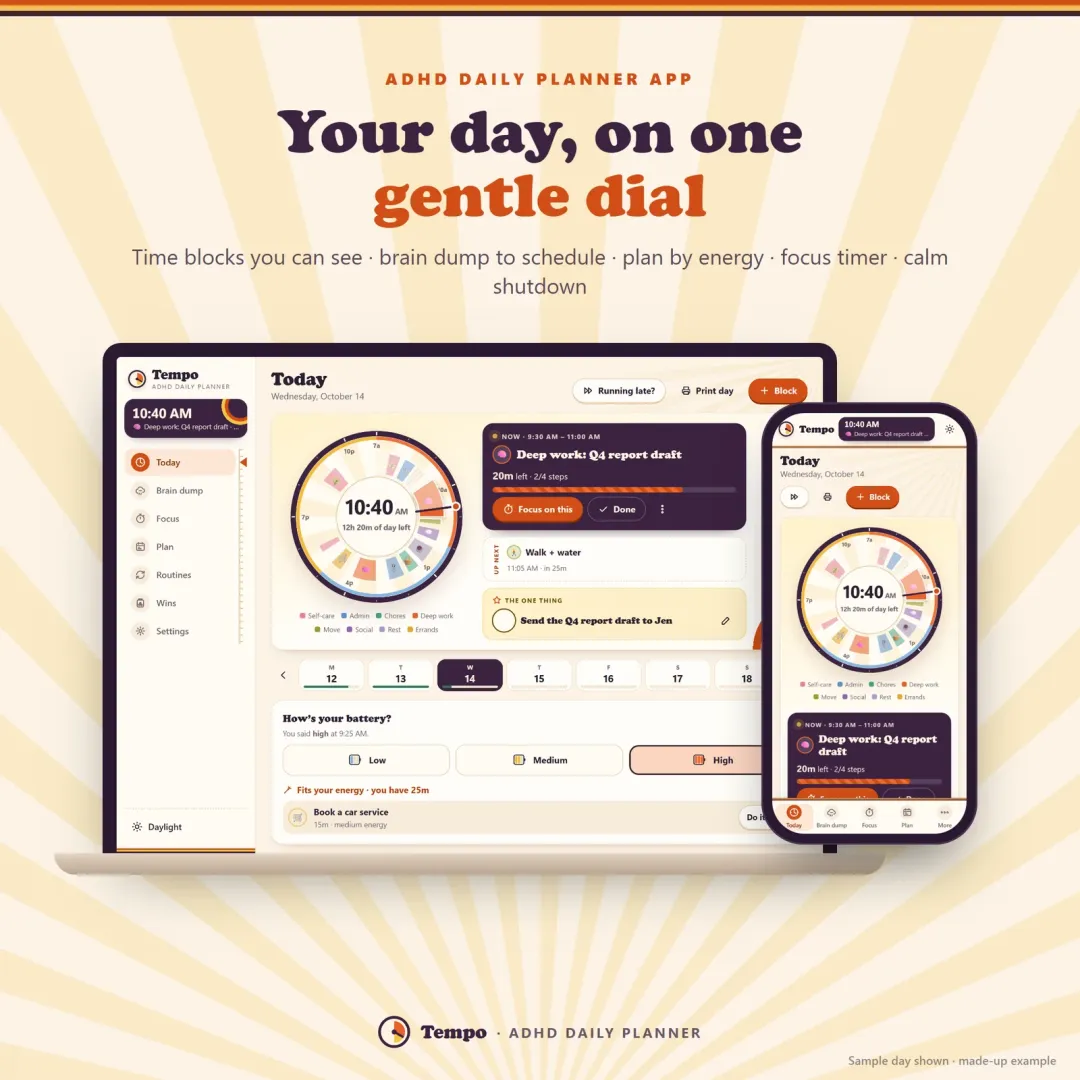
Flow is our broader ADHD budget planner, and Tempo is our ADHD daily planner, for when time is the bigger problem.

When to get more help
If money problems keep causing you real stress, debt or conflict, you don't have to handle them alone. A doctor or psychologist can assess you for ADHD and talk through treatment. A nonprofit credit counselor can help with debt, and a financial therapist can help with the feelings around money.
This article is general information, not medical, mental-health or financial advice.
Frequently asked questions
What is the ADHD tax?
How much does the ADHD tax cost?
Why is managing money so hard with ADHD?
How can someone with ADHD budget?
Can you claim ADHD expenses on your taxes?
How do I stop forgetting to pay bills with ADHD?
Do I need an ADHD diagnosis for these tips to help?
Written by
Finance Specialist & Editor, VaultlyApps
Emma Whitfield writes and edits the VaultlyApps money guides and free calculators. Her focus is US household finance — budgeting on a real paycheck, paying down credit card and student debt, emergency funds and savings goals, renting — and the money side of freelancing and small-business income, from pricing and profit margins to self-employment tax. Every guide is researched against primary sources such as IRS publications and the CFPB, every number is checked in our tested calculators, and tax content is reviewed each year when new IRS figures come out. Emma is not a licensed financial adviser or tax preparer; her work is general education, not personal advice.
Researched against primary US sources, checked with our calculators and reviewed by a finance expert on our team. Written for US readers — general education, not financial, tax or legal advice. Editorial policy · Disclaimer