Time Blindness: What It Is, the Signs, a Quick Self-Check and 12 Ways to Cope
Time blindness is trouble sensing how much time has passed or how long something will take — common with ADHD. What it is, the signs, a 10-question self-check, and 12 practical ways to make time visible.
In this article
- What is time blindness?
- Time blindness and ADHD
- Signs of time blindness
- A quick time blindness self-check
- 12 ways to cope with time blindness
- Make time visible
- Plan with time, not lists
- Use alarms the smart way
- Work with your brain
- How Tempo helps with time blindness
- Time blindness at work, school and home
- When to get help
You sit down to answer "one quick email", and when you look up the whole afternoon has gone. You were sure the drive took 15 minutes; it takes 30, again. A deadline was "ages away" — until it was tomorrow. If that sounds familiar, you may be dealing with time blindness. Here's what it is, how to spot it, and twelve practical ways to make time something you can actually see.
What is time blindness?
Time blindness describes a weak internal sense of time. Three things tend to go wrong:
- Feeling time pass. Ten minutes and an hour feel similar, especially when you're absorbed in something.
- Estimating how long things take. Tasks are judged by their best case: "a shower is five minutes" (it's fifteen).
- Feeling the future. Deadlines, appointments and consequences don't feel real until they're very close — then they feel urgent all at once.
Time blindness isn't a diagnosis by itself, and it isn't laziness or rudeness. It's a way the brain handles time. The psychologist Russell Barkley, one of the best-known ADHD researchers, has described ADHD as a problem with using time well rather than knowing what to do — which is why "just try harder" so rarely works.
Time blindness and ADHD
Time blindness isn't on the official list of ADHD symptoms, but it shows up in many of them: losing track of time, missing deadlines, being late, underestimating tasks, struggling with long-term goals. Studies on time perception have found that, on average, people with ADHD have more trouble estimating and reproducing time intervals than people without it.
Many people describe ADHD time as having only two settings: now and not now. Anything in "not now" is invisible — until it suddenly becomes "now". That's why deadlines feel like they arrive out of nowhere, and why a task that's "for next week" doesn't get started.
People without ADHD experience time blindness too, especially under stress, when sleep-deprived, or when deep in something enjoyable (hyperfocus is the extreme version).
Signs of time blindness
- You're often late, even when you leave "on time".
- You underestimate how long tasks, trips and routines take.
- You lose hours to something absorbing and only notice when it's dark.
- Deadlines feel far away, then suddenly urgent.
- You start things at the last minute because that's when they finally feel real.
- You find it hard to switch from one task to the next.
- You forget future plans unless there's a reminder right before.
- People describe you as unreliable, though you care a lot about being on time.
A quick time blindness self-check
There's no official time blindness test, but this 10-question self-check can help you see whether time is a regular struggle. Answer often, sometimes or rarely:
- I'm late even when I thought I had plenty of time.
- I'm surprised by how long tasks actually take.
- I look up from something and an hour has gone.
- I put off tasks until the deadline is very close.
- I find it hard to stop one activity and start the next.
- I forget appointments unless I'm reminded right before.
- I plan more for a day than could possibly fit.
- I struggle to work towards goals more than a few weeks away.
- Waiting feels much longer than it is, or the opposite.
- People have commented on my timekeeping.
Mostly "often"? Time is likely a real struggle for you, and the strategies below are worth trying. If it comes with trouble focusing, organising or finishing things, consider talking to a doctor or psychologist about an ADHD assessment. This self-check is for reflection only — it isn't a diagnosis.
12 ways to cope with time blindness
The common thread: make time visible, and plan for the time you'll really need, not the time you hope for.
Make time visible
- Use analogue clocks. A clock face shows time as a space that shrinks; digits don't. Put one where you work, in the kitchen and in the bathroom.
- Use a visual timer. A coloured disc that shrinks as minutes pass is the classic tool. Try our free visual timer — full screen, presets, Pomodoro rounds.
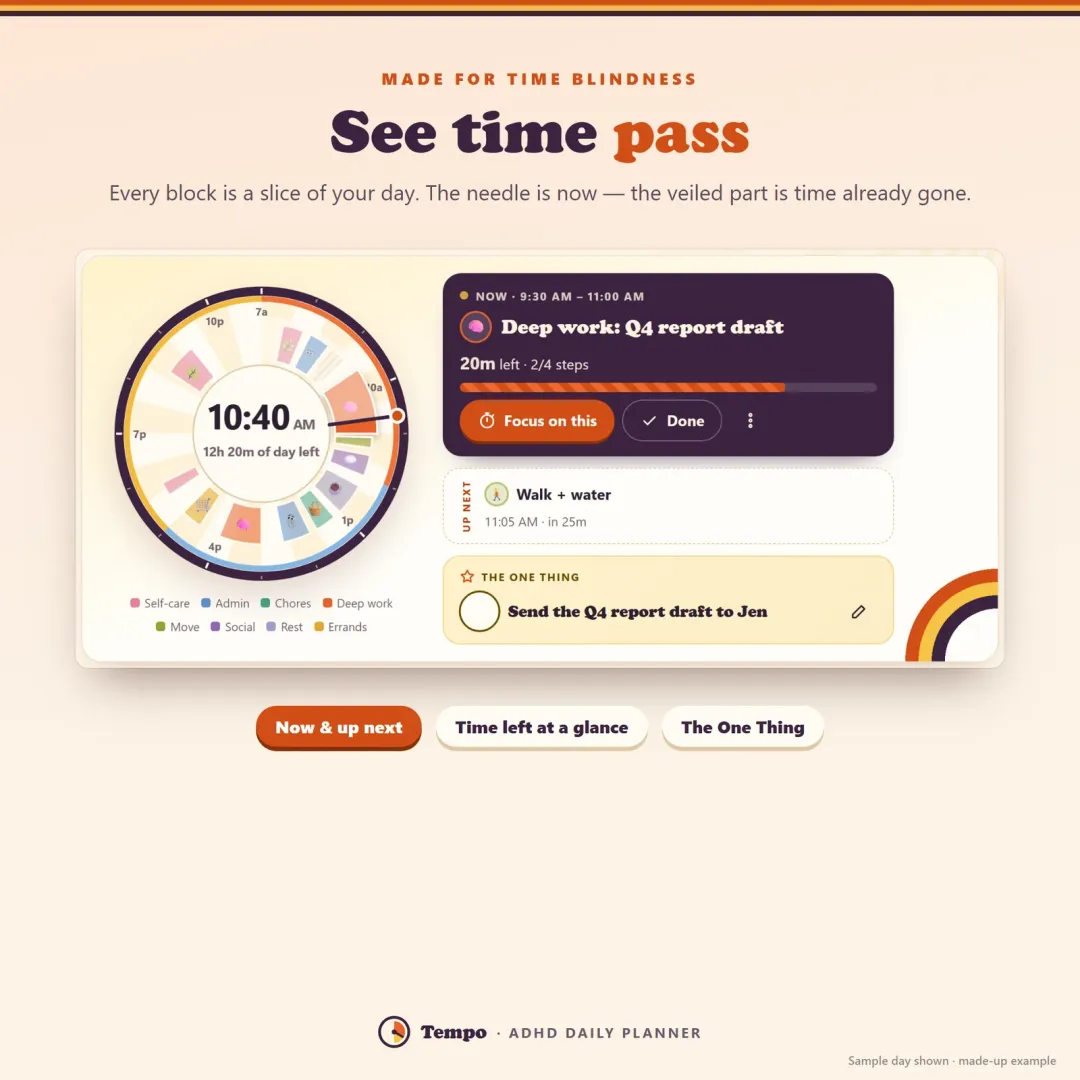
- See your whole day at once. A daily planner that shows the day as a timeline or a dial — not just a list — makes "how much time is left" obvious.
Plan with time, not lists
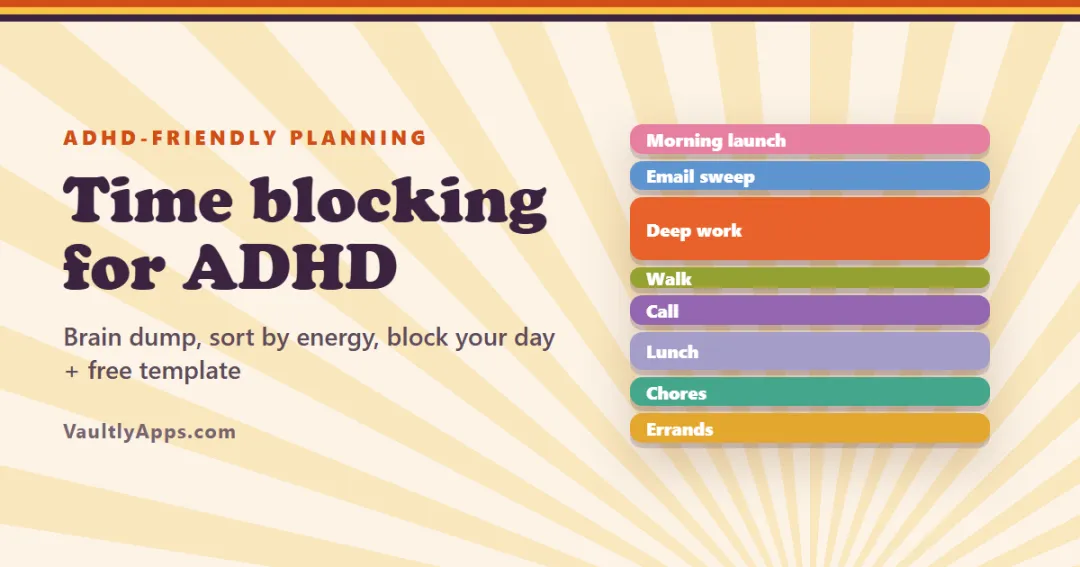
- Time-block your day. Give each task a slot with a start and an end. A list says what; a time block says when, which makes it obvious when the day is overbooked. Our time blocking for ADHD guide shows how.
- Time your routines once. Use a stopwatch for your morning routine, your commute, a load of laundry. Plan with the real numbers, not your guess.
- Add buffers. Put 5–10 minutes between blocks and 25% extra on travel. Then a slow start doesn't wreck the whole day.
Use alarms the smart way
- Set "leave by" alarms, not "arrive at" reminders. "Leave in 10 minutes" is something you can act on.
- Use transition warnings. An alarm five minutes before you need to switch makes the change less of a shock. Many planners and timers can do this for you.
- Count backwards from deadlines. Break a far deadline into dated steps ("outline by Tuesday") so each part sits in now, not not now.
Work with your brain
- Make starting small. "Open the document" is a two-minute task you can do now. Time blindness makes big tasks feel endless; tiny first steps make them feel finite.
- Get company. Body doubling — working alongside someone — gives a session a clear start and end.
- Review the day. A two-minute look at what took longer than expected, every evening, slowly trains your estimates. A short shutdown routine is a good place for it.
How Tempo helps with time blindness
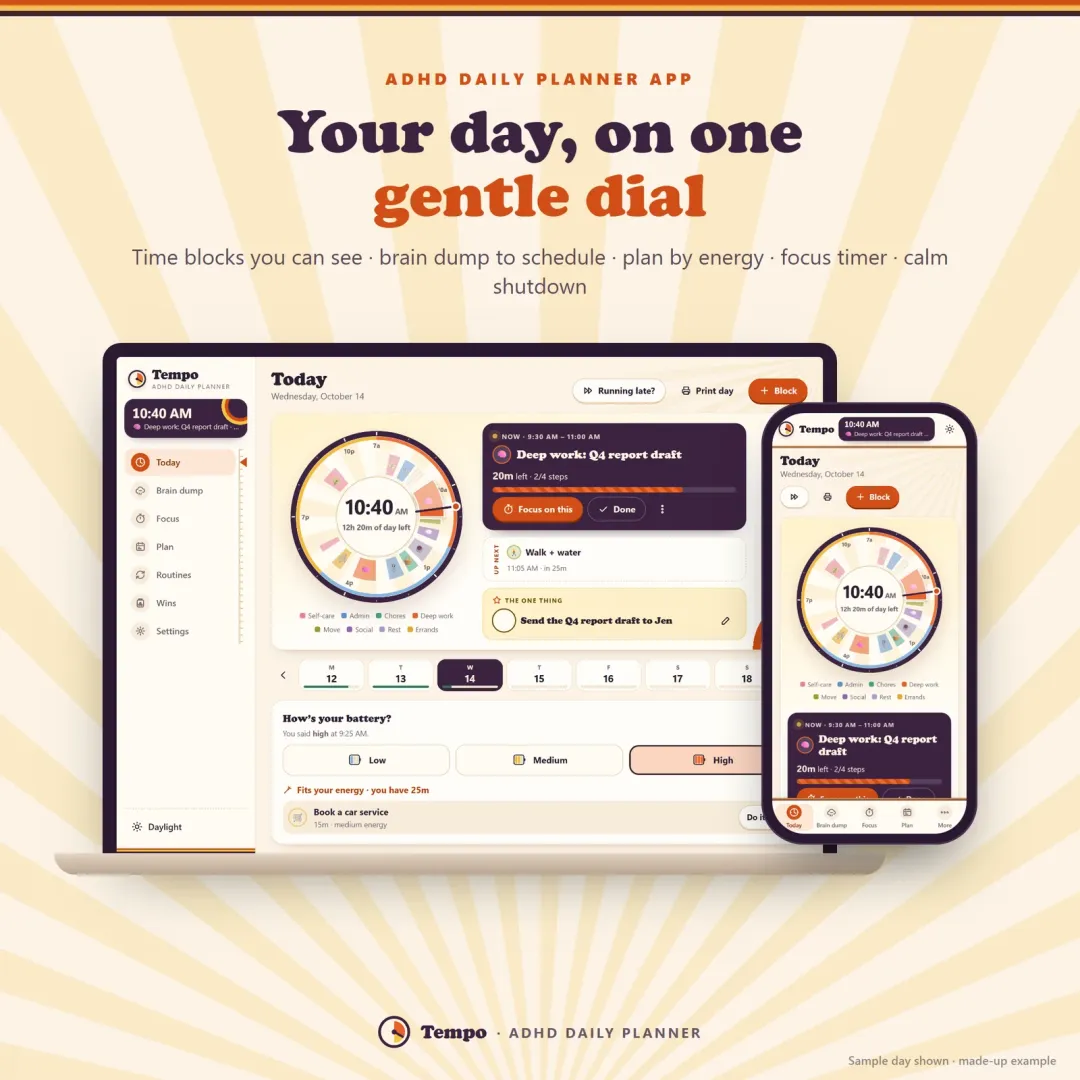
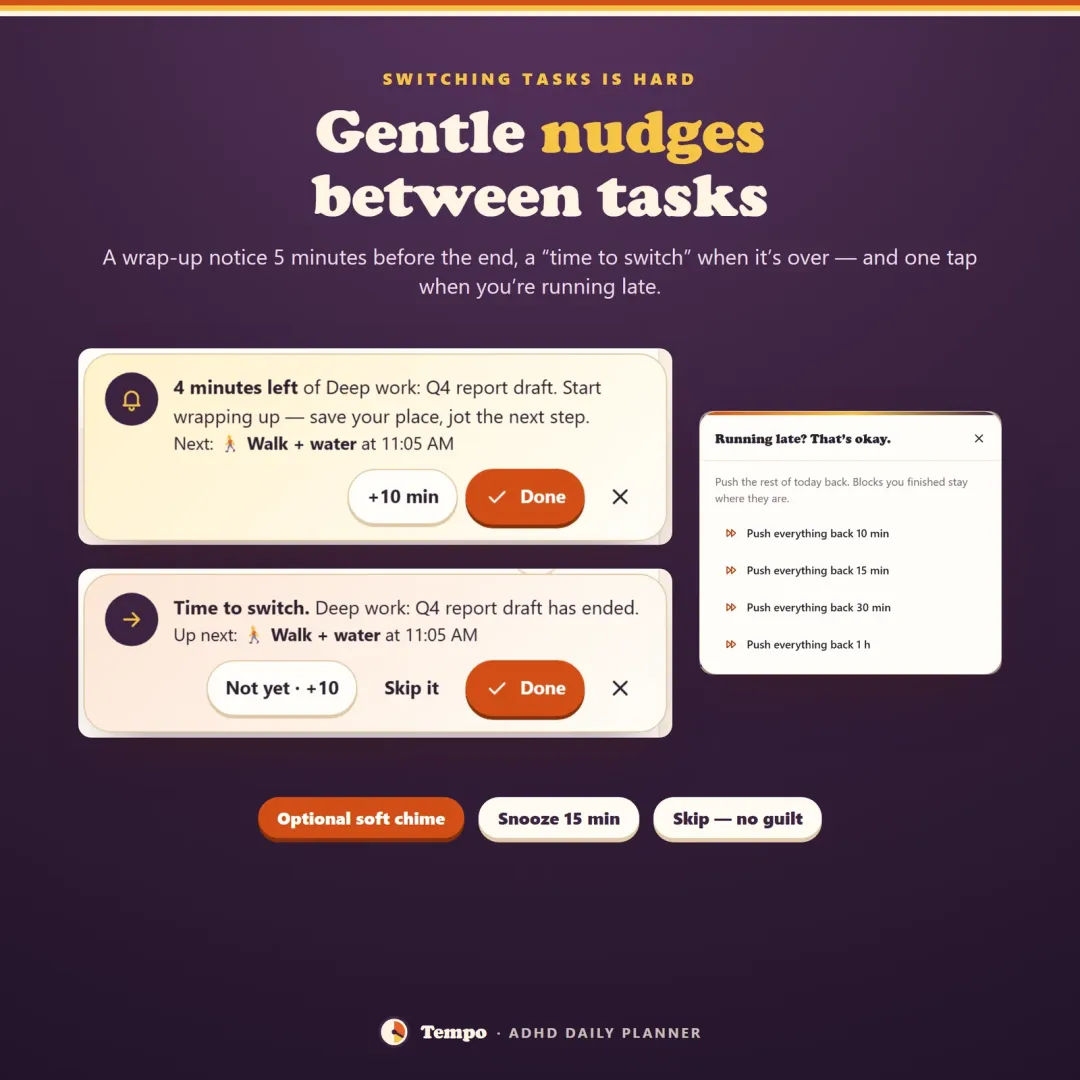
We built Tempo, our ADHD daily planner, around this problem. Your day sits on a dial from wake-up to bedtime with a needle at now and the past veiled, so you can see how much day is left. Blocks have a start and a length, with breathers between them. A wrap-up nudge comes five minutes before a block ends and a time-to-switch card when it does; the focus timer shows time as a shrinking slice; and a Running late? button pushes the rest of the day back in one tap when your estimate was off. You can try the free demo in your browser.
Time blindness at work, school and home
At work: block meetings and deep work on a calendar, add travel time between meetings, and give yourself a "leave the desk" alarm at the end of the day.
At school: break assignments into dated steps the day you get them, and use a visual timer for study sprints.
At home: time your morning routine, put analogue clocks where you get ready, and set "start getting ready" alarms 15 minutes before you need to leave.
In relationships: explain time blindness to the people you're late for. It's not an excuse, but it helps them understand — and agreeing on "leave by" times together can take a lot of tension out of plans.
When to get help
If time problems regularly affect your job, studies, money or relationships — and especially if they come with trouble focusing, organising or finishing tasks — talk to a doctor or psychologist. ADHD is very treatable, and a diagnosis can open up support that tools alone can't give. For gentler daily structure, see our morning routine ideas.
Frequently asked questions
What is time blindness?
Is time blindness an ADHD symptom?
Is there a time blindness test?
How do you fix time blindness?
Why am I always late?
What's the best clock for time blindness?
Can time blindness be treated?
Written by
Finance Specialist & Editor, VaultlyApps
Emma Whitfield writes and edits the VaultlyApps money guides and free calculators. Her focus is US household finance — budgeting on a real paycheck, paying down credit card and student debt, emergency funds and savings goals, renting — and the money side of freelancing and small-business income, from pricing and profit margins to self-employment tax. Every guide is researched against primary sources such as IRS publications and the CFPB, every number is checked in our tested calculators, and tax content is reviewed each year when new IRS figures come out. Emma is not a licensed financial adviser or tax preparer; her work is general education, not personal advice.
Researched against primary US sources, checked with our calculators and reviewed by a finance expert on our team. Written for US readers — general education, not financial, tax or legal advice. Editorial policy · Disclaimer