Body Doubling: What It Is, Why It Helps With ADHD, and 15 Ways to Try It
Body doubling means doing a task with another person nearby — in the room, on a video call or even on a livestream. Why it helps so many people with ADHD start and finish tasks, 15 ways to try it, and how to make it work.
In this article
If you've ever cleaned the whole kitchen because a friend was sitting at the table chatting, or finally answered a pile of email at a café because people were working around you, you already know body doubling. It's one of the simplest focus tricks there is — and one of the most talked-about tools in the ADHD community. Here's what body doubling is, why it seems to help so much, and fifteen ways to try it this week.
What is body doubling?
Body doubling is working on a task while another person is with you. That person — the body double — usually isn't involved in what you're doing. They might fold their own laundry, answer their own email, read a book or simply sit nearby. Sometimes you're both in the same room; often you're on a video call with cameras on and microphones muted; sometimes there are dozens of strangers in an online co-working room.
The name comes from film, where a body double stands in for an actor. In the productivity world it means something simpler: a second body in the room makes your own task easier to do.
Why body doubling helps with ADHD
Body doubling for ADHD gets a lot of attention because it targets the moment ADHD makes hardest: starting. Research on body doubling itself is still early — it's mainly supported by experience and by what we know about attention and motivation — but people describe a few common reasons it works:
- A clear "now". ADHD often splits time into now and not now. A planned session with someone turns a vague "later" into a specific "now, for 45 minutes". (If time feels slippery for you, read our guide to time blindness.)
- Gentle accountability. You said out loud what you'd work on, and someone will ask how it went. That small social nudge is often enough.
- Mirroring. Seeing someone else calmly working seems to pull your own attention toward the task.
- Less drift. With someone watching (even loosely), it's harder to slide into your phone for "just a minute".
- A borrowed routine. Many people with ADHD struggle to build structure alone; a recurring session is structure you don't have to create from scratch.
It doesn't fix everything, and it doesn't work for every task or every person. But for tasks you've been avoiding for weeks, it's often the thing that finally gets them moving.
15 ways to try body doubling
In person
- Invite a friend over for a "work date". You do your paperwork, they do theirs. Agree on a start and end time.
- Work at the kitchen table while someone cooks. A family member nearby counts, even if they're busy with something else.
- Go to a library or café. Strangers working around you are a mild, free body double.
- Use a co-working space a day or two a week for the tasks you avoid at home.
- Pair up for chores. "You do the bathroom, I'll do the kitchen, 30 minutes, then tea."
- Study groups for students — quiet, side-by-side studying, not group projects.
Online
- Video call a friend with cameras on and mics muted. Say your goal at the start, check in at the end.
- Virtual co-working rooms. Several websites match you with a stranger or a group for 25- to 50-minute sessions.
- "Study with me" / "work with me" videos and livestreams. Put one on a second screen — many include a built-in timer and break.
- Discord or community co-working channels where people log on to work together.
- A work buddy at your job — a standing 30-minute call to tackle admin together.
Lighter versions
- Phone call while you do chores — call a friend while you fold laundry or wash up.
- Text check-ins: "Starting the tax forms now" … "Done with page one!"
- Tell your household what you're doing and how long it'll take — just saying it aloud helps.
- Work next to a pet. Not quite the same, but some people find a dog asleep at their feet surprisingly anchoring.
How to make a body doubling session work
Pick one task and say it out loud. "I'm going to fill out the insurance form." Vague goals like "get stuff done" are easy to slide away from.
Set a clear length. 25 to 50 minutes is a good start. Use a visual timer both of you can see, so the end is visible from the start.
Make the first step tiny. "Open the form and find the policy number" is easier to begin than "do the insurance".
Check in at the end. One sentence each: what you got done, what's next. It closes the loop and makes the next session easier to start.
Make it a routine. The same time each week — say Tuesday evenings for admin, Sunday mornings for the house — turns body doubling from an occasional trick into structure.
Take breaks together. If you do several rounds, stand up, stretch and refill your drink between them. A short break you both take is much more likely to actually end.
What to body double
Body doubling works best for tasks that are boring, dreaded or easy to put off:
| Task type | Examples |
|---|---|
| Admin | email, forms, insurance, bills, taxes, returns |
| Home | dishes, laundry, decluttering one drawer, meal prep |
| Work | reports, data entry, expense claims, inbox zero |
| Study | reading, flashcards, essays, revision |
| Creative | starting a draft, editing, practising an instrument |
| Money | a monthly budget check, sorting receipts, cancelling subscriptions |
Money admin is a classic one. Ten minutes on a call with a friend is often all it takes to finally cancel the subscriptions you meant to cancel or catch up on a budget you've been avoiding.
Body doubling when you're on your own
No one free right now? A few things get close:
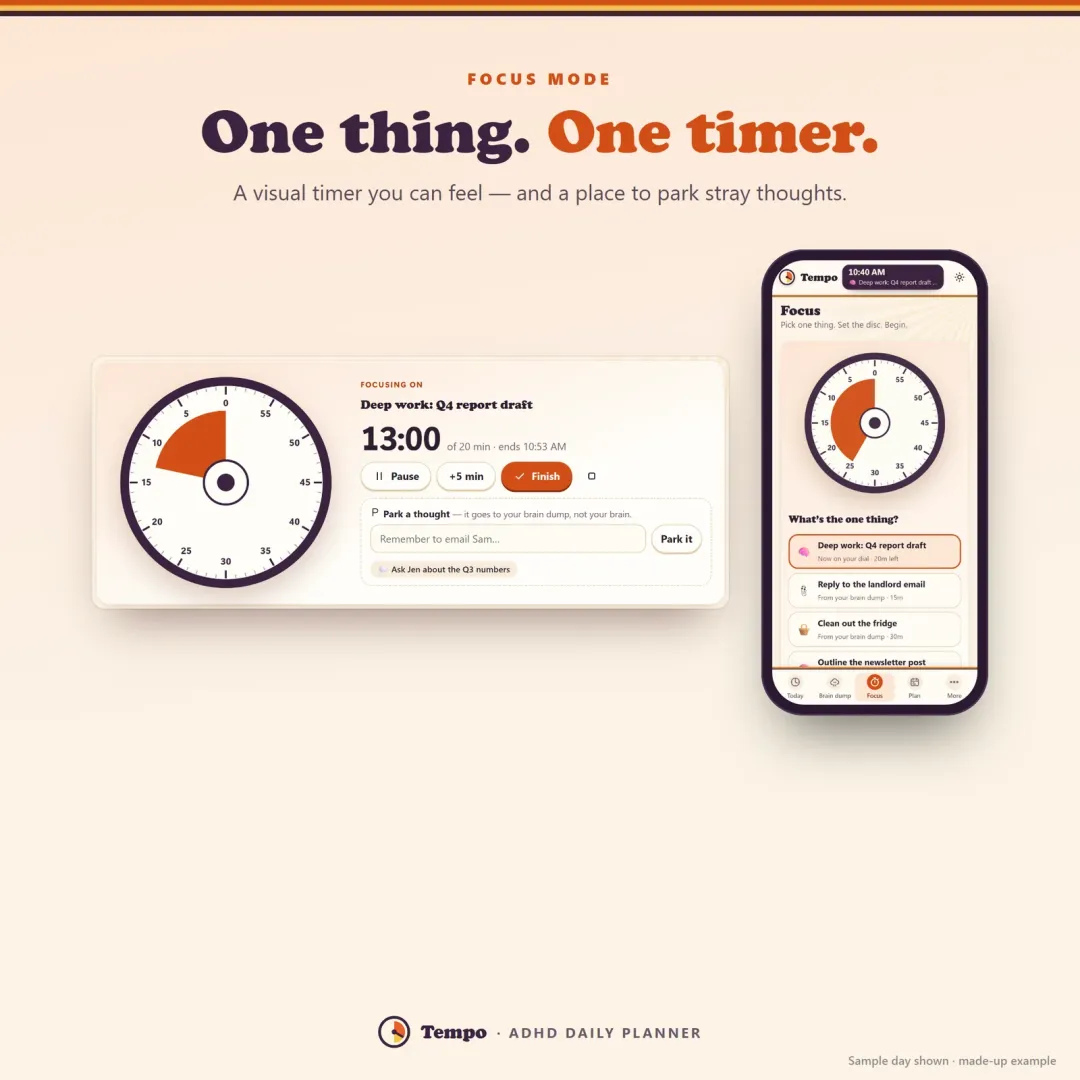
- A "work with me" video with a timer, on a second screen.
- A visible timer and a written plan. Our visual timer is free and works full screen.
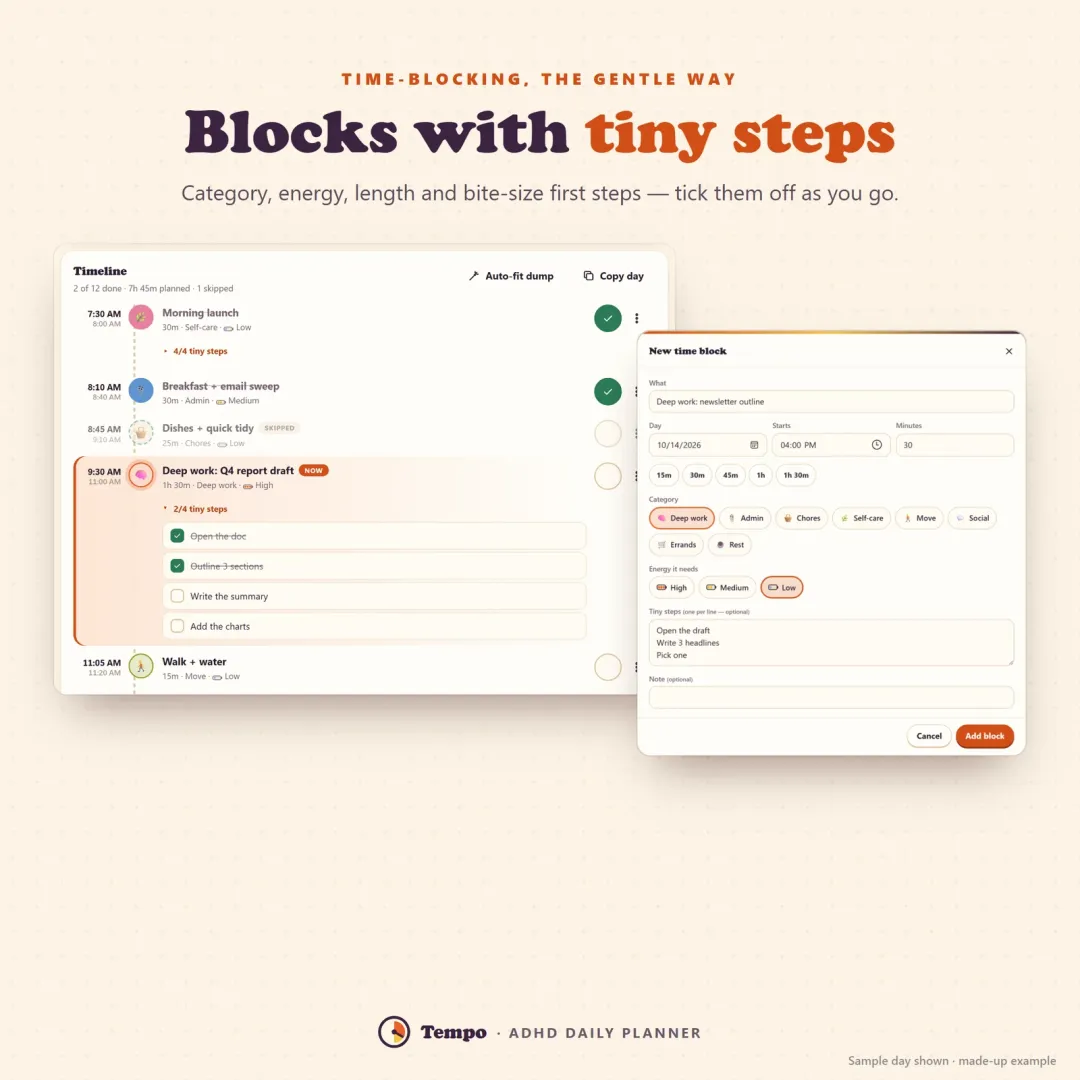
- Plan the session like an appointment. Put it on your day as a time block with a start, an end and a first step. Our guide to time blocking for ADHD walks through it.
- A dopamine "side": music, a podcast, a candle. Building a dopamine menu gives you a list of these ready to go.
How Tempo fits in
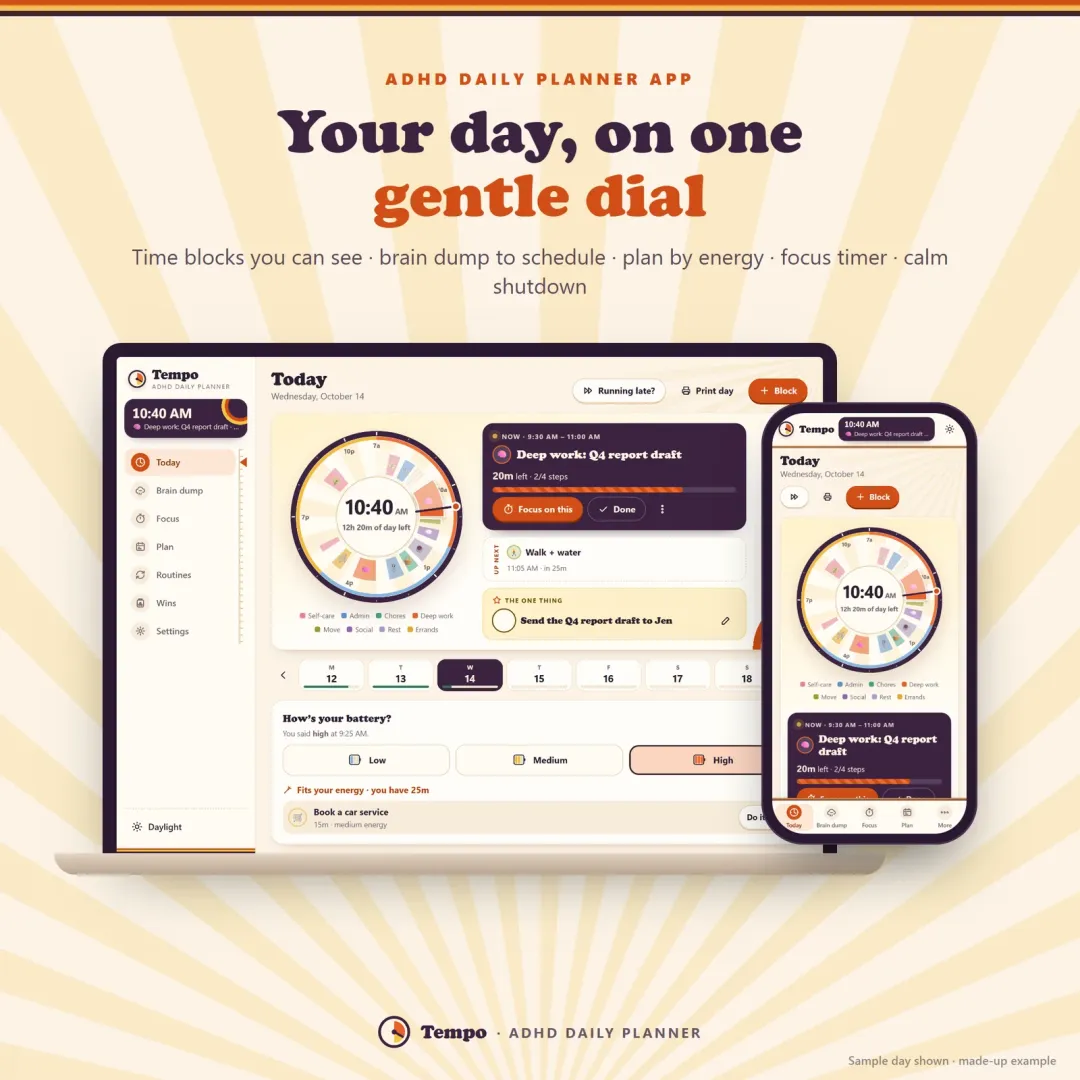
Tempo, our ADHD daily planner, isn't a body doubling app — but it pairs well with one. Put the session on your day as a block with tiny steps, start the visual focus timer when your body double joins, park stray thoughts without breaking flow, and tick the block off together at the end. You can try the Tempo demo free in your browser.
When body doubling isn't enough
Body doubling is a helpful habit, not a treatment. If starting tasks, focusing or keeping up with daily life is a constant struggle, it's worth talking to a doctor or a psychologist about ADHD — an assessment and proper support can make a much bigger difference than any single trick. For more small, practical habits, see our guides to morning routine ideas and a self-care routine you can actually keep.
Frequently asked questions
What is body doubling?
Why does body doubling work for ADHD?
Does body doubling work online?
Does the body double have to do anything?
What tasks is body doubling good for?
Is body doubling only for people with ADHD?
How long should a body doubling session be?
Written by
Finance Specialist & Editor, VaultlyApps
Emma Whitfield writes and edits the VaultlyApps money guides and free calculators. Her focus is US household finance — budgeting on a real paycheck, paying down credit card and student debt, emergency funds and savings goals, renting — and the money side of freelancing and small-business income, from pricing and profit margins to self-employment tax. Every guide is researched against primary sources such as IRS publications and the CFPB, every number is checked in our tested calculators, and tax content is reviewed each year when new IRS figures come out. Emma is not a licensed financial adviser or tax preparer; her work is general education, not personal advice.
Researched against primary US sources, checked with our calculators and reviewed by a finance expert on our team. Written for US readers — general education, not financial, tax or legal advice. Editorial policy · Disclaimer