How to Save Money in College: 35 Money Saving Tips for Students
35 practical ways to save money in college — food and cheap meals, textbooks, housing and splitting rent with roommates, transport, subscriptions and fun — plus how to build a small savings habit on a student budget.
In this article
- Start with a plan, not a list of cuts
- Food: the biggest flexible cost
- Cheap meals for college students
- Textbooks and supplies
- Housing and roommates
- How to split rent with roommates
- Transport
- Phone, subscriptions and tech
- Fun, without overspending
- Turn savings into a savings habit
- Saving money when you're already broke
- Keep it all in one place
Money saving tips for students usually start with "skip the latte". That helps a little, but the real savings in college come from a few big decisions — where you live, what you eat, how you buy textbooks — and from a simple plan for the money you have.
Here are 35 ways to save money in college, grouped by where students spend the most, plus how to split rent with roommates fairly and how to turn the savings into an actual savings habit.
Start with a plan, not a list of cuts
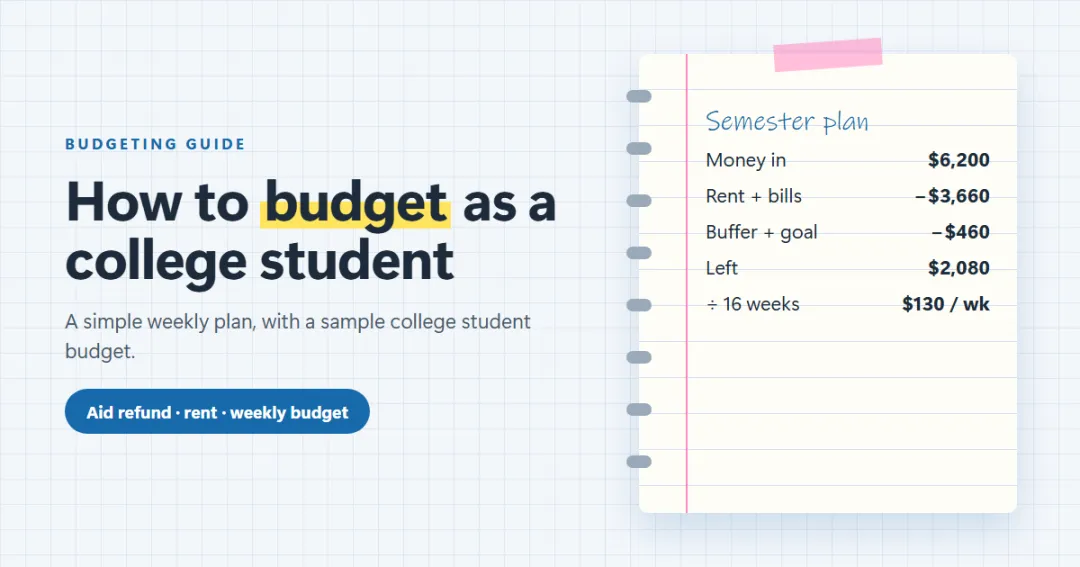
Saving is much easier when you know what you can spend each week. If you haven't set a budget yet, read how to budget as a college student first: add up your money for the semester, take off rent and bills, and divide the rest by the weeks left. Every tip below then shows up as more room in your weekly number.
Food: the biggest flexible cost
Food is where most students can save the most, because it's spent every day.
- Use your meal plan fully. If you've paid for swipes, use them before buying food elsewhere.
- Choose the right meal plan next term. If you skip breakfast every day, a smaller plan may be cheaper.
- Cook a few staple meals you can make without a recipe.
- Batch cook on Sunday. One pot of chili or curry is four or five meals.
- Shop with a list and stick to it.
- Buy store brands — they're usually much cheaper for the same staples.
- Use frozen fruit and vegetables. They're cheap, healthy and don't go off.
- Bring your own coffee and snacks to campus.
- Find free food on campus. Club meetings, talks and events often have food.
- Split bulk buys with roommates — rice, oil, cleaning supplies.
Cheap meals for college students
A few cheap meals for college students that cost a couple of dollars a serving:
- Rice and bean bowls with salsa, cheese and whatever vegetables you have.
- Pasta with a jar of sauce and a bag of frozen vegetables.
- Egg fried rice — the best use of leftover rice.
- Lentil or vegetable soup, made in a big pot.
- Sheet-pan chicken and vegetables — one tray, little washing up.
- Oatmeal with banana, peanut butter or frozen berries.
- Baked potatoes with beans, cheese or chili.
- Chili or curry in a big batch, frozen in portions.
- Tortilla wraps with eggs, beans or leftover chicken.
- Ramen upgraded with an egg, frozen spinach and a spoon of peanut butter.
Plan the week's meals around two or three of these and eating out becomes a treat, not the default.
Textbooks and supplies
Textbooks are one of the biggest surprise costs of a semester. Here's how to save money on textbooks:
- Check the library and course reserves first. Many required books are on reserve.
- Wait until the first class to see which books you really need.
- Buy used, rent or go digital — compare all three for each book.
- Ask if an older edition is fine. It often costs a fraction of the new one.
- Share a book with a classmate in the same section.
- Sell your books back at the end of term, or list them online for more than the buyback desk offers.
- Track rental return dates — late fees can cost more than the rental.
- Use free software your school provides instead of buying your own.
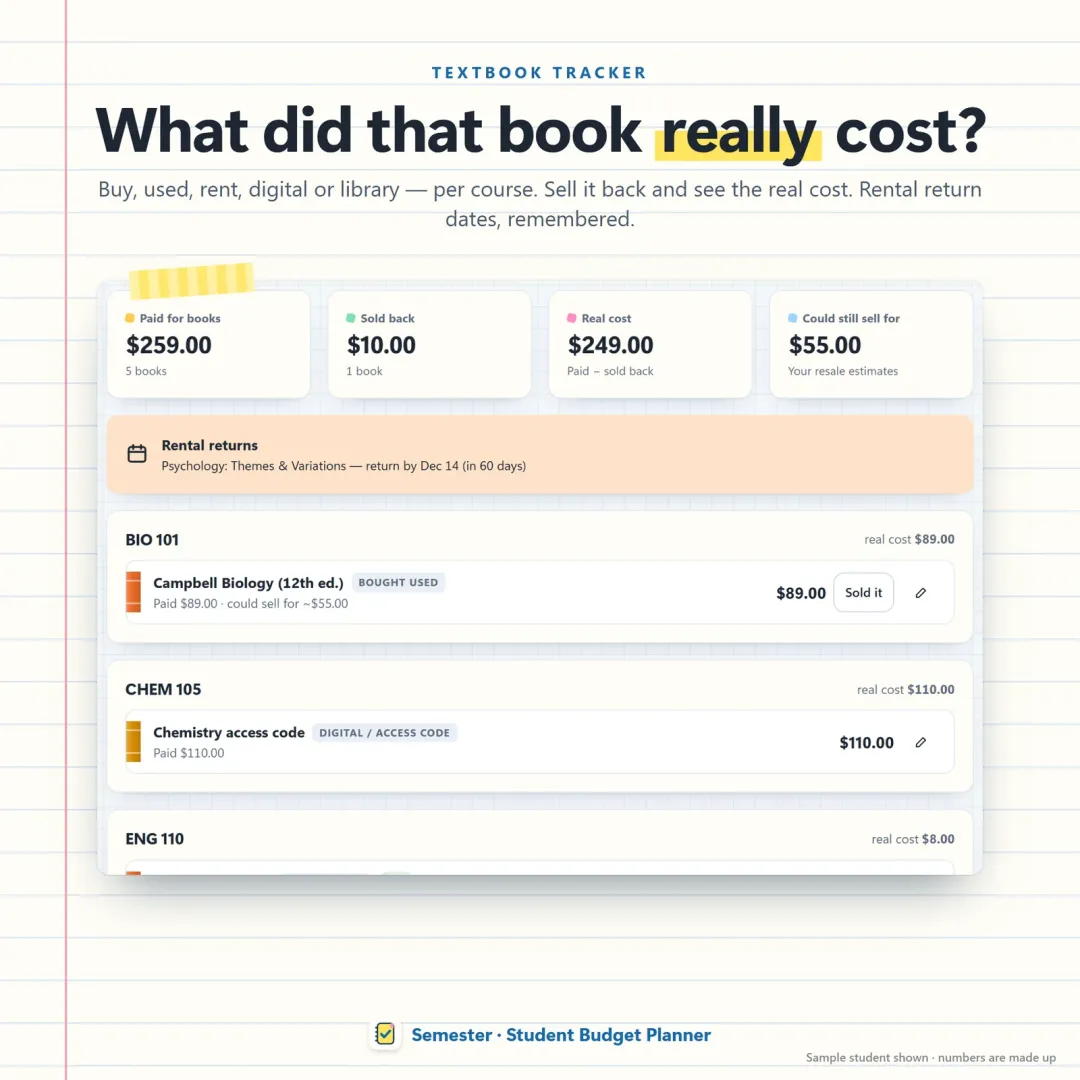
Semester has a textbook tracker for every course: bought new or used, rented, digital or from the library, with the sell-back value and the real cost of each book — plus the return date for every rental.
Housing and roommates
Housing is the biggest cost for most students, so this is where a good decision saves the most.
- Live with roommates. Sharing a two- or three-bedroom apartment usually costs far less per person than a studio.
- Compare the true cost of dorms and apartments, including utilities, furniture, transport and a 12-month lease vs a 9-month stay.
- Ask about utilities and Wi-Fi before you sign — "all included" can be cheaper.
- Buy furniture second-hand or take what graduating students leave behind.
- Agree how you'll split costs before you move in.
How to split rent with roommates
The fairest way to split rent depends on the rooms:
- Similar rooms: split equally.
- Different sizes: split by room size — each person pays their room's share of the total square footage.
- Private bathroom: add a premium, often 10–20%, for the room that has one.
- Very different incomes: some friends and couples split by income instead.
Utilities, Wi-Fi and shared groceries are usually split equally. The free rent split calculator works out all three methods in seconds. Put the agreement in writing — including deposits and what happens if someone pays late.
How to split utilities with roommates day to day: one person pays each bill, everyone logs what they've paid for, and you settle up once a month. Keeping a running tab in your head is how friendships end.
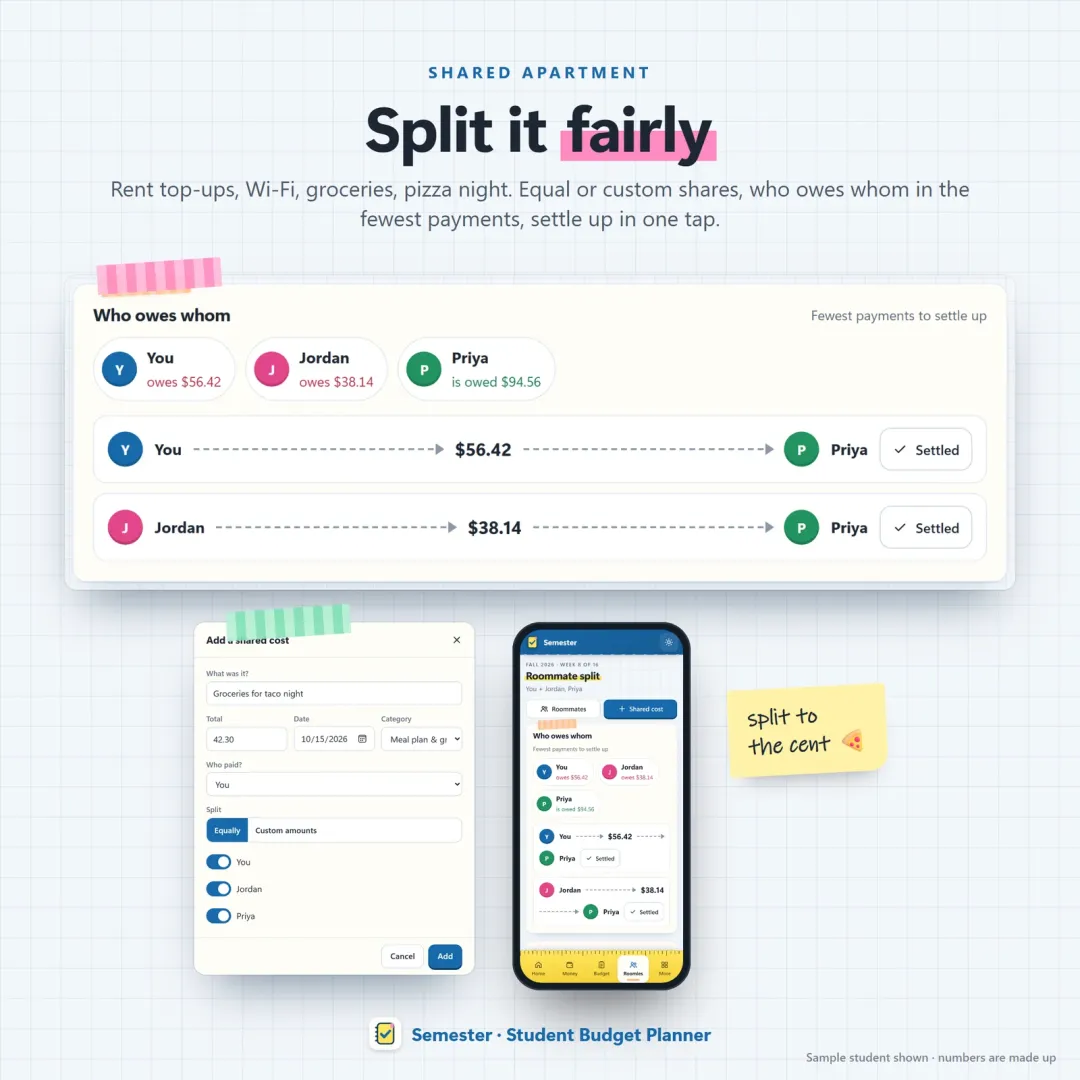
Semester's roommate page does this for you: add rent top-ups, Wi-Fi, utilities or a grocery run, split it equally or with custom amounts, and it shows who owes whom in the fewest payments.
Transport
- Use your student transit pass if your school offers one — it's often free or heavily discounted.
- Bike or walk for short trips.
- Think twice about bringing a car. Parking permits, insurance, fuel and repairs add up fast.
- Book trips home early and look for student fares.
Phone, subscriptions and tech
- Get student discounts on streaming, music, software and news — many services have a student plan at half price or less.
- Share family plans where the rules allow it.
- Review subscriptions every semester and cancel what you don't use. Our guide on how to track subscriptions shows how to find them all.
- Use a cheaper phone plan. Prepaid and smaller carriers are often much cheaper than big-name plans.
- Buy refurbished tech with a warranty, and check student pricing before buying a laptop.
Fun, without overspending
- Use free campus events — games, concerts, films and the rec center are often included in your fees.
- Ask for student discounts everywhere — museums, cinemas, restaurants and shops.
- Set a weekly fun budget and stick to it. When it's gone, it's gone until next week.
Turn savings into a savings habit
Cutting costs only helps if the money doesn't disappear somewhere else. Three habits make it stick:
- Pay yourself first. Each time money arrives — an aid refund, a paycheck, money from family — move a fixed amount into savings before you spend anything.
- Give your savings a job. An emergency buffer first (even $300 to $500 helps), then known costs like next term's books, a laptop or spring break.
- Keep savings separate. A no-fee savings account, ideally high-yield, keeps the money out of everyday spending. Our comparison of CDs vs high-yield savings accounts explains the options.
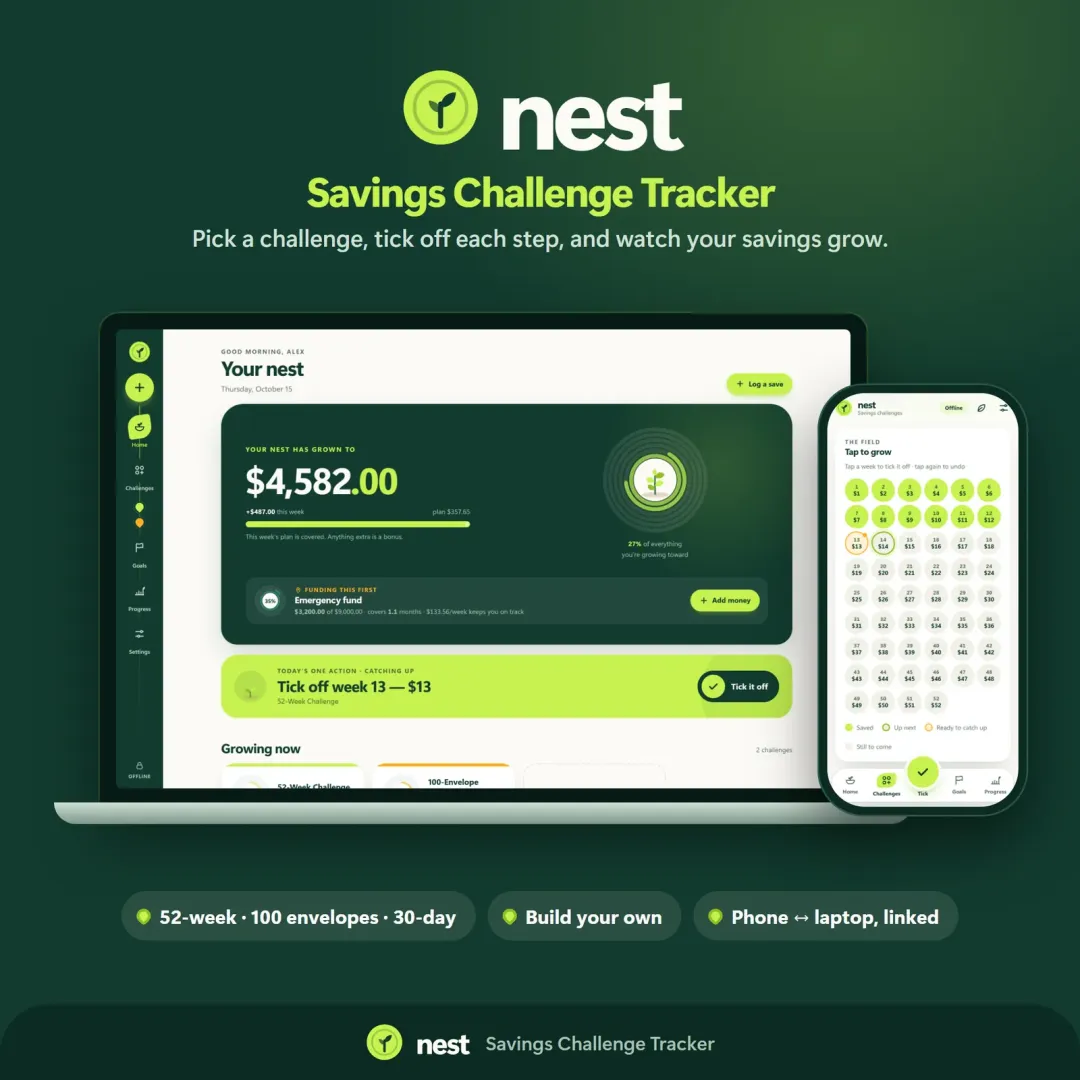
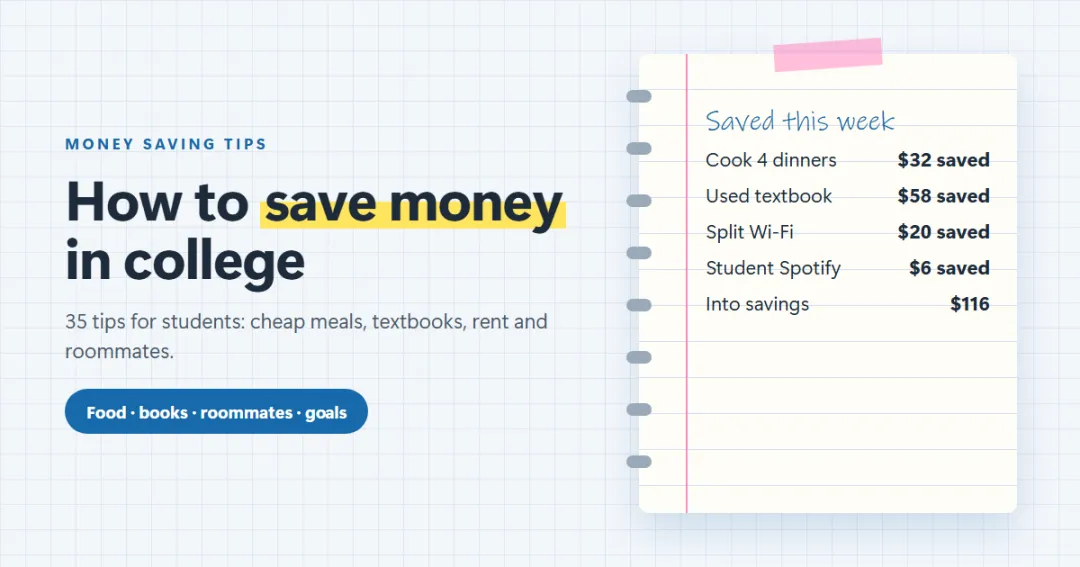
Even $15 a week is $240 over a 16-week semester — a full emergency fund for many students. The savings goal calculator shows how fast a goal adds up, and Nest turns saving into a fun challenge if you like that style.
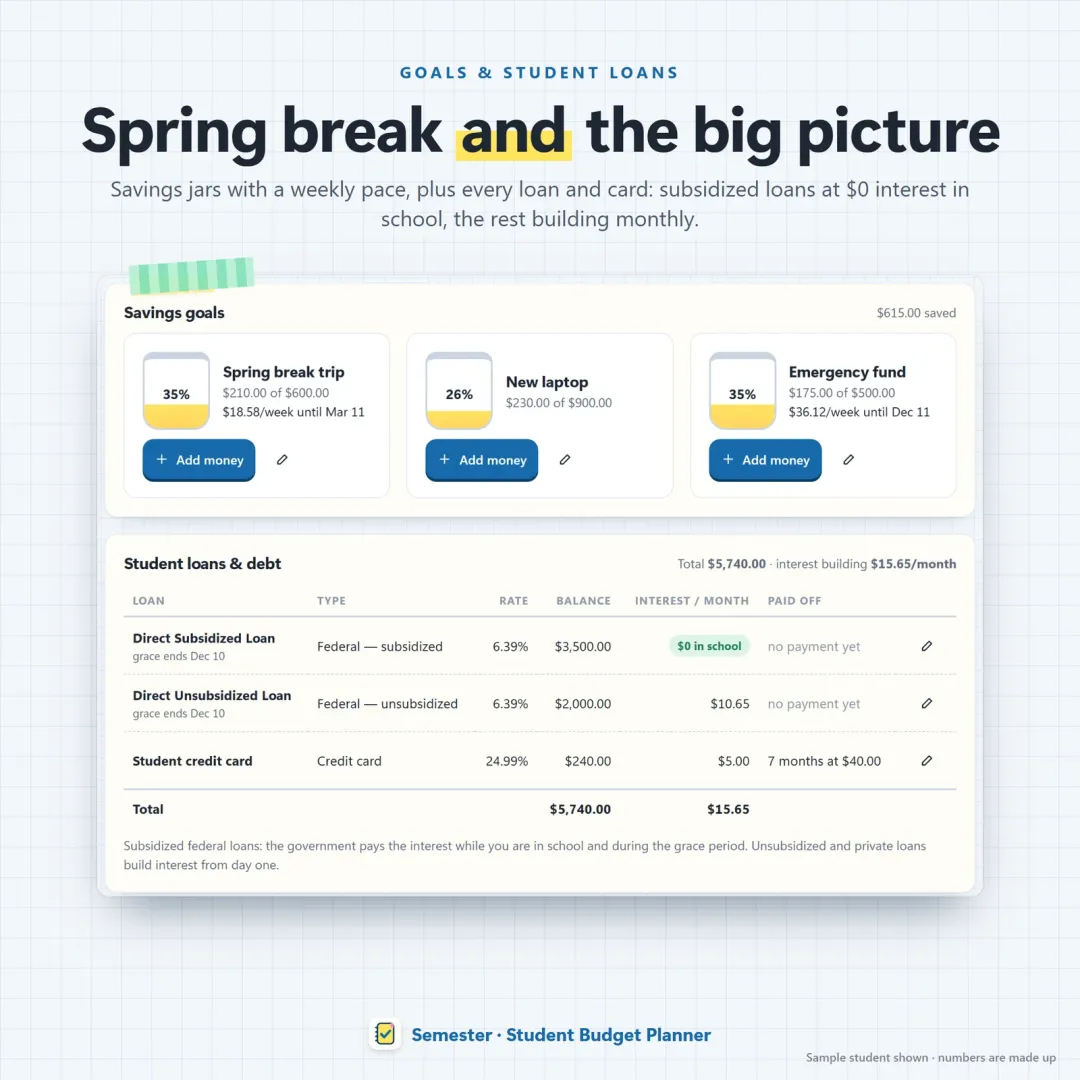
In Semester, savings goals come with a weekly pace — the amount to set aside each week to reach the goal by your date — next to your student loans, so you see the whole picture in one place.
Saving money when you're already broke
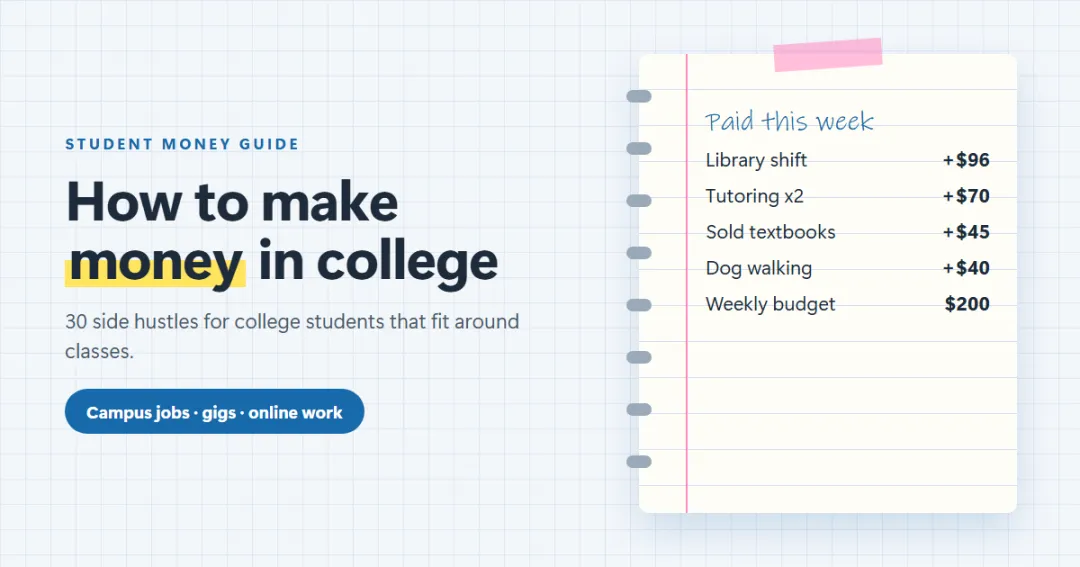
If there's nothing left to save, focus on the two biggest levers: lower the fixed costs next term (housing, meal plan, phone, car) and add a little income. Our list of 30 ways to make money in college has side hustles that fit around classes. In the meantime, use a daily limit — the money you have divided by the days until your next money arrives — to get through the week.
Keep it all in one place
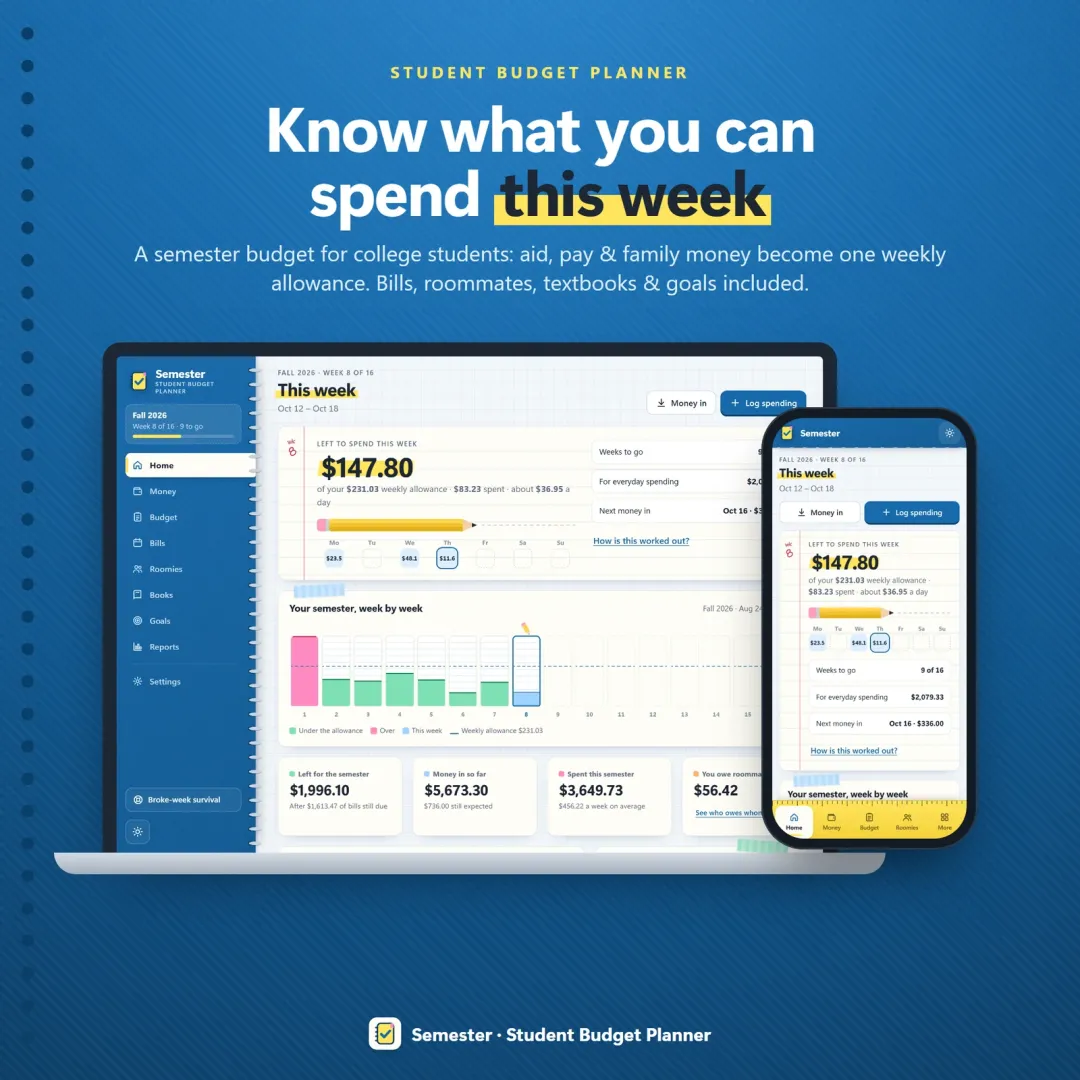
The easiest way to save money in college is to always know where you stand. Semester is a student budget planner that turns your aid, pay and family money into a weekly budget, sets bills aside first, splits costs with roommates, tracks textbooks and keeps your savings goals on pace — on your phone and laptop, with no bank login.
Try the free Semester demo, or read how to budget as a college student to set up the same system on paper.
Frequently asked questions
What is the best way to save money in college?
How much should a college student save?
What are some cheap meals for college students?
How do you split rent with roommates fairly?
How can I save money on textbooks?
Should college students have a savings account?
Written by
Finance Specialist & Editor, VaultlyApps
Emma Whitfield writes and edits the VaultlyApps money guides and free calculators. Her focus is US household finance — budgeting on a real paycheck, paying down credit card and student debt, emergency funds and savings goals, renting — and the money side of freelancing and small-business income, from pricing and profit margins to self-employment tax. Every guide is researched against primary sources such as IRS publications and the CFPB, every number is checked in our tested calculators, and tax content is reviewed each year when new IRS figures come out. Emma is not a licensed financial adviser or tax preparer; her work is general education, not personal advice.
Researched against primary US sources, checked with our calculators and reviewed by a finance expert on our team. Written for US readers — general education, not financial, tax or legal advice. Editorial policy · Disclaimer