Financial Anxiety: Why Money Feels So Scary and 12 Ways to Feel Calmer
Financial anxiety is the worry, dread or avoidance that money can bring — even when the numbers are okay. Here are the signs, where the fear of finances comes from, 12 practical ways to feel calmer and when to look for financial anxiety treatment.
In this article
- What is financial anxiety?
- Signs you might have financial anxiety
- Why money feels so scary: where financial anxiety comes from
- 12 ways to feel calmer about money
- 1. Look in small, kind doses
- 2. Rate your worry before and after
- 3. Set aside first, then see what's yours
- 4. Think in ranges, not single numbers
- 5. Build a tiny cushion
- 6. Put bills on autopilot
- 7. Use a worry inbox
- 8. Schedule a weekly money date
- 9. Calm your body first
- 10. Change the words you use
- 11. Limit the triggers
- 12. Write a financial safety plan
- Financial self care
- Financial anxiety treatment: when to get help
- A budgeting app built for money anxiety
- The bottom line
You know you should check your bank balance. You know the credit card bill is sitting in your inbox. But every time you think about it, your chest tightens and you find something — anything — else to do.
If that sounds familiar, you're not bad with money. You may be dealing with financial anxiety: worry, dread or fear about money that feels bigger than the situation itself. It's one of the most common kinds of stress there is. Year after year, the American Psychological Association's Stress in America survey lists money among the top sources of stress for US adults.
This guide explains what financial anxiety is, the signs, why the fear of finances happens and — most importantly — 12 practical ways to feel calmer about money, plus when it's time to look for financial anxiety treatment.
What is financial anxiety?
Financial anxiety (also called money anxiety) is a pattern of worry, fear or dread connected to money. It can show up when money really is tight — but it can also stick around when you're doing fine, or even well. Two people with the same income and debts can feel completely different about them.
It usually has three parts:
- Thoughts — "What if something goes wrong?", "I'll never get ahead", "I'm so bad with money."
- Feelings and body — a knot in the stomach, a racing heart, irritability, poor sleep.
- Behaviour — avoiding, over-checking, overspending to cope or under-spending even on necessities.
Financial anxiety isn't a separate medical diagnosis. But when money worry is constant and gets in the way of daily life, it can be part of an anxiety disorder or depression, and that's worth talking to a professional about.
Signs you might have financial anxiety
You might recognise a few of these:
- You avoid opening bills, bank statements or your banking app.
- You check your balance over and over, sometimes several times a day.
- You feel sick or tense before paying for things, even small things.
- You lose sleep thinking about money.
- You argue with a partner about money, or avoid the topic completely.
- You buy things to feel better, then feel worse afterwards.
- You can't enjoy spending on anything, even when you can afford it.
- You put off taxes, paperwork or calls to lenders until they become urgent.
- No amount of savings ever feels like enough.
Notice that some of these are avoidance and some are hyper-vigilance. Both are anxiety; they just point in different directions.
Why money feels so scary: where financial anxiety comes from
Real uncertainty. Irregular income, rising costs, debt, a job that might not last. Uncertainty is one of the strongest triggers for anxiety — and money is full of it.
Past experiences. Growing up with money fights, scarcity, secrecy or a sudden loss teaches your nervous system that money equals danger. That lesson can stay long after your situation changes.
Shame. Many people feel they should be better with money by now. Shame makes us hide, and hiding from money is avoidance.
Comparison. Social media is a stream of other people's holidays and renovations. It's very hard not to measure yourself against it.
Tools that shout. Red "over budget" warnings, alerts on every purchase and one safe-to-spend number that drops with each coffee keep your alarm system switched on.
The avoidance loop. This one ties it all together. Money feels scary → you avoid looking → you don't know where you stand → the unknown feels scarier → you avoid even more. Avoidance gives relief in the moment, which is exactly why it's so hard to stop. The good news: loops can be broken, and small steps break them best.
12 ways to feel calmer about money
1. Look in small, kind doses
Instead of one huge "sort out my finances" session you'll keep postponing, look for five minutes. Open one account, read the balance, close it. Tomorrow, open one bill. Small exposures teach your brain that looking is survivable — that's the core of how anxiety eases.
2. Rate your worry before and after
Before you look at your money, rate your worry from 1 to 5. Look. Rate it again. Most of the time the "after" number is lower than you predicted. Writing that down builds evidence that the dread is worse than the reality.
3. Set aside first, then see what's yours
Anxiety loves a number that keeps falling. Flip it around: first set aside the money for bills due in the next month, everyday essentials, any savings or debt steps and a small buffer. What's left is safe to spend — and it doesn't need checking every hour. Our guide to what "safe to spend" means walks through it.
4. Think in ranges, not single numbers
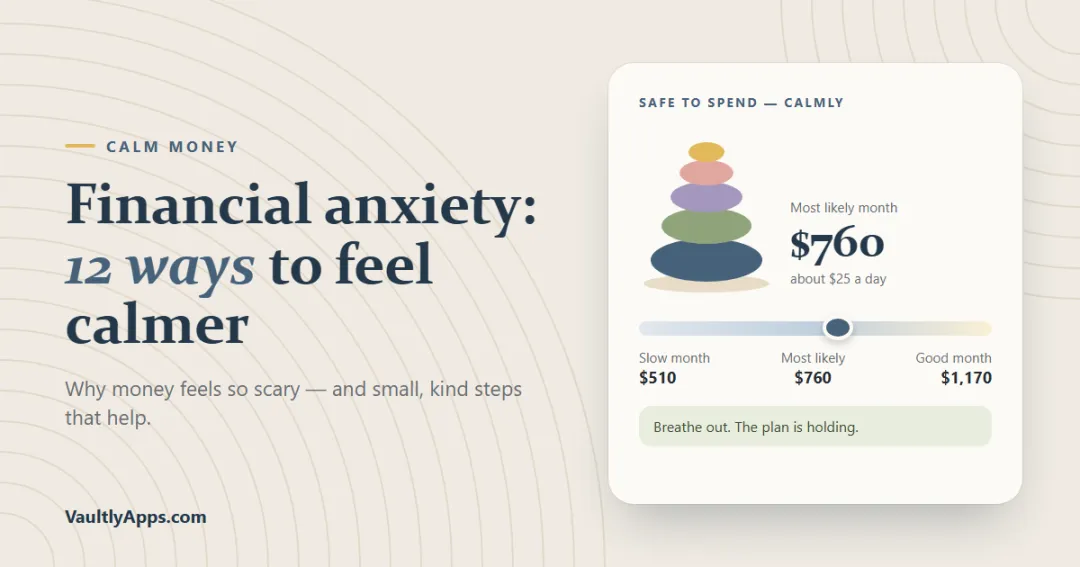
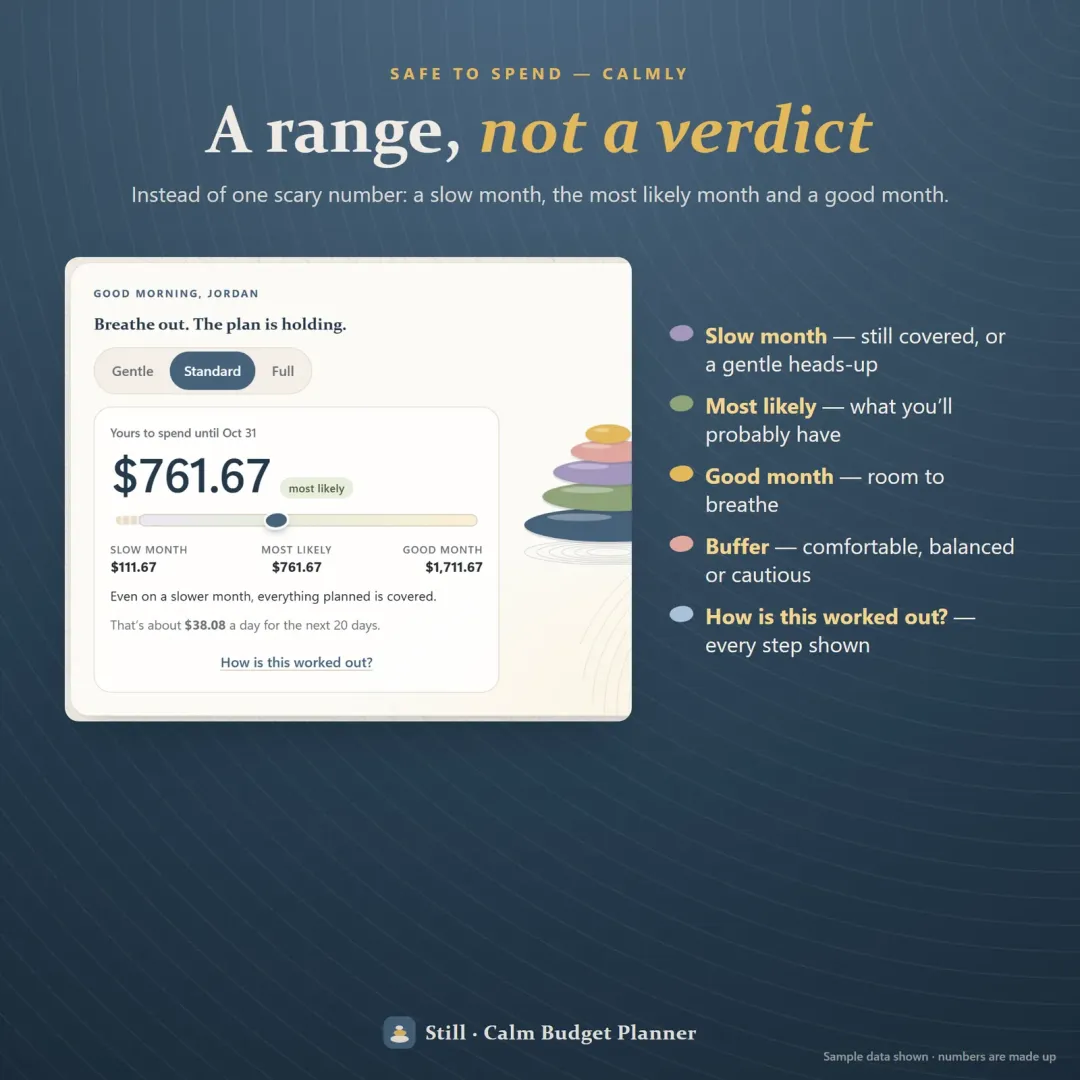
If your income varies, one precise figure is a promise reality can't keep. Plan with a slow month, a most likely month and a good month. If the slow month is covered, you can breathe. If a good month comes, you get a bonus instead of a surprise.
5. Build a tiny cushion
Nothing calms money anxiety like a buffer. It doesn't need to be three months of expenses on day one — $500 or $1,000 can absorb a surprise bill without panic. Once it exists, grow it toward a full emergency fund. Use the how long will my savings last calculator to see how many months your savings already cover; the number is often more reassuring than the feeling.
6. Put bills on autopilot
Late fees and forgotten bills feed anxiety. List every bill and subscription with its date, set up autopay for fixed ones where it's safe, and set aside money for the next 31 days. Then a bill arriving is just a bill arriving. (Our guide to tracking subscriptions helps you find the ones you've forgotten.)
7. Use a worry inbox
When a money worry starts circling, write it down in one sentence. Then decide: is there one small next step this week (make one call, get one quote, send one email)? Or is this a "not today" worry you'll look at on a set day? When it's handled, move it to a settled list. Seeing that list grow is proof that worries end.
8. Schedule a weekly money date
Pick a time — Sunday morning, Wednesday lunch — and make it pleasant: a good drink, music, ten minutes. Look back at the week, look ahead at what's due, note one worry and one intention. Predictable, short check-ins replace the vague, constant dread with a bounded task.
9. Calm your body first
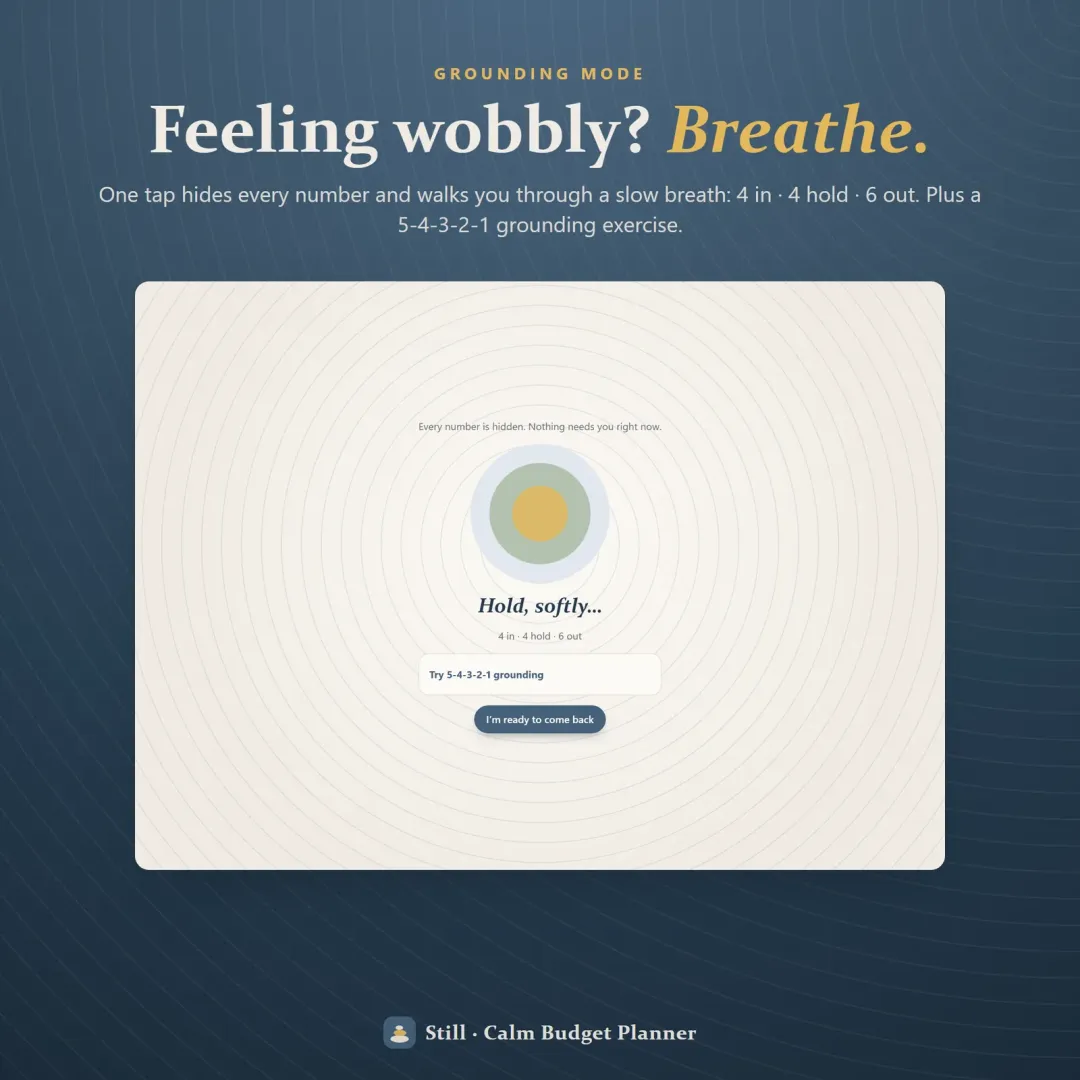
Anxiety lives in the body, and a body on high alert can't think clearly about numbers. Before a money task, try slow breathing — in for 4, hold for 4, out for 6 — or the 5-4-3-2-1 grounding exercise (five things you see, four you can touch, three you hear, two you smell, one you taste). It takes a minute and makes the next ten easier.
10. Change the words you use
"Over budget", "failed", "blew it" are verdicts. Try "room left", "spent more than planned", "the plan can bend". It sounds small, but the language you use about money shapes how safe it feels to look at it. Drop the streaks too; count the times you showed up instead.
11. Limit the triggers
Turn off push alerts for every transaction if they spike your anxiety (keep fraud alerts). Unfollow accounts that make you feel behind. Check balances at set times instead of constantly. Some people find it calmer to add spending themselves rather than watch a live bank feed.
12. Write a financial safety plan
On a calm day, write one page for a hard one: what must be covered each month, how long your cushion lasts, the first three steps if income stops, and the people and services who can help. When "what if" thoughts start spiralling, you have an answer already written in your own words.
Financial self care
Financial self care means looking after your money in a way that also looks after you. It might include:
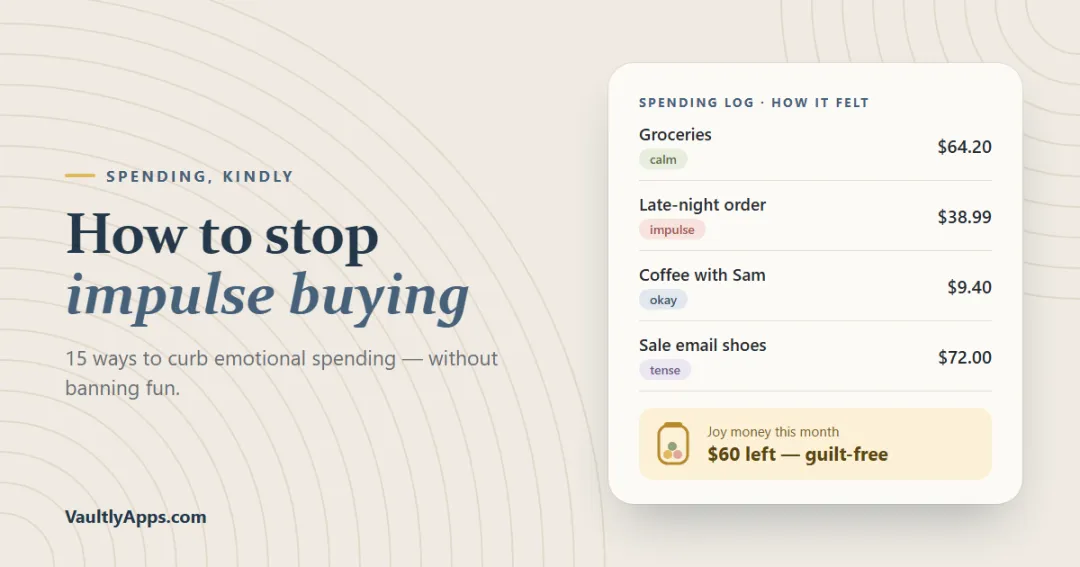
- a budget that includes joy money — a planned, guilt-free amount for things that make life better,
- a weekly check-in that's short and kind, not a punishment,
- a cushion, however small, that you leave alone,
- saying no to spending that's about keeping up with others,
- talking about money with someone you trust instead of carrying it alone,
- noticing emotional spending without judging it (see how to stop impulse buying).
It's the same idea as any self-care routine: small, regular acts that make the hard days easier.
Financial anxiety treatment: when to get help
Self-help works well for everyday money worry. Look for professional support if:
- money worry is there most days, for weeks at a time,
- it's affecting your sleep, eating, work or relationships,
- you have panic attacks around money,
- you're using spending, gambling, alcohol or other things to cope,
- debt or bills have reached a crisis point.
Financial anxiety treatment can include:
- Talking therapy — cognitive behavioural therapy (CBT) is a well-studied approach for anxiety and helps you change the thoughts and avoidance behind it.
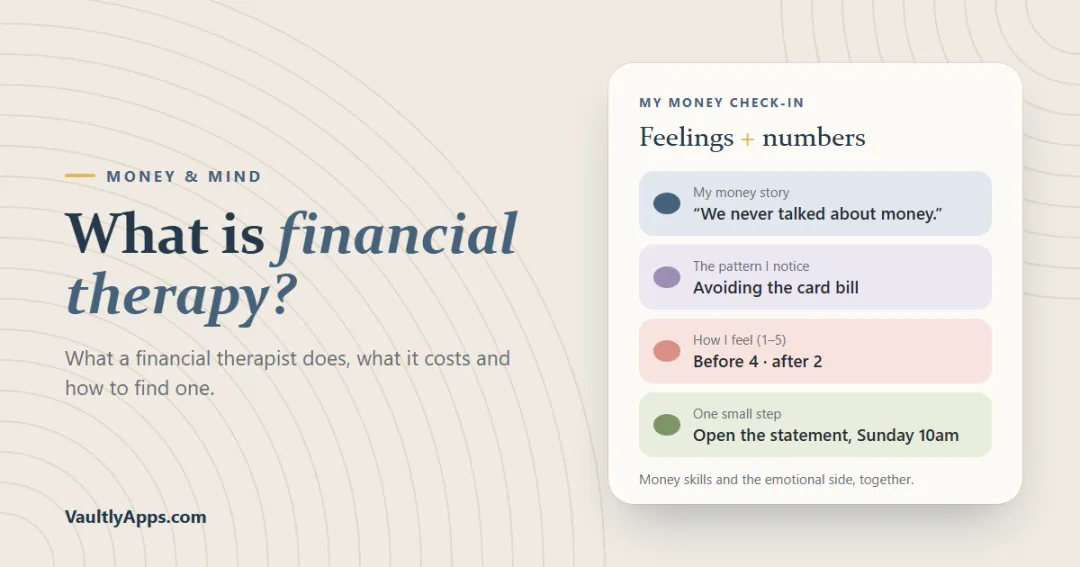
- Financial therapy — a blend of money skills and emotional support from someone trained in both. Our guide to financial therapy explains what a financial therapist does and how to find one.
- Nonprofit credit counselling — for a clear plan when debt is the main source of stress. Look for agencies affiliated with the National Foundation for Credit Counseling.
- Your doctor — for anxiety that's affecting your health, and to talk through whether other treatment could help.
If you're in crisis or having thoughts of harming yourself, call or text 988 in the US or your local emergency number.
A budgeting app built for money anxiety
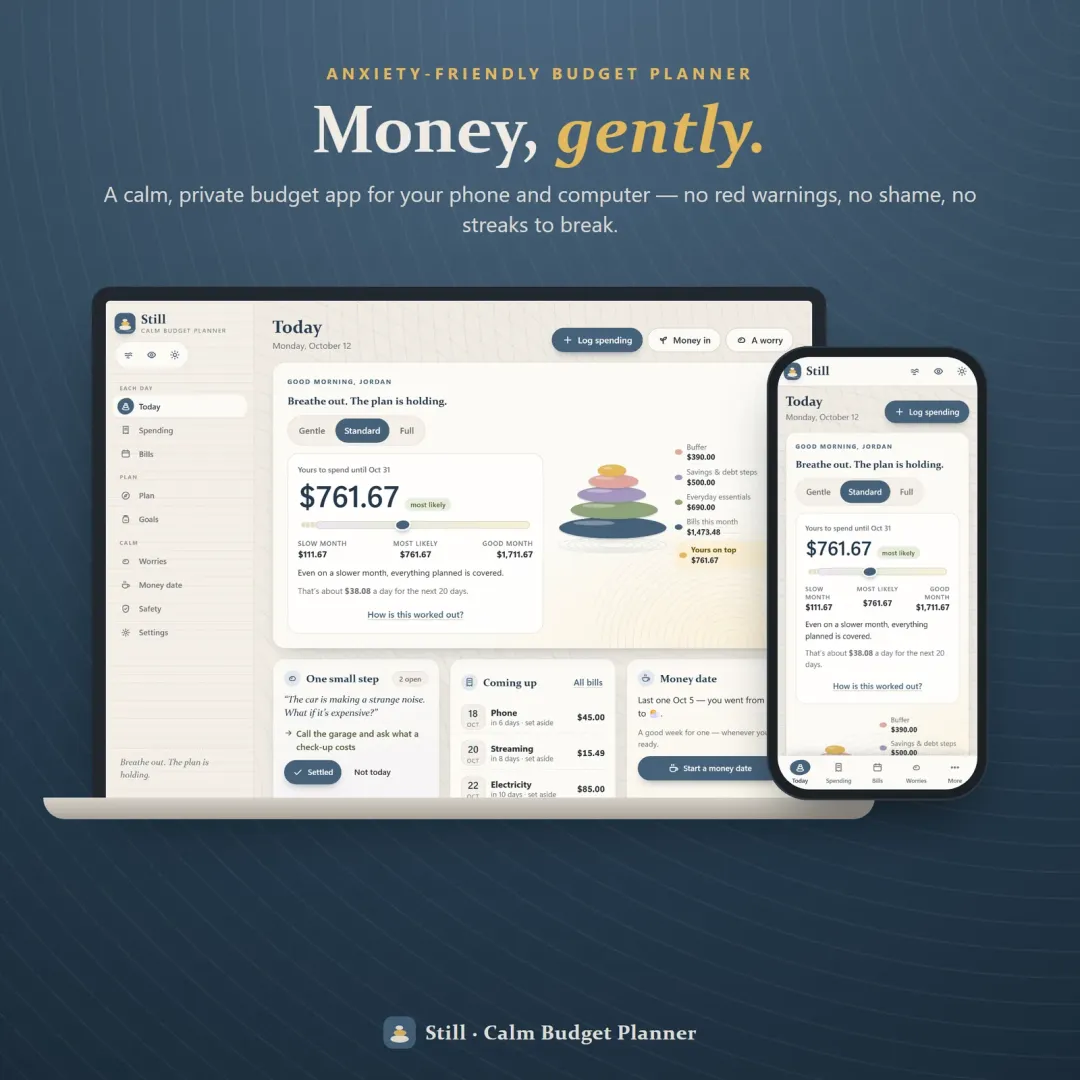
Most budgeting apps are built for people who already feel in control. We built Still for everyone else. It's a calm digital budget planner that shows what's safe to spend as a range, sets aside bills, essentials, savings and a buffer first, and has no red anywhere — "room left" instead of "over budget".
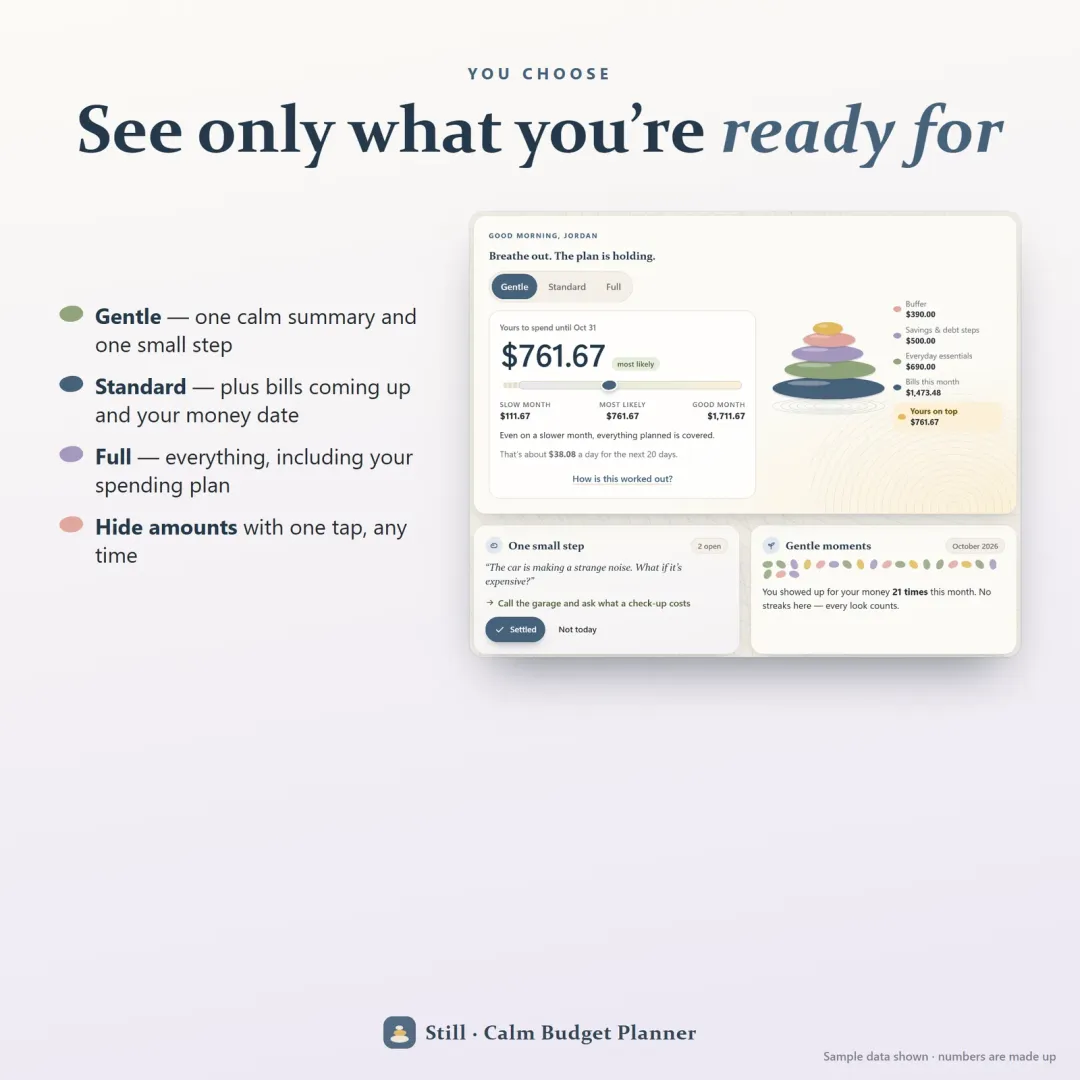
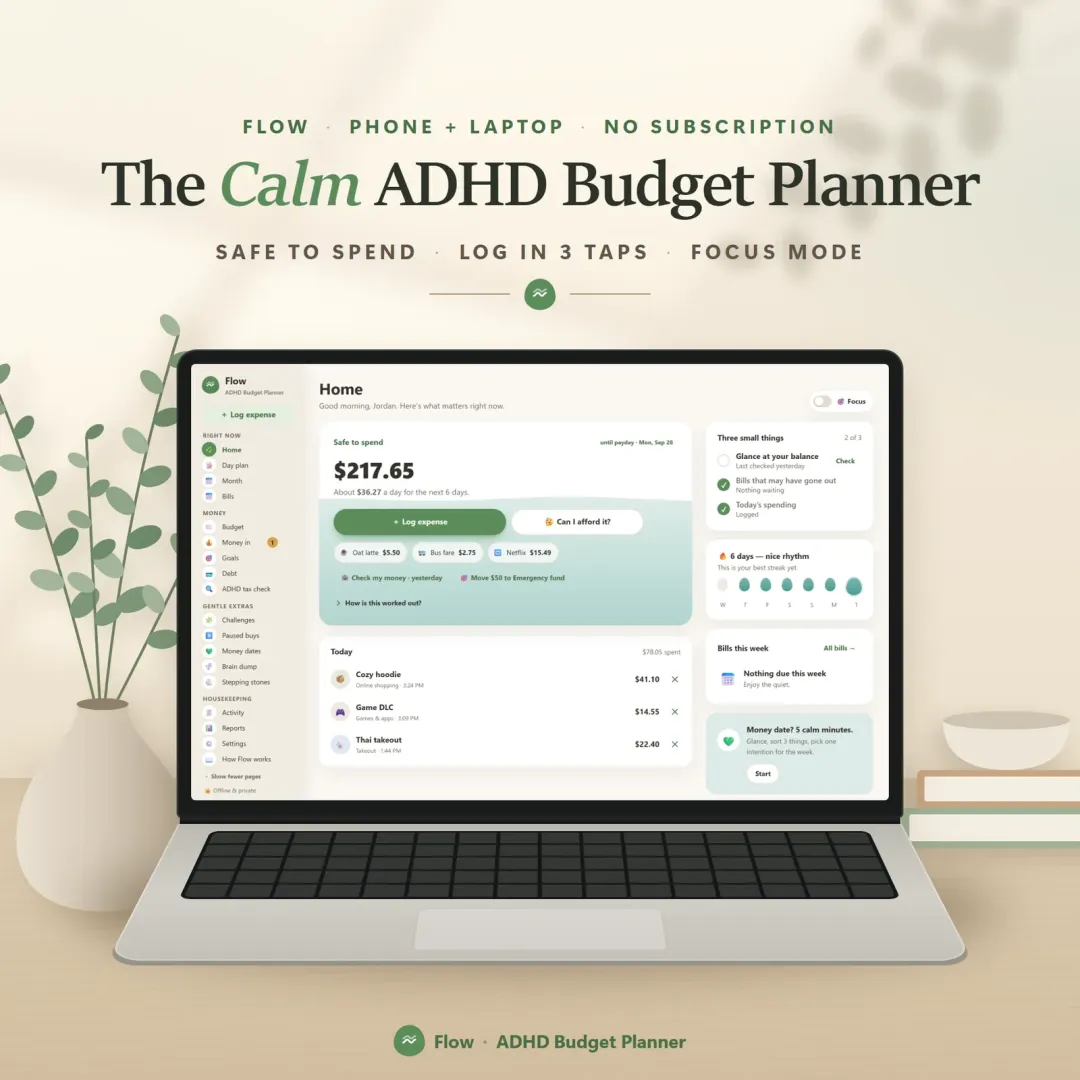
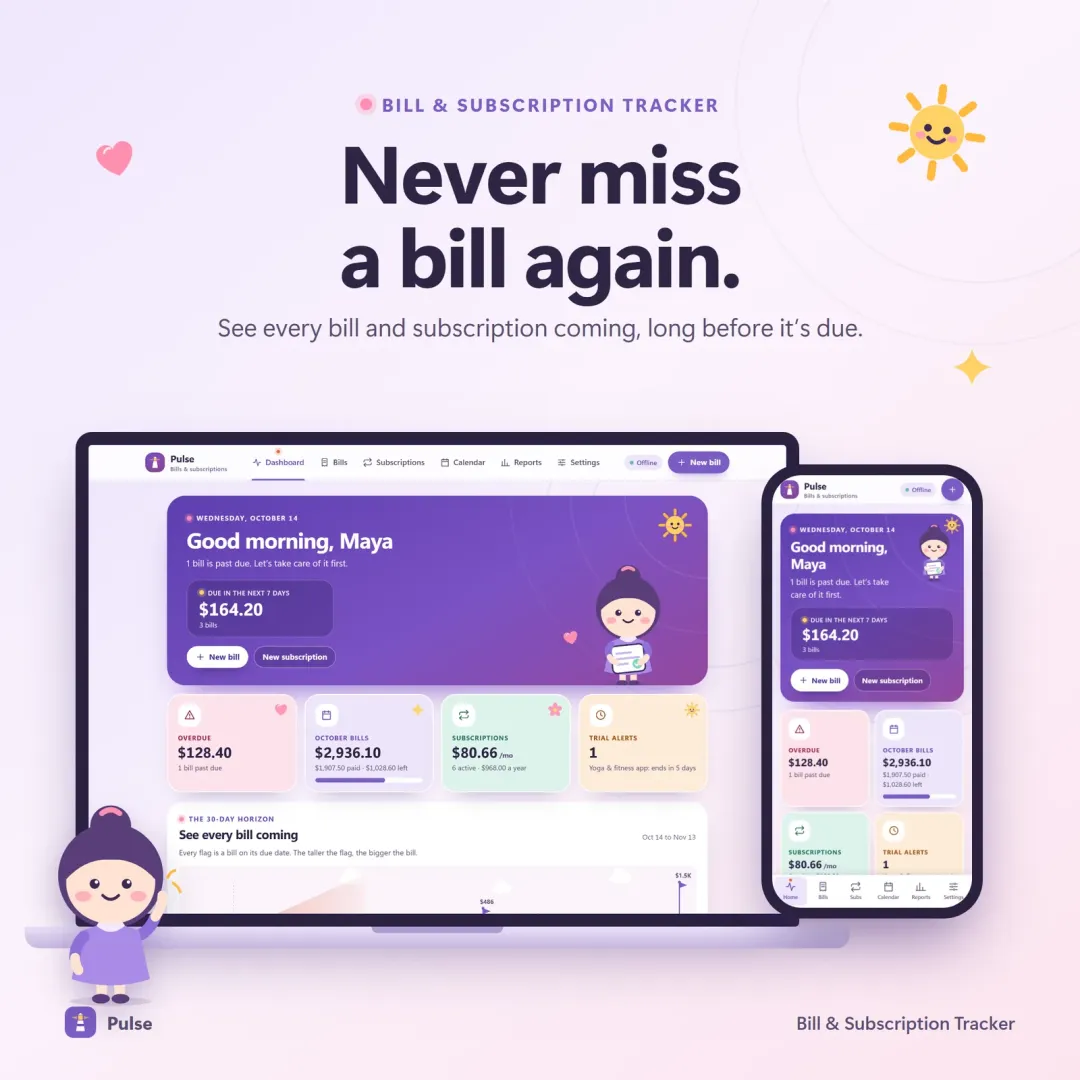
You choose how much you see (Gentle, Standard or Full), hide amounts with one tap, set worries down in a worry inbox, have a guided weekly money date and open Breathe when you feel wobbly. Bills, spending, savings goals, debt payoff and irregular income are all inside, and it never connects to your bank. Try the free Still demo — no sign-up. If bills and subscriptions are the main source of stress, Pulse tracks them on their own; if your brain needs quick wins, try Flow.
The bottom line
If you're stressed about money, you're in very large company — and you're not failing. Financial anxiety grows in uncertainty and avoidance, and it shrinks with small, regular, kind contact with your numbers: set aside first, think in ranges, build a cushion, write worries down, calm your body and get help when it's too heavy to carry alone.
This article is general information, not financial, medical or mental-health advice.
Frequently asked questions
What is financial anxiety?
Is financial anxiety a real condition?
Why am I so scared to look at my finances?
How do I stop being stressed about money?
What is financial anxiety treatment?
What is financial self care?
Can a budgeting app make money anxiety worse?
Written by
Finance Specialist & Editor, VaultlyApps
Emma Whitfield writes and edits the VaultlyApps money guides and free calculators. Her focus is US household finance — budgeting on a real paycheck, paying down credit card and student debt, emergency funds and savings goals, renting — and the money side of freelancing and small-business income, from pricing and profit margins to self-employment tax. Every guide is researched against primary sources such as IRS publications and the CFPB, every number is checked in our tested calculators, and tax content is reviewed each year when new IRS figures come out. Emma is not a licensed financial adviser or tax preparer; her work is general education, not personal advice.
Researched against primary US sources, checked with our calculators and reviewed by a finance expert on our team. Written for US readers — general education, not financial, tax or legal advice. Editorial policy · Disclaimer