How to Avoid Overdraft Fees: 12 Ways That Work (and How to Get One Refunded)
What overdraft fees are, what they cost, how to turn them off, 12 ways to avoid them for good and a word-for-word script for getting one refunded.

In this article
- What is an overdraft fee?
- How much do overdraft fees cost?
- Turn off overdraft coverage first
- 12 ways to avoid overdraft fees
- Stop them at the bank
- Get warned in time
- Keep money between you and zero
- Why your balance causes overdrafts
- How to get an overdraft fee refunded
- Other bank fees worth checking
- When overdrafts keep happening
- A daily number that keeps you out of overdraft
You buy lunch for $11, your balance dips $4 below zero and your bank charges you $27 for it. Overdraft fees are one of the most expensive ways to borrow a few dollars for a day, and they tend to arrive when you can least afford them.
What is an overdraft fee?
An overdraft happens when a transaction takes your checking account below zero and the bank pays it anyway. The overdraft fee is what the bank charges for doing that. You then owe the bank both the negative balance and the fee, and it takes them from your next deposit.
It's easy to mix this up with a related charge:
| What the bank does | What you pay | |
|---|---|---|
| Overdraft | Pays the transaction | Overdraft fee, if your bank charges one |
| NSF (non-sufficient funds) | Declines the payment | NSF fee at some banks, plus a possible late or returned-payment fee from the company |
| Overdraft transfer | Moves money from your linked savings or card | Usually a smaller fee, or none |
| Extended overdraft fee | Keeps charging while you stay negative | A further fee at some banks if you don't fix it within a few days |
How much do overdraft fees cost?
Bankrate's 2025 checking survey put the average overdraft fee at $26.77, and its review found that most accounts still charge one. There's no federal limit. A Consumer Financial Protection Bureau rule that would have capped fees at $5 for large banks was repealed by Congress in May 2025 before it took effect.
The fee is flat, so it hurts more the smaller the purchase. A $27 fee on a $4 coffee makes that coffee cost $31. The fees can also stack up: three small purchases on a bad day can mean three fees, so a $20 shortfall costs you $80.
Policies differ a lot from bank to bank. These details come from Bankrate's review, published in November 2025, and they can change, so check your own account's fee schedule:
| Bank | Overdraft fee | Good to know |
|---|---|---|
| Capital One, Citibank, Ally, Discover, Alliant Credit Union, EverBank | $0 | No overdraft fees on consumer checking |
| Bank of America | $10 | Up to two a day, no NSF fee |
| Wells Fargo | $35 | Up to three a day, 24-hour grace period |
| U.S. Bank | $36 | 24-hour grace period, no fee if you're overdrawn by under $50 |
Turn off overdraft coverage first
This is the most useful thing in this guide, and it takes one call. Under federal rules (Regulation E), a bank can't charge you an overdraft fee on an ATM withdrawal or an everyday debit card purchase unless you opted in. Many people opted in years ago without noticing, when they opened the account.
You can cancel that opt-in at any time. Without it, a purchase you can't cover is simply declined at the register. That's embarrassing for a moment, but it costs nothing.
Opting out doesn't cover everything. Checks, automatic bill payments and other ACH payments and recurring debit card charges can still overdraw your account and bring a fee, depending on your bank. That's why the rest of this list matters too.
12 ways to avoid overdraft fees
Stop them at the bank
- Opt out of debit card and ATM coverage. Call your bank, use its app or visit a branch.
- Switch to a no-overdraft-fee account. If you overdraw more than once or twice a year, this alone may save you more than everything else here.
- Link a savings account. Overdraft transfers usually cost little or nothing compared with a fee. Check the terms first, and don't link a credit card without reading what it charges.
- Use the grace period. Some banks waive the fee if you bring your balance back up by a deadline, often the end of the next business day. Find out your bank's deadline before you need it.
Get warned in time
- Set a low-balance alert. Choose a number that gives you time to act, such as $100 rather than $10.
- Add bills to your phone's calendar. Set a heads-up for the evening before each one, especially for autopay.
- Check your balance on a set day. A weekly 10-minute money check-in catches most problems before they cost anything.
Keep money between you and zero
- Keep a small buffer in checking. Even $50 to $100 that you treat as zero will absorb most small surprises. A separate emergency fund can grow from there.
- Move bill due dates. Most utilities, card companies and insurers will move a due date if you ask. Put your big bills just after payday.
- Line up autopay with payday. Autopay is great until it runs the day before your paycheck lands. Check the date on every automatic payment you have.
- Cancel what you don't use. Forgotten renewals are a classic cause of surprise overdrafts. Our guide to tracking subscriptions shows how to find every one.
- Spend from what's safe, not from your balance. This is the root cause, so it gets its own section.
Why your balance causes overdrafts
Most overdrafts aren't overspending. They're a timing problem. Your balance says $340 on Tuesday, so lunch feels fine. But the $290 car payment leaves on Wednesday and the $65 phone bill on Thursday, and now you're negative. Nothing about your balance warned you.
A safe-to-spend number fixes this by subtracting what's already promised:
| Amount | |
|---|---|
| Balance today | $340 |
| Car payment due Wednesday | −$290 |
| Phone bill due Thursday | −$65 |
| Safe to spend until payday | −$15 |
So you can see the problem on Tuesday, while you still have choices. You can skip the takeout, move the phone bill or transfer $20 from savings. All of those are free. To see how this looks across a whole pay period, try the paycheck budget calculator.
Pending transactions make this worse. A debit card purchase can take a few days to post, so your balance may not show money you've already spent. Some banks may also post larger transactions first, which can trigger more fees, so read how yours orders payments.

How to get an overdraft fee refunded
Banks don't have to refund the fee, but many will if you ask, especially if it's rare for you. Call soon after the fee, or use the secure message in your banking app. Be polite and direct:
"Hi, I was charged a $27 overdraft fee on [date]. I've been a customer for [X years] and I don't usually overdraw, and I've already brought my balance back up. Could you refund that fee as a one-time courtesy?"
If the answer is no, ask once more:
"I understand. Is there someone else who can review it, or a partial refund you can offer? I'd also like to opt out of overdraft coverage for debit card and ATM transactions while we're talking."
Ask them to confirm the refund and the opt-out in writing, then check that the money has come back. If you think the charge was a real mistake, such as a double posting, say so clearly, because that's an error dispute and not a courtesy request. You can also file a complaint with the Consumer Financial Protection Bureau (opens in a new tab) if the bank won't resolve an error.

Other bank fees worth checking
Overdrafts are the best known, but they're rarely the only leak. Download a few months of statements and look for these hidden bank fees:
- Monthly maintenance fees. Many can be waived with direct deposit or a minimum balance, so ask.
- Out-of-network ATM fees. You can pay both your bank and the ATM owner.
- Paper statement fees. Going paperless usually removes them.
- Returned-payment fees from the company you were paying, on top of anything your bank charges.
- Foreign transaction fees on your debit or credit card.
When overdrafts keep happening
If you get hit every few months, the setup is the problem, and the steps above should fix it. If it's every month, there's probably not enough room between your pay and your bills. Our guide on how to stop living paycheck to paycheck walks through what to change first.
Be careful with the fixes that make it worse. A payday loan to cover a shortfall usually costs far more than the overdraft fee. Paycheck advance apps can also add tips and fees and leave your next paycheck smaller. If you're facing a bill you can't pay, call the company before the due date, because many offer a payment plan or a later date.
If forgetting is the main cause rather than money, you're not alone. These are the kinds of costs people call the ADHD tax, and the fix is a system that doesn't rely on memory.
A daily number that keeps you out of overdraft
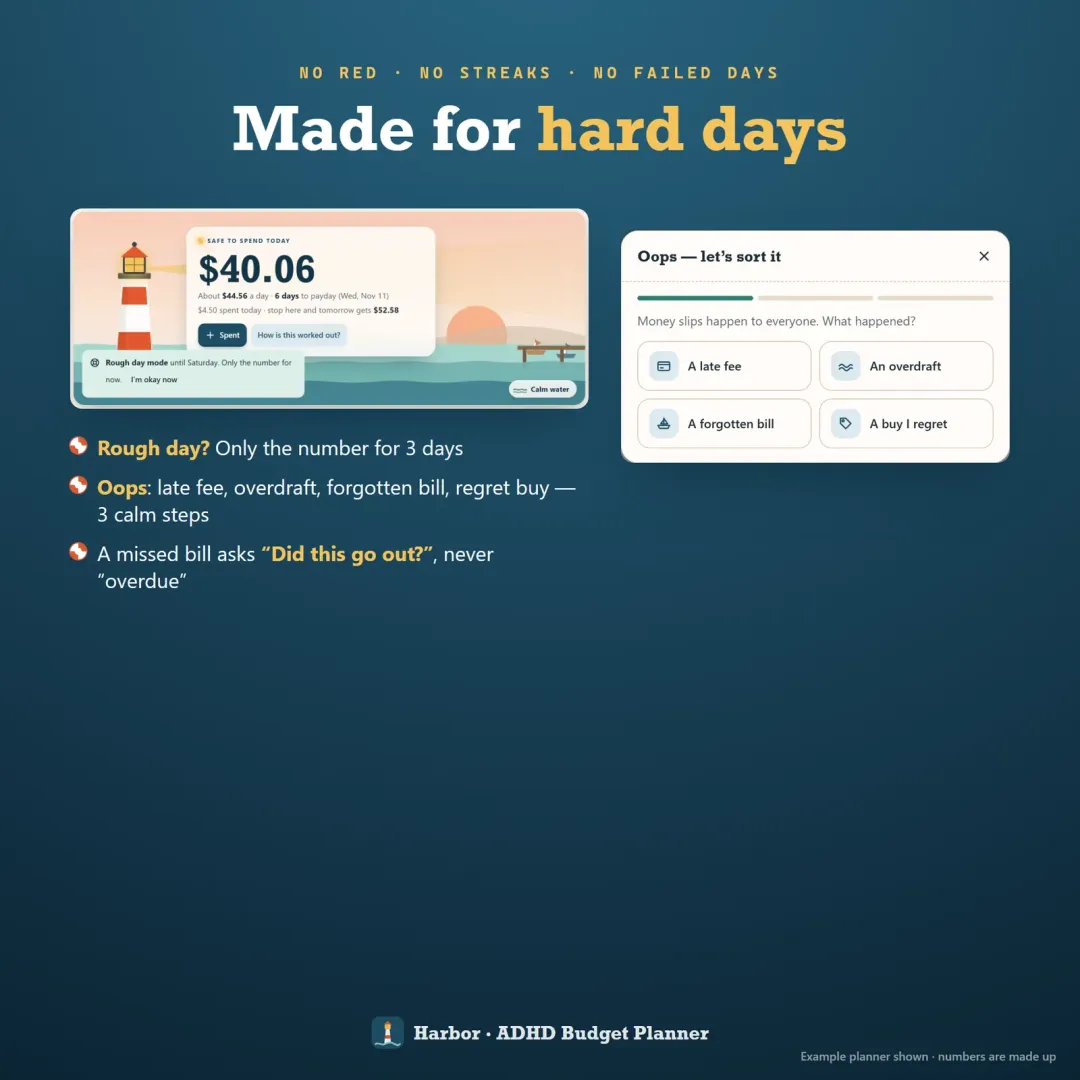
Harbor is our daily spending tracker and paycheck budget planner, and it's built around this exact problem. It keeps back the bills due before payday and shows one number: what's safe to spend today. Bills can go on your phone's calendar with a heads-up the evening before. Oops walks you through a late fee or an overdraft in 3 calm steps, copy-ready scripts help you ask for a fee back, and the hidden fees check reads a CSV statement from your bank, on your device only, and finds repeating fees and subscriptions. You can try the free demo with sample numbers.
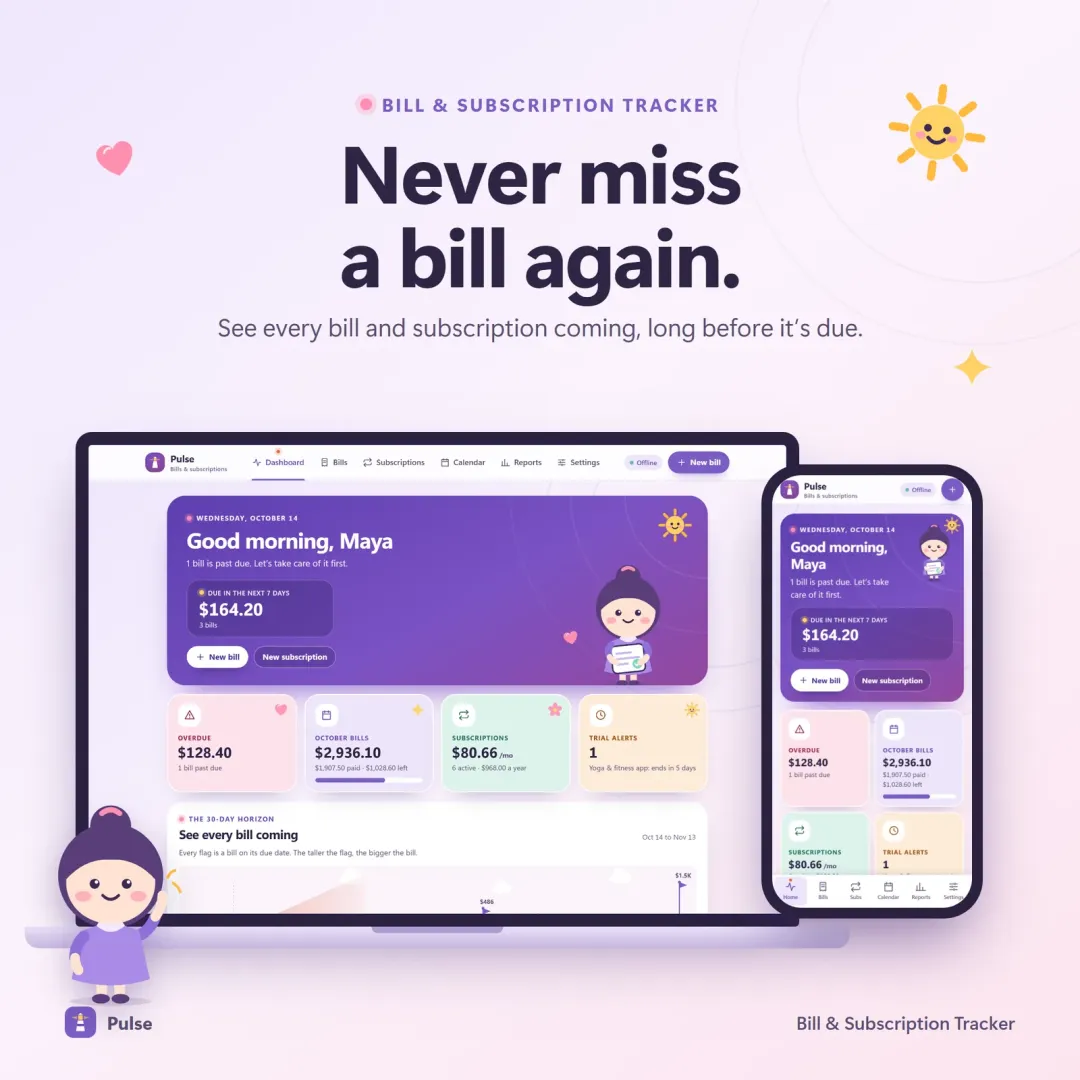
If bills are your main worry, Pulse is our bill and subscription tracker, with a due-date calendar and free trial countdowns.
This article is general information, not financial or legal advice. Bank fees and policies change, so check your own account's terms.
Frequently asked questions
How much are overdraft fees?
How can I avoid overdraft fees?
Can I get an overdraft fee refunded?
What is the difference between an overdraft fee and an NSF fee?
Do overdraft fees affect my credit score?
Can a bank charge an overdraft fee on a debit card purchase?
Is there a legal limit on overdraft fees?
Key terms
Written by
Finance Specialist & Editor, VaultlyApps
Emma Whitfield writes and edits the VaultlyApps money guides and free calculators. Her focus is US household finance — budgeting on a real paycheck, paying down credit card and student debt, emergency funds and savings goals, renting — and the money side of freelancing and small-business income, from pricing and profit margins to self-employment tax. Every guide is researched against primary sources such as IRS publications and the CFPB, every number is checked in our tested calculators, and tax content is reviewed each year when new IRS figures come out. Emma is not a licensed financial adviser or tax preparer; her work is general education, not personal advice.
Researched against primary US sources, checked with our calculators and reviewed by a finance expert on our team. Written for US readers — general education, not financial, tax or legal advice. Editorial policy · Disclaimer