
Weekly Cleaning Schedule: a Realistic Plan (Room by Room, ADHD-Friendly)
A simple weekly cleaning schedule that takes about 20 minutes a day — one focus area per day, daily resets, monthly jobs and a chore chart for adults — plus ADHD-friendly tips for keeping the house clean without burning out.
In this article
- Why a weekly cleaning schedule works
- The 3 layers of a cleaning routine
- The daily reset (10–15 minutes)
- The weekly cleaning schedule (one focus per day)
- Monthly and seasonal cleaning jobs
- Room-by-room cleaning checklist
- A weekly cleaning routine for working parents
- A 30-minute weekend reset
- A chore chart for adults
- ADHD cleaning: how to keep the house clean with ADHD
- How to make chores fun (or at least less boring)
- Make your weekly cleaning schedule stick
- A cozy way to keep track of chores
- Printable weekly cleaning schedule
- The bottom line
There are two kinds of cleaning schedules: the beautiful ones on Pinterest with forty tasks a day, and the ones people actually follow. This guide is about the second kind. A good weekly cleaning schedule isn't about a spotless house; it's about never facing a four-hour Saturday disaster again — and about knowing exactly what to do when you have twenty minutes.
Below you'll find a simple schedule with one focus per day, a 15-minute daily reset, a monthly and seasonal list, a chore chart for adults you can share, and practical ADHD cleaning tips that make it stick.
Why a weekly cleaning schedule works
Mess grows quietly. Dishes become a sink-full, one jumper becomes a chair-full, and suddenly the whole house feels impossible. A schedule breaks that cycle in three ways:
- It removes decisions. You don't stand in the hallway wondering where to start — today is floors day.
- It shrinks the job. No single day is bigger than 20–30 minutes.
- It catches the forgotten jobs. The bathroom fan, the fridge shelves and the baseboards get a turn instead of waiting until guests come.
The 3 layers of a cleaning routine
Think of your cleaning routine as three layers stacked on top of each other:
- Daily reset (10–15 minutes): the small things that stop mess from growing.
- Weekly focus (15–20 minutes): one area or job per day.
- Monthly and seasonal jobs: one rotated into each week.
That's it. Everything else is optional.
The daily reset (10–15 minutes)
Do these every day — ideally at the same time, such as straight after dinner or before bed:
- Dishes washed or dishwasher loaded and run
- Kitchen counters and table wiped
- A 10-item tidy: put away ten things that are out of place
- A quick wipe of the bathroom sink
- Trash out if it's full
- Tomorrow's clothes and bag ready (your future self will thank you)
Set a timer for 15 minutes and stop when it rings, even if something's left. The point is to reset, not to perfect.
The weekly cleaning schedule (one focus per day)
| Day | Focus | Time |
|---|---|---|
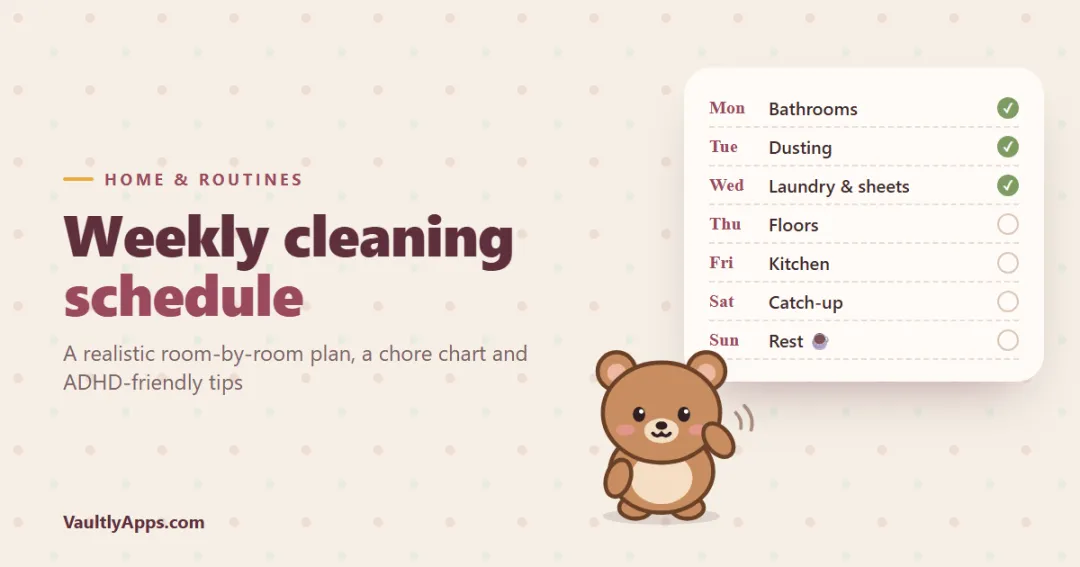
| Monday | Bathrooms: toilet, sink, mirror, shower or tub, towels | 20 min |
| Tuesday | Dusting and surfaces: shelves, TV, lamps, light switches, door handles | 15 min |
| Wednesday | Laundry and bedding: wash sheets, change towels, fold and put away | 20 min |
| Thursday | Floors: vacuum, then mop kitchen and bathroom floors | 20–30 min |
| Friday | Kitchen: wipe appliances, microwave, stovetop, clean out old food | 20 min |
| Saturday | Catch-up + one monthly job (see below) | 20–30 min |
| Sunday | Rest — or a 10-minute reset before the new week | 10 min |
Change the days to suit your life. If laundry day works better on Sunday, move it. The only rule is one focus per day.
Monthly and seasonal cleaning jobs
Add one of these to your Saturday catch-up each week, and you'll get through the list every couple of months:
Monthly
- Clean inside the fridge and throw out old jars
- Clean the microwave and oven door
- Wipe baseboards and door frames
- Wash the shower curtain or clean the glass
- Vacuum the sofa and under cushions
- Declutter one drawer or shelf
- Clean the dishwasher filter and washing machine seal
Seasonal (every 3 months)
- Wash windows inside
- Flip or rotate the mattress
- Clean the oven properly
- Wash pillows and duvets
- Dust ceiling fans, vents and light fittings
- Clear out the wardrobe and donate what you don't wear
Room-by-room cleaning checklist
When it's a room's turn, this is what "clean" means. Do the bold items every week; the rest when you have time.
Kitchen
- Wipe counters, hob and splashback
- Clean the sink and tap
- Wipe the microwave inside and out
- Empty old food from the fridge before the weekly shop
- Wipe cupboard doors and handles
- Clean the toaster crumb tray and kettle base
Bathroom
- Clean the toilet, inside and out
- Scrub the sink and wipe the mirror
- Clean the shower or tub
- Fresh towels and bath mat
- Wipe tiles and the shower screen
- Empty the bin and restock toilet paper
Bedroom
- Change the sheets
- Put clothes away (or in the wash)
- Clear the bedside table
- Dust surfaces and the headboard
- Vacuum under the bed once a month
Living room
- Tidy surfaces and fold the throw
- Vacuum the floor and rug
- Fluff the cushions
- Dust the TV, shelves and lamps
- Wipe the remote and light switches
A weekly cleaning routine for working parents
If you work full time and have kids, the schedule above still works — just shrink it:
- Weekdays: the 15-minute daily reset only, done together after dinner. Kids can handle "put away ten things" and wiping the table.
- One evening a week: a 20-minute "power hour lite" — bathrooms and floors, with music on.
- Weekend: sheets, laundry and one monthly job, split between everyone at home.
- Batch and simplify: one laundry day, one big shop, meals planned for the week so the kitchen stays calmer. A weekly meal plan with a grocery list helps here.
The goal is a home that works, not one that's photo-ready. Lower the bar for weekdays and let the weekend catch up.
A 30-minute weekend reset
When the week got away from you, this reset brings the house back in half an hour:
- 5 minutes: open the windows, start a load of laundry, put on a playlist.
- 10 minutes: a "basket sweep" — walk through every room with a basket and collect everything that's out of place.
- 5 minutes: dishes and kitchen counters.
- 5 minutes: wipe the bathroom sink and toilet, swap the towels.
- 5 minutes: a quick vacuum of the main walkways.
Then stop. Make a cup of tea. The rest can wait for its day on the schedule.
A chore chart for adults
If you share your home, a chore chart for adults turns "who does what" into something you agree on once instead of arguing about weekly. Keep it simple:
| Chore | How often | Who |
|---|---|---|
| Dishes / dishwasher | Daily | Take turns by day |
| Kitchen counters | Daily | Whoever cooked |
| Bathrooms | Weekly | A |
| Vacuum and mop | Weekly | B |
| Laundry (own) | Weekly | Everyone |
| Sheets and towels | Weekly | A |
| Trash and recycling | Weekly | B |
| Fridge clean-out | Monthly | Rotate |
A few rules make it fair: count the time each job takes (not just the number of jobs), swap the worst jobs every month, and agree what "done" means. If you split costs as well as chores, our split rent calculator helps with the money side.
ADHD cleaning: how to keep the house clean with ADHD
ADHD cleaning isn't about willpower. It's about making the job small, visible and a little bit fun. What helps most people:
- One surface, not one room. "Clean the kitchen" is vague. "Clear the counter by the kettle" is a task.
- Use a timer. "Just ten minutes" makes starting easy, and starting is the hard part. A visual timer shows the time shrinking.
- Body doubling. Clean while a friend is on a call, or put on a "clean with me" video. Our guide to body doubling explains why it works.
- Make it rewarding. A favourite playlist, a podcast or a candle you only light while tidying. A dopamine menu gives you ideas.
- Same order every time. Top to bottom, left to right. You stop deciding and just follow the path.
- Baskets everywhere. A "doesn't belong here" basket in each room means tidying is just carrying one basket back.
- Lower the bar on purpose. A 70% clean house you keep beats a 100% clean house once a month.
- Never call it overdue. Missed bathrooms on Monday? It's not failed — it's just next. Guilt makes starting harder.
How to make chores fun (or at least less boring)
- Race the clock: how much can you tidy before one song ends?
- Pair chores with treats: fold laundry while watching one episode of a show.
- Track the wins: ticking something off a list — or earning a small reward — gives your brain a little hit of satisfaction.
- Batch tiny jobs: keep a "five-minute jobs" list for when you're waiting for the kettle.
Make your weekly cleaning schedule stick
- Write it where you'll see it. On the fridge, in your planner, or as repeating chores in an app.
- Attach it to an anchor. Bathroom after Monday's shower, floors after Thursday's dinner.
- Start smaller than you think. Begin with the daily reset only for a week. Add the weekly focus in week two.
- Review once a week. On Sunday, look at what got done and move anything missed to next week — a ten-minute weekly reset keeps the plan honest.
- Let it bend. Busy week? Do the daily reset and skip the rest. The schedule serves you, not the other way round.
A cozy way to keep track of chores
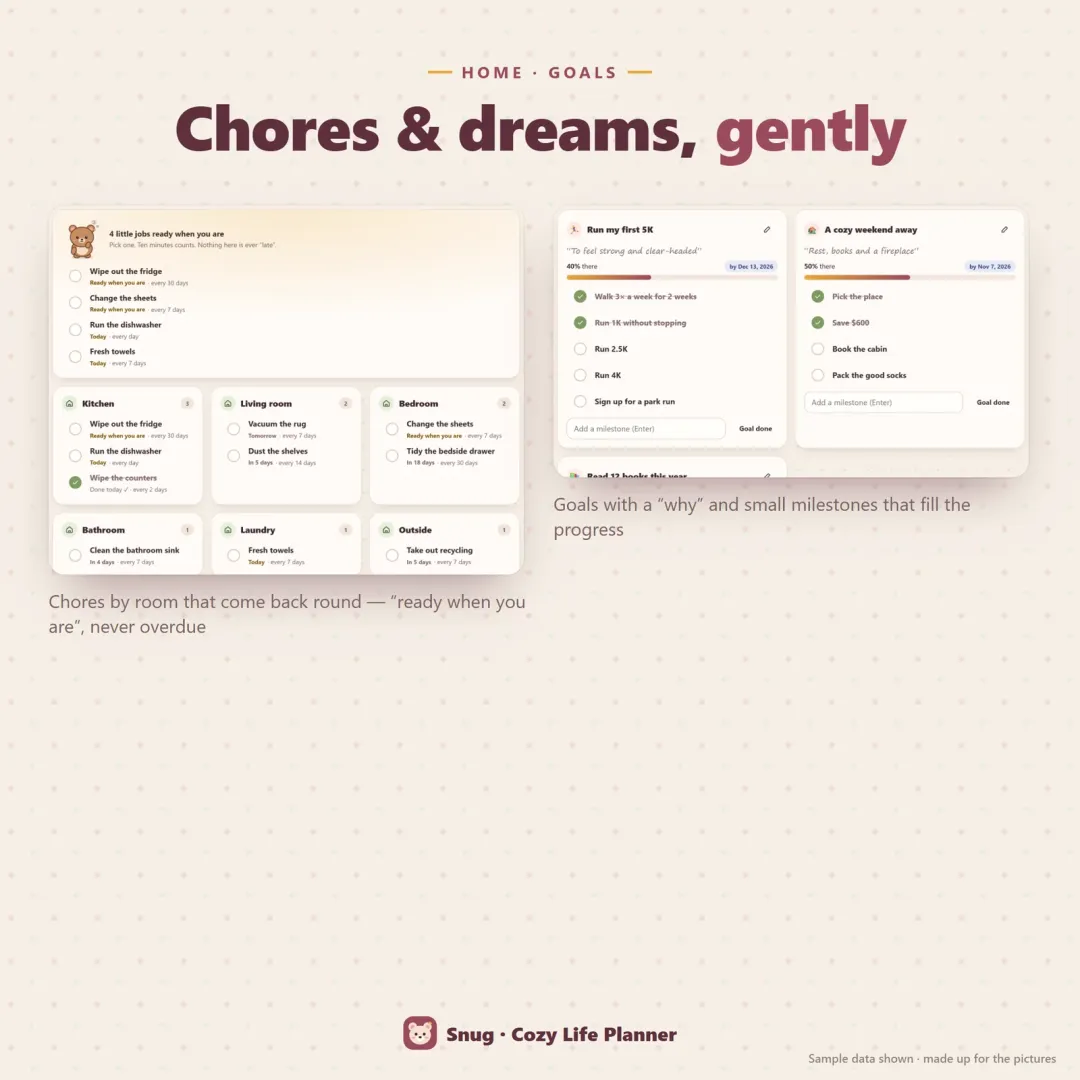
Our cozy planner app, Snug, has a Home & chores room built for exactly this: add chores by room with how often they come round — every day, every week, every month or every three months — and Snug shows what's ready, sorted by room. Tick a chore and it quietly comes back after its interval. Nothing ever turns red or says "overdue", and every finished chore earns an acorn for your companion's cozy room. You can try the free demo with a sample home.
If you're building routines around the house, our guides to morning routine ideas and a self-care routine pair well with a cleaning plan — a tidy space and a calm morning feed each other.
Printable weekly cleaning schedule
Want it on paper? Copy the table above onto an index card, or print the weekly plan page from any planner and give each day its focus. Keep it short: if it doesn't fit on one card, it's too much.
The bottom line
The best weekly cleaning schedule is the one you'll still be doing in three months. Keep the daily reset tiny, give each day one focus, rotate one bigger job a week, and forgive the missed days. Your home doesn't need to be perfect — it just needs to feel like a place you can rest.
Frequently asked questions
What should be on a weekly cleaning schedule?
How do I make a cleaning schedule I'll actually follow?
How long should cleaning take each day?
What is a chore chart for adults?
How do you clean with ADHD?
What chores should be done daily, weekly and monthly?
Should I clean a little every day or all at once?
Written by
Finance Specialist & Editor, VaultlyApps
Emma Whitfield writes and edits the VaultlyApps money guides and free calculators. Her focus is US household finance — budgeting on a real paycheck, paying down credit card and student debt, emergency funds and savings goals, renting — and the money side of freelancing and small-business income, from pricing and profit margins to self-employment tax. Every guide is researched against primary sources such as IRS publications and the CFPB, every number is checked in our tested calculators, and tax content is reviewed each year when new IRS figures come out. Emma is not a licensed financial adviser or tax preparer; her work is general education, not personal advice.
Researched against primary US sources, checked with our calculators and reviewed by a finance expert on our team. Written for US readers — general education, not financial, tax or legal advice. Editorial policy · Disclaimer