How to Do the 100 Envelope Challenge: Rules, Schedules and a Printable Chart
How the 100 envelope challenge works, how much it saves ($5,050), the rules, weekly, biweekly and monthly schedules, smaller and bigger versions, a printable chart and where to keep the money.

In this article
- How the 100 envelope challenge works
- How much do you save with the 100 envelope challenge?
- The rules (there are only two)
- 100 envelope challenge schedules
- The daily version
- The weekly version
- The biweekly version
- The monthly version
- Smaller and bigger versions
- A printable 100 envelope challenge chart
- How to pick the next envelope
- Cash envelopes or a savings account?
- Is the 100 envelope challenge realistic?
- What to save for
- Tips to finish the 100 envelope challenge
- Track the 100 envelope challenge in an app
The 100 envelope challenge is one of the most popular savings challenges on the internet, and for good reason: it's simple, it's visual, and it saves a surprisingly large amount, $5,050. You number 100 envelopes, fill them with the dollar amount on the front in any order you like, and watch the box of empty envelopes shrink.
This guide covers how to do the 100 envelope challenge, the rules, schedules for daily, weekly, biweekly and monthly saving, smaller and bigger versions, a printable 100 envelope challenge chart, and where to keep the money.
How the 100 envelope challenge works
- Get 100 envelopes (or print a chart, below) and number them 1 to 100.
- Pick an envelope whenever you save. Draw one at random, or choose one that fits your budget that day.
- Put in the dollar amount on the front. Envelope 1 gets $1, envelope 37 gets $37, envelope 100 gets $100.
- Repeat until all 100 are full. You've saved $5,050.
That's the whole challenge. The freedom to choose the order is what makes it work: you can fill a $3 envelope at the end of a tight week and a $90 one on payday.
How much do you save with the 100 envelope challenge?
The total is the sum of the numbers 1 to 100: 1 + 2 + 3 + … + 100 = $5,050. A quick way to see it: pair the first and last envelopes (1 + 100 = 101), the second and second-to-last (2 + 99 = 101) and so on. That's 50 pairs of $101, which is $5,050.
That pairing trick also makes the best schedule, as you'll see below.
The rules (there are only two)
- Each envelope holds the amount on its number.
- Fill all 100 eventually.
Everything else is up to you: the order, the pace, whether you use paper envelopes, a jar, a binder or a chart, and whether the money stays as cash or goes into a bank account. Many people add a few house rules of their own:
- No "borrowing" from filled envelopes.
- If you miss a week, you catch up with small envelopes rather than skip.
- Windfalls (a tax refund, a bonus, a sale) fill big envelopes.
100 envelope challenge schedules
| Pace | Envelopes | Average amount | Finish in |
|---|---|---|---|
| Daily | 1 a day | $50.50 a day | 100 days |
| Weekly | 2 a week (paired to $101) | $101 a week | 50 weeks |
| Biweekly | 4 per paycheck (two pairs) | $202 a paycheck | 25 paychecks |
| Twice a month | 4 per paycheck | about $202 a paycheck | about 12.5 months |
| Monthly | 8 or 9 a month | about $421 a month | 12 months |
The daily version
The original viral version fills one envelope a day for 100 days. It averages $50.50 a day, around $1,500 a month, which is far more than most budgets can handle. If you can do it, it's a fast way to build an emergency fund. If you can't, don't worry: very few people do it daily.
The weekly version
Fill two envelopes a week that add up to $101: 1 and 100, 2 and 99, 3 and 98, and so on. Every week costs exactly the same, $101, and you finish in 50 weeks. This is the most realistic version for a full year.
The biweekly version
If you're paid every two weeks, the 100 envelope challenge biweekly works by filling four envelopes (two pairs) per paycheck: $202. After 25 paychecks, just under a year, all 100 are full. If $202 is too much, fill two envelopes per paycheck and finish in two years.
The monthly version
Fill 8 or 9 envelopes a month, about $421, and you're done in 12 months. It's the same total as the weekly version, just in bigger steps. It works well if you budget monthly or get paid once a month.
Smaller and bigger versions
| Version | Total |
|---|---|
| 50 envelopes ($1 to $50) | $1,275 |
| 100 envelopes, $0.50 per number | $2,525 |
| 100 envelopes (classic) | $5,050 |
| 100 envelopes, $2 per number | $10,100 |
| 200 envelopes ($1 to $200) | $20,100 |
The 50 envelope challenge is the easiest way in. The half-dollar version keeps the 100-envelope fun at half the cost. The $10,000 version (double each envelope) is for big goals like a down payment or paying off a car. Try any version in the 100 envelope challenge tracker.
A printable 100 envelope challenge chart
You don't need 100 real envelopes. A chart with 100 numbered squares works just as well: colour one in each time you put that amount aside, and keep the money itself in a savings account.
- Our 100 envelope challenge tracker lets you tap envelopes as you fill them, draw a random envelope, and print or save the chart as a PDF.
- Our printable savings tracker makes a colour-in chart for any goal. Set 100 squares and Growing amounts for a classic $1 to $100 grid, or try Shuffled for a mixed-up order.
Print it, stick it on the fridge and colour in as you go.

How to pick the next envelope
Choosing is half the fun. A few ways people do it:
- Draw at random. Put 100 numbered slips in a jar.
- Roll dice. Roll two dice and use the number or a pair.
- Match your budget. Look at what's left this week and pick the biggest envelope you can afford.
- Pair it. Always fill one big and one small envelope together to keep each week the same.
- Big on payday, small at month end.
Cash envelopes or a savings account?
Part of the challenge's charm is cash in real envelopes, and it overlaps with cash stuffing, where people put their spending money in labeled envelopes to stick to a budget. For savings, though, cash at home has real downsides: it's easy to "borrow" from, it can be lost or stolen, and it earns nothing.
The common middle ground: keep the envelopes or chart for tracking, and move the money into a separate high-yield savings account each week or payday. You get the fun of the challenge and the interest. On $5,050 saved over a year, that can add up to around $100 at today's rates; see how much with the savings calculator.
Is the 100 envelope challenge realistic?
For many people, $5,050 in a year is a lot: about $97 a week, or a fifth of a $25,000 take-home pay. That's fine, because the challenge bends:
- Do the 50 envelope challenge or the half-dollar version first.
- Take two years instead of one: one pair a paycheck.
- Fund big envelopes with windfalls: tax refunds, bonuses, side income, things you sell.
- Combine it with a no spend challenge for a month to free up money.
If you want something gentler and slower, the 52-week savings challenge saves $1,378 over a year, starting at $1. Our guide to 15 savings challenges compares all the popular ones side by side.
What to save for
The challenge works best when the money has a job:
- An emergency fund. $5,050 covers a few months of essentials for many households; see how much you need.
- Christmas and birthdays. Start in January and the holidays are paid for in cash.
- A trip or a car without a loan.
- Paying down debt. Send each filled envelope to the card with the highest rate; compare the debt snowball vs debt avalanche.
- Sinking funds for yearly bills; see our guide to sinking funds.
Tips to finish the 100 envelope challenge
- Write the goal on the box or chart. A named goal beats "savings".
- Automate the base. Set up a transfer of $101 a week or $202 a paycheck, and use the chart to tick it off.
- Front-load the big envelopes while motivation is high.
- Never skip, shrink. A $1 envelope still counts.
- Do it with someone. Split the envelopes with a partner, or race a friend.
- Celebrate milestones: 25, 50 and 75 envelopes done.
Track the 100 envelope challenge in an app
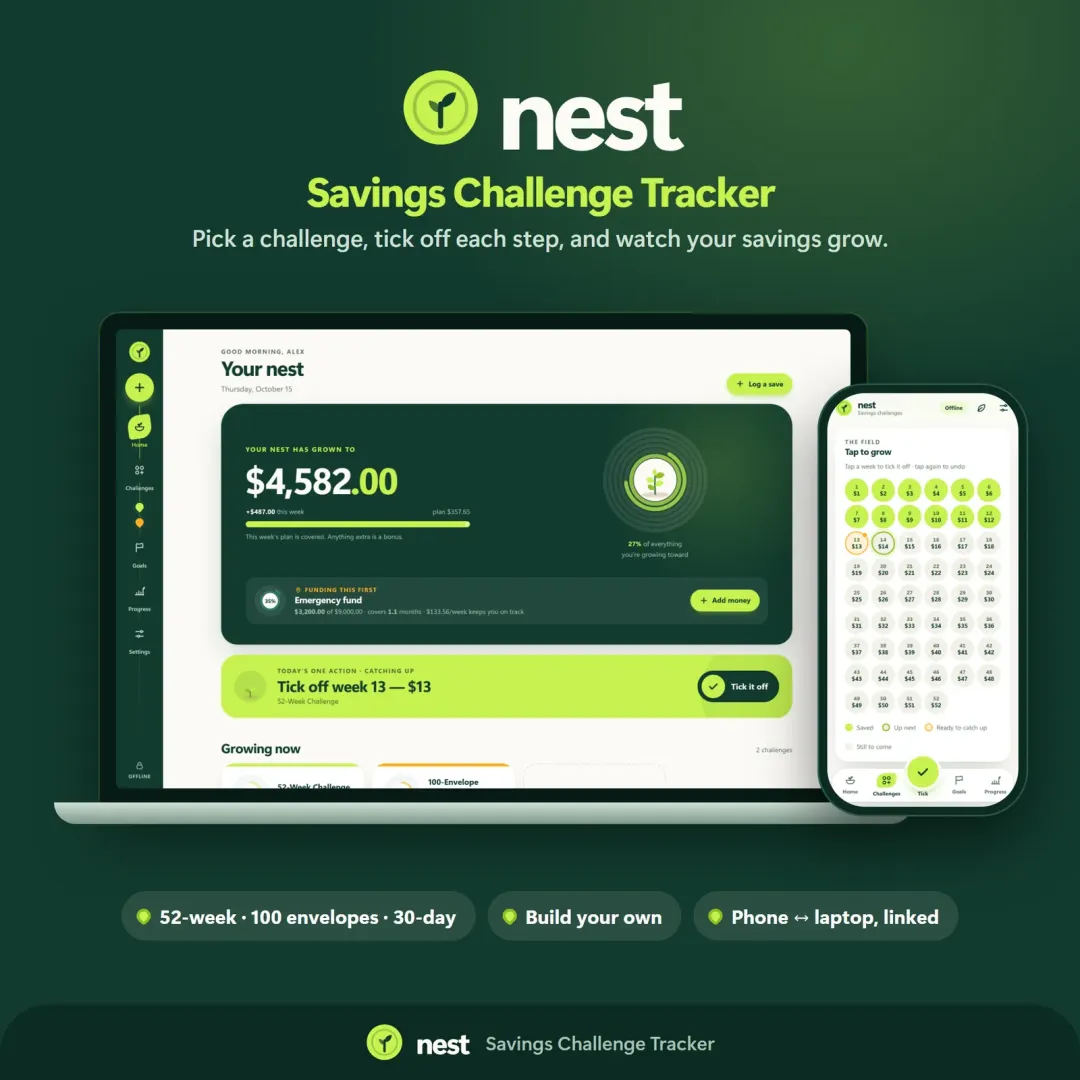
Mochi is a cute budget planner app with the 100 envelope challenge, the 50 envelope challenge, the 52 week challenge and $1,000 in 30 days built in. Roll the dice or scratch a gold card to pick the next envelope, link the challenge to a savings picture and watch it colour in, all next to your budget and bills. Nest is our savings challenge tracker for the 100 envelope, 52-week and 365-day challenges. Both have a free demo with sample data.

Frequently asked questions
How does the 100 envelope challenge work?
How much do you save with the 100 envelope challenge?
How long does the 100 envelope challenge take?
How do I do the 100 envelope challenge biweekly?
What are the rules of the 100 envelope challenge?
Is the 100 envelope challenge realistic?
Written by
Finance Specialist & Editor, VaultlyApps
Emma Whitfield writes and edits the VaultlyApps money guides and free calculators. Her focus is US household finance — budgeting on a real paycheck, paying down credit card and student debt, emergency funds and savings goals, renting — and the money side of freelancing and small-business income, from pricing and profit margins to self-employment tax. Every guide is researched against primary sources such as IRS publications and the CFPB, every number is checked in our tested calculators, and tax content is reviewed each year when new IRS figures come out. Emma is not a licensed financial adviser or tax preparer; her work is general education, not personal advice.
Researched against primary US sources, checked with our calculators and reviewed by a finance expert on our team. Written for US readers — general education, not financial, tax or legal advice. Editorial policy · Disclaimer