15 Savings Challenges That Actually Work (With Totals and Free Printables)
15 money saving challenges compared, from the 52 week and 100 envelope challenges to the 50 envelope, $1,000 in 30 days and no spend challenges, with how much each one saves, who it suits and how to track it.

In this article
- Savings challenges compared
- 1. The 52 week savings challenge
- 2. The reverse 52 week challenge
- 3. The 26-paycheck challenge
- 4. The 100 envelope challenge
- 5. The 50 envelope challenge
- 6. Save $1,000 in 30 days
- 7. The 365-day $1 challenge
- 8. The penny challenge
- 9. The 12-month challenge
- 10. The $5 bill challenge
- 11. The round-up challenge
- 12. The no spend challenge
- 13. The dice challenge
- 14. The weather challenge
- 15. The sinking fund challenge
- How to choose the right savings challenge
- Savings challenge printables
- Fun ways to save money (that aren't a challenge)
- Where to keep your challenge money
- Tips to actually finish
- A savings tracker that colours itself in
A savings challenge turns saving money into a game. Instead of "I should save more," you get a simple rule, a chart to fill in and a finish line. That's why they work: every square you colour in is a small win, and the total at the end is often far more than you'd have saved by just trying to spend less.
Below are 15 money saving challenges with how much each one saves, who it suits and how to track it, plus a quick comparison table to pick the right one.
Savings challenges compared
| Challenge | How it works | Total saved | Time |
|---|---|---|---|
| 52 week challenge | $1 more each week | $1,378 | 1 year |
| Reverse 52 week | $52 down to $1 | $1,378 | 1 year |
| 26-paycheck challenge | A set amount every paycheck | Your choice | 1 year |
| 100 envelope challenge | Envelopes $1 to $100, any order | $5,050 | 100 days to 1 year |
| 50 envelope challenge | Envelopes $1 to $50 | $1,275 | 50 days to 6 months |
| $1,000 in 30 days | About $33 a day | $1,000 | 1 month |
| 365-day $1 challenge | $1 a day | $365 | 1 year |
| Penny challenge | 1¢ more each day | $667.95 | 1 year |
| 12-month challenge | $50 more each month | $3,900 | 1 year |
| $5 bill challenge | Save every $5 bill you get | Varies | Any |
| Round-up challenge | Round every purchase up | Varies | Any |
| No spend challenge | Spend only on essentials | Varies | Weekend to month |
| Dice challenge | Roll for the amount | Varies | Any |
| Weather challenge | Save the temperature | Varies | 1 year |
| Sinking fund challenge | One goal per big yearly cost | Your choice | 1 year |
1. The 52 week savings challenge
Save $1 in week one, $2 in week two and so on, up to $52 in the last week. By the end of the year you've saved $1,378. It's the classic 52 week money challenge because it starts painlessly and grows slowly. The catch is that December gets expensive (the last month alone is over $200), right when the holidays hit.
Our 52-week savings challenge guide covers paycheck and monthly versions, and the 52-week savings challenge calculator makes a chart with your own starting amount.
2. The reverse 52 week challenge
Same total, $1,378, but you start with $52 and finish with $1. It front-loads the hard weeks into January, when motivation is high, and leaves easy $1 to $10 weeks for the holidays. If you've quit the normal version in November before, try this one.
3. The 26-paycheck challenge
If you're paid every two weeks, a weekly challenge fights your pay schedule. Instead, pick an amount per paycheck: $20 a paycheck saves $520, $50 saves $1,300 and $100 saves $2,600 over 26 paychecks. Or make it grow: $5 more each paycheck, from $5 to $130, saves $1,755. Set it up as an automatic transfer on payday and you're done.
4. The 100 envelope challenge
Number 100 envelopes from 1 to 100. Each time you save, pick an envelope in any order and put in that many dollars. When they're all full, you've saved $5,050. Because you choose the order, you can do small envelopes in tight weeks and big ones on payday. Read the full guide to the 100 envelope challenge or track it with our 100 envelope challenge tracker.
5. The 50 envelope challenge
The 50 envelope challenge is the gentler version: envelopes 1 to 50, $1,275 in total. One envelope a day finishes in 50 days; two a week takes about six months. It's a great first envelope challenge, or a way to save for something specific like the holidays or a trip.
6. Save $1,000 in 30 days
A one-month sprint. $1,000 over 30 days is about $33.33 a day. Most people mix it up: small amounts on weekdays, a bigger chunk on payday, plus money from selling things you don't use. It pairs very well with a no-spend month, which frees up the cash. Make a 30-square chart with our printable savings tracker and colour one in each day.
7. The 365-day $1 challenge
Save $1 a day for a year and finish with $365. It's the easiest challenge here, which makes it great for kids, students or a very tight budget. Want more? Make it $2 a day ($730) or $5 a day ($1,825).
8. The penny challenge
Save 1¢ on day one, 2¢ on day two, up to $3.65 on day 365. The total is $667.95. It's easy early on and gets heavier in December, so many people do it in reverse, starting with $3.65.
9. The 12-month challenge
Save $50 in January, $100 in February, $150 in March and so on up to $600 in December. The total is $3,900. It suits people who budget monthly and like one transfer a month instead of weekly ones.
10. The $5 bill challenge
Every time a $5 bill lands in your wallet, it goes into a jar. It's random, painless and adds up faster than you'd think; people commonly save several hundred dollars to over $1,000 a year. It only works if you still use some cash.
11. The round-up challenge
Round every purchase up to the next dollar (or next $5) and save the difference. A $4.30 latte becomes $5.00 and 70¢ goes to savings. Many banks do this automatically. It won't build a big fund on its own, but it's a nice background habit.
12. The no spend challenge
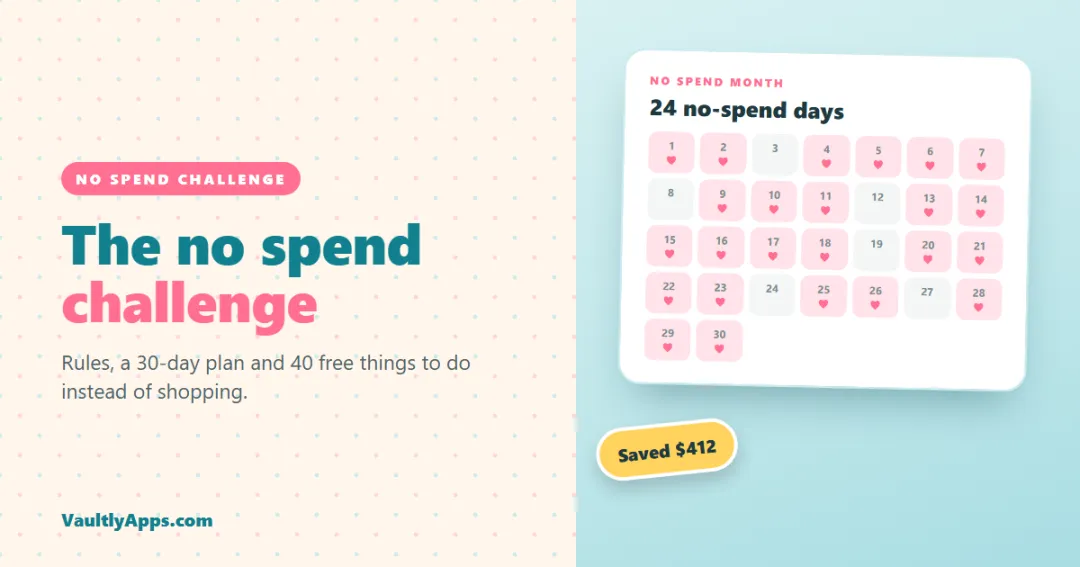
Instead of saving a set amount, you stop spending on wants for a weekend, a week or a month, and save what you would have spent. It's the best challenge for finding out where your money really goes. See our full guide to the no spend challenge, with rules, a 30-day plan and 40 free things to do.
13. The dice challenge
Roll a die (or two) and save that amount: $1 to $6, or $2 to $12 with two dice. Multiply by 10 for a bigger challenge. It adds a little surprise to saving, which helps people who get bored of fixed schedules.
14. The weather challenge
Once a week, check the high temperature and save that many dollars. A hot summer week means more saved, a cold winter week less. In a mild climate this saves roughly $3,000 a year; you can halve it if that's too much.
15. The sinking fund challenge
Pick your big yearly costs (car insurance, holidays, birthdays, car repairs, annual subscriptions), divide each by 12 or by your paychecks, and save that amount for each one. It's less of a game and more of a system, but it's the challenge that makes surprise bills disappear. Learn how in our guide to sinking funds, and work out each monthly amount with the savings goal calculator.
How to choose the right savings challenge
- New to saving? Start with the 365-day $1 challenge, the 50 envelope challenge or a no-spend weekend.
- Paid every two weeks? The 26-paycheck challenge fits your schedule.
- Want a big number? The 100 envelope challenge or the 12-month challenge.
- Need cash fast? $1,000 in 30 days plus a no-spend month.
- Get bored easily? The dice, envelope or weather challenges keep it fun.
- Always surprised by bills? The sinking fund challenge.
A good rule: the weekly or per-paycheck amount at its highest point should still fit your budget. If the last weeks of a challenge are more than you can afford, choose a smaller version or a reverse one now, rather than quit in month ten.
Savings challenge printables
A chart on the fridge is half the fun. You can:
- Make your own with our free printable savings tracker: type any goal, pick 10 to 100 squares and equal, growing or shuffled amounts, then print it.
- Print a 52 week chart from the 52-week savings challenge calculator.
- Print an envelope grid from the 100 envelope challenge tracker, which also does 50 and 200 envelope versions.
All three save your progress in your browser, so you can tap squares on your phone and print a clean copy whenever you like.

Fun ways to save money (that aren't a challenge)
Not every saving trick needs a chart. A few that work well alongside any challenge:
- Pay yourself first. Move savings out on payday, before you can spend it.
- Use a 48-hour rule for anything that isn't essential.
- Sell one thing a week you don't use and save what it brings in.
- Bank every refund, rebate and cash-back payout.
- Save raises and bonuses before your lifestyle catches up.
- Name your savings accounts after the goal ("Beach trip", "Emergency fund"); it's harder to raid a goal with a name.
Where to keep your challenge money
Envelopes and jars are fun, but cash at home is easy to borrow from and earns nothing. Most people keep the envelopes or chart for tracking and move the actual money into a separate high-yield savings account each week or payday. For money you won't need for a year or more, a CD can lock in a rate; see CD vs high-yield savings. Saving for your first emergency fund? Here's how much you should have.
Tips to actually finish
- Automate the base amount and use the challenge chart for the extra.
- Start in any month. A challenge doesn't need January.
- Catch up, don't quit. Fell behind? Do two small squares next payday, or restart from where you are.
- Do it with someone. A partner, a friend or your kids keeps you honest.
- Give the money a job. A goal with a name and a picture is easier to keep going for.
A savings tracker that colours itself in
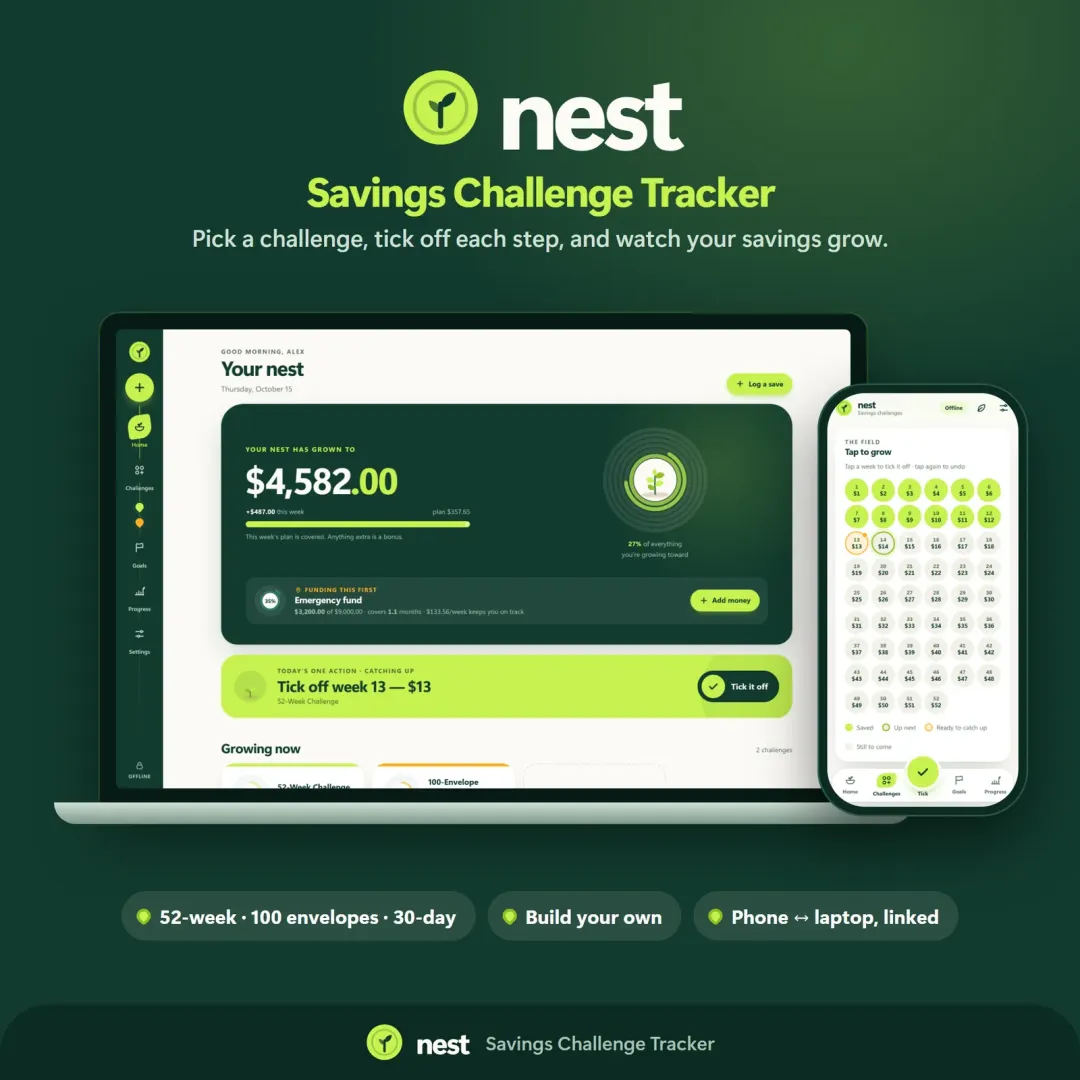
Mochi is a cute budget planner app with the 100 envelope, 50 envelope, 52 week and $1,000 in 30 days challenges built in (or your own), with a dice roll and scratch cards to pick the next amount. Every savings goal is a colour-by-number picture that fills in as you save, next to your budget, bills and a no-spend calendar. Nest is our dedicated savings challenge tracker with the 52-week, 365-day and no-spend challenges and goals with target dates. Both have a free demo with sample data you can open in your browser.

Frequently asked questions
What is a savings challenge?
What is the best savings challenge for beginners?
How much do you save with the 50 envelope challenge?
Which savings challenge saves the most money?
Should I keep savings challenge money in cash?
Can I do two savings challenges at once?
Written by
Finance Specialist & Editor, VaultlyApps
Emma Whitfield writes and edits the VaultlyApps money guides and free calculators. Her focus is US household finance — budgeting on a real paycheck, paying down credit card and student debt, emergency funds and savings goals, renting — and the money side of freelancing and small-business income, from pricing and profit margins to self-employment tax. Every guide is researched against primary sources such as IRS publications and the CFPB, every number is checked in our tested calculators, and tax content is reviewed each year when new IRS figures come out. Emma is not a licensed financial adviser or tax preparer; her work is general education, not personal advice.
Researched against primary US sources, checked with our calculators and reviewed by a finance expert on our team. Written for US readers — general education, not financial, tax or legal advice. Editorial policy · Disclaimer