
VaultlyApps logo VaultlyApps

Free calculator

HSA Calculator: Tax Savings and Growth of a Health Savings Account

Enter your coverage, age and what you and your employer put in. See your 2026 HSA limit and how much room is left, the federal, state and payroll tax you save this year, and what the account can grow to by 65 after paying some medical bills along the way.

By Updated Private — runs in your browser Free, no sign-up Save, print, PDF & CSV — with a QR code to reopen it

Your health plan covers

Counts toward the limit.

0 in CA and NJ (they tax HSAs).

Tax you save this year


2026 limit


Balance at 65


You and your employer together are over the 2026 limit. Extra contributions are taxed 6% a year until you take them out.

Your HSA by age
AgePut in, netBalance

2026 limits: $4,400 self-only, $8,750 family, plus $1,000 from age 55. You need an HSA-eligible health plan (deductible of at least $1,700 self-only or $3,400 family). Medical withdrawals are tax-free; after 65, other withdrawals are taxed like a traditional IRA.

For readers in the United States. Estimates for planning only — not financial, investment, tax or legal advice. Disclaimer · How we check our numbers

Summit app icon

Want these numbers to update by themselves?

Summit — Net Worth Tracker — keeps this plan current as you log real payments. Try the free demo, no sign-up.

How to use the HSA calculator

  1. Choose just me or my family coverage.
  2. Enter your age, the balance now, and what you and your employer put in each year.
  3. Add the medical bills you expect to pay from the HSA each year, an investment return, and your federal and state tax rates.
  4. Tick through payroll if your contributions come out of your paycheck: they also skip Social Security and Medicare tax.

HSA limits for 2026

Self-only Family
Contribution limit $4,400 $8,750
Catch-up (age 55+) +$1,000 +$1,000
Minimum plan deductible $1,700 $3,400
Maximum out-of-pocket $8,500 $17,000

Source: IRS Revenue Procedure 2025-19. The catch-up is per person: spouses who are both 55 or older each need their own HSA for it.

Why an HSA can beat a 401(k)

A 401(k) saves tax going in and is taxed coming out. A Roth IRA is taxed going in and free coming out. An HSA used for medical costs is free on both sides, and through payroll it also skips the 7.65% FICA tax that 401(k) contributions still pay. That's why many people fill the HSA after getting their full employer 401(k) match. Compare the other accounts with the 401(k) calculator and Roth IRA calculator, and read Roth IRA vs 401(k).

Tax savings examples

You put in Tax rate Tax saved
$3,900 by payroll 22% + 5% + 7.65% $1,351
$3,900 on your own 22% + 5% $1,053
$8,250 by payroll (family) 22% + 5% + 7.65% $2,859

Contributions you make yourself are deducted on your tax return; only payroll contributions avoid FICA. California and New Jersey tax HSA contributions and growth, so enter 0 for state tax there.

The "receipt" strategy

You don't have to reimburse yourself in the same year. Pay small medical bills from your budget, keep the receipts, and let the HSA stay invested. Years later you can withdraw the total of those receipts tax-free. Paying nothing from the HSA in the example above lifts the balance at 65 from about $296,000 to about $359,000.

What an HSA can pay for

Doctor visits, prescriptions, dental and vision care, glasses and contacts, mental health care, many over-the-counter medicines and menstrual products, and after 65 Medicare premiums (not Medigap). Health insurance premiums usually don't qualify before 65, except COBRA, coverage while on unemployment benefits, and long-term care insurance.

HSA in your retirement plan

Medical costs are one of the biggest expenses in retirement, so a large HSA is a tax-free health fund for later. After 65 it works like a traditional IRA for anything else, without required minimum distributions; see the RMD calculator for accounts that have them.

Track every account in one place

Summit is a net worth tracker that keeps your HSA, 401(k), IRAs, cash and debts together and shows your progress over time. Nest tracks savings goals with target dates. Both have a free demo with sample data.

2026 IRS limits; an estimate, not tax or investment advice.

Frequently asked questions

What are the HSA contribution limits for 2026?

$4,400 for self-only coverage and $8,750 for family coverage, plus a $1,000 catch-up from age 55. The limit includes your employer's contributions.

How much tax does an HSA save?

Your federal bracket plus your state rate, plus 7.65% Social Security and Medicare if you contribute through payroll. $3,900 a year at 22% federal and 5% state through payroll saves about $1,351.

Who can open an HSA?

Anyone covered by an HSA-eligible high-deductible health plan with no other non-qualifying coverage and not enrolled in Medicare. In 2026 the plan's deductible must be at least $1,700 for self-only or $3,400 for family coverage.

What is the triple tax advantage?

Contributions are tax-deductible (or pre-tax through payroll), growth is tax-free, and withdrawals for qualified medical expenses are tax-free. No other account gets all three.

What happens to my HSA at 65?

Medical withdrawals stay tax-free. Other withdrawals have no penalty but are taxed as income, like a traditional IRA. Before 65, non-medical withdrawals are taxed plus a 20% penalty.

Should I invest my HSA or keep it in cash?

Keep enough cash for your deductible and invest the rest if you can pay smaller bills from your budget. Save the receipts: you can reimburse yourself tax-free years later, while the money has kept growing.

Written by

Emma Whitfield

Finance Specialist & Editor, VaultlyApps

Emma Whitfield writes and edits the VaultlyApps money guides and free calculators. Her focus is US household finance — budgeting on a real paycheck, paying down credit card and student debt, emergency funds and savings goals, renting — and the money side of freelancing and small-business income, from pricing and profit margins to self-employment tax. Every guide is researched against primary sources such as IRS publications and the CFPB, every number is checked in our tested calculators, and tax content is reviewed each year when new IRS figures come out. Emma is not a licensed financial adviser or tax preparer; her work is general education, not personal advice.

Researched against primary US sources, checked against independent calculators and reviewed by a finance expert on our team. Written for US readers — general education, not financial, tax or legal advice. Editorial policy · Disclaimer


From VaultlyApps

Apps that do this for you

Each one has a free live demo with sample data — open it in your browser, nothing to install.

Summit net worth tracker app showing net worth as a mountain range with one peak per monthly check-in Live
Summit app icon

Summit

Net Worth Tracker

A private net worth tracker for your phone and computer — add what you own and what you owe, check in once a month and watch your net worth climb, with milestones, a what-if forecast and a printable Net Worth Statement.

Nest savings challenge tracker with growth rings and a savings garden Live
Nest app icon

Nest

Savings Challenge Tracker

Run a 52-week, 365-day, no-spend or custom savings challenge and watch your savings grow — with goals, an emergency fund tracker and kind catch-up options.

Keep planning

Related calculators

All calculators

401(k) Calculator

Your 401(k) at retirement with employer match and 2026 limits.

Open calculator

Roth IRA Calculator

Your 2026 Roth IRA limit and tax-free balance at retirement.

Open calculator

RMD Calculator

Your required minimum distribution, deadline and future RMDs.

Open calculator

Further reading

Guides on this topic

All articles
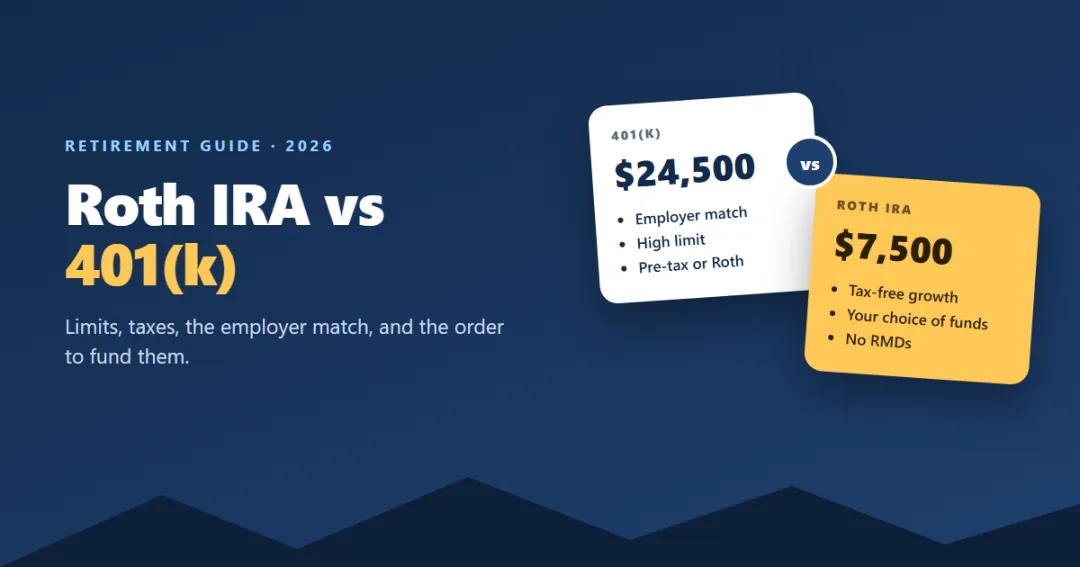
Roth IRA vs 401(k) — two paths up a mountain to retirement, one with an employer match and one tax-free

Personal Finance

Roth IRA vs 401(k): Which Should You Fund First in 2026?

A 401(k) has higher limits and often a free employer match; a Roth IRA gives tax-free growth and more control. Here's how they compare in 2026 — limits, taxes, access and fees — with the math on Roth vs traditional, and a simple order for where each retirement dollar should go.

8 min read
How much should you have in an emergency fund — a $19,500 six-month fund built from $3,250 of monthly essentials

Personal Finance

How Much Should You Have in an Emergency Fund?

How much emergency savings you really need, worked out step by step: add up your essentials, choose three, six or more months, and turn the total into a monthly plan you can actually reach.

7 min read
The FIRE movement explained — a path from a high savings rate to financial independence at 25 times yearly spending

Personal Finance

The FIRE Movement Explained: How Financial Independence, Retire Early Actually Works

FIRE — financial independence, retire early — is built on one idea: save a big share of your income, invest it, and live off the returns once you have about 25 times your yearly spending. Here's how the math works, the different types of FIRE, realistic timelines by savings rate, the risks, and how to start even if early retirement isn't your goal.

7 min read

Try Summit free in your browser

A private net worth tracker for your phone and computer — add what you own and what you owe, check in once a month and watch your net worth climb, with milestones, a what-if forecast and a printable Net Worth Statement. The live demo uses sample data — nothing to install, no sign-up.

We use optional cookies for anonymous analytics. Nothing optional is set until you choose. Cookie policy