
VaultlyApps logo VaultlyApps

Free calculator

RMD Calculator: Your Required Minimum Distribution for 2026

Enter last year-end balance and your year of birth. See your required minimum distribution for the year, the IRS life expectancy factor, the deadline, when RMDs start for you under SECURE 2.0, and a year-by-year projection of future RMDs.

By Updated Private — runs in your browser Free, no sign-up Save, print, PDF & CSV — with a QR code to reopen it

Traditional IRA, 401(k), 403(b) or SEP. Work out each account separately.

For the projection.

Federal + state.

Your required minimum distribution


No RMD due this year


RMDs start at


After tax


RMD projection
YearAgeBalanceFactorRMD

IRS Uniform Lifetime Table (Publication 590-B). If your spouse is more than 10 years younger and your only beneficiary, the Joint Life table gives a smaller RMD. Inherited IRAs and Roth IRAs follow different rules. Missing an RMD costs a 25% excise tax (10% if fixed in time).

For readers in the United States. Estimates for planning only — not financial, investment, tax or legal advice. Disclaimer · How we check our numbers

Summit app icon

Want these numbers to update by themselves?

Summit — Net Worth Tracker — keeps this plan current as you log real payments. Try the free demo, no sign-up.

How to use the RMD calculator

  1. Enter the account balance on December 31 of last year. For a 2026 RMD, use the balance on December 31, 2025, from your year-end statement.
  2. Enter the year you were born and the year you want the RMD for.
  3. Add an expected growth rate to project future RMDs, and your tax rate to see what's left after tax.

IRS Uniform Lifetime Table (selected ages)

Age Factor RMD on $100,000 RMD on $500,000
73 26.5 $3,774 $18,868
75 24.6 $4,065 $20,325
80 20.2 $4,950 $24,752
85 16.0 $6,250 $31,250
90 12.2 $8,197 $40,984
95 8.9 $11,236 $56,180
100 6.4 $15,625 $78,125

The table is in IRS Publication 590-B (Table III) and has been in use since 2022. The calculator uses every age from 72 to 120. If your spouse is more than 10 years younger and your only beneficiary, the Joint Life table applies and your RMD is smaller.

When your RMDs start

Born First RMD at age
1950 or earlier Already started (age 72 or 70½)
1951–1959 73
1960 or later 75

You can delay the first RMD to April 1 of the year after you reach your start age. Every later RMD is due by December 31. Still working at 73? You can usually delay RMDs from your current employer's 401(k) until you retire, unless you own more than 5% of the company. IRAs have no such exception.

Which accounts have RMDs

  • Traditional IRA, SEP IRA and SIMPLE IRA: yes.
  • 401(k), 403(b), 457(b) and other workplace plans: yes (Roth 401(k)s no longer, since 2024).
  • Roth IRA: not for the original owner.
  • Inherited IRAs: different rules, often the 10-year rule; this calculator doesn't cover them.

Taxes and RMDs

RMDs from pre-tax accounts are taxed as ordinary income. A large RMD can push you into a higher bracket, make more of your Social Security taxable and raise Medicare premiums. Ways to manage it:

  • Qualified charitable distributions (QCDs): from age 70½ you can give IRA money straight to charity; it counts toward your RMD and isn't taxed.
  • Roth conversions before RMDs start spread the tax over lower-income years and shrink future RMDs.
  • Withhold tax from the RMD so you don't owe a large bill in April.

How RMDs fit your retirement plan

The RMD is a minimum, not a spending plan. Many retirees withdraw more, and some reinvest RMDs they don't need in a taxable account. See how long your savings last at your withdrawal rate with the how long will my money last calculator, and compare account types in Roth IRA vs 401(k). Still saving? The 401(k) calculator and Roth IRA calculator show what you'll have.

See your whole retirement picture

Summit is a net worth tracker that keeps every account, from IRAs and 401(k)s to property and debts, in one place and shows how your net worth changes over time. Try the free demo with sample data.

IRS rules as of October 2026; not tax advice. Check RMDs with your account provider.

Frequently asked questions

How is an RMD calculated?

Divide the account balance on December 31 of the previous year by the IRS life expectancy factor for your age that year. At 74 the factor is 25.5, so a $500,000 IRA has an RMD of $500,000 ÷ 25.5 = $19,607.84.

At what age do RMDs start?

Age 73 if you were born from 1951 through 1959, and age 75 if you were born in 1960 or later (SECURE 2.0 Act). People born in 1950 or earlier have already started.

When is the RMD deadline?

December 31 each year. For your very first RMD only, you can wait until April 1 of the following year, but then you take two RMDs in that second year, which can push you into a higher tax bracket.

What happens if I miss an RMD?

The IRS charges a 25% excise tax on the amount you should have taken. It drops to 10% if you take the missed amount and file a corrected return within two years.

Do Roth IRAs have RMDs?

Not for the original owner. Since 2024, Roth 401(k)s don't require RMDs during the owner's life either. Inherited Roth accounts do have withdrawal rules.

Can I take one RMD from several accounts?

For IRAs, yes: work out each IRA's RMD, add them up and take the total from any one or more IRAs. 401(k) RMDs must come from each 401(k) separately. 403(b)s can be combined like IRAs.

Written by

Emma Whitfield

Finance Specialist & Editor, VaultlyApps

Emma Whitfield writes and edits the VaultlyApps money guides and free calculators. Her focus is US household finance — budgeting on a real paycheck, paying down credit card and student debt, emergency funds and savings goals, renting — and the money side of freelancing and small-business income, from pricing and profit margins to self-employment tax. Every guide is researched against primary sources such as IRS publications and the CFPB, every number is checked in our tested calculators, and tax content is reviewed each year when new IRS figures come out. Emma is not a licensed financial adviser or tax preparer; her work is general education, not personal advice.

Researched against primary US sources, checked against independent calculators and reviewed by a finance expert on our team. Written for US readers — general education, not financial, tax or legal advice. Editorial policy · Disclaimer

From VaultlyApps

Apps that do this for you

Each one has a free live demo with sample data — open it in your browser, nothing to install.

Summit net worth tracker app showing net worth as a mountain range with one peak per monthly check-in Live
Summit app icon

Summit

Net Worth Tracker

A private net worth tracker for your phone and computer — add what you own and what you owe, check in once a month and watch your net worth climb, with milestones, a what-if forecast and a printable Net Worth Statement.

Keep planning

Related calculators

All calculators

401(k) Calculator

Your 401(k) at retirement with employer match and 2026 limits.

Open calculator

Roth IRA Calculator

Your 2026 Roth IRA limit and tax-free balance at retirement.

Open calculator

Further reading

Guides on this topic

All articles
Roth IRA vs 401(k) — two paths up a mountain to retirement, one with an employer match and one tax-free

Personal Finance

Roth IRA vs 401(k): Which Should You Fund First in 2026?

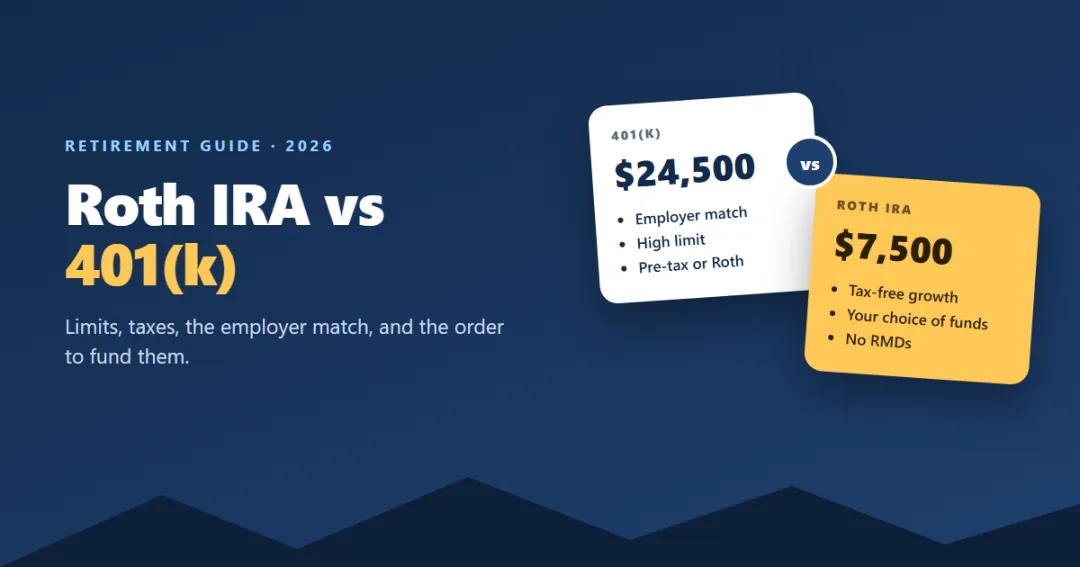
A 401(k) has higher limits and often a free employer match; a Roth IRA gives tax-free growth and more control. Here's how they compare in 2026 — limits, taxes, access and fees — with the math on Roth vs traditional, and a simple order for where each retirement dollar should go.

8 min read
Average and median net worth by age — bars rising from under 35 to 65–74 with the median marked

Personal Finance

Average and Median Net Worth by Age in the U.S. (and How to Compare Yours)

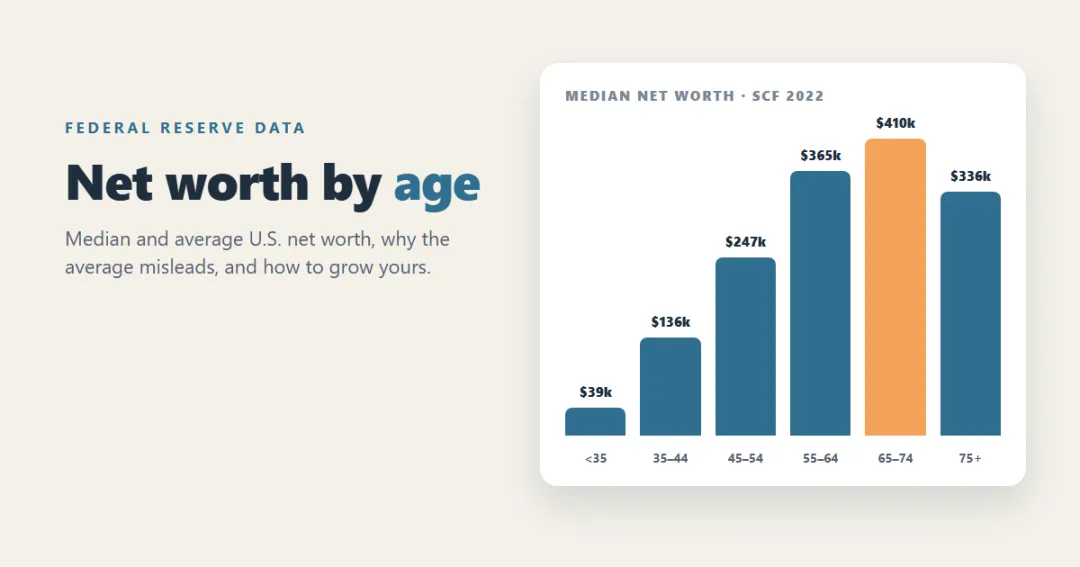
The typical American household under 35 has a net worth of about $39,000; at 65–74 it's about $410,000. Here's the latest Federal Reserve data on median and average net worth by age, why the average is so misleading, useful savings benchmarks by age, and how to grow your own number at any stage.

6 min read
The FIRE movement explained — a path from a high savings rate to financial independence at 25 times yearly spending

Personal Finance

The FIRE Movement Explained: How Financial Independence, Retire Early Actually Works

FIRE — financial independence, retire early — is built on one idea: save a big share of your income, invest it, and live off the returns once you have about 25 times your yearly spending. Here's how the math works, the different types of FIRE, realistic timelines by savings rate, the risks, and how to start even if early retirement isn't your goal.

7 min read

Try Summit free in your browser

A private net worth tracker for your phone and computer — add what you own and what you owe, check in once a month and watch your net worth climb, with milestones, a what-if forecast and a printable Net Worth Statement. The live demo uses sample data — nothing to install, no sign-up.

We use optional cookies for anonymous analytics. Nothing optional is set until you choose. Cookie policy