
How to use the break-even calculator
- Add up your fixed costs per month: rent, software, insurance, a salary for yourself.
- Enter your price per unit and the variable cost per unit: materials, packaging, fees and shipping for one sale.
- Optionally, enter a profit goal per month.
You'll see your break-even point in units and in sales dollars, your contribution margin and the number of sales you need to reach your goal. The table shows profit or loss at different sales levels.
A worked example
A small candle business has these numbers:
- Fixed costs: $2,500 a month (studio rent, website, insurance, software)
- Price: $45 per candle set
- Variable cost: $18 per set (wax, jars, packaging, fees, shipping)
Each sale leaves a contribution margin of $27, or 60% of the price. The business breaks even at 93 sets a month. To also make $1,500 a month of profit, it needs (2,500 + 1,500) ÷ 27 = 149 sets, about $6,667 in sales.
| Sets sold | Sales | Profit |
|---|---|---|
| 46 | $2,070 | −$1,258 |
| 93 | $4,185 | $11 |
| 139 | $6,255 | $1,253 |
| 186 | $8,370 | $2,522 |
What the break-even point tells you
- Is the plan realistic? If you need 300 sales a month and you're making 40, change the price, the costs or the plan before you spend more.
- How much room do you have? Sales above break-even are your margin of safety. A slow month shouldn't push you below it.
- What a price change does. Raising the price from $45 to $50 lifts the contribution margin to $32 and drops break-even from 93 to 79 sets.
- Whether a new cost is worth it. A $300-a-month tool needs 300 ÷ 27 = 12 more sales to pay for itself.
Getting the inputs right
Variable costs are easy to underestimate. Include marketplace fees: the Etsy fee calculator shows that fees take around 10% of a typical order. Use your real shipping cost, not what you charge the buyer.
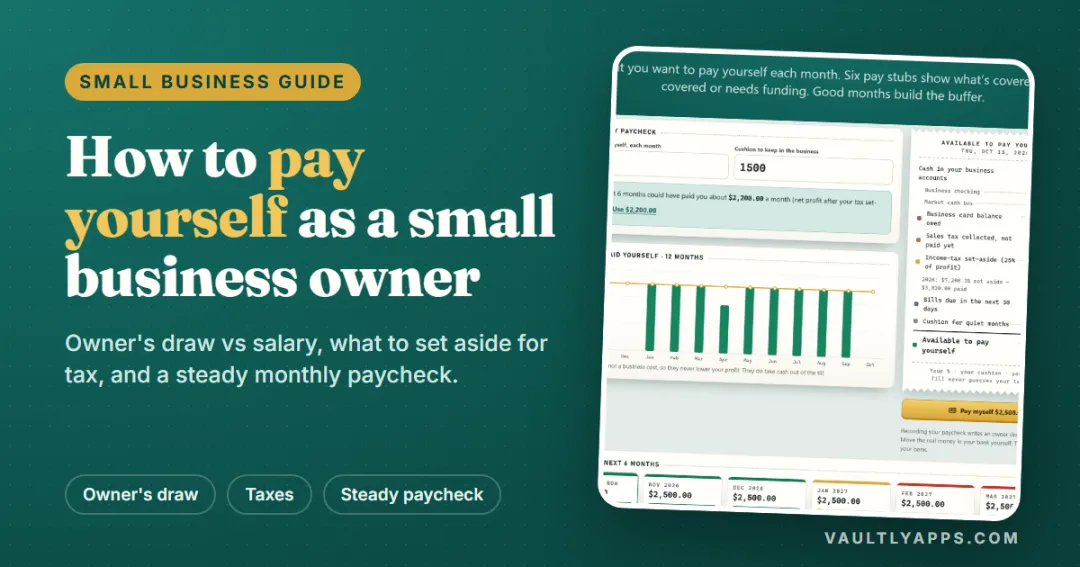
Fixed costs should include paying yourself. If the business only breaks even when you work for free, it isn't really breaking even. The guide on how to pay yourself as a small business owner explains how to set a salary.
Not sure what to charge? Start from your cost with the markup calculator and check the margin after fees with the profit margin calculator. And remember tax: break-even is before income tax, and the self-employment tax calculator shows what to set aside on profit.
Watch it month by month
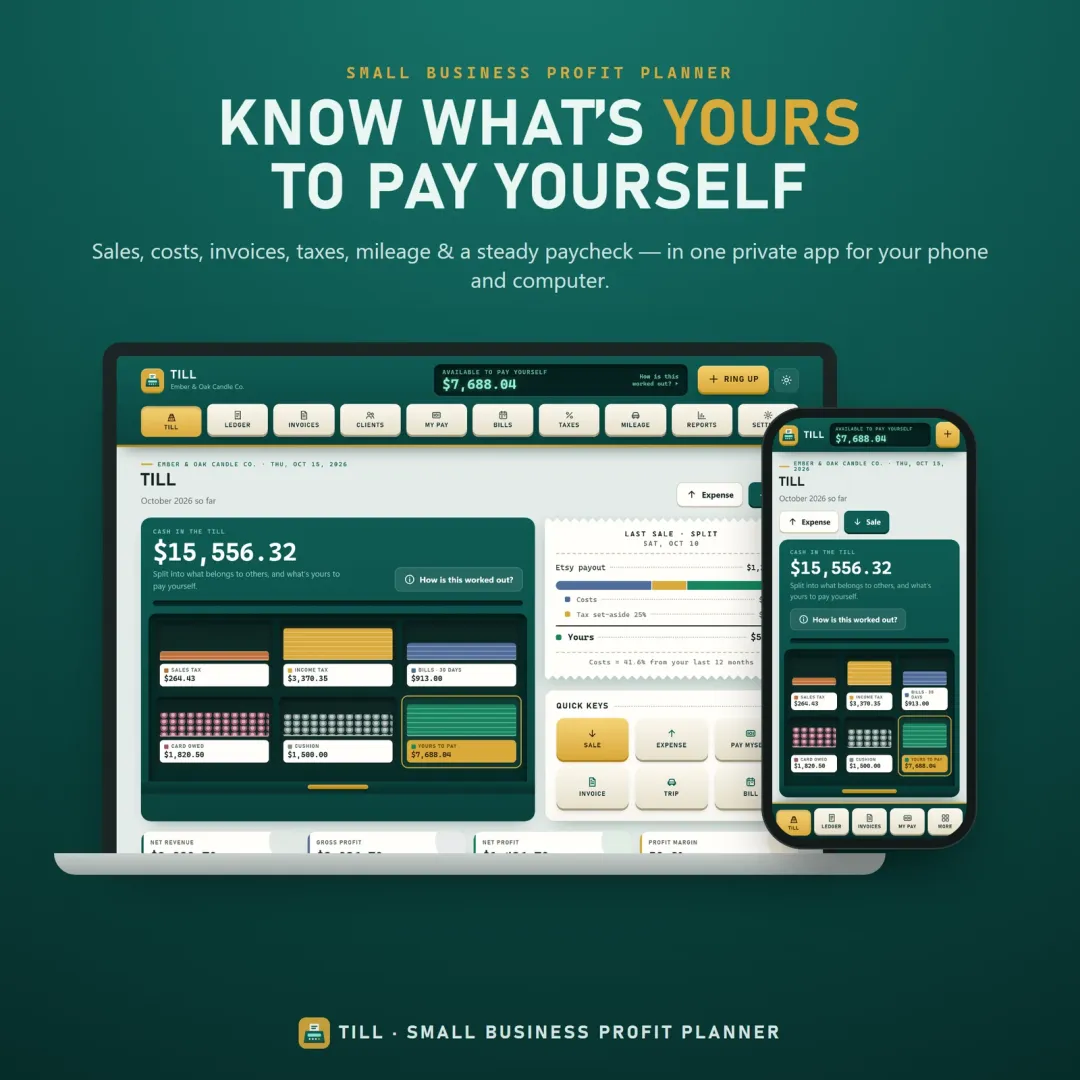
Break-even isn't a number you work out once. Costs creep up, prices change and sales move with the seasons. Till is a small business profit planner that tracks revenue, fixed and variable costs and profit every month, so you can see whether you're above break-even before the month ends. Try the free demo with sample data.
Frequently asked questions
How do you calculate the break-even point?
What is the break-even point in sales dollars?
What is contribution margin?
What counts as a fixed cost?
What counts as a variable cost?
How do I lower my break-even point?
Written by
Finance Specialist & Editor, VaultlyApps
Emma Whitfield writes and edits the VaultlyApps money guides and free calculators. Her focus is US household finance — budgeting on a real paycheck, paying down credit card and student debt, emergency funds and savings goals, renting — and the money side of freelancing and small-business income, from pricing and profit margins to self-employment tax. Every guide is researched against primary sources such as IRS publications and the CFPB, every number is checked in our tested calculators, and tax content is reviewed each year when new IRS figures come out. Emma is not a licensed financial adviser or tax preparer; her work is general education, not personal advice.
Researched against primary US sources, checked against independent calculators and reviewed by a finance expert on our team. Written for US readers — general education, not financial, tax or legal advice. Editorial policy · Disclaimer