Wheel of Life: Free Template, the 8 Life Areas and How to Do the Exercise
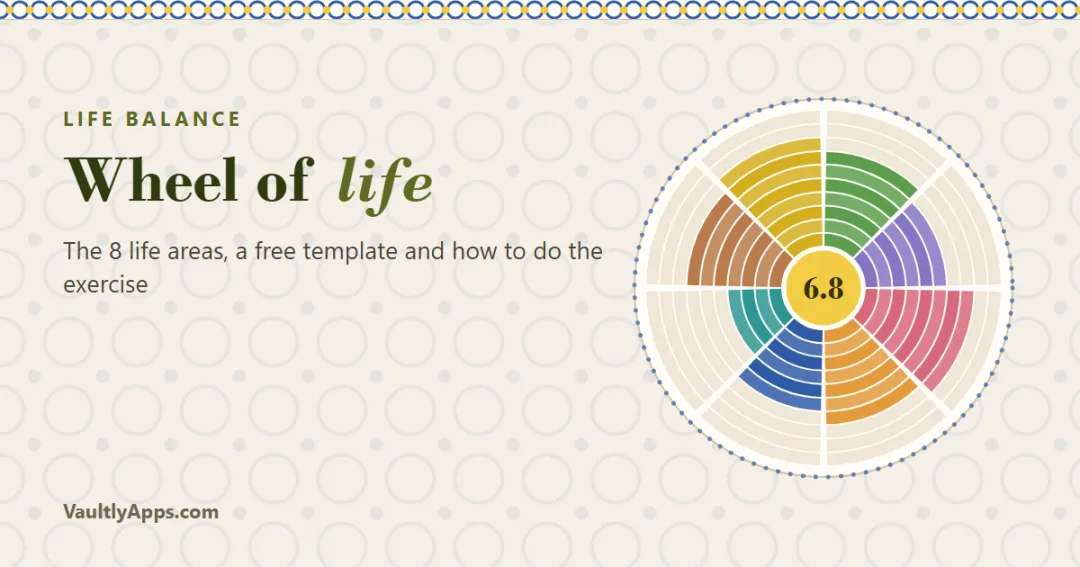
The wheel of life is a 10-minute exercise that shows which areas of your life are thriving and which need care. Here are the 8 life areas, a free template, scoring questions for each area and what to do with your results.
In this article
- What is the wheel of life?
- The 8 areas of life
- How to do the wheel of life exercise
- 1. Get a template
- 2. Score each area from 1 to 10
- 3. Colour or join the scores
- 4. Look at the shape
- 5. Choose one or two focus areas
- 6. Turn it into a goal and a habit
- Wheel of life assessment: questions for each area
- How to read your wheel of life
- From scores to goals: what to do next
- Common mistakes with the wheel of life
- How often should you do it?
- A wheel of life template you can print or use in an app
- The bottom line
You know the feeling: work is going well, but you haven't seen your friends in weeks. Or your health is finally on track, while money quietly worries you at night. Life rarely falls apart all at once — one area slips while you're busy with another. The wheel of life is a ten-minute exercise that makes those slips visible, so you can decide where to put your energy next.
What is the wheel of life?
The wheel of life (also called a balance wheel or life balance wheel) is one of the most widely used tools in life coaching. It's usually credited to Paul J. Meyer, who founded the Success Motivation Institute in the 1960s, and coaches have adapted it ever since.
The idea is simple. Picture your life as a wheel with eight spokes. Each spoke is an area of life, scored from 0 at the centre to 10 at the rim. When you join your scores you get a shape. If the shape is round and big, the wheel rolls smoothly. If it's lopsided, the ride is bumpy — even if some areas are doing brilliantly.
The wheel of life doesn't tell you what to do. It shows you, honestly and quickly, where you are, which is the hardest part of planning anything.
The 8 areas of life
There is no official list, and you should change the areas to fit your life. Here's a set that works for most people (it's the one we use in Grove):
Health — sleep, movement, food, energy, how your body feels.
Mind — stress, rest, calm, mental wellbeing, time to think.
Love — your partner or romantic life, or how you feel about being single.
Family & friends — the people you're close to and how connected you feel.
Career — work, studies or business: meaning, growth and workload.
Money — savings, debt, spending and how secure you feel.
Home — your physical space: tidy, cosy, a place you like being.
Fun & growth — hobbies, learning, travel, play and creativity.
Other common areas are spirituality, personal growth, contribution (giving back) and recreation. If one of those matters more to you than an area above, swap it in. Eight is a good number: enough to cover a life, few enough to score in ten minutes.
How to do the wheel of life exercise
1. Get a template
Draw a circle with eight slices on paper, or use a wheel of life template — a circle with eight sectors and ten rings. Our free printable is part of the Grove bonus pack, and you can also use the wheel inside the Grove demo with no sign-up.
2. Score each area from 1 to 10
Ask one question for each area: "How satisfied am I with this part of my life right now?" 1 is "very unhappy", 10 is "couldn't be better". Go with your first answer — this is about how it feels, not a precise measurement.
3. Colour or join the scores
Shade each slice up to its score, or put a dot on each spoke and join them. The shape is the point.
4. Look at the shape
Notice three things: your two lowest areas, how even the wheel is, and anything that surprises you.
5. Choose one or two focus areas
Pick the area (or two) where a small improvement would make the most difference to your whole life. That's usually — but not always — the lowest one.
6. Turn it into a goal and a habit
A score only becomes useful when it changes what you do this week. More on that below.
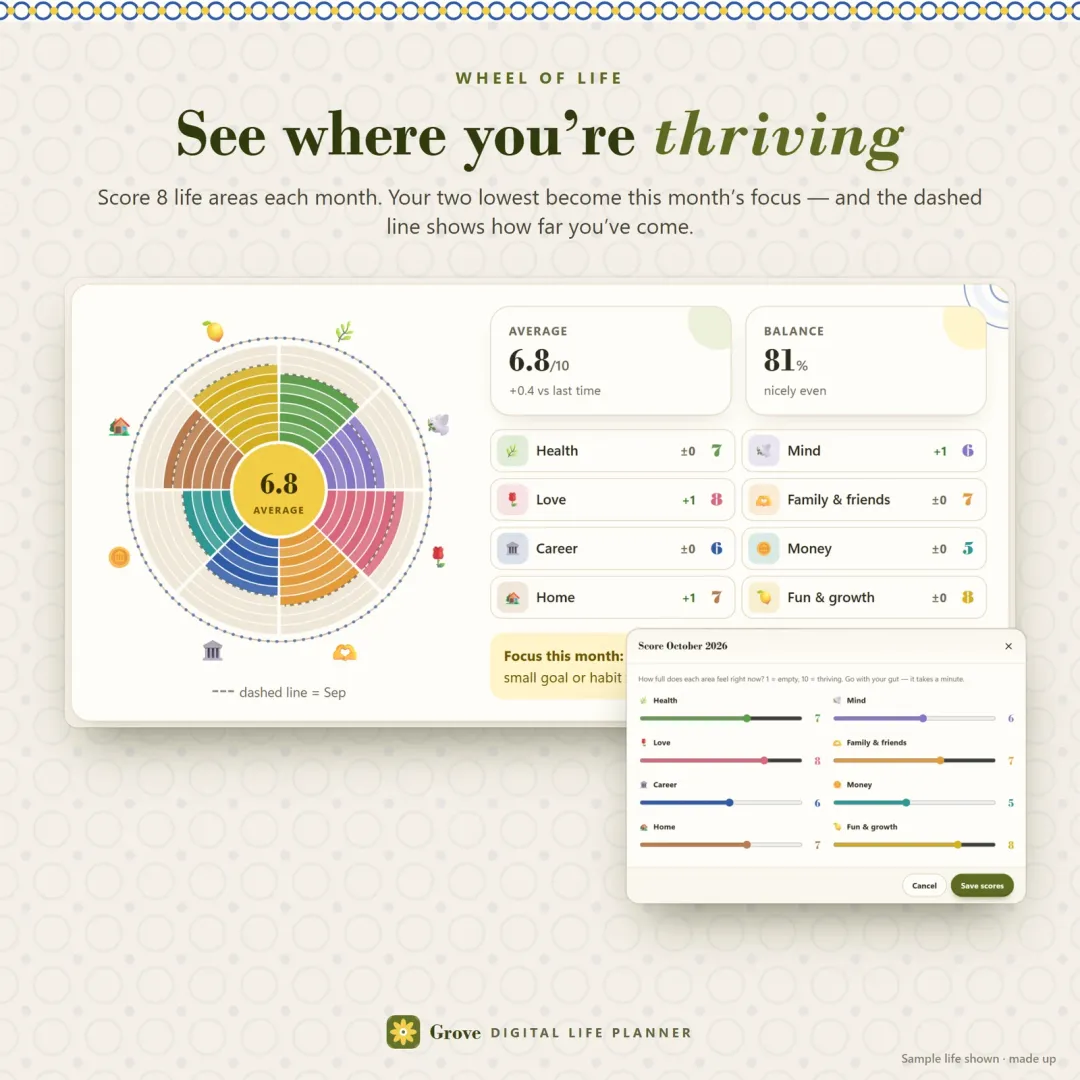
A wheel of life scored for one month: each area fills ring by ring, the dashed line shows last month, and the two lowest areas become this month's focus.
Wheel of life assessment: questions for each area
If a number feels hard to pick, these questions help. Score the area after reading them.
Health: Do I wake up rested? Do I move most days? Do I like what I eat? Do I have energy in the afternoon?
Mind: How stressed do I feel most days? Do I get real rest? Do I have quiet time to think?
Love: Do I feel loved and appreciated? Do we make time for each other? If single, am I at peace with it?
Family & friends: Do I see the people who matter often enough? Is there someone I can call on a bad day?
Career: Does my work use my strengths? Am I learning? Is the workload sustainable?
Money: Could I handle a surprise $500 bill? Do I know where my money goes? Is debt shrinking?
Home: Do I like being at home? Is there a corner that drains me every time I see it?
Fun & growth: When did I last do something just for joy? Am I learning anything new?
You don't need a perfect answer to every question. They simply stop you from scoring on autopilot.
How to read your wheel of life
Look at the lowest scores first. A 3 in one area usually affects all the others. Poor sleep (health) lowers patience (love, family), focus (career) and energy for fun.
Look at balance, not the average. A wheel of 6s and 7s often feels better to live in than one with three 9s and a 2. In Grove, a balance score shows how even your wheel is, next to the average.
Look for knock-on effects. Which area, if it improved, would lift two or three others? That's often the best place to start, even if it isn't the lowest.
Compare with last time. The wheel is most useful as a series. A 5 that was a 3 last month is a win. Grove draws last month's scores as a dashed line on the wheel so you can see the change at a glance.
Don't aim for all 10s. Life has seasons. During a new job, career takes more space; with a new baby, almost everything else shrinks for a while. The aim is a wheel you choose, not a perfect circle.
From scores to goals: what to do next
Here's a simple way to turn the wheel into action:
Pick one focus area (two at most) for the month.
Write a one-line vision for it: what would a 10 look like for you, three years from now? (See our personal vision statement examples for help.)
Set one small goal for the next 4–12 weeks — concrete, with a date.
Break it into milestones and pick the very next action you could do this week.
Add one tiny habit that feeds it. If you're new to habits, start with our guide to how long it takes to form a habit.
Check in every week and re-score the wheel next month.
For example: Money scored 4. Vision: "Six months of savings and no credit card debt." Goal: "Save a $1,000 cushion by March." Milestones: $250, $500, $750, $1,000. Next action: "Set up an automatic $50 transfer on payday." Habit: "Log spending every evening."
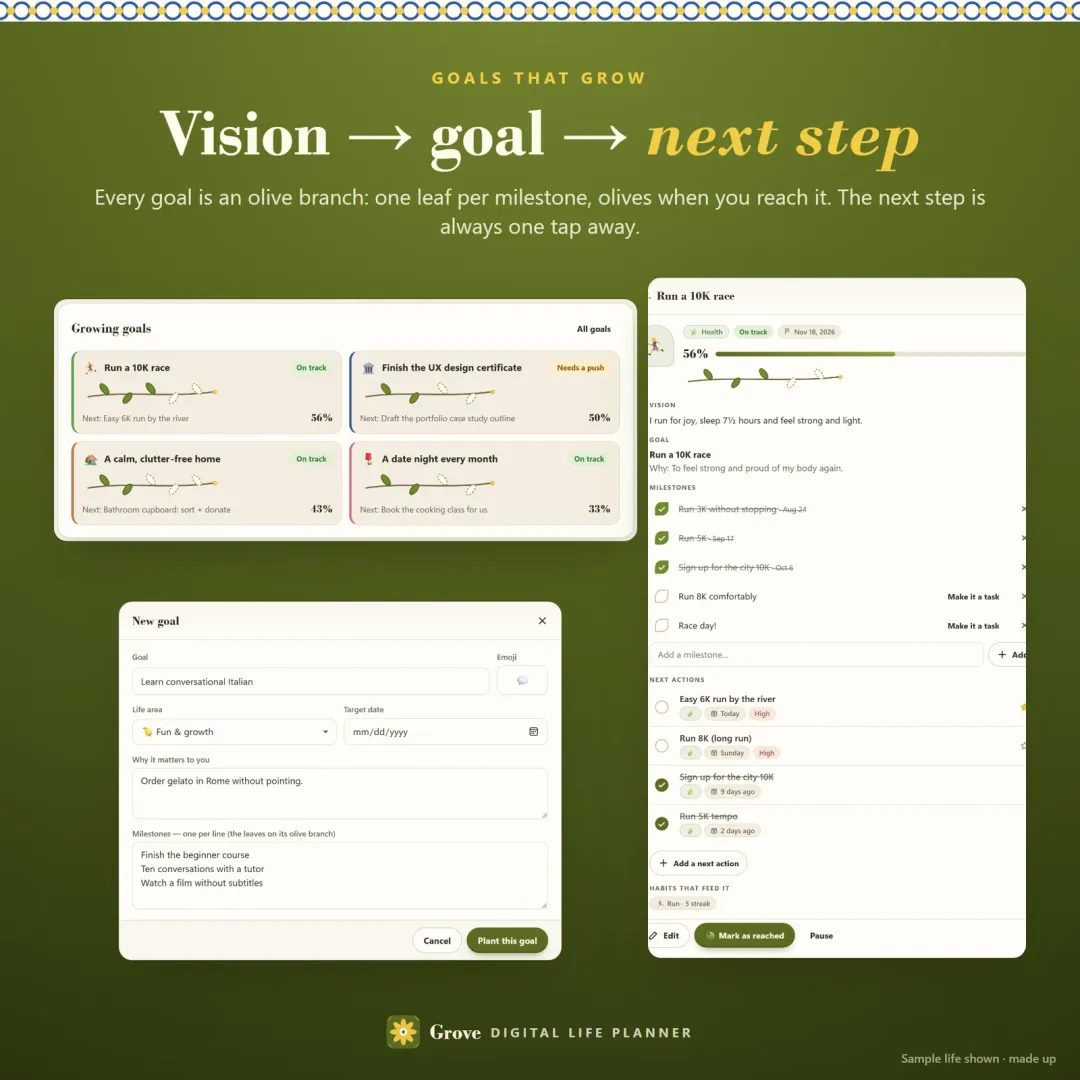
Turning a focus area into a goal: milestones are the leaves on the branch, and the next step is always visible.
Common mistakes with the wheel of life
Scoring what you think you should feel. Be honest; nobody else sees it.
Trying to fix everything at once. Eight goals means none of them get done. One or two areas per month is plenty.
Doing it once. A single wheel is a snapshot. Monthly wheels show a story.
Ignoring the high scores. Ask what's working in your best areas — it's often a habit you can copy elsewhere.
Using someone else's areas. If "career" doesn't fit because you're a full-time parent or retired, change it.
How often should you do it?
Once a month is the sweet spot. Many people score the wheel on the first of the month as part of a monthly reset, and do a 30-second "wheel check" during their weekly review to catch an area that's slipping. A quarterly deep dive — with a fresh vision for each area — works well too.
A wheel of life template you can print or use in an app
Paper is perfect for your first wheel: a circle, eight slices, ten rings and a pen. If you want to see how your wheel changes over time, a digital version saves you redrawing it every month.
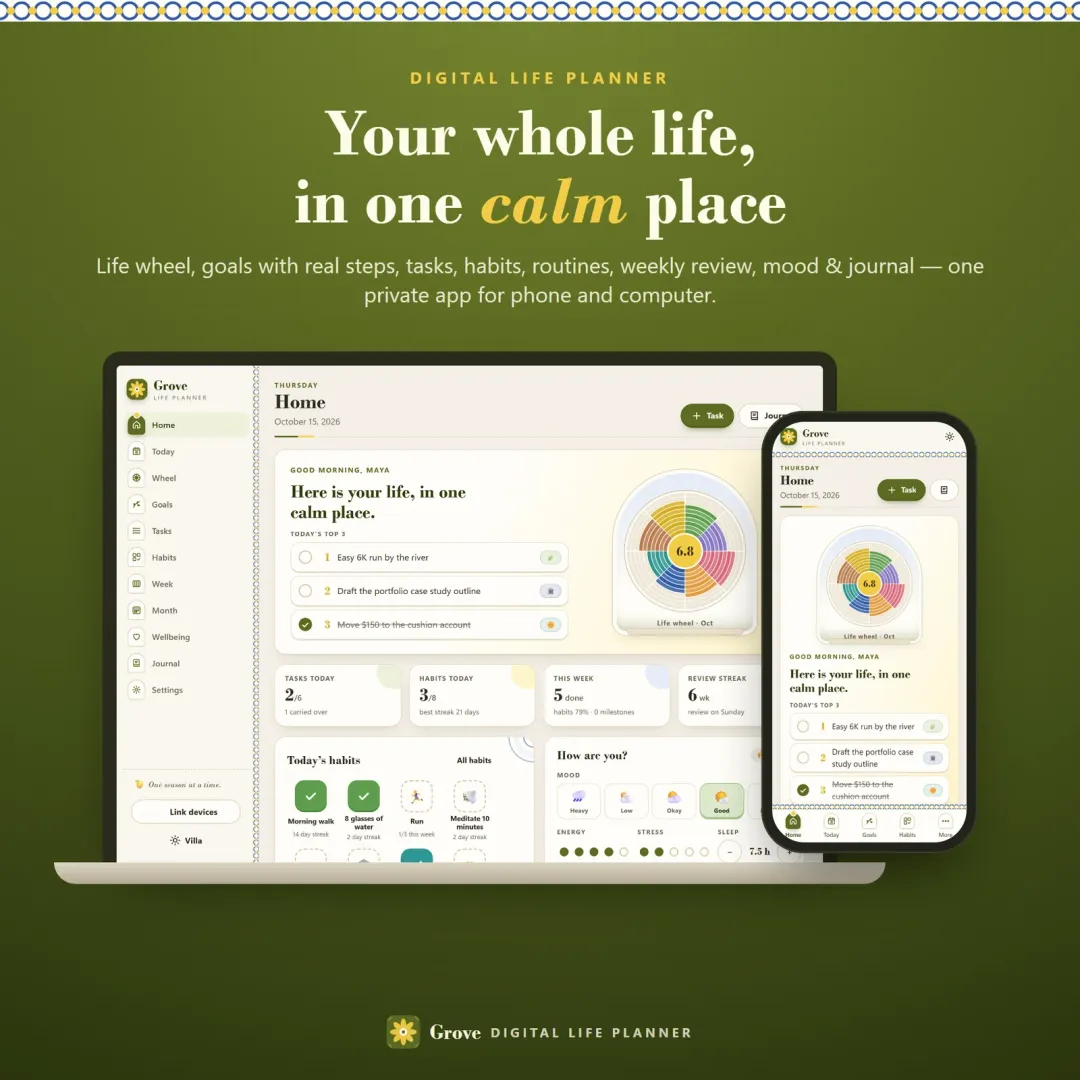
Grove, our digital life planner, has the wheel built in. You score eight areas with sliders once a month, and Grove shows your average and balance, the change since last time, and your two lowest areas as focus areas, each with a one-tap "new goal". Tap any area to see its vision, goals, habits and open tasks. The bonus pack also includes a printable wheel of life worksheet, and the free demo lets you try it with a sample life.
The bottom line
The wheel of life is the quickest honest check-up you can give your life. Score eight areas, look at the shape, pick one area to tend, and turn it into a small goal and a habit. Do it again next month. Small, steady changes in the right area move the whole wheel.
Frequently asked questions
What is the wheel of life?
What are the 8 areas of the wheel of life?
How often should you do the wheel of life?
What is a good wheel of life score?
Who created the wheel of life?
What is the difference between the wheel of life and a balance wheel?
Can I do the wheel of life on my phone?
Written by
Finance Specialist & Editor, VaultlyApps
Emma Whitfield writes and edits the VaultlyApps money guides and free calculators. Her focus is US household finance — budgeting on a real paycheck, paying down credit card and student debt, emergency funds and savings goals, renting — and the money side of freelancing and small-business income, from pricing and profit margins to self-employment tax. Every guide is researched against primary sources such as IRS publications and the CFPB, every number is checked in our tested calculators, and tax content is reviewed each year when new IRS figures come out. Emma is not a licensed financial adviser or tax preparer; her work is general education, not personal advice.
Researched against primary US sources, checked with our calculators and reviewed by a finance expert on our team. Written for US readers — general education, not financial, tax or legal advice. Editorial policy · Disclaimer