40 Personal Vision Statement Examples (and How to Write Your Own)
A personal vision statement describes the life you want in a few clear sentences. Here are 40 examples by life area, a simple formula, a step-by-step guide and how to turn your vision into a 3-year and 5-year plan.
In this article
- What is a personal vision statement?
- Vision statement vs mission statement
- A simple formula
- 40 personal vision statement examples
- Whole-life vision statements
- Health
- Mind and wellbeing
- Love
- Family and friends
- Career and work
- Money
- Home
- Fun and growth
- How to write your own vision statement
- 1. Look at your whole life first
- 2. Daydream — on purpose
- 3. Find the feelings and values
- 4. Write one line per life area
- 5. Combine it into one paragraph
- 6. Read it often and update it yearly
- From vision to a 5-year plan, 3-year plan and this week
- Keep your vision where you'll see it
- The bottom line
It's hard to plan a life you can't picture. A personal vision statement fixes that: a few clear sentences describing the life you want to be living, written as if it's already true. It turns vague wishes ("I want to be healthier", "I want more money") into a direction you can steer by — and it makes everyday choices much easier.
What is a personal vision statement?
A personal vision statement is a short, positive description of the future you're working towards. It answers: What does a great life look like for me, a few years from now?
Good vision statements share four qualities:
Present tense — "I run for joy", not "I will try to run more".
Specific enough to picture — you can see it, not just think it.
About feelings and values, not only achievements — calm, proud, free.
Yours — it sounds like you, not a company poster.
Vision statement vs mission statement
A vision is the destination: where you want to be. A mission is the way you travel: how you live and act every day. "I live by the sea, write books and have time for my family" is a vision. "I write every morning and protect my evenings for family" is closer to a mission. Start with the vision.
A simple formula
I am / I live / I have [what your life looks like] so that [why it matters to you].
Or, for each life area:
In three years, my [area] looks like this: [two or three present-tense sentences].
40 personal vision statement examples
Whole-life vision statements
I live a calm, healthy life in a home I love, do meaningful work four days a week, and have time and energy for the people who matter most.
I wake up excited for my days, feel at peace with money, and spend my weekends outdoors with my family.
I am a steady, kind presence for the people I love, and I build a life that leaves room for rest, play and growth.
I live simply and intentionally, owning less, saving more and saying yes only to what lights me up.
I am healthy, debt-free and doing work I'm proud of, with a small circle of close friends and a garden of my own.
I live a life of curiosity — always learning, travelling once a year and making something with my hands every week.
I am the calm centre of a busy family home, with routines that give everyone room to breathe.
I live with courage: I try new things, speak up for what I believe in and forgive myself quickly.
Health
I sleep seven and a half hours, move every day and feel strong and light in my body.
I run for joy, finish a race every year and feel proud of what my body can do.
I cook simple, fresh food most nights and treat meals as a time to slow down.
I have the energy to play with my kids after work without needing the sofa.
I take care of my body like it's my favourite home — rest, movement and regular check-ups.
Mind and wellbeing
My mind feels calm most days; I make room for quiet, nature and screen-free evenings.
I notice stress early and have simple tools — a walk, a journal, a call — that bring me back.
I treat myself with the same kindness I give my best friend.
Love
I share a warm, honest partnership with time for just us every week.
We laugh every day, argue kindly and plan adventures together.
I am happy and whole on my own, open to love that adds to my life.
Family and friends
I see the people I love often and show up for them when it matters.
Our home is the place friends drop by for coffee and stay for dinner.
My children feel heard, safe and free to be themselves.
I keep in touch with my oldest friends and make one new friend each year.
Career and work
I work as a UX designer on products I believe in, four days a week.
I run a small business that pays me well, fits around my life and serves people I like.
I'm known for doing calm, excellent work and for lifting up the people around me.
I earn a living from my creativity and spend most days making things.
I lead a team that does its best work and goes home on time.
I've built skills that let me choose my work rather than accept whatever comes.
Money
I have six months of savings, no credit card debt and a holiday fund that refills itself.
Money feels calm: I know where it goes, I save first and I spend on what I love without guilt.
I'm on track for financial independence by 55, and I give generously along the way.
I own my home and invest every month without thinking about it.
Home
I live in a calm, tidy home that feels like a holiday.
My home is cosy, full of plants and light, with a corner for reading and one for making things.
Everything I own has a place, and I only keep what I use or love.
Fun and growth
I learn something new every year — a language, an instrument or a craft.
I travel somewhere new every year and say yes to small adventures every month.
I make time to play — games, music, dancing in the kitchen — without needing a reason.
I read a book a month and keep a notebook of the ideas that change me.
How to write your own vision statement
1. Look at your whole life first
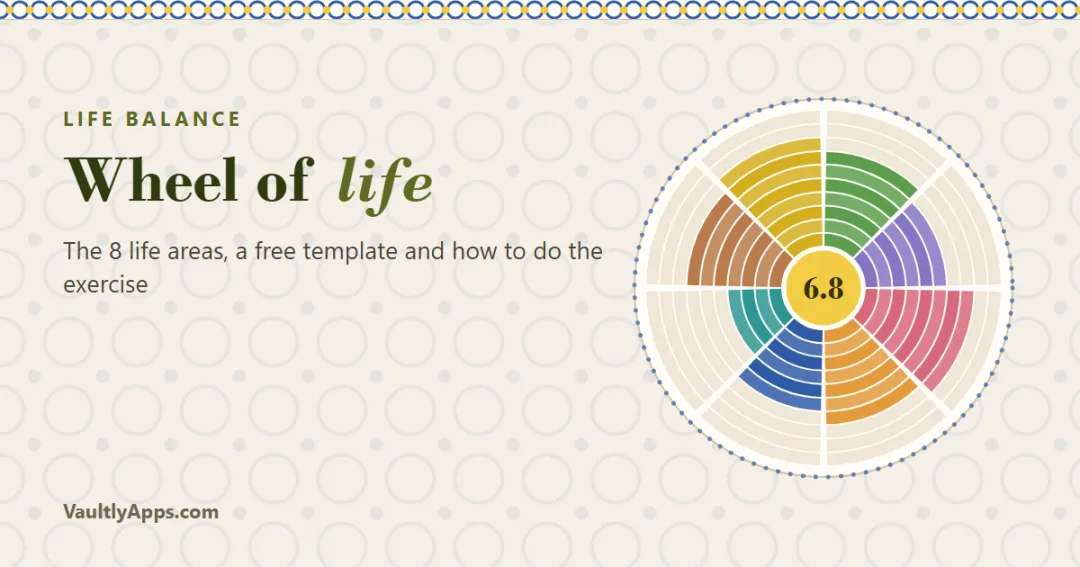
Score the eight areas of your life on a wheel of life. Your vision should cover the whole wheel, not only your career.
2. Daydream — on purpose
Pick a date three years from now. Imagine an ordinary Tuesday. Where do you wake up? Who's there? What does your work look like? How do you feel at 6 pm? Write it down without editing.
3. Find the feelings and values
Underline the words that carry emotion: calm, proud, free, close. Those are your values. Keep them in the final statement.
4. Write one line per life area
Use the formula above. Two or three sentences per area is plenty. Present tense. Positive. Specific.
5. Combine it into one paragraph
Pull the most important parts into a whole-life statement of one to three sentences — the version you'd put on your phone wallpaper.
6. Read it often and update it yearly
A vision is a living document. Read it at your weekly review, and rewrite it once a year, maybe alongside choosing a word of the year.
From vision to a 5-year plan, 3-year plan and this week
A vision without steps stays a dream. Work backwards:
5-year vision — the big picture (your vision statement).
3-year plan — what needs to be true in three years for that vision to be on its way? One line per area.
This year — one goal per focus area, with a target date and your why.
This quarter — two or three milestones for each goal.
This week — the very next action, small enough to do in under an hour.
Every day — one tiny habit that feeds the goal. If habits don't stick for you, read how long it takes to form a habit.
Example: Vision (money): "Six months of savings and no credit card debt." 3-year plan: "Card paid off, $12,000 saved." This year: "Pay off the card by December." Quarter: "$1,500 paid off by March." This week: "List every debt with its rate." Habit: "Log spending every evening."
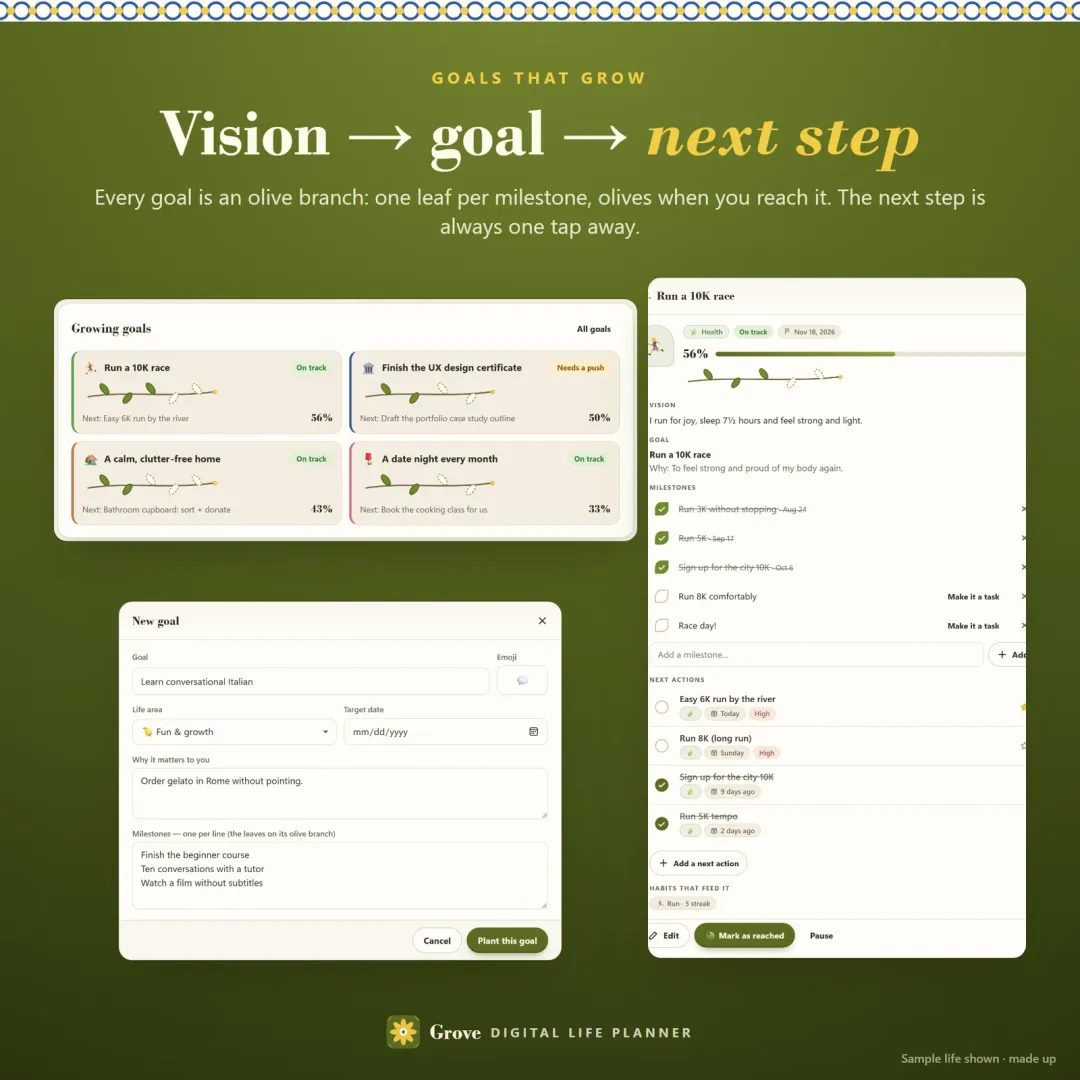
A goal ladder: the area's vision at the top, then the goal, its milestones and the next actions for this week.
Keep your vision where you'll see it
The most common reason visions fail is simple: they're written once and forgotten in a notebook. Put yours where you plan.
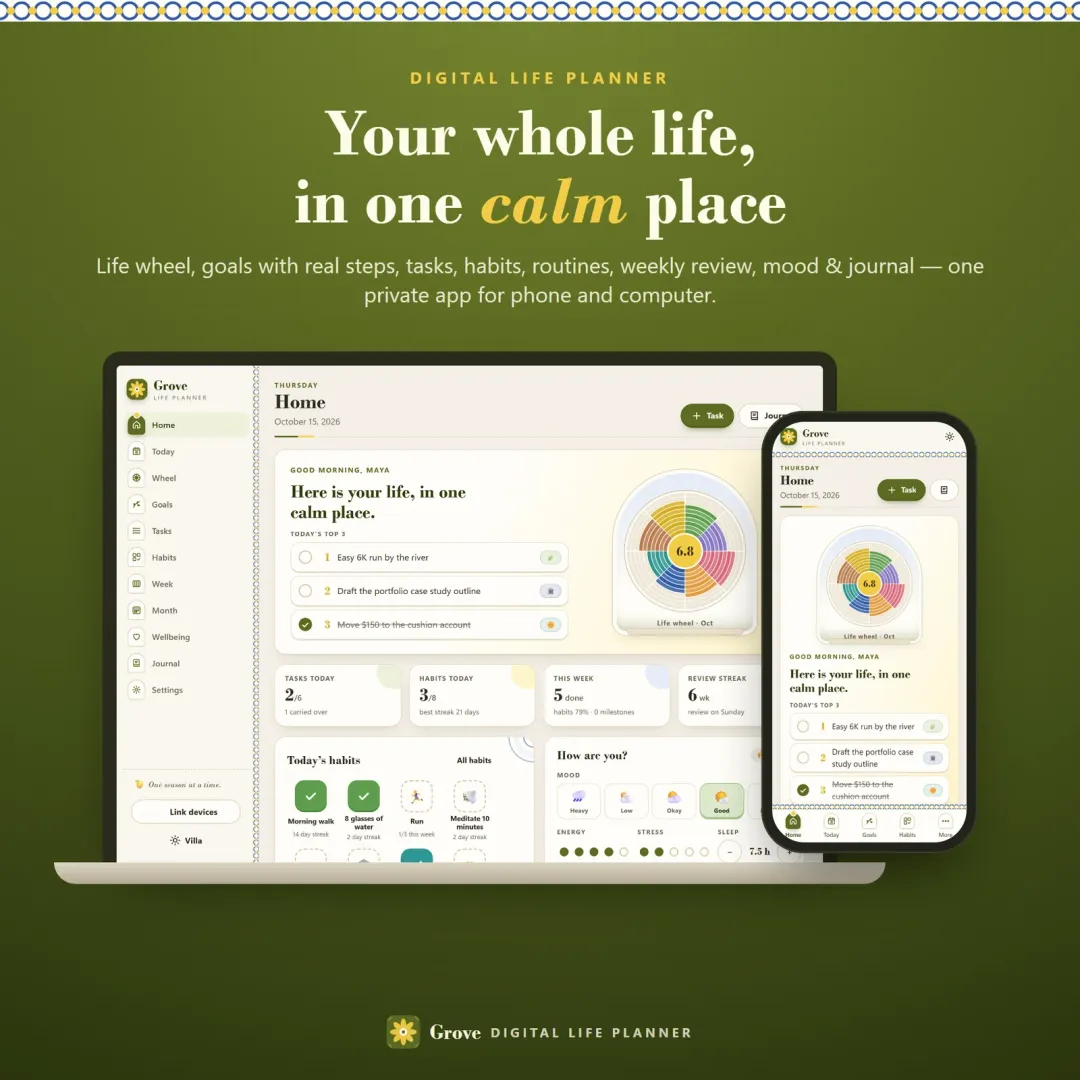
Grove, our digital life planner, keeps a three-year vision for each of your eight life areas right next to that area's score on the wheel of life. Every goal you open shows the vision it belongs to at the top of its ladder — vision → goal → milestones → next actions — so the big picture is never more than one tap away from today's tasks. The bonus pack includes a printable "vision by life area" worksheet, and you can try it all in the free demo.
The bottom line
A personal vision statement is a few sentences that describe the life you want, written as if it's already true. Write one line for each area of your life, combine them into one paragraph, and work backwards into a 3-year plan, this year's goals and this week's next step. Then keep it where you'll see it — and let it quietly steer your days.
Frequently asked questions
What is a personal vision statement?
What is the difference between a vision statement and a mission statement?
How long should a personal vision statement be?
What is a good personal vision statement example?
How do I turn a vision into goals?
Should I write a 5-year plan or a 3-year plan?
Written by
Finance Specialist & Editor, VaultlyApps
Emma Whitfield writes and edits the VaultlyApps money guides and free calculators. Her focus is US household finance — budgeting on a real paycheck, paying down credit card and student debt, emergency funds and savings goals, renting — and the money side of freelancing and small-business income, from pricing and profit margins to self-employment tax. Every guide is researched against primary sources such as IRS publications and the CFPB, every number is checked in our tested calculators, and tax content is reviewed each year when new IRS figures come out. Emma is not a licensed financial adviser or tax preparer; her work is general education, not personal advice.
Researched against primary US sources, checked with our calculators and reviewed by a finance expert on our team. Written for US readers — general education, not financial, tax or legal advice. Editorial policy · Disclaimer