| Excel / Google Sheets | Vault | |
|---|---|---|
| Price | Free (Google Sheets) or part of Microsoft 365 | One-time purchase on Etsy |
| Setup | Build your own sheet or find a template | Ready to use, with a guided setup |
| Formulas | You write and fix them | Built in and tested |
| On your phone | Possible, but fiddly to edit | Made for phone and computer |
| Logging a purchase | Find the right row and cell | A few taps |
| Bills, debt and net worth | Only if you build them | Included |
| Privacy | Stored in your Microsoft or Google account | Stays on your own devices |
| Works offline | Excel yes; Google Sheets limited | Yes, installable app |
| Sharing | Share the file | Sync your own devices with a 6-digit code |
Microsoft 365 and Google Workspace pricing varies by plan. Excel / Google Sheets is a trademark of its owner. VaultlyApps is not affiliated with or endorsed by it.
Try before you switch: Vault has a free live demo with sample data — no sign-up, no bank login.
Open the Vault demoWhy people budget in a spreadsheet
Spreadsheets are where a lot of good budgets start, and for good reasons:
- They're free — Google Sheets costs nothing, and many people already have Excel.
- Total flexibility. Any category, any layout, any formula you can think of.
- No bank login. Your numbers are typed in by you, so nothing is shared with a third-party app.
- You understand every cell, because you built it.
If that describes you and your sheet is working, keep it — a budget you actually use is the best budget.
Where spreadsheet budgets break down
Most spreadsheet budgets don't fail because of the maths. They fail because of the upkeep:
- Logging spending is slow. You buy coffee on your phone, then have to open the sheet, scroll to the right month and find the right cell. So you put it off, and the sheet falls behind.
- Formulas break. One inserted row or pasted value and a total quietly goes wrong.
- Every new month is a rebuild — copying tabs, resetting numbers, fixing references.
- Bills, debt payoff and net worth need their own sheets and formulas, which most people never get round to building.
- Phones are awkward. Spreadsheet apps work, but editing a grid on a small screen is fiddly.
- Privacy is shared with your cloud account. A Google Sheet or OneDrive file lives in that company's cloud, not only on your device.
The alternative: Vault
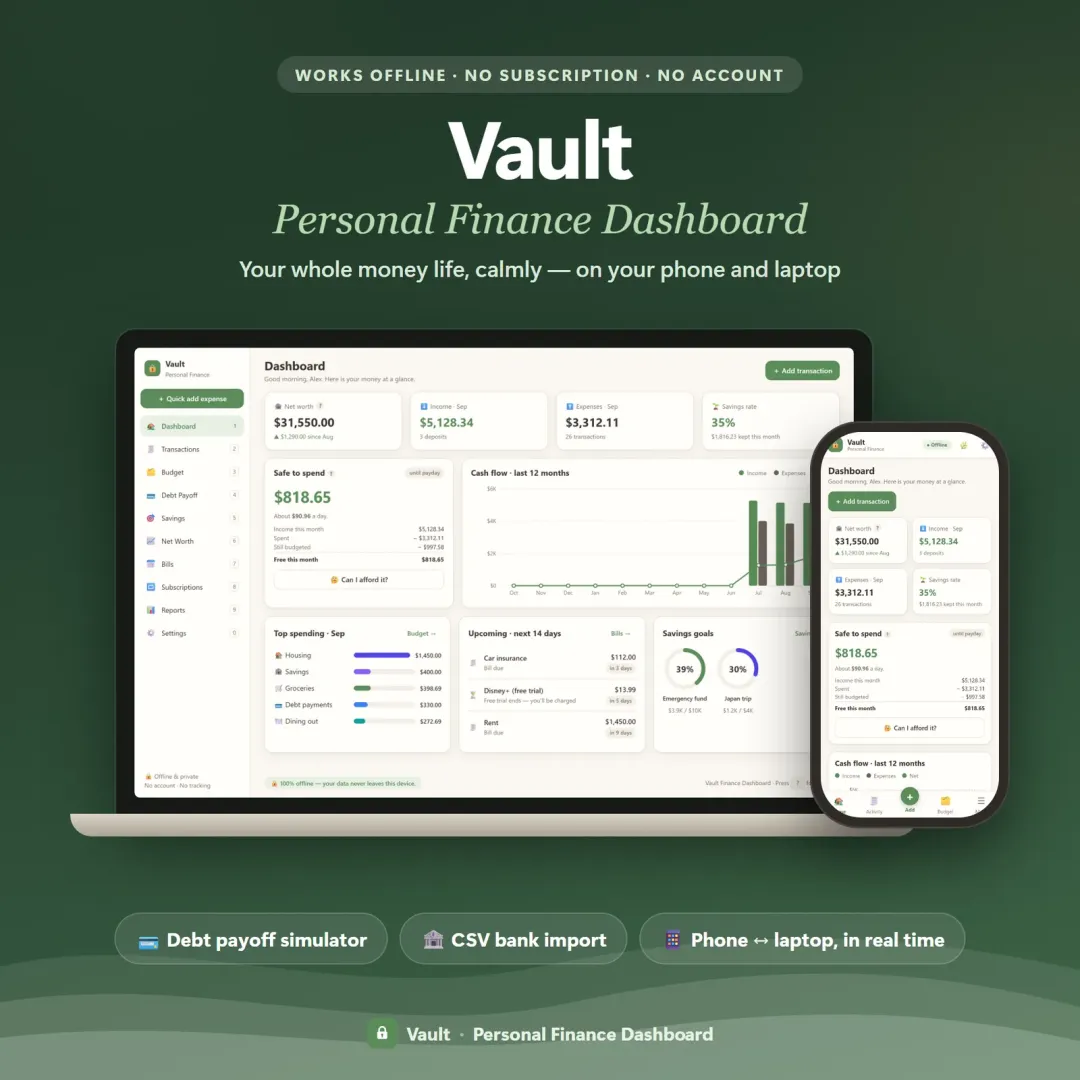
Vault, the VaultlyApps personal finance dashboard, keeps what people like about spreadsheets — no bank connection and full control of your numbers — and removes the upkeep:
- A zero-based budget that's ready on day one, with recurring income and bills that fill in each month.
- A Safe to Spend number, so you know what's free to spend today without adding up columns. (What is safe to spend?)
- Bills and subscriptions, a snowball or avalanche debt payoff plan and net worth tracking — all included, all connected.
- Built for phone and computer: logging a purchase takes a few taps, and it installs like an app and works offline.
- Your data stays on your own devices, with private sync between them using a 6-digit code.
- A one-time purchase — no subscription.
Which should you choose?
- Stay with a spreadsheet if you enjoy building and tweaking it, mostly budget at a computer, and it's already working.
- Choose Vault if you've started spreadsheet budgets and let them slide, want to log spending on your phone, or want bills, debt and net worth without building them.
Not ready for either? Start with the free 50/30/20 budget calculator or the printable monthly budget template.
Try it before you switch
The free Vault live demo opens in your browser with realistic sample data — no account, no bank login, nothing to install — so you can compare it with your spreadsheet before you spend anything.
Frequently asked questions
Is a spreadsheet better than a budget app?
Is Google Sheets good for budgeting?
Can I move from my spreadsheet to Vault?
Does Vault connect to my bank like some apps?
Is there a free budget template?
Written by
Finance Specialist & Editor, VaultlyApps
Researched against primary US sources and reviewed by a finance expert on our team. Written for US readers — general education, not financial, tax or legal advice. Editorial policy · Disclaimer