Due dates
| Income earned | Payment due |
|---|---|
| January 1 – March 31 | April 15 |
| April 1 – May 31 | June 15 |
| June 1 – August 31 | September 15 |
| September 1 – December 31 | January 15 (next year) |
When a date falls on a weekend or holiday, it moves to the next business day. Payments are made with Form 1040-ES or online through IRS Direct Pay or your IRS online account. Many states have their own estimated tax payments too.
How much to pay
Estimate your yearly tax — income tax plus self-employment tax — subtract any withholding, and divide by four. The self-employment tax calculator gives you a quarterly figure and a monthly amount to set aside.
Safe harbor
You generally avoid the underpayment penalty if your withholding and estimated payments add up to at least 90% of this year's tax or 100% of last year's tax (110% if your adjusted gross income was over $150,000).
Make it painless
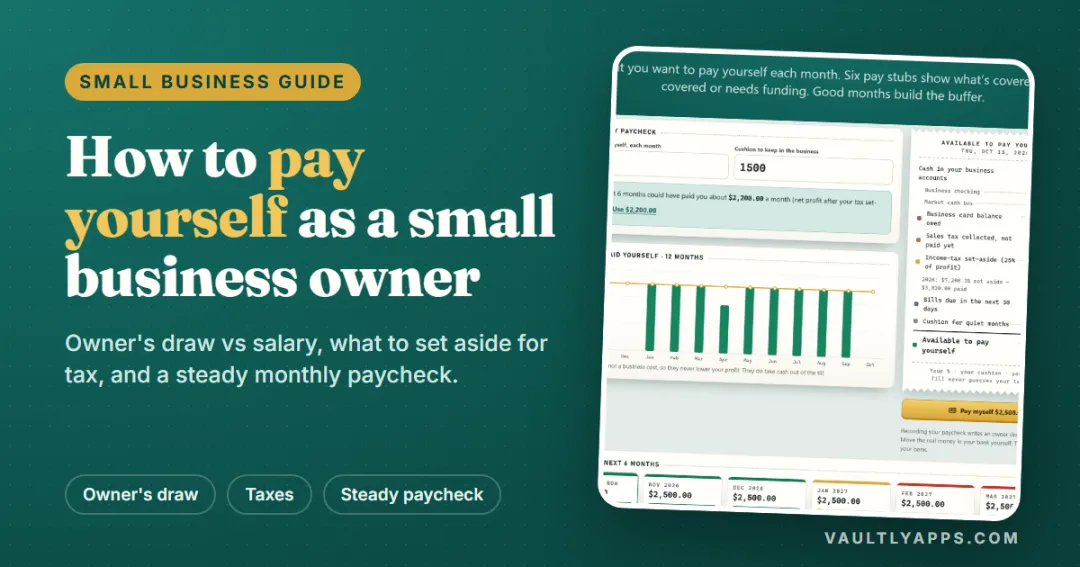
Move a fixed percentage of every payment you receive into a separate tax account the day it arrives. Our guide on how to pay yourself as a small business owner shows a simple system.
Frequently asked questions
Who has to pay quarterly estimated taxes?
What happens if I miss a quarterly payment?
Can I avoid the underpayment penalty?
Written by
Finance Specialist & Editor, VaultlyApps
Researched against primary US sources and reviewed by a finance expert on our team. Written for US readers — general education, not financial, tax or legal advice. Editorial policy · Disclaimer