
How to Plan a Wedding: Step-by-Step Guide + Wedding Planning Checklist
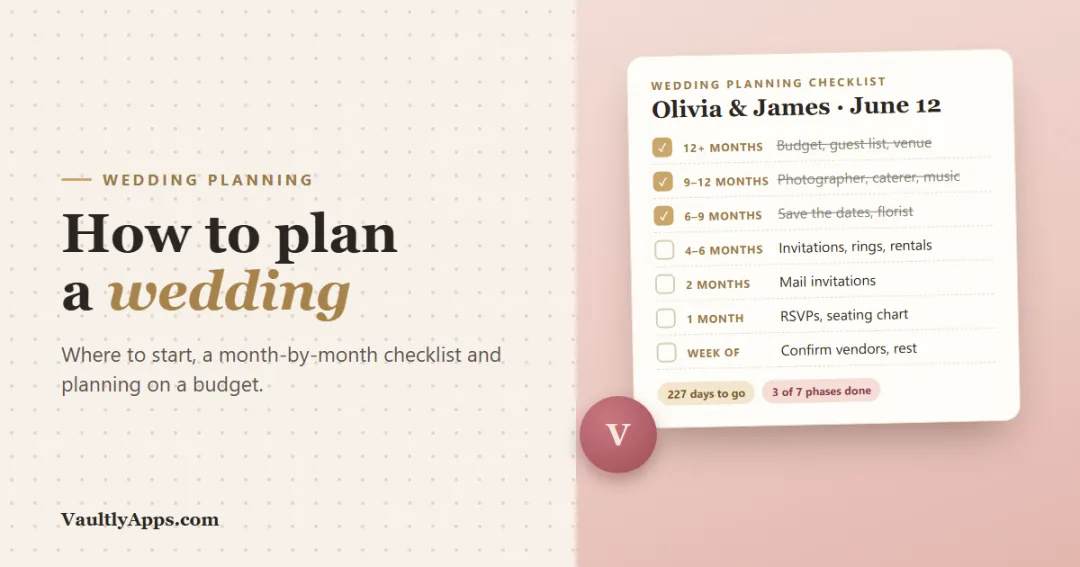
How to plan a wedding from the first conversation to the thank-you notes: where to start, a month-by-month wedding planning checklist and timeline, who pays for what, and how to plan a wedding on a budget.
In this article
- Where to start planning a wedding
- Step 1: Set the wedding budget
- Who pays for what in a wedding?
- Step 2: Draft the guest list
- Step 3: Book the venue (and the date)
- Step 4: Book the key vendors
- Step 5: Save the dates, invitations and RSVPs
- The wedding planning checklist and timeline
- 12+ months before
- 9 to 12 months before
- 6 to 9 months before
- 4 to 6 months before
- 2 to 4 months before
- 1 to 2 months before
- The last weeks
- After the wedding
- How to plan a wedding on a budget
- Small wedding ideas that feel big
- Keep the plan in one place
- The day itself
Planning a wedding feels huge because it's dozens of small decisions that all depend on each other. The good news: they happen in a predictable order. This guide shows how to plan a wedding step by step: where to start, a month-by-month wedding planning checklist and timeline, how to split the money, who pays for what, and how to plan a wedding on a budget without it taking over your life.
Where to start planning a wedding
Before you look at a single venue, sit down together (and with anyone who's contributing money) and agree on three things. They decide almost everything else.
- The total budget. Not a wish, a number you can actually pay. Include what family is giving, in writing, and leave 5 to 10% as a buffer.
- A rough guest count. Write the "must invite" list first: immediate family, closest friends. Then the "would like to" list. The number tells you what size of venue you need.
- The season or date range. Summer Saturdays are the most expensive and the first to go. A Friday, Sunday or off-season month opens up more venues at lower prices.
Then talk about priorities. Ask each other: what three things will we remember in 20 years? For some couples it's the food and the band; for others it's the photos and the dress. Spend on those, and keep the rest simple.
Step 1: Set the wedding budget
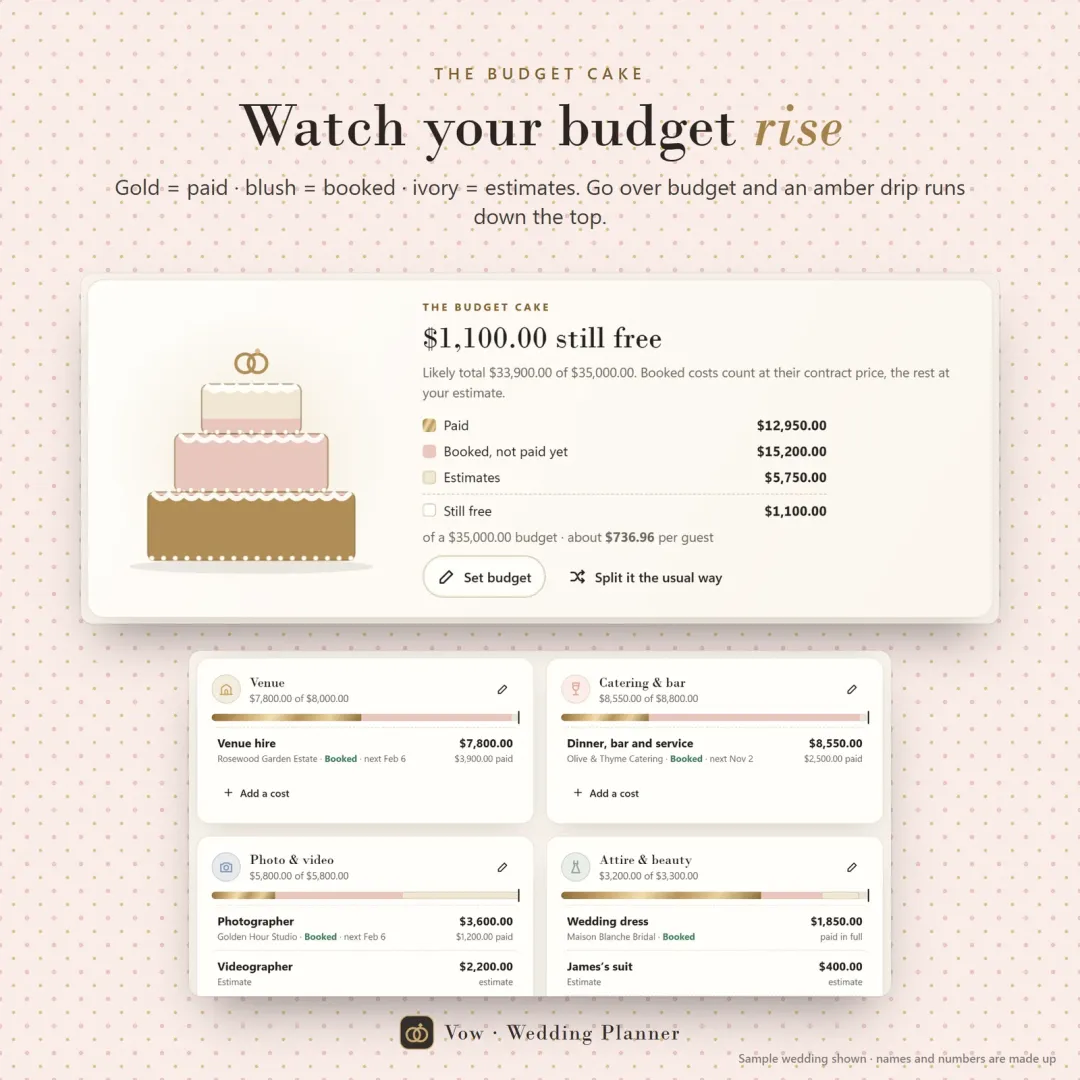
A common split is about 45% for venue and catering, 10 to 12% for photography and video, 7 to 10% each for flowers and decor and for music, 5 to 8% for attire and beauty, small shares for rings, stationery, transport and favors, and a 5 to 10% buffer. Use the free wedding budget calculator to turn your total into dollar amounts per category and see the cost per guest.
The cost per guest is the most useful number in wedding planning. If your budget is $25,000 for 125 guests, that's $200 per guest for everything. If local venues charge $120 a head for dinner and drinks alone, you'll know right away that the guest list or the venue has to change.
Who pays for what in a wedding?
Traditionally, the bride's family paid for the ceremony, reception, flowers and photography, and the groom's family paid for the rehearsal dinner, the officiant and the honeymoon. Very few families follow that strictly today. Most couples pay a large part themselves, and parents on either side contribute a fixed amount or cover a specific item, like the bar or the dress.
What matters is that everyone agrees early. A contribution "toward the flowers" is easier to plan around than a vague promise. Write down who's giving what and when, and add it to your budget.
Step 2: Draft the guest list
Make a spreadsheet or list with a row per household (one invitation each): names, address, side, and whether they get a plus-one. Count adults and children separately, since catering often charges less for kids. Expect roughly 10 to 20% of invited guests to decline, more for a destination wedding.
Keep the list in one place from the start. You'll use it for save the dates, invitations, RSVPs, meal choices, the seating chart and thank-you notes, so retyping it later wastes hours.
Step 3: Book the venue (and the date)
The venue sets the date, the maximum guest count and often the caterer and bar rules. When you visit, ask:
- What's included: tables, chairs, linens, setup and cleanup, a coordinator?
- Is there an in-house caterer, or can we bring our own? Are there corkage or cake-cutting fees?
- What's the deposit, when are the payments due, and what's the cancellation policy?
- What's the backup plan for rain, if anything is outside?
- When do we get access on the day, and when must everything end?
Read the contract carefully, and put every deposit and due date into your budget straight away.
Step 4: Book the key vendors
Vendors who can only do one wedding a day fill up first. In rough order: photographer (and videographer), caterer if the venue doesn't provide one, band or DJ, and officiant. Then the florist, hair and makeup, cake or dessert, rentals and transport.
For each one, get a written quote that lists exactly what's included, the deposit and the payment schedule. Compare at least two or three side by side, not just on price but on what you actually get: hours of coverage, number of edited photos, setup fees, overtime rates.
Step 5: Save the dates, invitations and RSVPs
Save the dates go out 6 to 8 months before (8 to 12 months for a destination wedding). Invitations go out 6 to 8 weeks before, with an RSVP deadline about 3 to 4 weeks before the wedding. Our guide on when to send wedding invitations covers each piece of stationery, wording and how to chase late replies. If you want a hashtag for guests' photos, the wedding hashtag generator gives you ideas from your names.
The wedding planning checklist and timeline
Here is the whole wedding planning timeline, month by month. If you have less time, compress it: do the first two blocks in the first month, and so on.
12+ months before
- Agree on the budget, who is contributing and your top priorities
- Draft the guest list and estimate the guest count
- Choose a season or date range and the style of wedding
- Tour and book the venue; this sets the date
- Hire a planner or day-of coordinator, if you want one
- Start a shared folder or app for contracts, quotes and ideas
9 to 12 months before
- Book the photographer and videographer
- Book the caterer (if separate), the band or DJ and the officiant
- Choose the wedding party
- Start shopping for the dress or suit
- Set up a wedding website and a registry
- Book a block of hotel rooms for out-of-town guests
6 to 9 months before
- Send save the dates
- Book the florist, hair and makeup, cake or dessert
- Plan and book the honeymoon (check passports)
- Book rentals: tables, chairs, linens, tent, lighting
- Order the wedding party's attire
4 to 6 months before
- Order invitations and other stationery
- Book transport for the couple, wedding party and guests if needed
- Buy the wedding bands
- Plan the rehearsal dinner
- Schedule a menu tasting and the hair and makeup trial
2 to 4 months before
- Mail invitations 6 to 8 weeks before the wedding
- Finalize the menu, the bar and the cake
- Write the ceremony and vows with your officiant
- First dress or suit fittings
- Buy favors, gifts for the wedding party and the guest book
- Check the marriage license rules in your state and county
1 to 2 months before
- RSVP deadline; follow up with guests who haven't replied
- Give the final guest count and meal choices to the caterer
- Make the seating chart; the wedding seating chart maker can seat whole parties together
- Write the day-of timeline with your photographer and coordinator
- Get the marriage license
- Final fittings; break in your shoes
The last weeks
- Confirm arrival times and details with every vendor
- Pay final balances and prepare tips in labeled envelopes
- Pack an emergency kit and the honeymoon bags
- Hand the timeline and vendor contacts to your coordinator or maid of honor
- Rehearsal and rehearsal dinner
- Rest, eat and drink water
After the wedding
- Return rentals and the suit
- Send thank-you notes within about three months
- Change your name, if you're changing it
- Back up your photos and keep the contracts and receipts
How to plan a wedding on a budget
The biggest savings come from a handful of decisions, not from cutting corners on everything:
- Invite fewer people. Every guest adds food, drink, a chair, a place setting and a slice of the venue. Cutting 20 guests can save thousands.
- Pick an off-peak date. Fridays, Sundays and winter months often cost much less, and vendors may negotiate.
- Choose an all-inclusive venue. One price for space, food and staff can beat renting an empty venue and hiring everyone separately.
- Simplify the bar. Beer and wine plus one signature cocktail costs much less than a full bar. The wedding alcohol calculator shows how much to buy.
- Spend on your top three. If photos matter most, book a great photographer and go simple on flowers and favors.
- Track deposits and due dates. Most vendors take a deposit at booking and the balance one or two weeks before the wedding. Knowing what's due when avoids expensive surprises.
- Save on purpose. Work out the monthly amount with the savings goal calculator and keep it in a separate account.
Small wedding ideas that feel big
A small wedding or elopement frees up budget for the things you care about. Some ideas couples love:
- A dinner party for 20 to 40 people at a favorite restaurant's private room
- A morning ceremony followed by brunch instead of a long evening reception
- A weekend away with immediate family, ceremony on the Saturday
- A courthouse ceremony with photos in the city and a big party later
- A backyard or family home wedding with food trucks or a taco bar
The same planning order applies, just with fewer vendors and a shorter checklist.
Keep the plan in one place
The hardest part of wedding planning is keeping it all straight: the checklist in one place, the budget in a spreadsheet, the guest list in another, and vendor details in your email. Pick one home for it, whether that's a binder, a shared spreadsheet or an app, and keep everything there from day one.
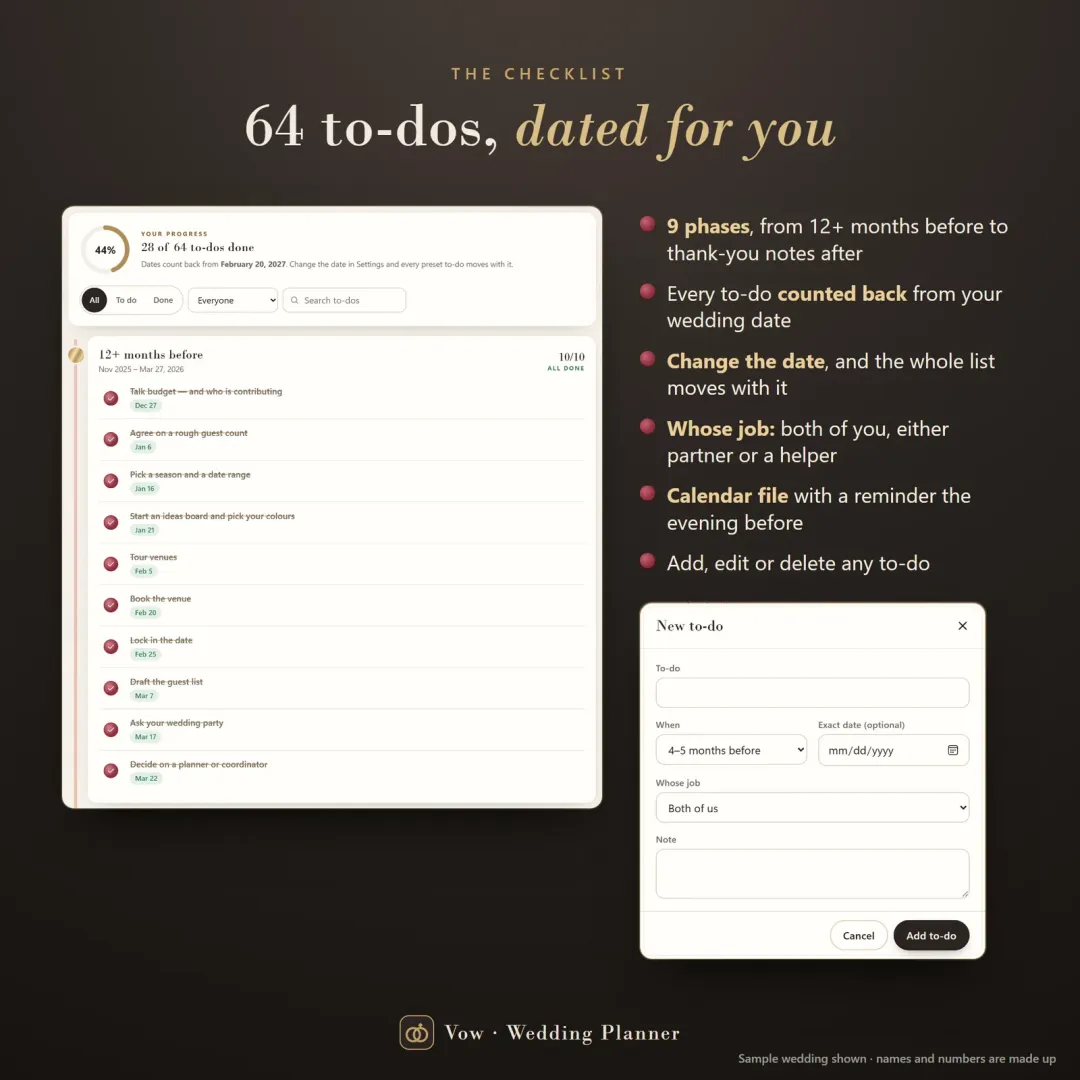
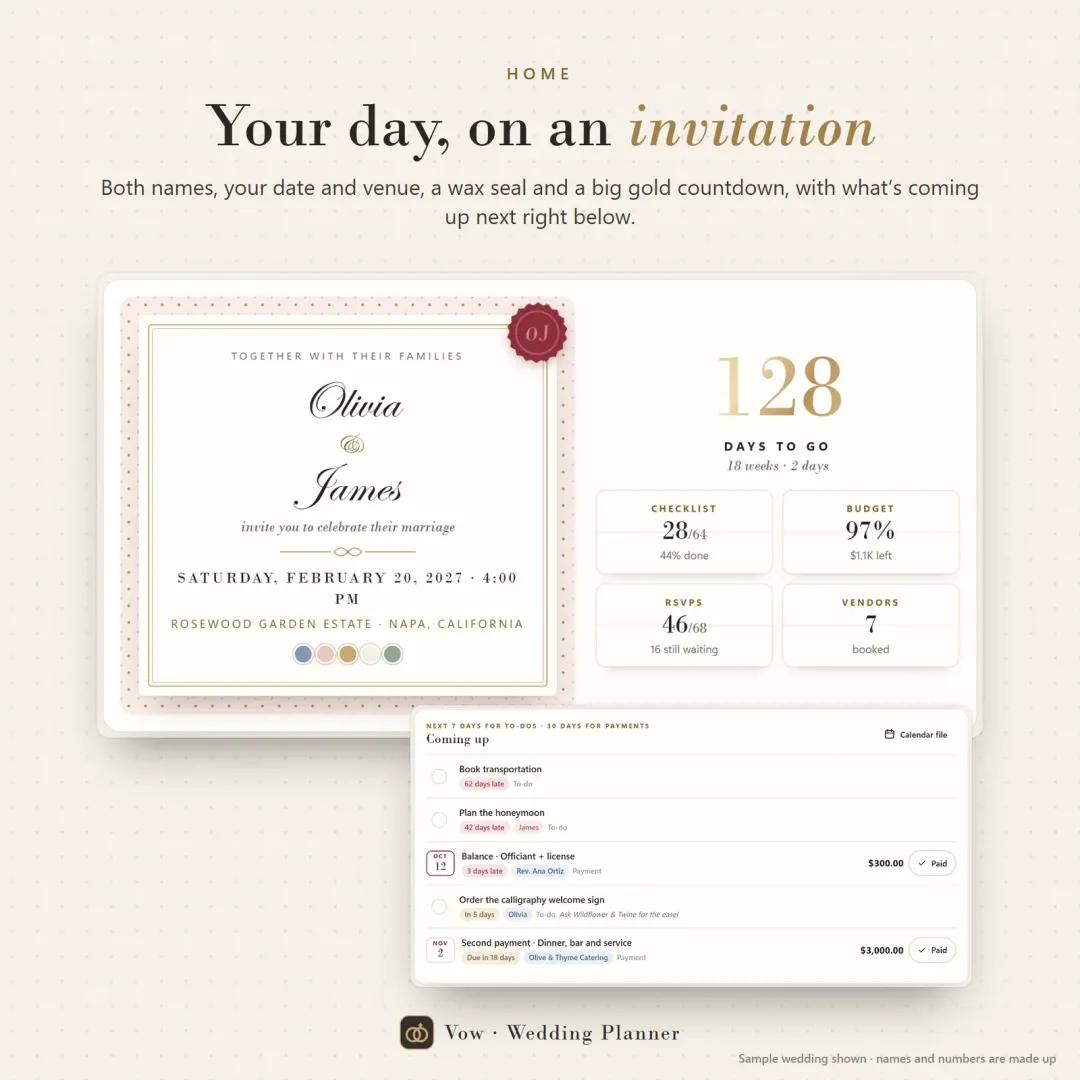
Vow, our wedding planner app, was made for exactly this. It starts with a 64-task checklist dated from your wedding day, a budget with deposits and due dates, a guest list with RSVPs and meals, a seating chart, a vendor tracker and the day-of timeline. Link your partner's phone with a code so you both see the same plan. You can try the free demo with a sample wedding.
The day itself
The last big piece is the wedding day timeline: when hair and makeup start, when the photographer arrives, when the ceremony, dinner, toasts and first dance happen. Our wedding day timeline guide has sample schedules for afternoon and evening weddings. And to see exactly how much time you have, use the wedding countdown.
Planning a wedding is a project, but it's a project with a known order. Make the three big decisions first, book the venue, then work down the checklist one block at a time. You'll get there, and you'll enjoy more of it if you leave a little room in the plan for the two of you.
Frequently asked questions
Where do you start when planning a wedding?
How far in advance should you plan a wedding?
What is the first thing to book for a wedding?
How do you plan a wedding on a budget?
Who pays for what in a wedding?
What should be on a wedding planning checklist?
Do we need a wedding planner?
Written by
Finance Specialist & Editor, VaultlyApps
Emma Whitfield writes and edits the VaultlyApps money guides and free calculators. Her focus is US household finance — budgeting on a real paycheck, paying down credit card and student debt, emergency funds and savings goals, renting — and the money side of freelancing and small-business income, from pricing and profit margins to self-employment tax. Every guide is researched against primary sources such as IRS publications and the CFPB, every number is checked in our tested calculators, and tax content is reviewed each year when new IRS figures come out. Emma is not a licensed financial adviser or tax preparer; her work is general education, not personal advice.
Researched against primary US sources, checked with our calculators and reviewed by a finance expert on our team. Written for US readers — general education, not financial, tax or legal advice. Editorial policy · Disclaimer