VaultlyApps logo VaultlyApps
Money glossary

What Is Sell-Through Rate? Formula, Example and a Good Rate

The number that tells a reseller or shop whether stock is turning into cash — or piling up.

By Updated Reviewed by a finance expert

The formula

Sell-through rate = units sold ÷ (units sold + units unsold) × 100

Retailers often use units sold ÷ units received for a season. Resellers usually count everything they had a chance to sell: what sold plus what is still listed or waiting to be listed.

Example for a reseller

Item Units
Sold this month 24
Still unsold at month-end 56
Items available to sell 80
Sell-through rate 30%

Check your own with the free sell-through rate calculator — it also shows how many days your remaining stock would take to sell and the money tied up in it.

What a good sell-through rate looks like

Monthly rate Meaning
Under 20% Slow — stock is piling up
20% – 40% Steady
40% – 60% Strong
60%+ Excellent, or priced a little low

Why it matters

A low sell-through rate means cash stays on your shelves as cost of goods you've already paid for. Watching it by platform and by sourcing spot shows where to list and where to stop buying. Flip, our reseller profit tracker, works it out automatically for every platform and source, next to true profit and days to sell.

Frequently asked questions

What is a good sell-through rate?

For resellers and small shops, about 40% to 80% a month is generally healthy and under 20% a month is slow. Seasonal fashion retailers often aim for 60% to 80% over a season.

Is it sell through rate or sell-through rate?

Both spellings mean the same thing. The hyphenated "sell-through rate" is the more common form in retail.

How is sell-through rate different from inventory turnover?

Sell-through rate is the percentage of units sold in one period. Inventory turnover is how many times the whole inventory is sold and replaced in a year, usually cost of goods sold ÷ average inventory value.

Written by

Emma Whitfield

Finance Specialist & Editor, VaultlyApps

Researched against primary US sources and reviewed by a finance expert on our team. Written for US readers — general education, not financial, tax or legal advice. Editorial policy · Disclaimer

From VaultlyApps

Apps that use this

Every app has a free live demo with sample data — open it in your browser, nothing to install.

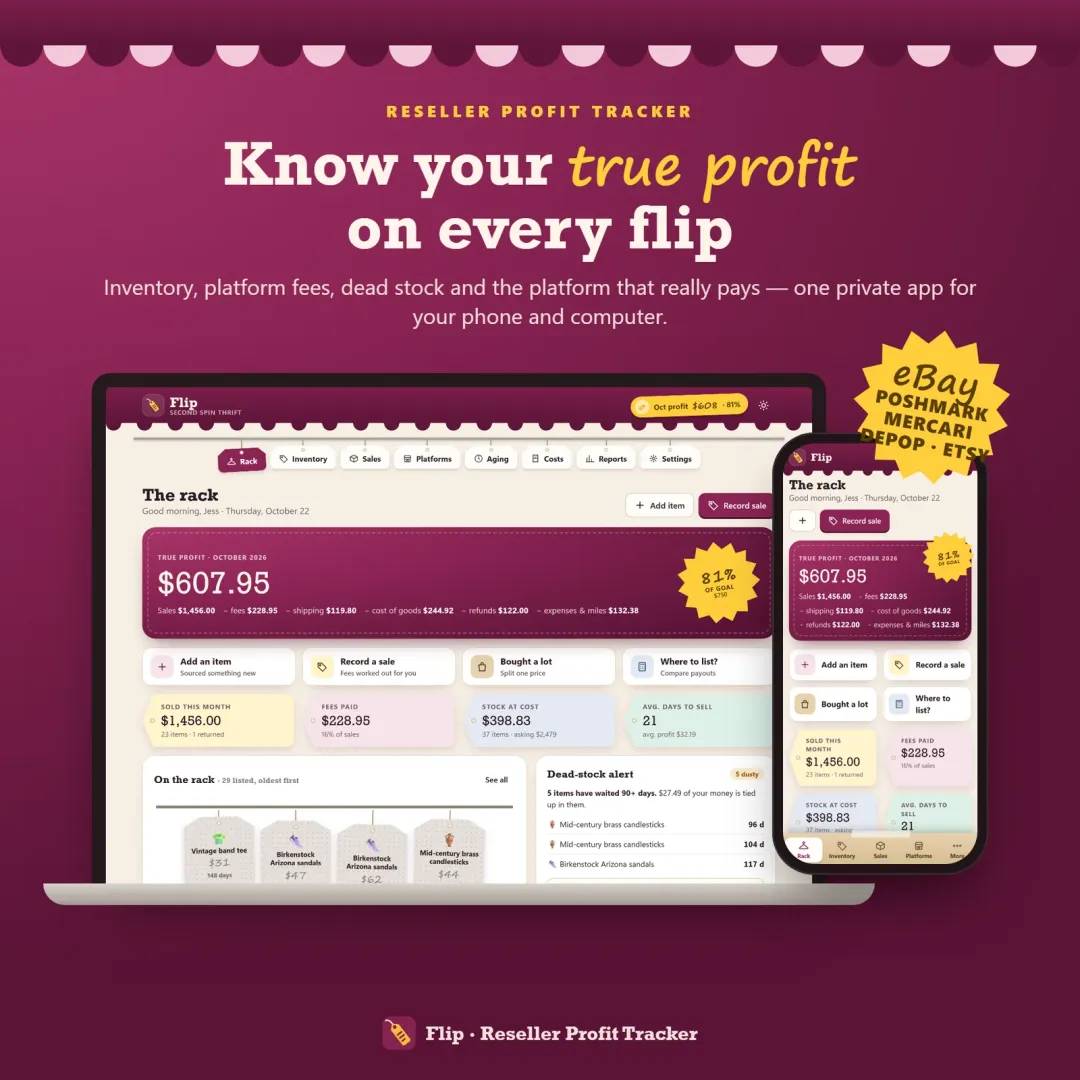
Flip reseller profit tracker app showing true profit this month, quick keys and a rack of listed items Live
Flip app icon

Flip

Reseller Profit Tracker

A reseller profit tracker and inventory tracker for eBay, Poshmark, Mercari, Depop and Etsy sellers — see the true profit on every flip after fees, shipping and cost of goods, spot dead stock and find the platform that really pays.

Free calculators

Profit Margin Calculator

Profit, margin and markup after fees — or the price to charge for a target margin.

Open calculator

Keep reading

Related terms

Money glossary

Cost of goods sold (COGS)

Cost of goods sold (COGS) is what you paid for the items you actually sold in a period — the purchase price plus costs to get them ready to sell, such as cleaning or repairs. Items you still have in stock are not part of COGS yet; they are inventory.

Profit margin

Profit margin is the percentage of each sale you keep as profit after costs. A 40% margin means you keep $40 of every $100 in sales. It is calculated by dividing profit by the selling price — not by the cost, which would be markup.

Further reading

Guides on this topic

All articles

Try Flip free in your browser

A reseller profit tracker and inventory tracker for eBay, Poshmark, Mercari, Depop and Etsy sellers — see the true profit on every flip after fees, shipping and cost of goods, spot dead stock and find the platform that really pays. The live demo uses sample data — nothing to install, no sign-up.

We use optional cookies for anonymous analytics. Nothing optional is set until you choose. Cookie policy