Report Card Comments: 150+ Examples for Every Student (and How to Write Them)
Over 150 report card comments and progress report comments you can adapt: strengths, areas to improve, behavior, work habits, reading, writing and math, plus a simple formula for writing your own and phrases to avoid.
In this article
- A simple formula for report card comments
- Positive report card comments
- General strengths
- Work habits and effort
- Social skills and collaboration
- Needs improvement comments (said kindly)
- Work habits
- Focus and behavior
- Social and emotional
- Report card comments by subject
- Reading
- Writing
- Math
- Science and social studies
- Art, music and PE
- Middle and high school report card comments
- Kindergarten and early years
- New students and English language learners
- Attendance and missing work
- Progress report comments (mid-term)
- End-of-year report card comments
- Words to use and words to avoid
- Make report card time faster
- Progress reports and parent communication in one place
Writing report card comments for 30, 90 or 150 students is one of the longest jobs of the term. The hard part isn't the writing. It's finding fresh, specific words that are honest, kind and useful to families. Below is a simple formula for writing your own, more than 150 report card comments and progress report comments sorted by situation, and a list of phrases to use and avoid. Replace [Name] and adjust each one to fit the student.
A simple formula for report card comments
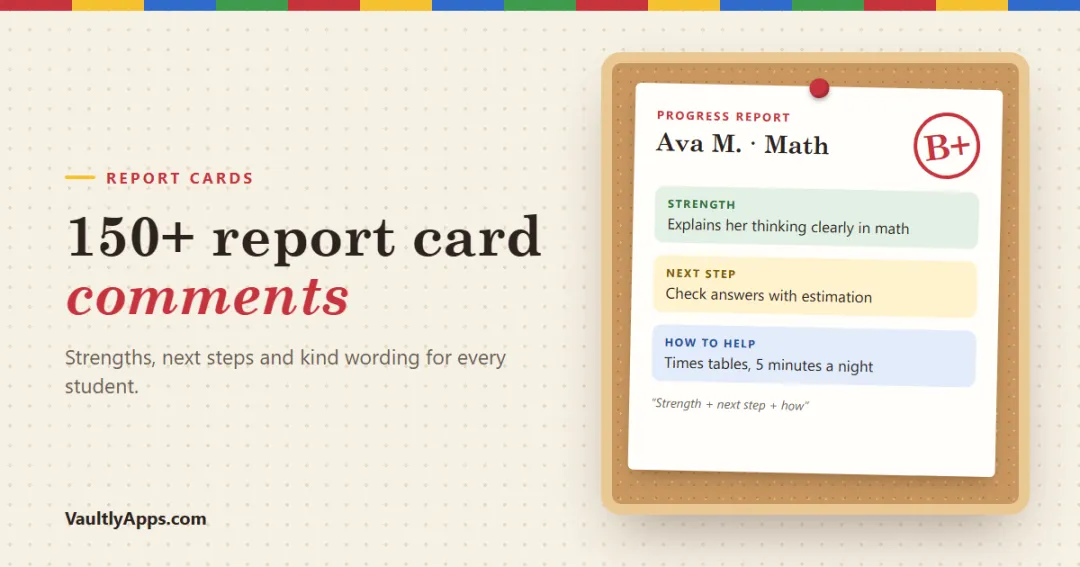
Strength + next step + how
Strength: name one specific thing the student does well. "[Name] writes vivid descriptions that bring stories to life."
Next step: one skill or habit to work on. "Next, they're working on organizing ideas into paragraphs."
How: what will help, at school or at home. "Planning with a simple outline before writing will help."
Keep it specific (name the skill), positive in tone (even when the news isn't), and honest. Families should never be surprised by a report card. If a comment carries bad news, a call or email home should have come first.
Positive report card comments
General strengths
[Name] is a curious learner who asks thoughtful questions.
[Name] comes to class ready to learn and sets a positive tone for the group.
[Name] takes pride in their work and checks it carefully before handing it in.
[Name] is a kind and respectful member of our class.
[Name] approaches new challenges with confidence and a can-do attitude.
[Name] listens carefully and builds on the ideas of others.
[Name] has made excellent progress this term.
[Name] is a hard worker who never gives up on a difficult task.
[Name] contributes thoughtful ideas to class discussions.
[Name] shows real enthusiasm for learning, and it's contagious.
[Name] is a natural leader who includes others.
[Name] has grown in confidence and now shares ideas readily.
Work habits and effort
[Name] uses class time well and finishes work on time.
[Name] follows directions carefully and works independently.
[Name] is organized and keeps track of materials and deadlines.
[Name] puts consistent effort into every assignment.
[Name] asks for help when needed, which is a real strength.
[Name] revises work after feedback and the improvement shows.
[Name] stays focused during independent work time.
[Name] goes beyond the minimum and often adds extra detail.
[Name] manages longer projects well, breaking them into steps.
[Name] is responsible and reliable, and can be trusted with classroom jobs.
Social skills and collaboration
[Name] works well with others and shares tasks fairly in group work.
[Name] is a supportive classmate who encourages others.
[Name] resolves small disagreements calmly and respectfully.
[Name] includes classmates who are new or on their own.
[Name] is a good listener and respects other points of view.
[Name] takes on different roles in a group, leading or supporting as needed.
[Name] celebrates the success of others.
[Name] is polite and considerate with adults and classmates.
Needs improvement comments (said kindly)
These comments name the challenge honestly and point to a next step.
Work habits
[Name] is capable of high-quality work. Next, we're working on finishing tasks within class time.
[Name] will benefit from writing assignments and due dates in a planner each day.
[Name] sometimes rushes through work. Taking a minute to check answers before handing in will lift their grades.
[Name] is working on starting tasks promptly. A short checklist at the start of each lesson is helping.
Several assignments are missing this term. Completing them by [date] will make a real difference to [Name]'s grade.
[Name] is learning to keep materials organized. A folder for each subject would help.
[Name] has good ideas but finds it hard to get them on paper. We're practising quick planning before writing.
[Name] would benefit from asking for help sooner when something doesn't make sense.
[Name] is working on following multi-step directions. Rereading the task before starting helps.
Homework is not always completed. A regular time and place at home for homework would support [Name].
Focus and behavior
[Name] is working on staying focused during independent work. Sitting near the front is helping.
[Name] has a lot to share. Next, we're working on waiting for a turn to speak.
[Name] is learning to make responsible choices when working with friends.
[Name] is working on using class time well, and has had some good days recently.
[Name] is learning to manage frustration when work is challenging. Taking a short break and then trying again is a strategy we're practising.
[Name] is working on following classroom routines without reminders.
[Name] is learning to keep hands and materials to themself during group work.
[Name] can find transitions between activities difficult. A heads-up before changes is helping.
[Name] is learning to respect personal space and wait in line calmly.
[Name] is working on listening while others speak. We'd love your support in talking about this at home.
Social and emotional
[Name] is working on joining group activities with more confidence.
[Name] is learning to share ideas in small groups before speaking to the whole class.
[Name] is working on solving disagreements with words and asking an adult for help when needed.
[Name] is learning to accept feedback as a way to improve.
[Name] is working on being a good sport in games and group challenges.
[Name] would benefit from making a habit of checking in with a friend during group work.
Report card comments by subject
Reading
[Name] reads fluently and with expression.
[Name] understands what they read and can retell the main events in order.
[Name] makes thoughtful predictions and connections while reading.
[Name] is reading a wider range of books, including nonfiction.
[Name] uses strategies to work out unfamiliar words.
[Name] can find the main idea and supporting details in a text.
[Name] is working on reading with more expression. Reading aloud at home for 10 minutes a night will help.
[Name] is working on understanding what they read. Asking "who, what, where, why?" after each chapter helps.
[Name] is building reading stamina and can now read independently for longer.
[Name] would benefit from reading every day at home, even just 15 to 20 minutes.
Writing
[Name] writes with a strong, clear voice.
[Name] organizes writing into clear paragraphs with a beginning, middle and end.
[Name] uses rich vocabulary and varied sentences.
[Name] supports opinions with good reasons and examples.
[Name] edits carefully for spelling and punctuation.
[Name] writes vivid descriptions that bring stories to life.
[Name] is working on using capital letters and periods consistently.
[Name] is working on adding detail to writing. "Show, don't tell" is our current goal.
[Name] has great ideas and is learning to plan them with an outline before writing.
[Name] is working on neat, legible handwriting.
Math
[Name] has a strong understanding of [topic] and applies it to new problems.
[Name] explains their mathematical thinking clearly.
[Name] is accurate and quick with math facts.
[Name] perseveres with challenging word problems.
[Name] checks answers using estimation.
[Name] uses a range of strategies to solve problems.
[Name] is working on recalling multiplication facts. Practising a few minutes each day at home will help.
[Name] understands the concepts and is working on showing all steps of the working.
[Name] is working on reading word problems carefully before choosing an operation.
[Name] would benefit from more practice with [topic], and extra practice sheets are available.
Science and social studies
[Name] asks insightful questions about how the world works.
[Name] follows lab safety rules and handles equipment carefully.
[Name] records observations accurately and draws sensible conclusions.
[Name] can explain cause and effect in historical events.
[Name] uses evidence from sources to support answers.
[Name] made an excellent contribution to our [unit] project.
[Name] is working on writing clear conclusions from lab results.
[Name] is working on learning key vocabulary for each unit. Flashcards would help.
Art, music and PE
[Name] experiments boldly with color and materials.
[Name] takes care with details and finishes artwork thoughtfully.
[Name] gives and receives feedback on artwork respectfully.
[Name] sings with confidence and keeps a steady beat.
[Name] is learning to read rhythms and simple notation.
[Name] practises regularly and it shows in their playing.
[Name] participates fully and encourages teammates in PE.
[Name] shows good sportsmanship whether winning or losing.
[Name] is developing coordination and ball skills.
[Name] follows safety rules and uses equipment responsibly.
[Name] is working on joining in with more confidence during performances.
[Name] is working on following game rules and taking turns.
Middle and high school report card comments
Older students need comments that speak to independence and study habits:
[Name] takes ownership of their learning and seeks feedback.
[Name] contributes thoughtful, well-supported arguments to discussions.
[Name] manages deadlines well across a demanding schedule.
[Name] produces work that shows real depth of understanding.
[Name] is a respected voice in class and lifts the level of discussion.
[Name] would benefit from reviewing notes regularly rather than before tests only.
[Name] is capable of a higher grade. Completing homework consistently is the key step.
[Name] is encouraged to attend extra help sessions before the next assessment.
[Name] is working on using an agenda or app to track assignments across classes.
[Name]'s test performance doesn't yet reflect their understanding in class. Practice tests will help.
Kindergarten and early years
[Name] is learning letter sounds and can name most letters.
[Name] is beginning to blend sounds to read simple words.
[Name] counts objects accurately to 20.
[Name] writes their name independently.
[Name] follows classroom routines and settles quickly in the morning.
[Name] plays cooperatively and is learning to share.
[Name] is building independence with buttons, zips and lunch boxes.
[Name] is working on holding a pencil with a comfortable grip.
New students and English language learners
[Name] has settled in well and is making new friends.
[Name] is gaining confidence speaking English in class every week.
[Name] uses pictures and gestures well to share ideas while building vocabulary.
[Name] understands much more than they say yet, which is a normal and positive stage.
[Name] is a hard-working learner who brings a valuable perspective to our class.
Reading together at home in any language will support [Name]'s literacy.
Attendance and missing work
[Name]'s regular attendance is helping them make steady progress.
Frequent absences have made it hard for [Name] to keep up. We'd like to work together on a plan.
[Name] has caught up well after time away.
[Name] is encouraged to check the class website for any work missed when absent.
Late arrivals mean [Name] misses the start of lessons, where key instructions are given.
[Name] has several missing assignments. A catch-up plan is ready to share with you.
Progress report comments (mid-term)
Progress report comments come while there's still time to change the outcome, so they should be short and point to action:
[Name] is off to a strong start this term, keep it up!
[Name] has a solid grade so far. Completing the two missing assignments would raise it further.
[Name] is currently at [grade]. Coming to extra help on [day] would support the next unit test.
[Name] is making steady progress in [subject] and participates well in class.
[Name]'s grade has improved since the start of term. The extra effort is paying off.
[Name] is capable of more than current grades show. Let's talk about a plan.
[Name] is doing well in class but test scores are lower than class work. Reviewing notes for 10 minutes a night will help.
[Name] has [number] missing assignments. All of them can still be turned in by [date].
[Name] participates well. The next step is turning in homework consistently.
[Name] has settled in well and is a positive presence in class.
End-of-year report card comments
It has been a pleasure to teach [Name] this year, and I can't wait to see what's next.
[Name] has grown so much this year, especially in [area].
[Name] ends the year as a confident, independent learner.
[Name] has worked hard all year and should be proud of their progress.
[Name] is ready for [next grade] and will continue to shine.
Over the summer, reading every day will help [Name] keep their progress going.
[Name]'s kindness made our classroom a better place this year.
[Name] has met every goal we set together this year.
Words to use and words to avoid
Instead of… | Try… |
|---|---|
lazy | is working on getting started on tasks |
careless / sloppy | is working on checking work carefully |
talks too much | has a lot to share and is learning to wait for a turn |
can't / never | is learning to… / is beginning to… |
disruptive | is working on making responsible choices during lessons |
struggles with | is developing / is building confidence with |
average | is meeting grade-level expectations in… |
below grade level | is working toward grade-level expectations in… |
Also avoid: comparisons with siblings or classmates, jargon families won't understand ("tier 2 intervention", "CVC words" without explanation), anything about diagnoses, family matters or private information, and surprises. Big concerns should reach families by phone or meeting first.
Make report card time faster
Keep notes during the term. A line per student every couple of weeks ("finally cracked long division!") makes comments almost write themselves.
Build your own comment bank from the lists above, adapted to your voice, and reuse it each term.
Start with the grades. Specific comments are easier when you can see each student's categories, scores and missing work in one place. The free grade calculator handles weighted grades quickly.
Batch by class. Write all comments for one class in one sitting, starting with the students you know best.
Keep a family contact log. Comments should never be the first time a family hears about a concern. A log of calls and emails with follow-up dates keeps parent-teacher communication on track.
Progress reports and parent communication in one place
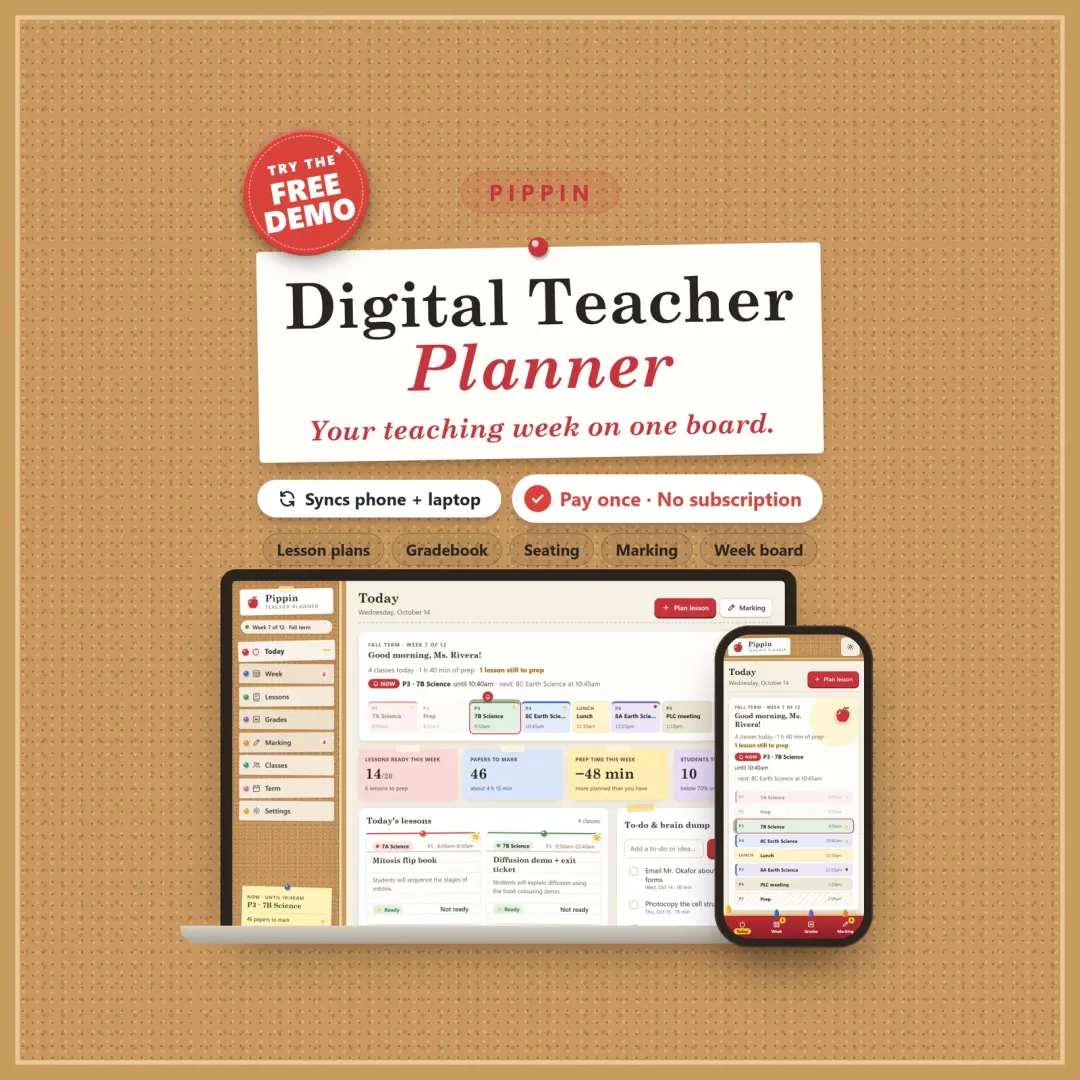
Pippin, our digital teacher planner, builds a student progress report in one tap: overall grade, each category, every score, missing work, family contacts and lines for your comments, ready to print for parent-teacher conferences. Its teacher gradebook does the math (weighted categories or points, excused and missing work, your own grading scale), and the family contact log keeps every call, email and meeting with a follow-up date. You can try the free demo.
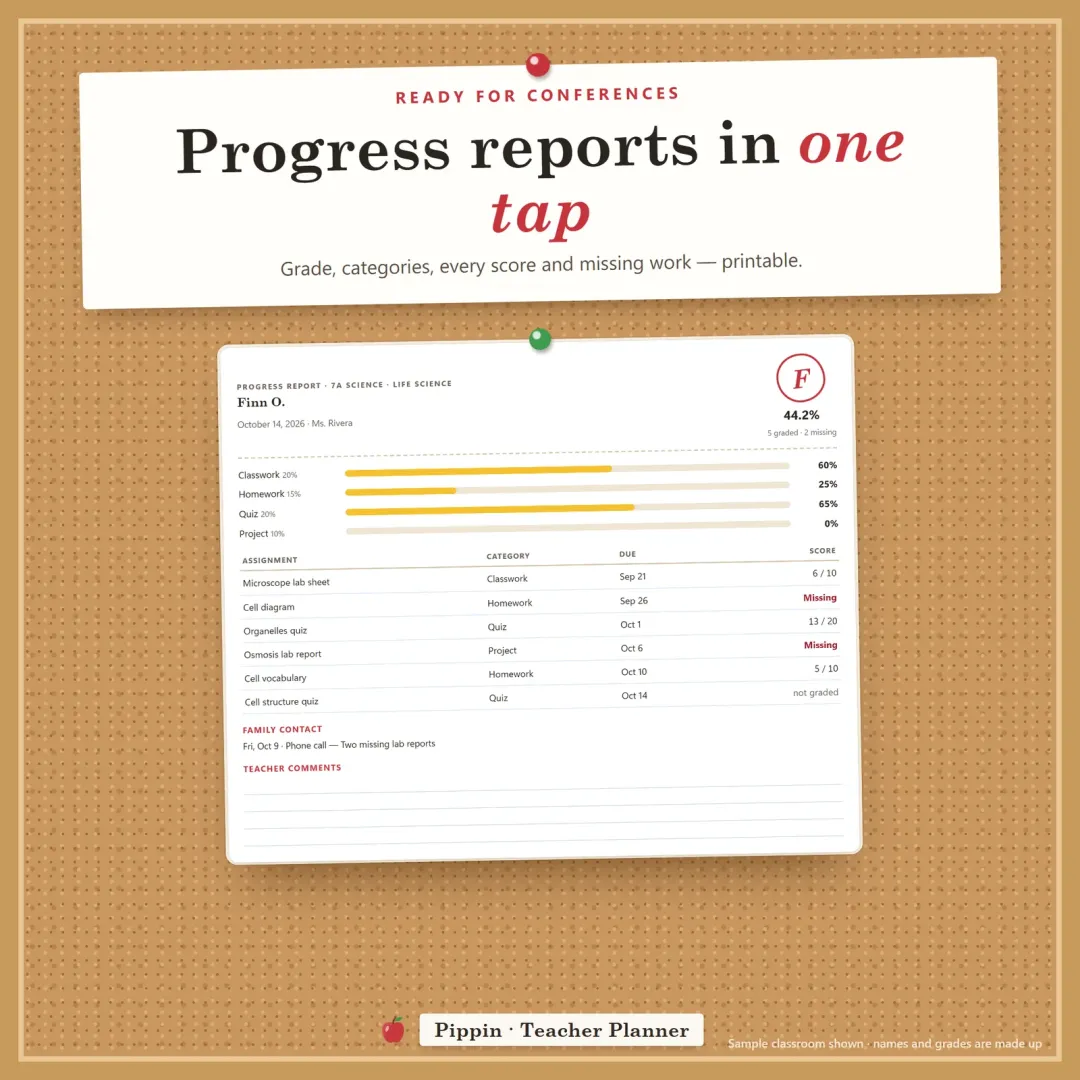
A one-tap student progress report: overall grade, categories, every score, missing work and lines for comments.
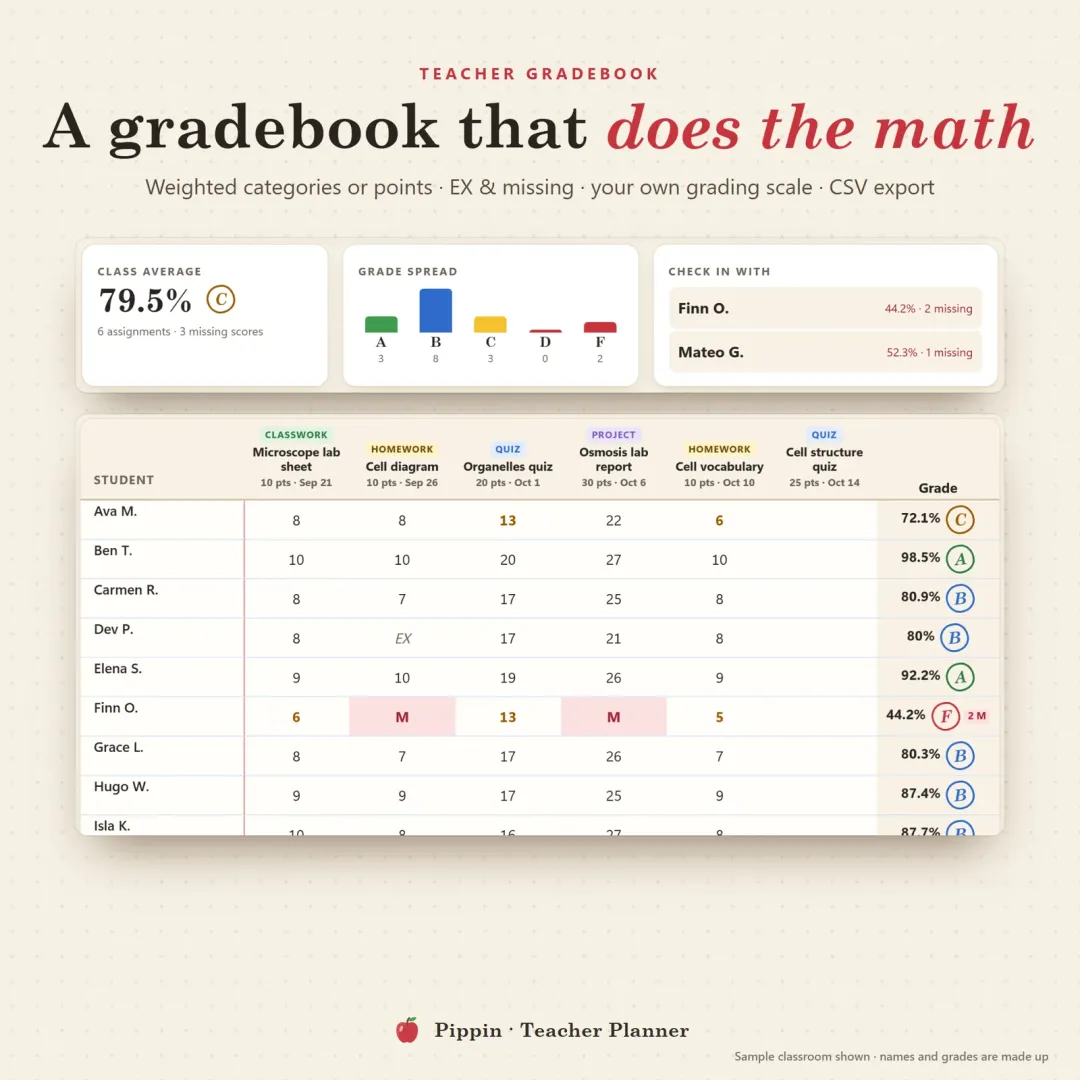
A teacher gradebook that does the math: weighted categories, excused and missing work, letter grades and a class average.
Planning next term? See our lesson plan template and classroom management strategies.
Frequently asked questions
How do you write a good report card comment?
What are some positive report card comments?
How do you say a student needs improvement nicely?
What's the difference between progress report comments and report card comments?
What words should you avoid in report card comments?
How long should report card comments be?
Written by
Finance Specialist & Editor, VaultlyApps
Emma Whitfield writes and edits the VaultlyApps money guides and free calculators. Her focus is US household finance — budgeting on a real paycheck, paying down credit card and student debt, emergency funds and savings goals, renting — and the money side of freelancing and small-business income, from pricing and profit margins to self-employment tax. Every guide is researched against primary sources such as IRS publications and the CFPB, every number is checked in our tested calculators, and tax content is reviewed each year when new IRS figures come out. Emma is not a licensed financial adviser or tax preparer; her work is general education, not personal advice.
Researched against primary US sources, checked with our calculators and reviewed by a finance expert on our team. Written for US readers — general education, not financial, tax or legal advice. Editorial policy · Disclaimer