
3 Day Workout Split: Full Body, Push Pull Legs or Upper/Lower (+ 4 Day Split)
The best 3 day workout split for your goal and schedule: a full body workout plan, push pull legs and upper/lower, with sample days, sets and reps, plus when a 4 day workout split makes more sense.

In this article
- The short answer
- What a workout split is (and why it matters)
- Option 1: Full body workout plan (3 days)
- Option 2: Push pull legs workout (3 days)
- Option 3: Upper/lower split
- The 4 day workout split
- How to choose your split
- Sets, reps and weight: how to progress
- Track it, or you're guessing
- Common mistakes
- Plan your split in Stride
If you can get to the gym three times a week, you can build real strength and muscle. The question is how to split those three days. Here's a plain guide to the 3 day workout split: the three main options (full body, push pull legs and upper/lower), sample days with sets and reps, who each one suits, and when a 4 day workout split is worth it.
The short answer
For most people, the best 3 day split is full body, three times a week, on non-consecutive days like Monday, Wednesday and Friday. Every muscle gets trained three times, you practice the main lifts often, and a missed day doesn't wipe out "leg day" for the week.
Push pull legs on three days is a good fit if you enjoy longer, focused sessions. Upper/lower works best on four days. Pick the plan you'll actually stick to: consistency beats the perfect split.
What a workout split is (and why it matters)
A workout split is how you divide your training across the week. You can train the whole body each session (full body), split by movement (push, pull, legs) or split by region (upper body, lower body).
Two numbers matter most for building muscle:
- How often each muscle is trained. Research reviews suggest that training a muscle about twice a week builds more muscle than once a week, when the total work is the same.
- How many hard sets each muscle gets per week. Roughly 10 or more sets per muscle per week is a common target for growth. Beginners make progress on less.
A good split lets you hit both numbers without making any one session miserable. With only three days, full body does this best.
Option 1: Full body workout plan (3 days)
Train your whole body in each session, with a day off between: Monday, Wednesday, Friday (or Tuesday, Thursday, Saturday). Use two slightly different workouts, A and B, and alternate them: A-B-A one week, B-A-B the next.
Workout A
| Exercise | Sets × reps |
|---|---|
| Squat or leg press | 3 × 6–10 |
| Bench press or dumbbell press | 3 × 6–10 |
| Seated cable row or dumbbell row | 3 × 8–12 |
| Romanian deadlift | 3 × 8–10 |
| Lateral raise | 2 × 12–15 |
| Plank | 3 × 30–45 s |
Workout B
| Exercise | Sets × reps |
|---|---|
| Deadlift or trap bar deadlift | 3 × 5–8 |
| Overhead press or dumbbell shoulder press | 3 × 6–10 |
| Lat pulldown or assisted pull-up | 3 × 8–12 |
| Leg press or split squat | 3 × 8–12 |
| Hip thrust | 3 × 8–12 |
| Dead bug | 3 × 8 per side |
Who it suits: beginners, people coming back after a break, busy parents and anyone whose week isn't predictable. It's also the most forgiving: miss Friday and you've still trained everything twice.
Downside: sessions feel similar, and as you get stronger, heavy squats and deadlifts in the same week three times can be a lot. That's when people move to a split.
Option 2: Push pull legs workout (3 days)
Push pull legs (PPL) splits the body by movement:
- Push day: chest, shoulders and triceps (bench press, overhead press, incline dumbbell press, lateral raise, triceps pushdown).
- Pull day: back and biceps (deadlift or rack pull, pull-up or lat pulldown, barbell or cable row, face pull, curls).
- Legs day: quads, hamstrings, glutes and calves (squat, Romanian deadlift, leg press, leg curl, calf raise).
Run it Monday, Wednesday, Friday with rest days between. Each session has room for 5 to 6 exercises and 15 to 20 sets for its muscles.
Who it suits: people who like longer, focused workouts and a clear "today is legs" plan.
Downside: on three days, each muscle is trained only once a week. That still works, especially if sessions are hard, but most people grow faster training each muscle twice. If you can train more often, push pull legs six days a week (PPL, PPL, rest) fixes this, at the cost of much more gym time.
Option 3: Upper/lower split
Upper/lower alternates upper body days and lower body days. On three days it's uneven (upper, lower, upper one week, then lower, upper, lower the next), so it really shines as a 4 day workout split.
The 4 day workout split
With four days, the classic choice is upper/lower twice a week:
| Day | Session |
|---|---|
| Monday | Upper (strength): bench press, row, overhead press, pulldown, curls |
| Tuesday | Lower (strength): squat, Romanian deadlift, leg press, calf raise |
| Wednesday | Rest |
| Thursday | Upper (volume): incline press, cable row, dips or push-ups, lateral raise, triceps |
| Friday | Lower (volume): deadlift or hip thrust, split squat, leg curl, core |
| Weekend | Rest, walk or play |
Each muscle gets two sessions a week and plenty of sets, and every session stays around an hour. Other good 4 day options are push, pull, legs + full body, or two full body days + one upper + one lower.
When to move from 3 to 4 days: when your 3 day sessions run past 75 minutes, when you want more sets for a lagging muscle, or simply when you enjoy training and have the time.
How to choose your split
| If you... | Choose |
|---|---|
| Are new to lifting or coming back | 3 day full body |
| Have a busy, unpredictable week | 3 day full body |
| Like long, focused sessions and a clear theme per day | 3 day push pull legs |
| Can train 4 days | 4 day upper/lower |
| Can train 6 days and love the gym | Push pull legs twice |
| Want to lose weight | Any of them + daily walking; the split matters less than your food and steps |
Sets, reps and weight: how to progress
Whatever split you pick, results come from progressive overload: doing a little more over time. A simple method is double progression:
- Pick a rep range, for example 8–12.
- Choose a weight you can lift for 8 good reps in every set.
- Each session, try to add a rep or two.
- When you hit 12 reps in every set, add a small amount of weight (2.5 to 5 lb on upper body lifts, 5 to 10 lb on lower body lifts) and start again at 8.
Leave one to three reps "in the tank" on most sets, rest long enough to keep your reps up (see how long to rest between sets), and plan an easier deload week every 6 to 10 weeks or when everything starts to feel heavy.
Loading the bar? The free plate calculator tells you which plates go on each side for any target weight.
Track it, or you're guessing
The difference between a plan that works and one that stalls is usually the notebook. If you don't know you did 115 lb for 12, 12, 11 last Wednesday, you'll lift whatever feels right today, and "whatever feels right" doesn't add up over months.
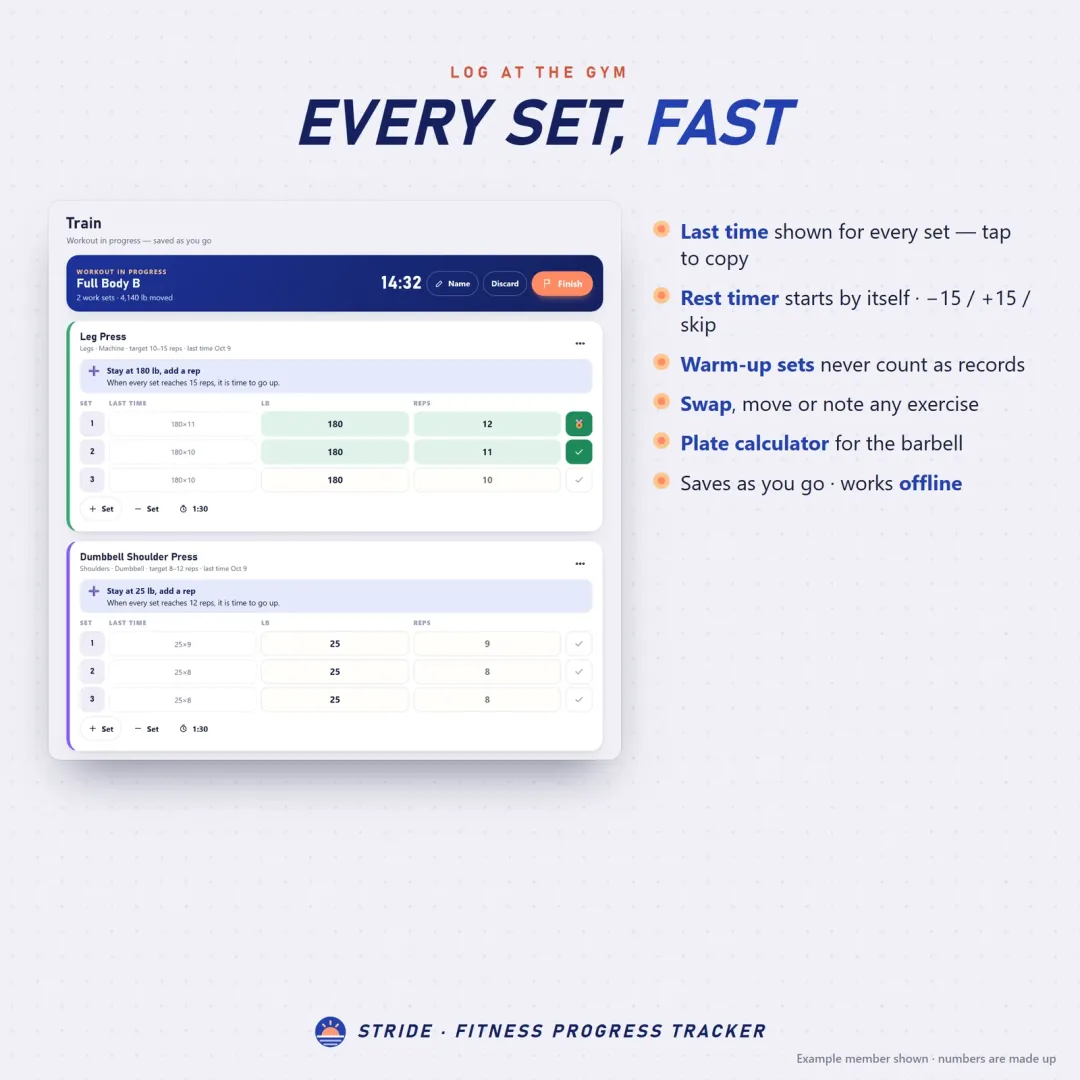
Write down every set: exercise, weight, reps. Before each workout, look at last time and aim to beat it by one rep or a little weight. Once a month, look back at your main lifts: if a number hasn't moved in three or four weeks, change something (more rest, more food, more sleep, or a deload).
Common mistakes
- Program hopping. Give a split 8 to 12 weeks before judging it.
- Too many exercises. Five or six good ones beat ten rushed ones.
- Skipping legs on a "short" week. On a 3 day plan, full body protects you from this.
- Going to failure on every set. It makes the next session worse. Save all-out sets for the last set of an exercise, if at all.
- No rest days. Muscles grow between sessions, not during them.
- Ignoring the basics. Sleep, enough protein and some daily walking do as much as the split.
Plan your split in Stride
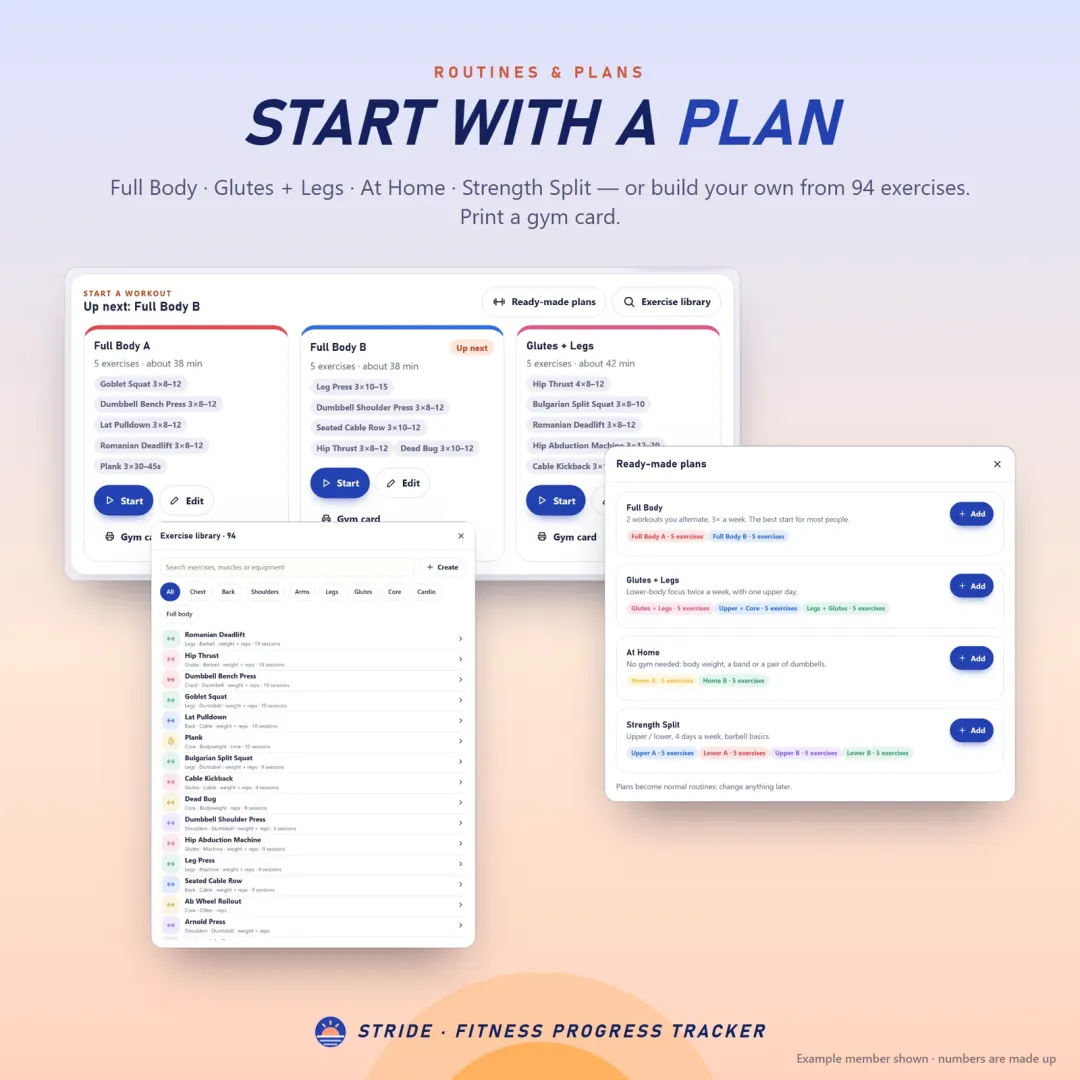
Stride, our fitness tracker app, comes with 4 ready-made plans and a 94-exercise library, or you can build your own A/B full body, push pull legs or upper/lower routines. The workout log shows last time's numbers next to every set, a rest timer runs between sets, and the progressive overload coach tells you when every set has hit the top of the range and it's time to go up. Your week fills up as a loaded barbell, one plate per session, so you can see at a glance whether you've hit your 3 or 4 days. Try the free demo with an example member.
This article is general information, not medical or personal training advice. If you're new to exercise, pregnant, or have a health condition or injury, check with your doctor before starting a new program.
Frequently asked questions
What is the best 3 day workout split?
Is a 3 day split enough to build muscle?
What is a good 4 day workout split?
How do I do push pull legs on 3 days?
How many exercises should be in a 3 day full body workout?
Should beginners do a split or full body?
Written by
Finance Specialist & Editor, VaultlyApps
Emma Whitfield writes and edits the VaultlyApps money guides and free calculators. Her focus is US household finance — budgeting on a real paycheck, paying down credit card and student debt, emergency funds and savings goals, renting — and the money side of freelancing and small-business income, from pricing and profit margins to self-employment tax. Every guide is researched against primary sources such as IRS publications and the CFPB, every number is checked in our tested calculators, and tax content is reviewed each year when new IRS figures come out. Emma is not a licensed financial adviser or tax preparer; her work is general education, not personal advice.
Researched against primary US sources, checked with our calculators and reviewed by a finance expert on our team. Written for US readers — general education, not financial, tax or legal advice. Editorial policy · Disclaimer